Quick Answer: Most sites are not cited by AI tools because a crawler cannot reach the page, cannot extract a clean answer from it, or has no reason to trust the source over the ten others saying the same thing. Crawler access is the most common cause and the fastest to fix. Everything else is content and authority work.
“Why isn’t my website being cited by AI tools” is a question with about seven answers, and the order matters enormously, because the first one is a thirty-minute fix and the last one takes six months.
The unhelpful version of this article lists best practices. The useful version is a diagnostic sequence. If your robots.txt is blocking OAI-SearchBot, no amount of content restructuring will help. If your pages render entirely in JavaScript, schema markup will not save you. And if you are being cited but not measuring it, you are about to spend a quarter fixing a problem you do not have.
There is also a lot of invented advice circulating. No AI-specific schema type exists. No file you upload makes you eligible. Google’s documentation says so directly, and the companies operating the crawlers publish exactly what they need from you, which is mostly access and clarity.
We run this diagnostic on client sites regularly, and the distribution is consistent. Roughly half the “we’re invisible in AI search” cases we open turn out to be an access or rendering problem nobody knew existed. The other half are genuine authority problems, which are slower but at least visible once you start measuring.
Work the list in order.
Key Takeaways
- The most common reason a site is not cited by AI tools is that a crawler cannot reach the content, usually through robots.txt rules, WAF blocking, or rate limiting rather than a deliberate decision.
- OpenAI and Anthropic each operate three separate crawlers with independent robots.txt controls, so blocking a training bot does not block the search bot and vice versa.
- Google’s documentation states plainly that no special schema, machine-readable file, or AI-specific markup is required to appear in AI Overviews or AI Mode.
- Cloudflare’s data on crawl-to-refer ratios shows AI platforms request vastly more pages than they send back in referrals, which means citation volume and traffic volume are separate metrics that must be measured separately.
- Being cited inside an AI Overview is measurably better than being omitted, with Seer Interactive finding cited brands earn 35% higher organic click-through rates than uncited brands on the same queries.
- If you want a team to run this diagnostic properly and fix what it finds, LYNX SEO builds AI search visibility programs for brands that depend on organic.
Why Isn’t My Website Being Cited by AI Tools? The Short Diagnosis
Citation failures happen at one of four layers, and they fail in sequence. A page has to be reachable before it can be read, readable before it can be extracted, extractable before it can be selected, and trusted before it gets selected over an alternative.
| Layer | Symptom | How to Check | Typical Fix Time |
| Access | Zero AI crawler hits in server logs | Log analysis, robots.txt review, WAF rules | Hours |
| Retrieval | Crawlers hit the page but content is missing | Fetch the raw HTML with JavaScript disabled | Days |
| Extraction | Content is present but never quoted | Read the page as a machine would; look for a clean answer block | Weeks |
| Authority | Content is extractable but competitors get cited instead | Compare brand mentions and third-party coverage | Months |
| Measurement | You assume you are invisible | Citation tracking across ChatGPT, AI Overviews, Perplexity | Days |
Debugging out of order is the most common mistake, because every layer above the broken one is invisible until the broken one is fixed. Start at access, every time.
Reason 1: AI Crawler Access Is Blocked
This is the first thing to check and the reason in roughly half the cases we open.
The problem is that AI crawlers are not one thing. OpenAI’s crawler documentation describes separate user agents with independent robots.txt controls, so a webmaster can allow one and block another. Anthropic did the same, formally separating three crawlers in documentation updated in February 2026, as Search Engine Journal reported, with each bot getting its own explanation of what blocking it costs you.
| Crawler | Operator | Purpose | What Blocking It Costs You |
| GPTBot | OpenAI | Model training | Exclusion from future training data only |
| OAI-SearchBot | OpenAI | ChatGPT search indexing | Your ability to appear as a cited source in ChatGPT search |
| ChatGPT-User | OpenAI | User-initiated page fetches | Retrieval when a user asks ChatGPT to read your page |
| ClaudeBot | Anthropic | Model training | Exclusion from future training datasets |
| Claude-SearchBot | Anthropic | Search indexing | Visibility and accuracy in Claude search results |
| Claude-User | Anthropic | User-initiated fetches | Visibility for user-directed web search in Claude |
| Googlebot | Search, AI Overviews, AI Mode | Everything, including classic organic |
The pattern we see constantly: a team decides in 2024 to block AI training, adds a blanket disallow, and unknowingly removes itself from ChatGPT search citations for two years. Blocking GPTBot is a reasonable business decision. Blocking OAI-SearchBot alongside it is usually an accident.
Access failures are rarely deliberate. Check all of these:
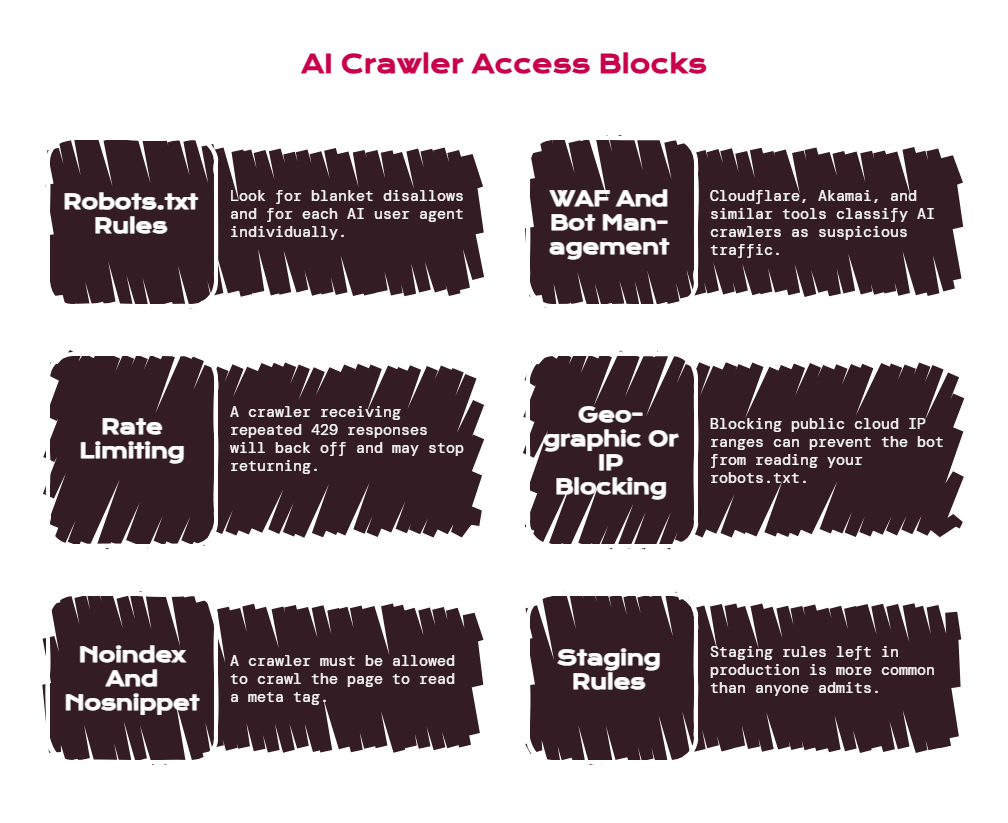
- Robots.txt Rules: Look for blanket disallows and for each AI user agent individually. Each requires its own directive.
- WAF And Bot Management: Cloudflare, Akamai, and similar tools frequently classify AI crawlers as suspicious traffic and block them before robots.txt is ever consulted.
- Rate Limiting: A crawler receiving repeated 429 responses will back off and may stop returning. This is a silent failure with no error anyone monitors.
- Geographic Or IP Blocking: Anthropic notes its bots use public cloud IP ranges, so blocking those ranges can prevent the bot from even reading your robots.txt.
- Noindex And Nosnippet Directives: OpenAI’s publisher FAQ notes that for a crawler to read a meta tag, it must be allowed to crawl the page in the first place.
- Staging Rules Left In Production: More common than anyone admits.
Check your server logs before you touch anything else, because a site receiving zero AI crawler requests has an access problem, not a content problem, and no content work will change that.
Reason 2: Your Content Cannot Be Retrieved
Crawlers reach the page, then find nothing worth reading.
The dominant cause is client-side rendering. If your content is assembled by JavaScript after page load, assume most AI crawlers will not see it. Search crawlers vary in what they render, and user-initiated fetch agents generally do not execute complex JavaScript at all. Server-side rendering, or at minimum server-rendered content for the parts you want quoted, removes the question entirely.
Other retrieval blockers worth checking: content behind a login or paywall, key information locked inside images or PDFs without text alternatives, infinite scroll that never delivers content to a non-interactive fetch, and cookie or consent walls that return an interstitial instead of the page.
The test is simple. Fetch your page with JavaScript disabled and read what comes back. If the answer you want quoted is not in that raw HTML, no AI system is going to quote it.
Reason 3: Your Pages Don’t Answer the Question Directly
Now we are into content, and this is where most technically sound sites lose.
Generative systems quote self-contained passages. A page that buries its answer in paragraph six, hedges every claim, or requires the surrounding context to make sense gives a retrieval system nothing clean to lift. Pew Research’s browsing study found the median AI summary in its sample ran 67 words, with 88% of summaries citing three or more sources. That is the shape of the target: short, synthesized, assembled from multiple pages that each contributed something extractable.
What makes a page quotable:
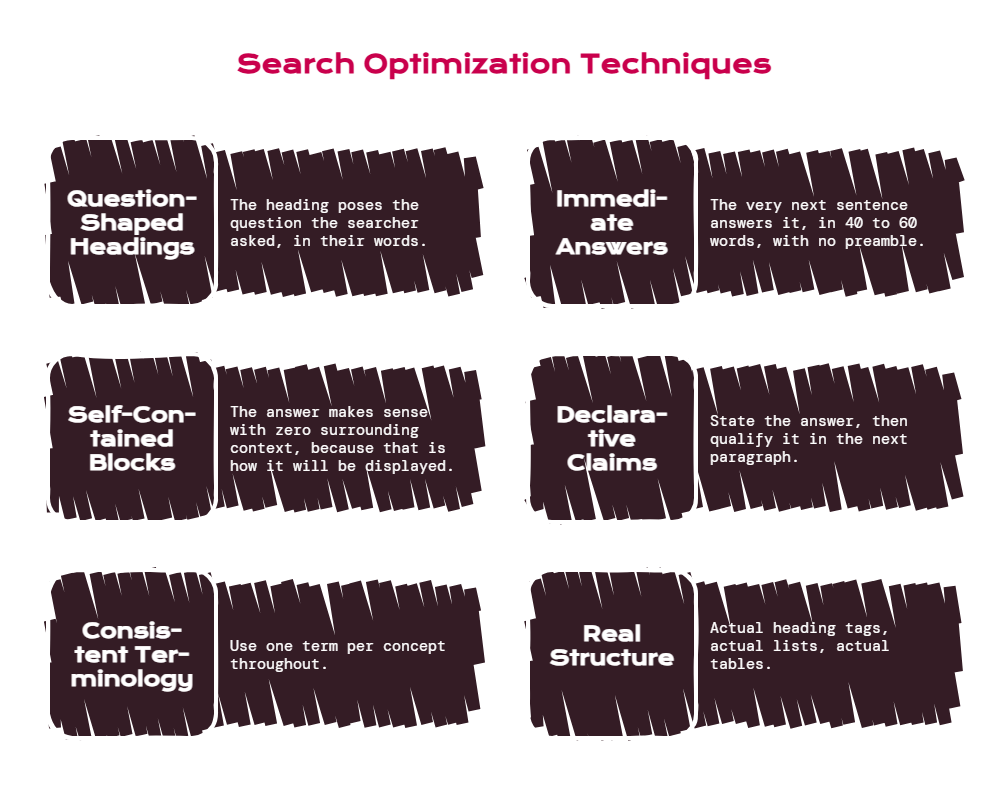
- Question-Shaped Headings: The heading poses the question the searcher asked, in their words.
- Immediate Answers: The very next sentence answers it, in 40 to 60 words, with no preamble.
- Self-Contained Blocks: The answer makes sense with zero surrounding context, because that is how it will be displayed. No “as mentioned above”, no pronouns standing in for the subject.
- Declarative Claims: Hedged, conditional phrasing rarely gets selected. State the answer, then qualify it in the next paragraph.
- Consistent Terminology: Use one term per concept throughout. Swapping synonyms reads as variety to an editor and as three different entities to a retrieval system.
- Real Structure: Actual heading tags, actual lists, actual tables. Styled divs that look like headings are invisible to extraction.
We go deeper on the writing mechanics in how to get cited in ChatGPT, which covers page-level construction rather than diagnosis.
Reason 4: You Have No Source Authority for AI
Extractable content gets you considered. Authority gets you selected over the ten other extractable pages saying the same thing.
Google’s guide to optimizing for generative AI features is explicit that these experiences are rooted in core Search ranking and quality systems, which means the trust signals that always mattered still do. Retrieval systems also weigh what other sources say about you, not only what you say about yourself.
The commercial case is documented. Seer Interactive’s analysis found organic click-through rate on AI Overview queries fell 61%, from 1.76% to 0.61%, while brands cited inside the overview earned 35% higher organic click-through and 91% higher paid click-through than uncited brands on the same queries. Ahrefs measured position-one CTR falling 58% when an AI Overview is present. The click environment is worse for everyone and considerably less bad if you are the named source.
What builds source authority in practice: editorial coverage on publications your category actually reads, inclusion in third-party roundups and comparison content, named authors with verifiable credentials, and consistent brand entity information across your site, your profiles, and anywhere else you appear. This is digital PR and link building work as much as it is content work, and it is the slowest layer to move.
Corroboration is the mechanism most brands under-invest in, because it is the only citation factor you cannot fix by editing your own website.
Reason 5: Your Content Is Commodity Content
If your page restates what twenty other pages already say, there is no reason for any system to prefer it.
This is the failure mode of high-volume content programs, and it got worse as production costs fell. A model synthesizing an answer needs sources that contribute something. A page that contributes nothing new is a page that adds no value to the synthesis, so it does not get cited even when it is well-structured and technically perfect.
What counts as non-commodity content: original data from your own operations, testing or benchmarking nobody else has run, practitioner detail that only comes from doing the work, specific numbers rather than general claims, and a clear position on something contested. A page that contains one statistic nobody else has published is more citable than a 4,000-word guide that synthesizes what was already available.
This is also where thin AI-generated content fails, not because of how it was produced but because of what it contains. We cover the distinction in making AI blog content worth reading and address the penalty question directly in does Google penalize AI content.
Reason 6: Entity Confusion and Content Freshness
Two smaller causes that account for a surprising number of remaining cases.
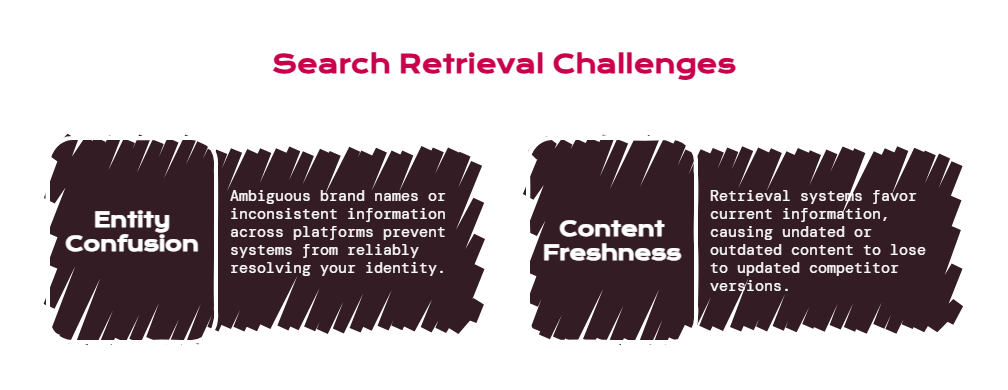
- Entity Confusion: If your brand name is ambiguous, shares a name with a larger entity, or is described differently across your site, your profiles, and third-party mentions, systems cannot reliably resolve who you are. The fix is consistency: the same brand name, the same one-line description, the same category positioning everywhere. Organization schema, an about page that states plainly what you do, and matching information across profiles all contribute.
- Content Freshness: Retrieval systems favor current information for anything time-sensitive. Undated content, or content with a visible date from three years ago, loses to a competitor’s updated version even when yours is more thorough. Add visible publish and update dates, and actually update rather than changing the date.
A third case worth naming: a site migration or redesign that broke URLs. Citations point at specific pages, and if those pages 404 or redirect through chains, you lose the citation and the authority attached to it. Our guide to redesigning a website without losing SEO covers the redirect discipline that prevents it.
Reason 7: You Might Already Be Cited and Not Measuring It
Before you conclude you are invisible, confirm it.
This matters more than it sounds, because citation and traffic have decoupled. Cloudflare’s analysis of crawl-to-refer ratios across AI platforms showed enormous gaps between how many pages a platform requests and how many referrals it sends back, with the ratios in their published example spanning several orders of magnitude between operators. The specific numbers move constantly, but the structural point holds: an AI platform can be reading and citing you heavily while sending almost no measurable traffic.
That means a flat referral graph is not evidence of zero citations. It might be evidence of citations that do not produce clicks.
What to measure instead:
- Server log hits from each AI user agent, which tells you whether access works at all.
- Referral traffic tagged with platform parameters, including the utm_source=chatgpt.com parameter OpenAI appends to ChatGPT referrals.
- Direct citation checks on your priority queries across ChatGPT, AI Overviews, Perplexity, and Claude, on a fixed cadence.
- Branded search volume, which tends to rise when a brand is named in answers without being clicked.
- Impressions-to-clicks divergence in Search Console, the fingerprint of an AI Overview sitting above you.
The full process lives in how to measure AI search visibility, and the structured diagnostic in our AI search visibility audit guide. For the broader question of which metrics deserve reporting at all, see how to measure the success of an SEO campaign.
What Doesn’t Affect AI Citations
Worth stating plainly, because a lot of billable hours are going into these.
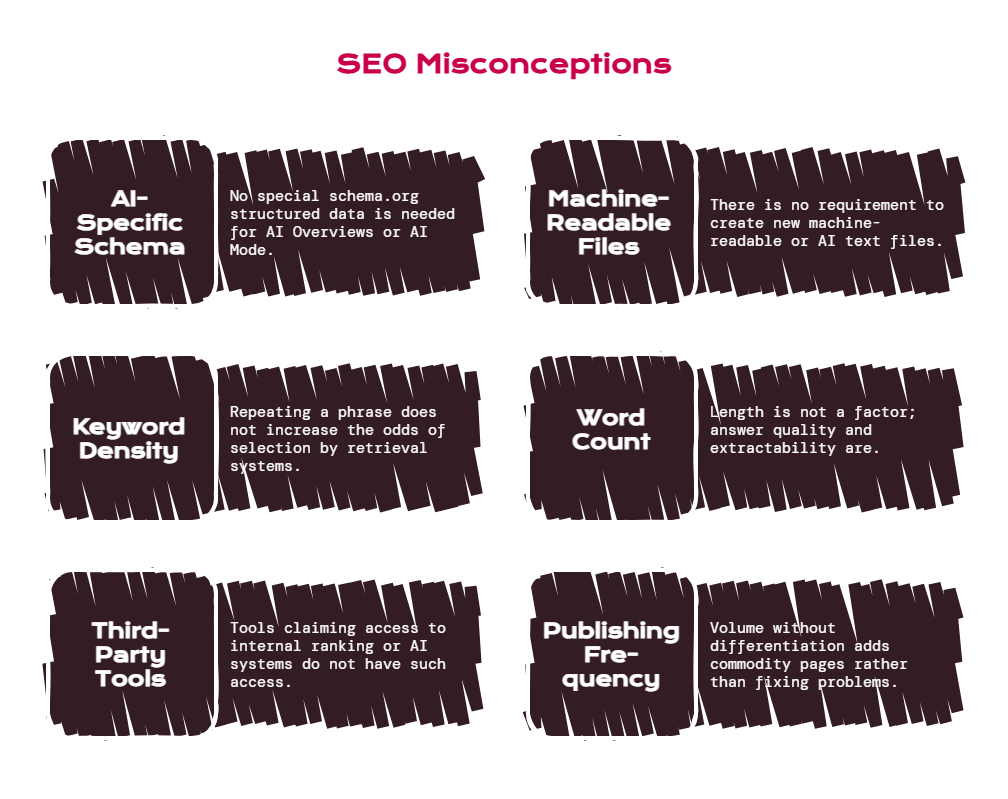
- AI-Specific Schema: Google’s AI features documentation states there is no special schema.org structured data needed to appear in AI Overviews or AI Mode. Schema still matters for rich results and for describing your content accurately. It is not a citation lever.
- New Machine-Readable Files: Google’s documentation is equally clear that you do not need to create new machine-readable or AI text files. Adoption by other platforms remains inconsistent, and none of them treat it as a requirement.
- Keyword Density: Retrieval systems work on meaning. Repeating a phrase does not increase the odds of selection.
- Word Count: Length is not a factor. Answer quality and extractability are.
- Third-Party Tools Promising Placement: Google explicitly warns against tools claiming access to internal ranking or AI systems. No such access exists.
- Publishing Frequency: Volume without differentiation adds commodity pages, which is the problem rather than the fix.
How to Fix AI Search Citations: Priority Order
The sequence that actually works, in the order we run it.
- Audit Crawler Access: Server logs first, then robots.txt, then WAF and rate-limiting rules. Confirm each AI user agent individually.
- Verify Retrieval: Fetch key pages with JavaScript disabled. If the content is not there, fix rendering before anything else.
- Restructure Top Pages: Take your twenty most important pages and add question headings with self-contained answer blocks directly beneath them.
- Fix Entity Consistency: Same brand name, same description, same positioning across the site and every profile.
- Add Something Original: One piece of proprietary data, testing, or practitioner detail per priority page.
- Build Corroboration: Editorial coverage, roundup inclusion, and third-party mentions in the publications your category reads.
- Instrument Measurement: Citation tracking on priority queries, running continuously rather than checked when someone asks.
Steps one and two are usually a week. Steps three through five are a quarter. Step six is ongoing and never finishes. Most in-house teams get through the first two, see improvement, and then stall on the content and authority work, which is where an outside team earns its fee.
Diagnose Before You Optimize
If your website is not being cited by AI tools, the question is not what tactic to add. It is which layer is broken.
Check access first, because it is the most common cause and the cheapest fix. Confirm your content is retrievable without JavaScript. Restructure your best pages so a machine can lift a clean answer. Fix your entity signals. Add something to each page that nobody else has published. Then build the third-party corroboration that decides which of several extractable sources gets named. And instrument all of it, because citation and traffic no longer move together.
The brands winning here are not doing anything exotic. They are reachable, clear, specific, and corroborated, in that order.
If you want that diagnosis run properly and the findings actually fixed, that is what we do. Talk to LYNX SEO and you get the full team, SEO Director, Strategist, Technical Lead, Designer, and Editor, for less than the cost of a single senior in-house hire. Our AI visibility and answer engine optimization work and technical SEO audits start exactly where this article does.
Frequently Asked Questions
Why Isn’t My Website Being Cited by AI Tools?
Usually because a crawler cannot reach the page, cannot extract a clean answer from it, or has no reason to trust your site over alternatives saying the same thing. Crawler access is the most common cause and the fastest to fix, so check server logs and robots.txt before assuming you have a content problem.
Why Doesn’t ChatGPT Cite My Website?
Check whether OAI-SearchBot is allowed in robots.txt. OpenAI runs separate crawlers with independent controls, so blocking GPTBot to opt out of training does not block search indexing, and many sites blocked both by accident. If access is fine, the next causes are JavaScript-only rendering and content that never states a clean, self-contained answer.
How Do I Get Cited by AI Search Engines?
Allow the search crawlers, render content server-side, structure pages so each question has a direct 40 to 60 word answer beneath it, publish something original that competitors cannot restate, and build third-party mentions that corroborate your expertise. There is no shortcut and no markup that substitutes for those five.
Do I Need Special Schema Markup for AI Search?
No. Google’s documentation states there is no special schema.org structured data and no new machine-readable file needed to appear in AI Overviews or AI Mode. Schema remains worthwhile for rich results and for describing your content accurately, but it is not what drives citation.
Does Blocking AI Crawlers Stop My Site From Being Cited?
Yes, if you block the search crawlers. Training crawlers and search crawlers are separate user agents with separate robots.txt directives. Blocking GPTBot or ClaudeBot affects training data. Blocking OAI-SearchBot or Claude-SearchBot removes you from the search indexes that produce citations.
How Do I Check If AI Crawlers Can Access My Website?
Start with server logs filtered by user agent to see whether AI crawlers are hitting your site and what status codes they receive. Then review robots.txt for each agent individually, check your WAF or bot management rules, and look for 429 rate-limiting responses. A crawler getting repeated 429s will back off silently.
Why Am I Cited in AI Overviews but Not ChatGPT?
Different systems, different indexes, different crawlers. Google AI Overviews draw on Google’s index, so classic SEO carries over directly. ChatGPT relies on its own search index plus retrieval, which requires OAI-SearchBot access specifically. Being visible in one is not evidence of access to the other.
How Long Does It Take to Start Getting AI Citations?
Access and rendering fixes can show results within days to weeks once crawlers re-fetch. Content restructuring typically takes a few weeks to a couple of months to be reflected. Authority and brand mention work runs on a multi-quarter timeline, because it depends on third parties publishing rather than on anything you control.
Does Original Research Help With AI Citations?
Substantially. Retrieval systems synthesize from sources that contribute something, so a page containing a statistic or finding nobody else has published gives a system a reason to name you specifically. Commodity content that restates available information rarely earns citation regardless of how well it is structured.
Do These AI Citation Problems Differ by Industry?
The diagnostic sequence is identical, but the authority layer varies sharply. Regulated and technical verticals face higher trust thresholds and thinner third-party coverage to draw on. We wrote up a vertical-specific version of this problem in hemp brand SEO and AI search visibility, and the platform version for stores in Shopify AI Overview optimization.
Sources
- OpenAI. “Overview of OpenAI Crawlers.” OpenAI Developer Documentation. https://developers.openai.com/api/docs/bots
- Google Search Central. “AI Features and Your Website.” Google Search Documentation. https://developers.google.com/search/docs/appearance/ai-features
- Cloudflare. “The Crawl Before the Fall of Referrals: Understanding AI’s Impact on Content Providers.” Cloudflare Blog. 2025. https://blog.cloudflare.com/ai-search-crawl-refer-ratio-on-radar/
- Seer Interactive. “AIO Impact on Google CTR: September 2025 Update.” https://www.seerinteractive.com/insights/aio-impact-on-google-ctr-september-2025-update
- Pew Research Center. “Google Users Are Less Likely to Click on Links When an AI Summary Appears in the Results.” 2025. https://www.pewresearch.org/short-reads/2025/07/22/google-users-are-less-likely-to-click-on-links-when-an-ai-summary-appears-in-the-results/