Quick Answer: Shopify stores struggle with AI Overview optimization because the platform has structural constraints that make it harder for AI systems to read, trust, and cite your content. The core issues are duplicate product URLs by default, thin schema markup, a blog architecture that buries content under /blogs/news/, and rigid URL prefixes you cannot change. These are not content problems – they are platform-level constraints. Every one of them is fixable, but you have to know what you are dealing with first.
If you are running a Shopify store and your products are not showing up in Google AI Overviews or getting cited in ChatGPT or Perplexity, the instinct is to blame the content. The descriptions are not good enough. The blog posts are not long enough. You have not posted in a while. Whatever.
But a lot of the time, content is not the main problem. The platform is.
Shopify was built to sell products. It does that well. What it was not built for is the kind of deep, flexible content architecture that AI systems use to decide whether to cite a source. And as AI Overviews become a bigger part of how people find products – Semrush’s analysis of over 10 million keywords found AI Overviews appeared for nearly 25% of all queries at their 2025 peak – those structural gaps are starting to cost stores real visibility.
We have worked through this with ecommerce clients across several verticals, and the Shopify-specific problems show up consistently. This post is the breakdown of Shopify AEO I wish existed when we first started digging into why stores with solid products and decent traditional rankings were nearly invisible in AI-generated answers.
Key Takeaways
- Shopify’s default URL structure – with forced /products/ and /collections/ prefixes and auto-generated duplicate URLs – creates conflicting technical signals that confuse both Google and AI systems about which page to cite.
- Thin schema markup out of the box means AI engines are often guessing at product details rather than reading clean, structured data from your pages.
- Shopify’s blog architecture buries posts under /blogs/news/, which is structurally weak for building the topical authority AI systems use to identify credible sources.
- For ecommerce specifically, the overlap between traditional organic rankings and AI Overview citations is far lower than other verticals – meaning ranking well in Google does not automatically get you into AI answers.
- The fixes exist – complete Product schema, FAQPage schema, proper canonical tag configuration, an llms.txt file, and content restructuring – but they require understanding the platform’s constraints first.
Why Shopify Doesn’t Rank in AI Search: The Platform Architecture Problem
Most ecommerce SEO guides treat Shopify like a blank slate. In reality, it ships with a fixed architecture that makes certain things easy and certain other things genuinely hard.
The platform handles the basics well. SSL, automatic sitemaps, canonical tags, clean crawlable HTML – it does all of that without you touching anything. The problem is that “handled automatically” does not always mean “handled correctly.”
Here is the structural reality: NotProvided.eu’s detailed breakdown of Shopify’s SEO architecture documents how Shopify creates multiple accessible URLs for every product – one under /products/ and one or several under /collections/[collection-name]/products/. Both are crawlable by default. And according to Google’s own canonical URL documentation, canonical tags are treated as hints, not rules – Google may override them when other signals conflict. When your entire internal linking structure points to the collection-aware URL while the canonical says to use /products/, you have conflicting signals everywhere.
The AI-specific impact is worse than the traditional SEO impact. When ChatGPT, Perplexity, or Google AI Mode encounters multiple versions of the same product page, research from Adfinite shows these systems often pick one at random – and it might be the collection-filtered version with less information, or an outdated variant. That breaks the data AI needs to confidently cite your product.
You cannot change the /products/ or /collections/ prefixes – that is locked in. But you can fix how internal links are generated by removing the within: current_collection Liquid filter from your theme templates, so your own pages consistently point to the canonical URL. That alone reduces signal conflict significantly.
Shopify SEO Problems vs. AI Overview Visibility: A Side-by-Side Look
| Shopify Limitation | SEO Impact | AI Overview Impact |
| Forced /products/ & /collections/ prefixes | No custom URL hierarchy | Reduced topical depth signals for AI |
| Duplicate product URLs by default | Split ranking power, wasted crawl budget | AI may cite the wrong URL or miss the page |
| Thin default schema markup | Fewer rich results in SERPs | AI cannot extract complete product data |
| Blog under /blogs/news/ path | Weak content hierarchy, isolated posts | Blog content rarely cited as topical authority |
| No native subcategory support | Flat architecture limits topical depth | Hard to signal subject expertise to LLMs |
| App-driven schema conflicts | Validation errors confuse Google’s parser | AI reads incomplete or contradictory data |
The Shopify Schema Markup Gap Costing You AI Visibility
Schema markup is how you hand AI systems machine-readable information about your products. Without it, they are guessing. With thin or broken schema, they are guessing wrong – and Shopify’s own documentation on ecommerce schema acknowledges that AI shopping assistants like Google AI Mode and Gemini rely directly on Product schema to evaluate and recommend products. Google Search Central’s structured data documentation for ecommerce sites spells out exactly which schema types matter for product pages, and how incomplete markup affects your eligibility for rich results and AI-driven shopping features.
Here is the issue. Shopify themes – including Dawn, which powers over 800,000 stores – include Product schema by default. But “includes schema” and “includes complete schema” are very different things.
The default schema is typically missing fields that are optional for traditional SEO but effectively required for AI visibility. Naridon’s complete guide to Shopify structured data makes this point directly: for traditional SEO, Google’s “recommended” schema properties are optional. For AI citation, every recommended property is a requirement. AI engines use every available data point to build their understanding of a product – more structured data means more trust, which means more citations.
Google’s own Search Central documentation on Product structured data outlines exactly which properties are required versus recommended for merchant listings – and the recommended list is extensive. For AI visibility specifically, treating those recommended fields as optional is a mistake.
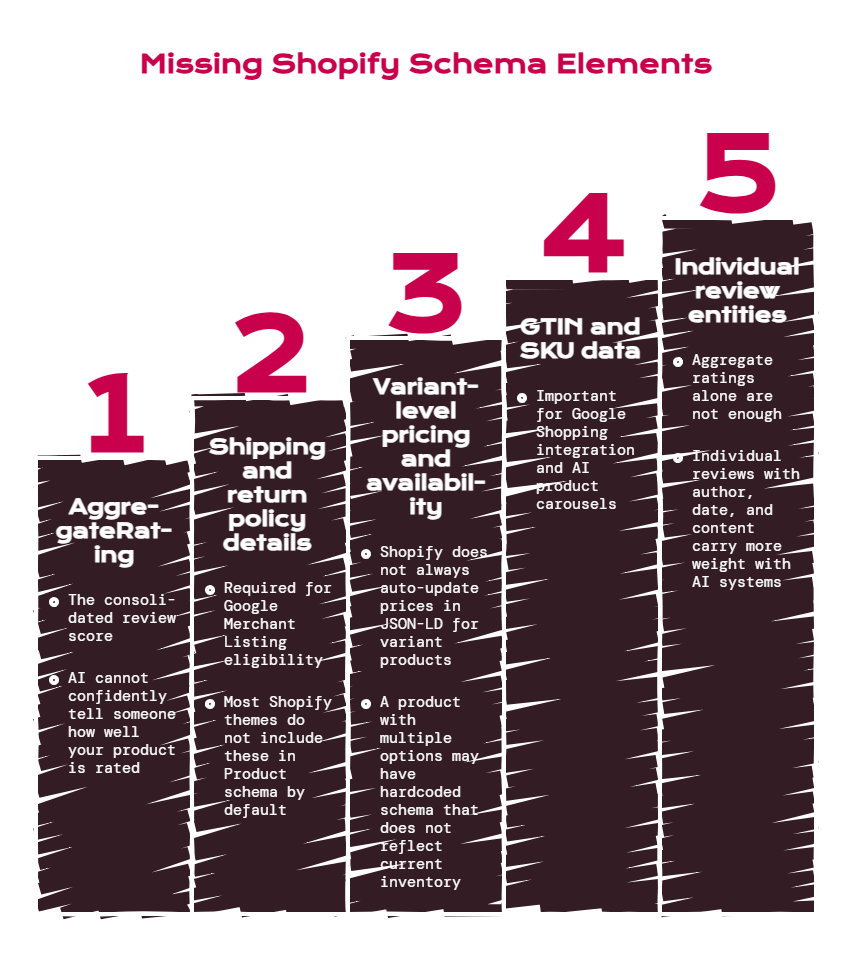
What is routinely missing from Shopify’s default schema:
- aggregateRating – The consolidated review score. Without this, AI cannot confidently tell someone how well your product is rated.
- Shipping and return policy details – Required for Google Merchant Listing eligibility. Most Shopify themes do not include these in Product schema by default.
- Variant-level pricing and availability – Shopify does not always auto-update prices in JSON-LD for variant products. A product with multiple options may have hardcoded schema that does not reflect current inventory.
- GTIN and SKU data – Important for Google Shopping integration and AI product carousels.
- Individual review entities – Aggregate ratings alone are not enough. Individual reviews with author, date, and content carry more weight with AI systems.
There is a compounding problem: schema conflicts. When your Shopify theme outputs microdata format and you have also installed a third-party SEO app injecting JSON-LD, Go Fish Digital’s Shopify structured data guide notes that multiple conflicting schema instances confuse Google’s parser. Audit existing markup with Google’s Rich Results Test before adding any schema apps, and disable conflicting sources when you find them.
Shopify Content Limitations and SEO: Why the Blog Architecture Hurts You
This is the one that surprises most Shopify store owners. They know the URL thing is annoying. They have heard about schema. But the blog structure issue does not get talked about much, and it is quietly killing AI visibility for a lot of stores.
Shopify’s native blog posts live under /blogs/[blog-name]/[post-title]. The default blog name is “news,” which means a carefully researched article ends up at something like yourstore.com/blogs/news/how-to-choose-the-right-size. Storefront Field Guide’s Shopify blog SEO analysis describes this as burying posts under a double subfolder that weakens the content hierarchy from day one.
The deeper issue is isolation. On most Shopify stores, blog posts do not receive internal links from commercial pages and do not pass link equity back to them effectively. They exist in a silo. That matters for AI systems because topical authority is one of the signals LLMs use to determine whether a site is credible enough to cite.
Compare this to a WordPress-based content operation, where you can build genuine content clusters – pillar pages, supporting posts, category hub pages, all linking back and forth with clean URLs that signal topical depth. Shopify’s architecture makes this harder to build and harder for AI systems to read.
The fix does not require leaving Shopify. It requires intentional structure: linking blog posts to relevant product and collection pages using descriptive anchor text, adding Article schema to blog post templates (Shopify does not do this by default), and building content clusters around product categories rather than publishing isolated posts.
The content architecture question connects directly to how you approach adding real value to AI-generated blog content – something we have covered in detail. Platform constraints do not excuse thin content. They make deep, well-structured content even more important.
Why Shopify Performs Poorly in AI Search: The Ecommerce Citation Gap
Here is a number worth knowing.
A 16-month study by BrightEdge tracking AI Overview citation overlap across nine industries found that ecommerce had the lowest convergence of any vertical tracked. While education saw overlap surge by over 53 percentage points between May 2024 and September 2025, ecommerce moved by just 0.6 points – and AI Overview coverage in ecommerce actually decreased over the same period. Shopping queries show only a 3.2% AI Overview trigger rate, the lowest of any category tracked.
That disconnect matters. It means that if you are running a Shopify store and you are ranking well in traditional Google search, you might still be nearly invisible in AI Overviews. The signals that get you ranked in blue-link results are not the same ones that get you cited in AI-generated answers about products.
The citation gap is also widening fast. Ahrefs’ updated study of 863,000 keyword SERPs and 4 million AI Overview URLs found that only 38% of pages cited in AI Overviews also rank in the top 10 for the same query – down from 76% in their July 2025 study. Search Engine Journal’s coverage of the same research notes that roughly two in three AI citations now come from pages a user searching that keyword would never see on page one. SEJ’s reporting on the Ahrefs study is worth reading in full – the pace of change over 18 months is significant.
For Shopify specifically, the gap is wider because the platform’s structural limitations – duplicate URLs, thin schema, isolated blog content – affect AI citation signals more than traditional ranking signals. Google has been adapting to Shopify’s quirks for years. AI systems are working from a different set of signals and do not have the same tolerance for structural ambiguity.
Compounding all of this: Ahrefs’ study of AI Overviews and click-through rates found that by December 2025, the presence of an AI Overview correlated with a 58% lower average CTR for the top-ranking page. If you are not in the AI answer, you are absorbing a major traffic penalty without any of the citation benefit.
This is also why shopping-specific queries are worth tracking separately from general informational queries. If your competitors have invested in structured data and content architecture and you have not, the citation gap between you is widening every month.
The same dynamic applies after a site migration or platform change. The technical signals that supported your old rankings do not transfer automatically. Our breakdown of how to redesign a website without losing SEO covers the principles – they apply directly to ecommerce platform migrations.
How to Optimize Your Shopify Store for AI Search
Everything above is diagnosis. Here is the treatment.
The good news is that most of Shopify’s AI visibility problems are fixable within the platform. You are not going to get full WordPress-level content flexibility, but you can get close enough on the signals that matter most.
Fix Canonical Tags First
Open Google Search Console and go to Index > Coverage > Excluded. Filter for “Duplicate, Google chose different canonical than user.” Whatever number comes up is the scale of your canonical conflict problem. For a store with 100 or more products spread across multiple collections, this is often in the hundreds.
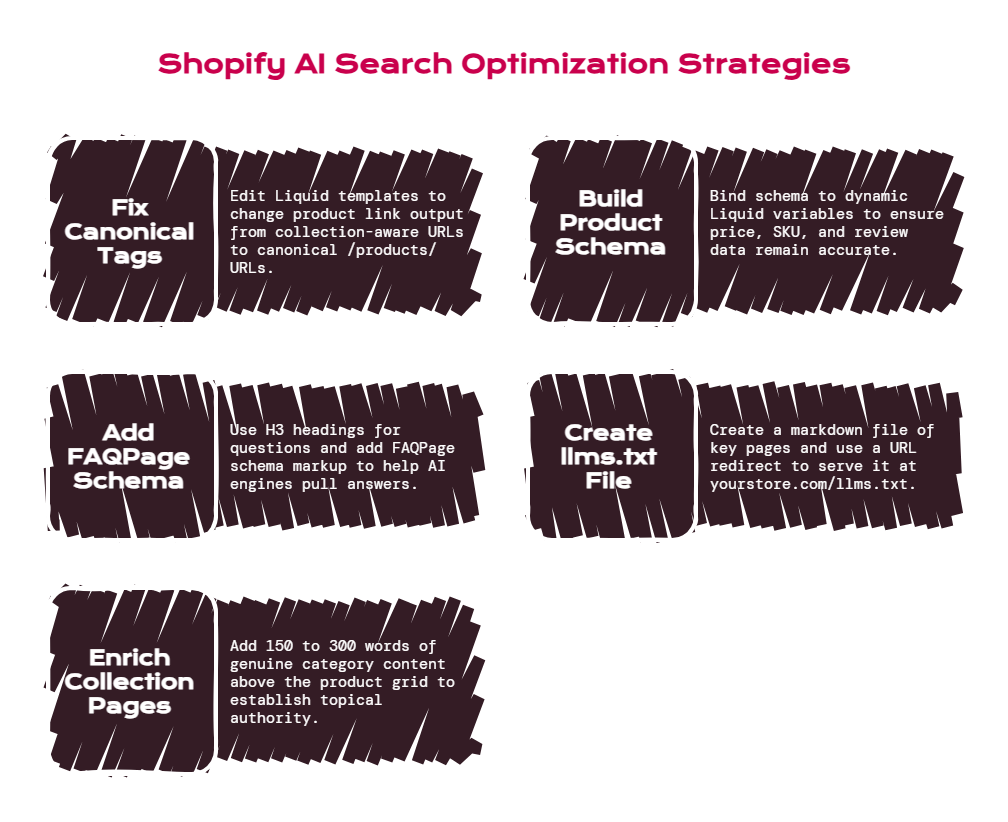
The fix requires editing your Shopify theme’s Liquid templates to change product link output from collection-aware URLs to canonical /products/ URLs. This is a single code change with high impact. After making it, verify by loading a collection-path product URL, viewing source, and confirming the canonical tag points to the clean /products/handle URL.
Build Complete Product Schema
Do not just check that schema exists – check that it is complete. Use Google’s Rich Results Test on your top product pages. Look for warnings on priceValidUntil, aggregateRating, SKU, and review fields. If they are flagged, that is what AI engines are working with when they try to pull your product data.
Bind schema to dynamic Liquid variables rather than hardcoding values. Hardcoded prices and availability do not update when your inventory changes, and AI systems recommending an out-of-stock product at the wrong price damages trust and user experience.
Add FAQPage Schema and Question-Based Content
AI Overviews frequently pull answers directly from FAQ sections – but only when they are structured correctly. Each question should be an H3 heading with a self-contained paragraph answer immediately following it. Add FAQPage schema markup to reinforce this for AI parsers.
The question phrasing matters too. People ask AI tools in natural language: “What size should I order for this brand?” “Is this jacket waterproof?” Match your FAQ questions to how real buyers ask them, not how you would phrase a product spec.
Create an llms.txt File
The llms.txt file is a new standard – think robots.txt, but for AI crawlers. It is a markdown file that gives LLMs a clean, structured index of your store’s most important pages without requiring them to parse heavy JavaScript or navigate complex filtering.
Shopify does not allow direct file uploads to the root directory, so you create it as a page and use a URL redirect to serve it at yourstore.com/llms.txt. Include your product collections, key blog posts, About page, and policy pages. Low effort, meaningful impact for stores that have not done it yet.
Enrich Collection Pages with Substantive Content
Empty collection pages – just a title, filters, and a product grid – cannot rank for category keywords and cannot get cited as topical authority. Adding 150 to 300 words of genuine category content above the grid, with buying guidance, use case explanations, and comparison content, gives AI systems something to work with.
This is also where internal linking between your blog content and collection pages pays off. The process of finding the right SEO keywords for your site should be driving both your blog strategy and your collection page content strategy at the same time.
Shopify AEO Fix Priority Matrix: Where to Start
| Fix | Effort | AI Visibility Impact | Priority |
| Audit and fix canonical tags | Low | High | Do First |
| Complete Product schema (JSON-LD) | Medium | Very High | Do First |
| Add FAQPage schema to key pages | Medium | High | Do Second |
| Create llms.txt file | Low | Medium | Do Second |
| Add 150-300 words to collection pages | Medium | Medium-High | Do Third |
| Rewrite product descriptions (fact-dense) | High | High | Do Third |
| Build topical blog cluster with Article schema | High | Very High (long term) | Ongoing |
Shopify vs WordPress for SEO and AI Visibility: The Real Trade-Off
This comes up constantly. Should you migrate to WordPress? Is Shopify holding you back?
Honest answer: Shopify is fine for AI visibility if you address its specific gaps. WordPress gives you more flexibility by default, but flexibility does not mean the work gets done. A well-maintained Shopify store with complete schema, proper canonicals, structured blog content, and an llms.txt file will outperform a poorly maintained WordPress site every time.
Where WordPress genuinely wins is content architecture depth – true URL control, granular category hierarchies, richer schema plugin ecosystems, and better content clustering tools. If content is your primary growth channel and you are operating at scale, that matters. If you are primarily an ecommerce brand where the store is the product and content supports it, Shopify with intentional optimization is more than enough.
One middle path that works well for some brands: Shopify for commerce, WordPress in a subfolder for editorial content via a proxy app. You get Shopify’s checkout and product management with WordPress’s content flexibility, and everything stays on the same domain so link equity and topical authority signals stay consolidated.
Understanding your current AI visibility baseline matters before you make infrastructure decisions. Our guide to forecasting SEO growth in 2026 walks through how to model what is actually moving your organic numbers – including how AI Overviews are breaking traditional CTR assumptions.
Ecommerce AI Visibility Beyond Technical Fixes: E-E-A-T and Brand Signals
Technical fixes are table stakes. What separates stores that consistently get cited from stores that fix the technical issues and still do not show up is brand authority and trustworthiness signals.
AI systems – particularly LLMs doing web retrieval – are not just reading your schema. They are synthesizing signals from across the web: product reviews on third-party sites, press coverage, mentions in industry publications, Reddit threads, and more. A brand that exists only on its own Shopify store is a brand AI systems do not know well enough to confidently recommend.
Ahrefs’ AI SEO statistics research found that brands in the top 25% for web mentions earn over 10 times more AI Overview mentions than the next quartile. A companion Ahrefs study analyzing 15,000 prompts across ChatGPT, Gemini, Copilot, and Perplexity found that on average only 12% of URLs cited by AI assistants also rank in Google’s top 10 for the same query – reinforcing that off-site authority signals and brand recognition play a far larger role in AI citation than traditional ranking position alone. That is not a marginal advantage – it is structural.
This is why digital PR and review acquisition matter so much for ecommerce AI visibility. Hemp brand SEO and AI search visibility is one vertical where we have seen this play out directly – brands with strong off-site presence get cited in AI answers even when their on-site technical setup is imperfect. Brands with perfect technical setups but minimal off-site footprint do not get mentioned at all.
For Shopify stores specifically, prioritize:
- Review acquisition and schema – Products with visible, structured reviews get cited more frequently. Use apps like Judge.me or Loox and make sure review schema is properly implemented alongside your Product schema.
- Third-party mentions and press – When authoritative publications mention your product in roundups or comparison articles, AI systems use those as trust signals. Earning those placements through outreach compounds your AI visibility over time.
- Consistent brand identity in schema – Organization schema on your homepage that clearly states who you are, what you sell, and who your customers are helps AI systems build an accurate picture of your brand. Inconsistent or missing Organization schema is one of the most common reasons AI systems get brand details wrong in citations.
- Content freshness – Ahrefs found that AI search platforms prefer to cite content that is 25.7% fresher than content cited in traditional organic results. Publishing schedules matter more for AI visibility than most ecommerce teams realize.
The same structural logic behind Shopify AEO applies across other verticals. Whether you are running a franchise operation, a local service business, or a niche content site, the citation authority signals work the same way. Our breakdown of local SEO for home service franchises covers how these signals operate at the local level. You can also see what we do at LYNX across competitive verticals – the playbook scales.
Conclusion: The Shopify AI Visibility Problem Is Fixable
If your Shopify store is not showing up in AI Overviews despite good products and decent Google rankings, now you have the actual answer. It is a combination of platform-level structural constraints – duplicate URLs, thin schema, isolated blog architecture, rigid URL formats – compounding with the fact that AI citation signals are different from traditional ranking signals to begin with.
The ecommerce AI visibility gap is real, documented, and widening. Stores that address it now – canonical conflicts, complete Product schema, FAQPage markup, llms.txt, substantive collection page content – are building a compounding advantage. Stores that do not are going to find it harder to close the gap as AI Overviews take up more real estate in shopping queries.
None of this requires leaving Shopify. It requires understanding where the platform falls short and filling those gaps intentionally. That is the work.
If you are an ecommerce brand trying to figure out where your AI visibility gaps are and how to close them, this is exactly what we do at LYNX SEO. We audit the technical foundation, fix structural problems, and build the content architecture that gets Shopify stores cited in AI answers – not just ranked in traditional results. See our case studies or get in touch if you want to start with an audit.
Frequently Asked Questions
Why Isn’t My Shopify Store Appearing in Google AI Overviews?
There are usually three reasons. First, Shopify’s default URL structure creates duplicate product pages that split your ranking signals, making it harder for AI systems to identify a single authoritative source to cite. Second, the platform’s default schema markup is often incomplete – missing review data, variant pricing, and return policy fields that AI engines rely on for Shopify AI Overview optimization. Third, most Shopify blogs are architecturally isolated from commercial pages, which limits topical authority signals. Fixing canonical tags, completing Product schema, and adding FAQPage markup to key pages are the highest-impact starting points.
What Are the SEO Limitations of Shopify That Affect AI Visibility?
The main Shopify SEO problems that specifically hurt AI visibility include: forced /products/ and /collections/ URL prefixes that cannot be changed, automatic generation of duplicate product URLs across collection paths, thin default schema markup missing recommended Product schema fields, a blog architecture that buries content under /blogs/news/ rather than building topical depth, and no native support for nested subcategories. The inability to upload files directly to the root directory also makes llms.txt implementation more complicated than it needs to be.
How Do I Optimize My Shopify Store for AI Search?
Start with the technical foundation: audit canonical tags in Google Search Console, check for duplicate URLs, and verify your Product schema using Google’s Rich Results Test. Then add complete schema including aggregateRating, return policy details, and variant-specific pricing. Add FAQPage schema to product and collection pages. Create an llms.txt file via a URL redirect. Write substantive content for collection pages – 150 to 300 words of buying guidance above the product grid. Build internal links between blog posts and commercial pages. These steps directly address the structural reasons why Shopify doesn’t rank in AI search as well as platforms with more flexible architecture.
Why Does Shopify Perform Poorly in AI Search Results Compared to WordPress?
The gap comes down to architecture flexibility. WordPress gives you complete URL control, deep content hierarchy, rich schema plugin ecosystems, and better content clustering tools – all of which AI systems use to evaluate topical authority and source credibility. Shopify’s commerce-first design means these are constrained or require workarounds. The Shopify vs WordPress for SEO debate comes down to use case: if editorial content is your primary growth channel and you operate at scale, WordPress offers structural advantages. If commerce is primary and content supports it, a properly optimized Shopify store is competitive.
What Is Shopify Schema Markup and Why Does It Matter for AI Overviews?
Shopify schema markup is machine-readable JSON-LD code embedded in your store’s pages that tells search engines and AI systems exactly what your products are, how much they cost, whether they are in stock, and what customers think of them. For AI Overview ecommerce visibility, complete schema is critical because AI engines like Google AI Mode and Perplexity pull structured data as a primary source when generating product recommendations. Stores with more complete schema provide AI engines with more material to work with, leading to more frequent and more accurate citations. Incomplete or conflicting schema causes AI systems to ignore the data or construct incorrect information.
Does Fixing Shopify SEO Problems Also Improve AI Visibility?
Generally yes, but not entirely. Traditional SEO fixes – improving page speed, fixing broken links, writing better product descriptions, building backlinks – do support ecommerce AI visibility because AI systems favor sources that Google already recognizes as authoritative. However, the overlap between traditional organic rankings and AI Overview citations in ecommerce is lower than almost every other vertical. That means you need a separate layer of optimization specifically for AI: structured data completeness, FAQ content formatting, llms.txt, and off-site brand presence signals. Standard SEO gets you part of the way; AI-specific optimization closes the gap.
What Is an llms.txt File and How Do I Add One to Shopify?
An llms.txt file is a markdown document that provides AI language models with a clean, structured index of your store’s most important pages – similar to robots.txt but designed for LLMs rather than traditional crawlers. On Shopify, since you cannot upload files directly to the root directory, you create the llms.txt as a page in your Shopify admin, format it in markdown with links to your key pages, and set up a URL redirect from /llms.txt to that page. AI crawler bots look for this file and use it to build a clearer map of your store, improving your Shopify AEO performance over time.
How Long Does It Take to See Results from Shopify AI Overview Optimization?
Technical fixes like canonical tag corrections and schema improvements typically show impact within four to eight weeks – that is roughly how long it takes for Google to recrawl affected pages and update its index. Content changes, like adding substantive copy to collection pages and building blog clusters, take longer: expect three to six months for meaningful topical authority development. Monitoring your brand in AI tools directly – by asking product category questions and checking whether you are cited – is the most reliable way to track progress on Shopify AI overview optimization outside of referral traffic data in Google Analytics.