Quick Answer: To measure AI search visibility, you need to track AI share of voice (how often your brand appears in LLM-generated answers), citation frequency, mention sentiment, and position within AI responses – across multiple platforms like ChatGPT, Perplexity, Gemini, and Google AI Mode. Tools like SERPent run your target prompts on a schedule and log where you appear, where competitors appear instead, and which of your pages are getting crawled by AI bots. This is a different measurement model than traditional SEO, and most agencies haven’t caught up yet.
Traditional SEO gave us a clean, measurable feedback loop. You ranked or you didn’t. You could open Search Console, pull your impressions, and know exactly where you stood for a given keyword.
AI search doesn’t work that way.
When someone asks ChatGPT which agency they should hire, or asks Perplexity for the best tools in your category, there’s no rank tracker telling you if you showed up. There’s no position 1. There’s either a mention or there isn’t – and if there isn’t, you have no idea why.
That’s the gap most agencies are sitting in right now. They know AI search matters. They’ve read the think pieces. They might even be writing content with AEO in mind. But they have no measurement system, which means they have no way to know if any of it is working.
At LYNX, we started taking LLM visibility tracking seriously early – partly because our clients were already seeing traffic shifts they couldn’t explain with Google data alone, and partly because the writing was on the wall. ChatGPT now serves over 800 million users weekly, and that number is moving in one direction. If you’re not tracking how your brand shows up inside those answers, you’re flying blind.
This is what our actual measurement framework looks like.
Key Takeaways
- AI search visibility requires a completely different measurement model than traditional SEO – rankings don’t exist, so you track mentions, citations, and share of voice instead.
- The core AEO metrics that matter are AI share of voice, citation frequency, mention sentiment, position within AI responses, and branded search lift.
- Prompt tracking is the foundation of any LLM visibility tracking system – you build a fixed library of prompts and run them consistently across platforms to detect changes over time.
- Tools like PromptWatch, Profound, and Semrush’s AI Visibility Toolkit make this scalable, but manual tracking with a spreadsheet is a legitimate starting point.
- Strong traditional SEO still feeds LLM visibility – a study by Grow & Convert found a 77% correlation between pages cited in ChatGPT/Perplexity and pages ranking in Google.
- Most agencies are reporting AI impressions or Google AI Overview appearances and calling it “AI search tracking.” That’s not the same thing.
Why Traditional SEO Metrics Don’t Measure AI Search Visibility
Let’s be direct about what we mean when we talk about AI search measurement vs. the stuff most agencies are already reporting.
Google Search Console shows you impressions and clicks from traditional SERPs and, to a limited degree, AI Overviews. That’s useful, but it only covers one platform and it doesn’t tell you what the AI actually said about you. You can have an impression in an AI Overview and still be framed poorly, still be mentioned third behind two competitors, or still have an outdated description attached to your brand.
More to the point, Google AI Overviews are one corner of a much bigger shift. ChatGPT, Perplexity, Gemini, and Claude are all generating answers to questions your potential customers are asking right now. None of that traffic routes through Google’s reporting. None of it shows up in your rank tracker.
The distinction matters because in AI search, there’s no ranked list. The model generates a synthesized answer. If you’re not in that answer, you’re not partially visible – you’re absent. And that absence is invisible to your existing reporting stack.
This is the blind spot. And most agencies either haven’t addressed it or are measuring adjacent things and calling it solved.
The Core AEO Metrics That Actually Matter for LLM Visibility
Before you pick a tool, you need to know what you’re measuring. These are the metrics we track for AI search measurement across client programs.
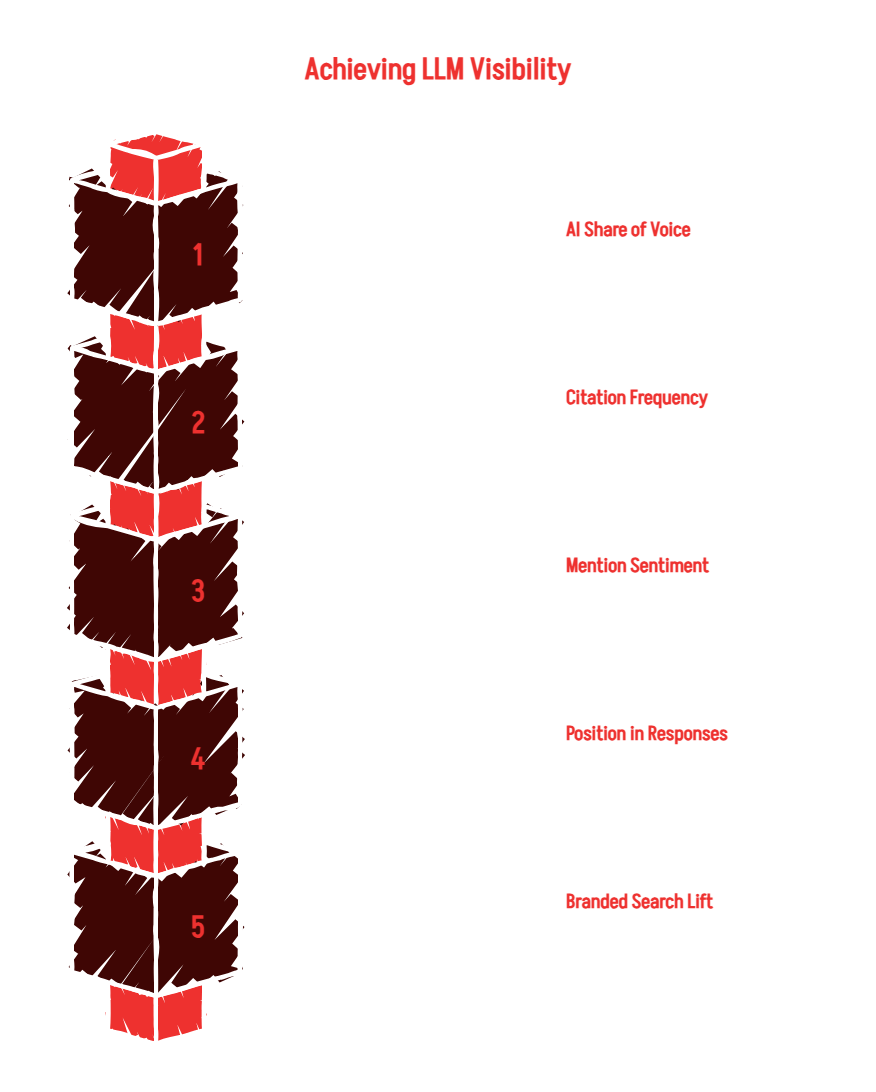
AI Share of Voice
This is the primary KPI for LLM visibility tracking. AI share of voice measures how often your brand appears in AI-generated answers compared to competitors, across a consistent set of tracked prompts.
The math is straightforward. If AI models mention brands 200 times across your prompt set and your brand appears 50 times, your AI share of voice is 25%. Track that number over time and against specific competitors. The trend matters more than the absolute figure.
A rising AI SOV over 8 to 12 weeks is a real signal that your content and brand signals are gaining traction with the models.
Citation Frequency and Citation Quality
Getting mentioned is one thing. Getting cited with a link – where the AI points to a specific page on your site as the source – is another. Citations are higher-value than bare mentions because they send referral traffic and reinforce authority signals over time.
Track both, but pay attention to which pages are being cited. That tells you what content the models trust, which feeds your content strategy going forward.
Mention Sentiment and Accuracy
AI systems can get your brand wrong. They can describe your services inaccurately, mention outdated information, or frame you in a context you’d rather not be associated with. Monitoring sentiment and factual accuracy is a brand protection exercise as much as a performance one.
This is where a lot of brands have a blind spot. They’re happy just to be mentioned. But being mentioned inaccurately at scale is a problem, especially when the AI is a confident narrator.
Position Within AI Responses
AI-generated answers aren’t a flat list, but position still matters. Being the first brand mentioned versus the third carries different weight in terms of attention and recommendation authority. Track where you land within responses, not just whether you appear.
Branded Search Lift
When your AI visibility rises, you should see a corresponding increase in direct branded searches in Google. People discover your brand through an AI answer, then search for you directly to learn more. This is one of the cleaner attribution signals available and it’s worth monitoring as a downstream indicator that your AEO strategy is working.
How Prompt Tracking for SEO Works
Prompt tracking is the operational foundation of any LLM visibility tracking system. Here’s what it looks like in practice.
You build a library of prompts – questions that reflect how your target customers actually research decisions in your category. Things like “best [service] for [business type]” or “what should I look for in a [vendor type]” or “top [tool category] platforms in [year].” These prompts are run across target platforms (ChatGPT, Perplexity, Gemini, Google AI Mode) on a consistent schedule – daily or weekly depending on your monitoring tier.
The tool logs the responses. It records whether your brand appeared, where it appeared, whether it was cited or just mentioned, what competing brands showed up, and which of your pages were referenced. Over time, aggregate sampling transforms apparent randomness into interpretable signals – much like how a poll is more reliable than a single data point.
This is a fundamentally different model than keyword rank tracking. You’re not measuring a fixed position for a fixed query. You’re building a statistical picture of how you perform across a distribution of relevant questions.
The practical implication: you need enough prompts (usually dozens, ideally hundreds at scale) and enough consistency (same prompts, run repeatedly over time) to make the data meaningful. Also worth noting: Grow & Convert’s research on what LLMs actually cite found that for product-specific and industry-specific queries, models cite niche industry sources 86% of the time – not Reddit or Wikipedia. Generic brand awareness tactics don’t move the needle where it counts.
The PromptWatch SEO Tool: What It Does and When It Makes Sense
PromptWatch is one of the more purpose-built platforms for this type of tracking. It monitors your brand’s presence across ChatGPT, Claude, Perplexity, Gemini, and Google AI Overviews at the prompt level.
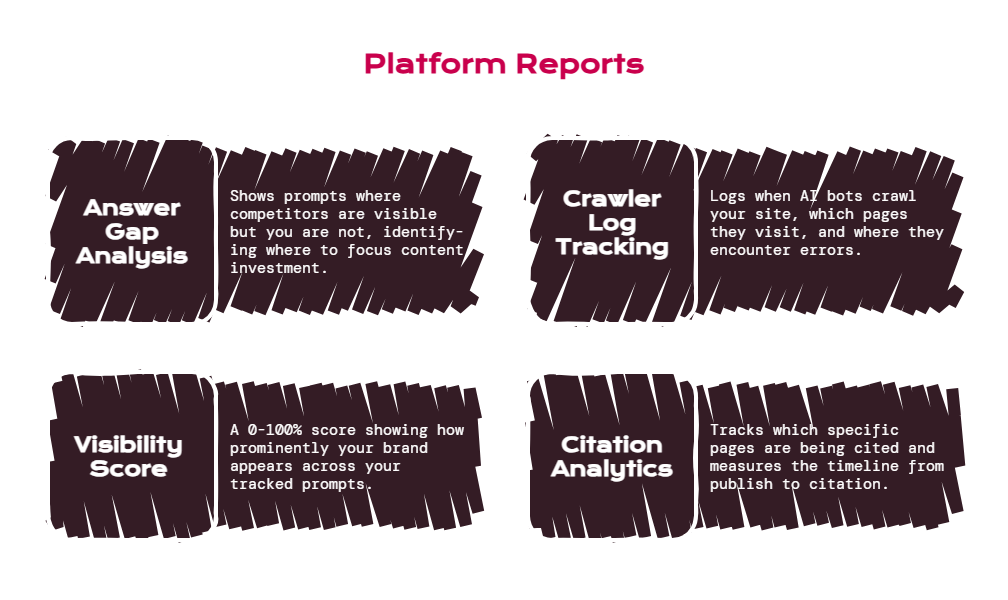
The standout features worth knowing about:
- Answer Gap Analysis: Shows you prompts where competitors are visible but you’re not. This is the most actionable report in the platform – it tells you exactly where to focus content investment.
- Crawler Log Tracking: Logs when AI bots (GPTBot, ClaudeBot, PerplexityBot) crawl your site, which pages they visit, and where they encounter errors. This gives you technical insight into how AI engines interact with your content before generating answers.
- Visibility Score: A 0-100% score showing how prominently your brand appears across your tracked prompts. 100% means you’re the first brand mentioned in responses.
- Citation Analytics: Tracks which of your specific pages are being cited, with a timeline from publish to citation so you can measure how long content takes to gain traction with different models.
It’s a strong tool for SEO teams and agencies managing brand visibility at scale. It’s not a one-size-fits-all – if your traffic is still almost entirely from Google SERPs and your category sees minimal AI query volume, you can start with a manual approach and graduate to a platform when the data warrants the investment.
Speaking of which: a manual tracking system with a spreadsheet is a legitimate starting point. Pick 10 to 15 priority queries, run them across ChatGPT and Perplexity once a week, log whether you appeared, and track changes month over month. It’s not scalable, but it builds intuition before you commit budget to tooling.
Comparing LLM Visibility Tracking Tools
The tooling landscape here is genuinely early. We’re still in a pre-Semrush/Moz/Ahrefs era for LLMs. That means the tools are improving fast, the pricing is all over the map, and no single platform has fully figured out attribution.
Here’s a practical comparison of the current options:
| Tool | Best For | Coverage | Notable Feature |
| PromptWatch | SEO teams and agencies | ChatGPT, Claude, Perplexity, Gemini, AI Overviews | Answer Gap analysis + crawler logs |
| Profound | Enterprise teams needing scale | 10+ engines including AI Mode + Shopping | Surfaces real user prompts, not just tracked ones |
| Semrush AI Toolkit | Teams already on Semrush | ChatGPT, Perplexity, Google AI Overviews | Integrated with existing SEO workflow |
| Meltwater GenAI Lens | Brand/comms teams | Major LLMs | Detects narrative drift, connects to media signals |
| Manual (spreadsheet) | Teams just getting started | Whatever you check manually | Free, builds intuition before committing to tools |
The key question when evaluating any platform: does it run prompts from the UI (which captures full rendered responses including maps, tables, and images) or only through the API? API-only tracking misses a meaningful portion of what users actually see. Backlinko’s breakdown of LLM tracking tools covers this in more detail if you want the full comparison.
What the Data Actually Shows About Brand Visibility in Generative AI
A few data points worth knowing before you build your tracking program:
- Grow & Convert analyzed 400+ bottom-of-funnel keywords across 16 clients and found a 77% correlation between first-page Google rankings and AI mentions – meaning strong traditional SEO is still the foundation. You don’t abandon SEO to win in AI search. When clients ranked in the top 3 positions, that correlation jumped to 82%.
- Profound’s analysis of 680 million citations found that citation patterns vary dramatically by platform. ChatGPT leans heavily on Wikipedia (47.9% of its top cited sources). Perplexity concentrates on Reddit (46.7%). Google AI Overviews takes a more distributed approach across source types. Your content strategy needs to be platform-aware, not platform-agnostic.
- Only 11% of domains are cited by both ChatGPT and Perplexity, according to cross-platform analysis of 680 million citations. If your team is tracking AI visibility on one platform only, 89% of the citation picture is invisible to you.
- According to Avinash Kaushik’s AEO framework, the three core KPIs for answer engine analytics are AI Brand Score, Visibility Score, and Average Position – and these can be defined differently across tools. Nail down definitions before you start reporting.
- Early referral data from AI search shows conversion rates significantly higher than organic. Seer Interactive found ChatGPT traffic converts at 16% versus Google organic’s 1.8%. This won’t stay that way forever, but it’s the current reality – AI-referred visitors are arriving pre-influenced.
What this means practically: you don’t need to blow up your existing SEO program. You need to extend it. The content that earns trust with Google tends to earn trust with LLMs. But you need the measurement infrastructure to verify that, and to catch cases where it breaks down.
How to Know If Your AEO Strategy Is Working
This is the question we hear most. You’ve started optimizing for AI search – how do you know it’s doing anything?
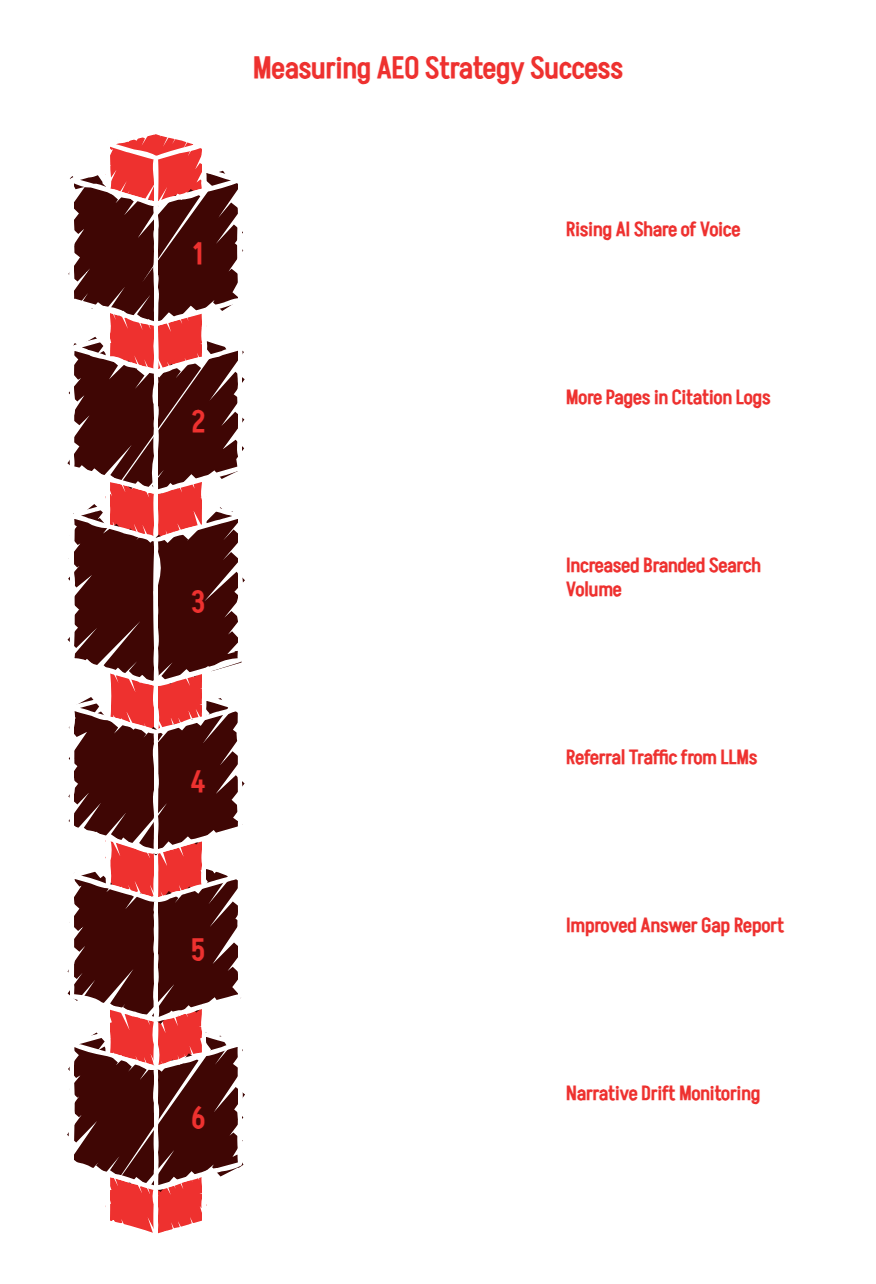
The signals to watch, in rough order of reliability:
- Rising AI share of voice over a sustained period (8 to 12 weeks minimum). Week-to-week noise is normal. Directional trends over a quarter are meaningful.
- More of your pages appearing in citation logs. If your tracking tool shows AI bots crawling more pages, and those pages are showing up as cited sources, your content is doing the job.
- An increase in branded search volume in Google. This is indirect but real – people who discover you through an AI answer come back via direct search.
- Referral traffic from LLM platforms in GA4. Set up source/medium filters for ChatGPT, Perplexity, and other platforms. The volume is still small for most brands, but track it from day one so you have a baseline.
- Improvement in your Answer Gap report. The set of prompts where competitors appear but you don’t should be shrinking over time as you close content gaps.
The Meltwater framework for LLM tracking adds another layer: watch for narrative drift, cases where the AI’s description of your brand starts to change over time. That’s both a risk (if the change is inaccurate) and an opportunity (if your content efforts are shifting how models represent you).
Monthly reporting cycles are the right cadence. Weekly is too noisy. Quarterly is too slow to catch and respond to changes.
This ties directly into how we approach content strategy for AI audiences. If you’re building content with AEO in mind and wondering how to make it actually useful to both humans and models, our piece on how to add value to AI blog content walks through the practical side of that.
Two Areas Where Most Agencies Get This Wrong
Here’s what we see consistently when clients come to us after trying to measure this themselves, or after working with agencies that claim to track AI visibility:
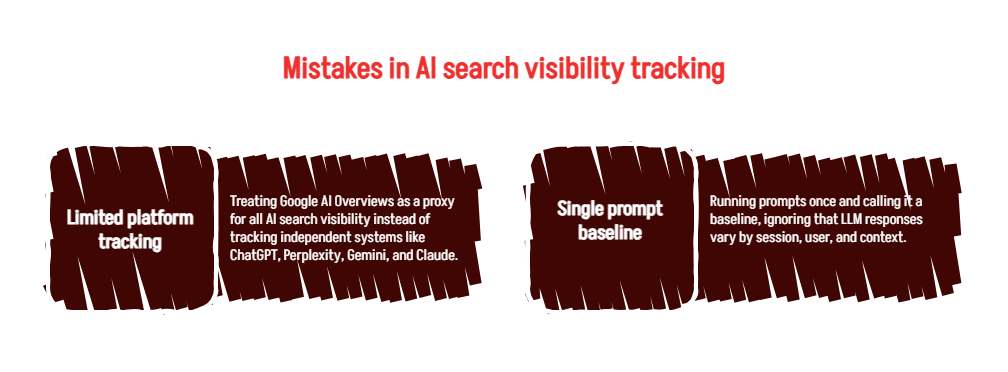
Mistake 1: Treating Google AI Overviews as a proxy for all AI search visibility.
AI Overview tracking is one piece. It tells you about one feature in one search engine. ChatGPT, Perplexity, Gemini, and Claude are independent systems with their own data sources and citation patterns. Showing up in AI Overviews and not appearing in ChatGPT is a real scenario – and you won’t know it’s happening if you only watch one platform.
Mistake 2: Running prompts once and calling it a baseline.
LLM responses vary by session, by user, by context. Running a prompt once and recording the result is a single data point, not a measurement. You need repeated runs over time to build a statistically stable picture of where you sit. This is why prompt tracking tools run queries on a schedule rather than on demand.
LLM Visibility Tracking: Key Metrics at a Glance
| Metric | What It Measures | Why It Matters |
| AI Share of Voice | Your brand mentions vs. competitors across tracked prompts | Primary visibility KPI; tracks your relative presence in the category |
| Citation Frequency | How often AI responses link to your specific pages | Higher-value than bare mentions; drives referral traffic |
| Mention Sentiment | Whether AI describes your brand accurately and positively | Brand protection; inaccurate descriptions scale fast |
| Response Position | Where in AI answers your brand appears | First mention carries more weight than third |
| Branded Search Lift | Increase in Google searches for your brand name | Downstream signal that AI visibility is driving awareness |
| Crawler Log Activity | Which AI bots are crawling your site and how often | Indicates content discoverability before citations appear |
Conclusion: Measure It or You’re Guessing
Most of what passes for AI search strategy right now is educated guessing. Write structured content. Use schema markup. Build E-E-A-T signals. These are all legitimate moves. But without measurement, you have no idea which ones are actually moving the needle inside AI answers.
The agencies and brands that get ahead of this aren’t necessarily doing more work. They’re doing the work with feedback. They know which prompts they’re winning. They know which competitors are beating them and where. They know which pages the AI is actually reading. That’s a completely different operating position than publishing content and hoping it sticks.
Building this measurement infrastructure takes real effort, and at scale it requires proper tooling and someone who knows how to read the data. If you’d rather skip the build phase and get to the insights, this is exactly the kind of work we run at LYNX. We can tell you where you stand in AI search right now, what’s driving it, and what to do about it.
Frequently Asked Questions
How Do You Measure Whether Your Brand Appears in AI Search?
You measure AI search visibility through prompt tracking – running a fixed set of target queries across platforms like ChatGPT, Perplexity, Gemini, and Google AI Mode on a consistent schedule, then recording whether your brand appears in the generated responses. Tools like PromptWatch automate this process and give you a visibility score, citation log, and share-of-voice metric over time. Manual tracking with a spreadsheet is also a valid starting point: pick 10 to 15 priority queries, run them weekly, and log the results.
What Metrics Should I Track for AI Search Visibility?
The core AEO metrics for AI search visibility are AI share of voice (your mentions vs. competitors across tracked prompts), citation frequency (how often AI links to specific pages on your site), mention sentiment and accuracy (whether the AI describes your brand correctly), position within AI responses (first mention vs. third), and branded search lift (more Google searches for your brand name as downstream evidence of AI-driven discovery). These replace keyword rankings and organic traffic as the primary visibility signals in AI search environments.
How Does Prompt Tracking Work for SEO?
Prompt tracking involves building a library of queries that reflect real user questions in your category – typically questions like “best [service type] for [business type]” or “what to look for in a [vendor type].” These prompts are run across multiple AI platforms on a scheduled basis (daily or weekly), and the tool records which brands appear in the generated answers, whether those brands are cited with links, and where they fall within the response. Over time, repeated runs build a statistically stable picture of your visibility, much like how polling works through aggregate sampling rather than single data points.
What Tools Measure LLM Brand Visibility?
The leading tools for LLM brand visibility tracking include PromptWatch (strong for SEO teams with its Answer Gap analysis and crawler logs), Profound (enterprise-focused, surfaces real user prompts at scale), Semrush’s AI Visibility Toolkit (good for teams already in the Semrush ecosystem), and Meltwater’s GenAI Lens (focused on narrative drift and brand comms use cases). Authoritas and Keyword.com’s AI Visibility Tracker are also worth evaluating. The right tool depends on your scale, budget, and whether you need it to integrate with existing SEO reporting.
How Do I Know If My AEO Strategy Is Working?
You know your AEO strategy is working when you see: a rising AI share of voice over an 8-to-12-week window; more of your pages appearing in citation logs inside your tracking tool; an increase in branded Google search volume; growing referral traffic from AI platforms visible in GA4; and a shrinking Answer Gap (fewer prompts where competitors appear but you don’t). Monthly reporting is the right review cadence – weekly data is too noisy, and quarterly reviews are too slow to course-correct.
How Do You Track ChatGPT Mentions Specifically?
Tracking ChatGPT mentions requires a tool that runs prompts against ChatGPT through the actual UI (not just the API) and logs the outputs. PromptWatch, Profound, and Semrush’s AI Toolkit all support ChatGPT monitoring. You can also track it manually by running target queries in ChatGPT weekly and logging whether your brand is mentioned, in what context, and whether you’re cited. GA4 also captures referral traffic from ChatGPT as a source – set up a custom filter for chat.openai.com and openai.com to separate it from other traffic.
Is LLM Visibility Tracking Different from Traditional SEO Reporting?
Yes – significantly. Traditional SEO reporting is built around keyword rankings, organic traffic, and click-through rates. LLM visibility tracking is built around mentions, citations, share of voice, and sentiment inside AI-generated answers that often produce no click at all. The two are complementary rather than competing: strong SEO fundamentals are still a prerequisite for AI visibility (there’s a high correlation between Google rankings and AI citations), but traditional metrics don’t tell you what AI is saying about your brand or how often it’s saying it. You need both reporting systems running in parallel.
Does SEO Still Matter If I’m Optimizing for AI Search?
Yes – and significantly so. Research consistently shows a strong correlation between pages that rank well in Google and pages that get cited by AI models. Good SEO practice – E-E-A-T signals, structured content, topical authority, and technical site health – is the foundation that makes AI citation possible. For a deeper look at how these two disciplines connect, our posts on local SEO for home service franchises, viral SEO keywords for Instagram, best SEO keywords for graphic designers, and how to redesign a website without losing SEO all cover foundational SEO work that feeds into AI visibility as a downstream effect.