Quick Answer: AI content doesn’t fail because it’s AI; it fails because it says nothing new. By default, AI produces the average answer, and Google already has dozens of those ranking. To make AI blog content worth reading and ranking, treat AI as a draft tool, not a publisher. Feed it real context, your audience, your positioning, and clear instructions. Then edit aggressively. Cut filler, verify every stat, and add what AI cannot: original data, firsthand experience, or a clear point of view. AI gives you speed, but performance comes from what you add after.
You put out a blog post. You used AI to write it, or most of it, because that’s just how content gets made now. It reads fine. It covers the topic. And it’s sitting on page four with zero traffic, zero links, and no real sign that anyone found it useful.
So you go looking for answers and land on some version of the same advice: humanize it, vary the sentence length, run it through a tool, add some personal touches. You try it. The post still doesn’t do anything.
The first step that people take here is to blame AI. However, the content isn’t underperforming because it sounds like AI. It’s underperforming because it has nothing to say. AI pulls from what already exists. Without real editorial input, you’re publishing a blander version of whatever’s already ranking. No amount of rewriting fixes that.
What does fix it is a different approach to how you use AI in the first place and what you do with the output before it goes anywhere near your site.
Key Takeaways
- Google does not penalize AI content specifically; it penalizes low-quality, low-effort content with little originality or added value.
- AI drafts underperform when they repeat existing search results without editorial insight, original data, experience, or a clear reason to exist.
- Better AI content starts with stronger inputs, including audience context, brand voice, past content, style rules, and clear negative instructions.
- Original data, firsthand tests, expert opinions, and contrarian insights are what make AI-assisted content difficult to replicate and worth citing.
- AI-assisted content still requires aggressive editing, source verification, updated web research, and removal of recognizable AI writing patterns.
- Humanizer tools do not improve substance; they only change surface texture and cannot fix weak arguments, hallucinated citations, or missing expertise.
Does Google Actually Penalize AI Content?
Short answer? No. Long answer? Still no.
Google penalizes low-quality content. At its core, despite hundreds of algorithm updates, Google has had one major goal: funnel out low-quality content to the made and take high-quality, well-researched work to the top. A lot of that low-quality content we’re talking about here just happens to be AI-generated right now, because it’s never been easier to publish hundreds of articles on topics you know nothing about.
Google’s own Search Central documentation is clear on this: the focus is on whether content is helpful and people-first, not how it was produced.
Generative AI can be particularly useful when researching a topic and adding structure to original content. However, using generative AI tools or other similar tools to generate many pages without adding value for users may violate Google’s spam policy on scaled content abuse.
John Mueller, Google’s Search Advocate, has reinforced this position in multiple office hours sessions. When asked whether using AI tools for initial content drafts was problematic, Mueller’s response, as reported by Search Engine Journal, focused on the quality of what gets published, not the tools used to produce it:
“What matters for us is the overall quality that you end up publishing on your website.”
He acknowledged that using AI for spelling, formulations, and initial drafting isn’t inherently an issue, but was clear that AI output isn’t automatically high-quality, and that editorial review is on the creator.
The January 2025 update to the Search Quality Rater Guidelines added the most explicit AI-specific language Google had included to date. Mueller called out Section 4.6.6, which instructs raters to flag content as lowest quality when it’s produced with little effort, little originality, and little added value for visitors, regardless of whether a human or a machine produced it.
Section 4.6.6. states:
“The Lowest rating applies if all or almost all of the MC on the page (including text, images, audio, videos, etc) is copied, paraphrased, embedded, auto or AI generated, or reposted from other sources with little to no effort, little to no originality, and little to no added value for visitors to the website. Such pages should be rated Lowest, even if the page assigns credit for the content to another source.”
The September 2025 update to the same guidelines added a new chapter on evaluating AI Overviews, but didn’t change the underlying AI content stance. Then came the March 2026 core update, which, in my opinion, was probably the most volatile in Google’s history by some measures, with significant movement in top rankings and continued targeting generic, low-quality content at scale, again without introducing any AI-specific penalty.
The position has been consistent across all of it: Google isn’t penalizing AI content.
It’s penalizing content that doesn’t earn its spot in the index. Right now, a large share of that content is being produced with AI because it’s never been easier to publish at scale on topics you know nothing about.
That’s the actual problem.
Why Do We Need to Make AI Content “Better”?
AI generates the median answer. That’s what it’s trained to do. It synthesizes what already exists and returns the most statistically probable output. The median answer to most topics is already sitting on page one of Google. So when you give an AI a basic prompt and publish what comes back, you’re producing a slightly worse version of content that already exists.
The gap isn’t fluency.
Modern AI writes clean sentences. It structures arguments reasonably well. It doesn’t make obvious grammar mistakes. The gap is that it has nothing original to say, because it can’t. It wasn’t there when you ran the test on three client sites and saw a 40% lift in six months. It doesn’t have a take that’s different from the consensus. It doesn’t know that the common advice in your industry is wrong, or why.
That’s what’s missing from most AI content: a reason for it to exist. Something it says that you can’t find in the 40 other results on the same query. Without that, it doesn’t matter how clean the prose is. It’s still filler.
This is the thing nobody talks about when they’re explaining how to “humanize” AI content.
They’re focused on surface texture. Swapping passive voice for active voice, adding a few “I” statements, and running it through a tool that makes it sound less robotic, but, at the end of the day, it’s not doing much, if anything.
None of that fixes an empty article. It just makes the emptiness harder to notice on the first read.
How to Add Real Value to AI Blog Content
The editorial layer is where content goes from filler to something worth reading. Most of it happens before you even open a blank draft, and the rest happens after you have one. Here’s how you can stand out in the long list of people using AI for content creation.
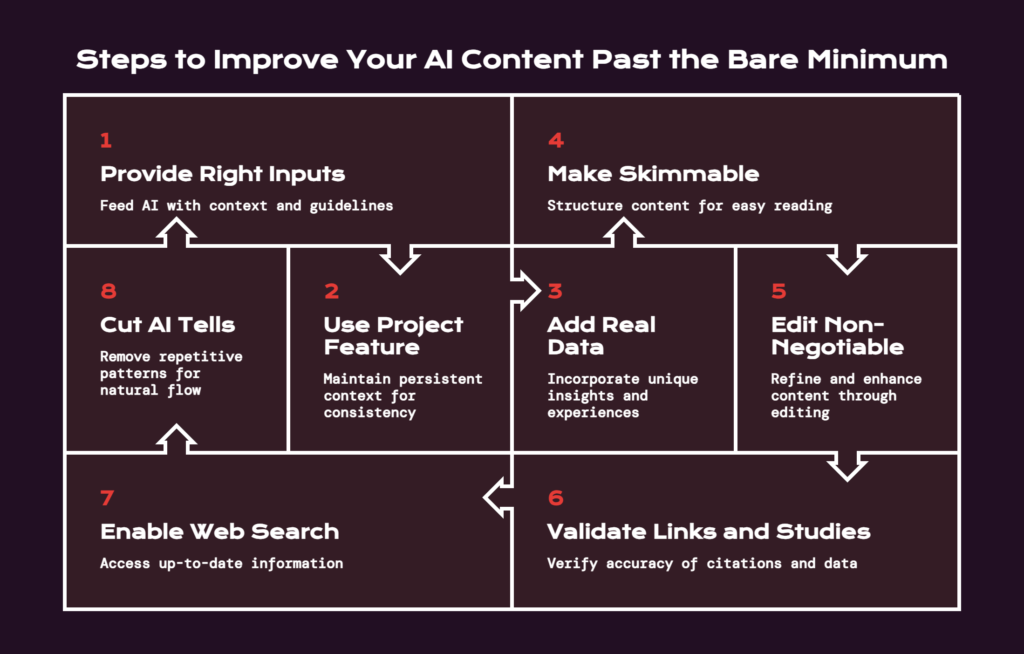
1. Feed It the Right Inputs Before You Start
AI is a reflection of what you give it. A basic prompt gets you a basic post. That post could have been written by anyone, about any company, for any audience. The specificity of your output is directly capped by the specificity of your input.
Before you generate anything, load the AI with context it couldn’t have otherwise. The top three most important things are:
- Your ideal customer profile. Not just “business owners” but the specific problems they’re dealing with, the way they describe those problems, what a win looks like for them.
- Past blog posts or PR content from your site so the AI can absorb your voice and the positions you’ve already taken.
- Brand guidelines, if you have them.
And lastly, tell it what not to do. “Don’t open with a definition. Don’t use passive voice. Don’t hedge the main argument. Don’t use the word ‘leverage’.” Negative instructions work better than they did when ChatGPT first came out. They eliminate the default behaviors AI falls back on when it isn’t told otherwise.
Does this mean your article will be ready to ship instantly? No, but you’ll be editing toward a finish line instead of rewriting from scratch.
2. Use the Project Feature (Most People Don’t)
Every major AI tool, ChatGPT, Claude, and Gemini, has a project or persistent context feature. ChatGPT calls it Projects. Claude has Projects too. Gemini has Gems.
The mechanic is the same: you set context once, and it’s present for every conversation inside that project. Your audience, your voice, your formatting rules, things you always include, things you never say.
Most people skip this entirely. They open a fresh chat for every piece of content, which means the AI has no memory of who you are, who you’re writing for, or what you’ve already said on the topic. Every session starts from zero. Then people wonder why the output feels generic. It’s generic because the AI is working from nothing.
There’s a practical content quality argument here too: without persistent context, you’re generating content in isolation. The AI doesn’t know what you’ve already covered, which means you get repetition, contradictions, and posts that undermine each other.
A properly configured project fixes that. It’s also where you capture everything from the “feed it the right inputs” step above, so you’re not re-pasting your ICP and brand docs into every single conversation.
3. Add Data That AI Couldn’t Have Written
This is the actual differentiator. Everything else in this list improves your content. This is the one thing that makes it irreplaceable.
AI synthesizes what already exists. It can tell your reader that B2B email open rates have declined. It cannot tell them what happened to open rates across your eight SaaS clients when you changed the sender name from a company address to a personal one last quarter.
It cannot tell them that the commonly cited benchmark in your industry is wrong because it’s based on a 2019 dataset that predates the iOS privacy changes.
It cannot tell them that you tested two content approaches for six months and one consistently outperformed the other in a way that contradicts the standard advice.
That kind of content, built on real experience, real tests, and a willingness to hold a position, earns links because it gives people something to cite that they can’t find anywhere else. It’s also the only content that AI cannot replicate, because it requires information that doesn’t exist in any training dataset.
When you finish a draft, ask yourself one question: what does this post say that nobody else has said? If you don’t have a clear answer, the post isn’t done.
4. Make It Skimmable
AI defaults to dense, uniform prose. Every paragraph is roughly the same length. Every sentence has roughly the same structure. It reads fine if you’re reading linearly, but online readers don’t read linearly. They (and everyone else, for that matter) don’t have the attention spans for it anymore. They scan first and commit later.
The average time a person can stay focused on one task has dropped from 2.5 minutes to 40 seconds. If the structure of your page doesn’t help them find what they’re looking for in about ten seconds, most of them won’t stay long enough to find out that the content is actually good.
Most people aren’t even going to read this article from start to end, and that’s why I started with both a quick answer AND key takeaways. People are not reading 4000-word blog posts in 2026, and your content has to adapt to that.
Subheadings should tell you what the section is about, not tease it. Bullets and numbered lists belong where the content is genuinely list-like, steps, comparisons, options, not as a default format for everything. Tables earn their place when you’re comparing multiple things across consistent attributes. Paragraph length should vary, because variation creates rhythm and rhythm keeps people reading. Short sentences land harder. Longer ones carry nuance. Alternating between the two is something AI does poorly and humans do naturally.
This matters for SEO beyond just time-on-page. Clear subheadings structure the content for featured snippets and AI Overview citations. Tables trigger rich results. Scannable structure is also part of how Google’s quality raters evaluate whether a page serves the user’s needs. It’s not a mere UX consideration right now.
5. Editing Is Non-Negotiable
Publishing an AI-first draft is how you end up with a site full of posts that are technically fine and completely useless.
A real editorial pass has two jobs: cutting and adding.
The cutting part most people know about: the filler intro that restates what the article is about, the conclusion that summarizes everything you just said, the transitions that announce themselves (“Furthermore,” “Moreover,” “It is worth noting that”), the hedging that turns every claim into a maybe. AI drafts run long by default. Most of what gets added in the last 20% of the word count could be removed without losing anything.
The adding part is where most people stop short. After you cut, what goes back in? The specific example that makes a general claim credible. The counterintuitive take that gives the reader something to think about. The sentence that acknowledges the limits of your own argument, because real expertise includes knowing where your knowledge ends.
This is the editorial layer that signals to a reader, and to Google’s quality evaluators, that a person with genuine experience wrote this, not a system optimizing for surface-level coherence.
Use this as your editing checklist before anything goes live:
Cut these on sight
- Filler intro paragraph that restates what the article is about
- Transitions that announce themselves: “Furthermore,” “Moreover,” “Additionally,” “It is worth noting that,” “It is important to understand that”
- Hedged claims that turn everything into a maybe: “may potentially,” “it could be argued,” “in many cases”
- Repeated points dressed up as new ones. AI circles back constantly
- The word “utilize” – “use” does the same job
- Any sentence that starts with “In today’s…”
- Three-item parallel lists that appear for no reason other than symmetry
Read for these before you hit publish
- Does every external link resolve to a real, live page?
- Does every cited stat match what the primary source actually says?
- Does the post sound like it was written by the same person who wrote your other content?
- Is there anything in here that you wouldn’t confidently say out loud to a client?
- Would a reader who already knows this topic find anything new here?
6. Validate Every Link and Study
AI hallucination in citations is a norm. It’s not something that ‘may’ happen. Hallucinations are a documented, systematic problem. A multi-model study found that only 26.5% of AI-generated references were entirely correct, with roughly 40% containing errors or outright fabrications.
Another analysis of papers accepted to NeurIPS 2025, one of the most prestigious AI conferences in the world, with 3 to 5 expert reviewers per paper, found 100 hallucinated citations that made it through peer review.
If fabricated citations are making it into peer-reviewed academic papers, they’re absolutely making it into your blog posts.
What AI does is generate citations that look right. They have plausible author names, realistic journal titles, and credible-sounding study conclusions without those sources actually existing. It will also correctly identify a real study and then misrepresent what the study actually found, because it’s pattern-matching from training data rather than reading the source.
Every stat, every external link, every cited study in an AI draft needs to be verified against the primary source before it goes anywhere near your publish button.
This matters everywhere, but it’s non-negotiable in health, legal, finance, or any YMYL adjacent topic where a fabricated citation is a liability. A 404 in your sources tells a reader you didn’t check, and they’re going to close your tab right then and there.
7. Enable Web Search Every Time
Every major AI tool has a web search toggle. Most people leave it off because it increases token usage and adds a few seconds to each response. Enable it anyway. It’s a reasonable compromise.
AI models have knowledge cutoffs. This is a hard date beyond which they know nothing. For example, Claude’s is August 2025, and without web search enabled, it works strictly from its training data. That’s nearly a year behind where we are right now, and the world has not been standing still.
If your content touches finance, energy, logistics, insurance, international trade, or defense, and you’re writing with AI that has no web access, you’re writing with a model that has no idea what is happening in the world. If you write with Claude today without using web search, your content will exclude the following world events:
- Longest US Government Shutdown in History: A 43-day shutdown, surpassing the previous record, halted federal operations, furloughed hundreds of thousands of workers, and created significant uncertainty across government contractors, healthcare, and financial services. Relevant to any content about US policy, federal procurement, or economic outlook.
- OpenAI Shutting Down Sora: OpenAI announced and then executed the shutdown of its Sora video generation app and API. If you’re writing about AI tools and generative media, and your AI has no web access, it may still be referencing Sora as an active product.
- Federal Intoxicating Hemp Ban Taking Effect November 12, 2026. Signed in November 2025, the law closes the Delta-8/THCa loophole from the 2018 Farm Bill and caps finished products at 0.4mg total THC per container, effectively banning most edibles, beverages, and tinctures on the market today. The industry is worth nearly $30 billion and is set to greatly affect hemp brands in the country.
- The US-Iran War and Strait of Hormuz Closure: Following Israeli and US strikes on Iran in late February 2026 that killed Supreme Leader Khamenei, Iran closed the Strait of Hormuz, a chokepoint for roughly 20% of global oil supply. The US military launched operations to reopen it in early May. Relevant to energy, shipping, insurance, logistics, and any content touching Middle East stability.
Now, will your content need the history of every single one of these events? Most likely not. If you’re working on smaller local SEO projects, you most likely won’t feel the difference. But, this goes to show that without up-to-date knowledge, there is a chance that your content will overlook extremely critical global events happening in your niche, without you even realizing.
The same applies to statistics, industry benchmarks, platform policy changes, tool acquisitions, and regulatory shifts. AI will cite 2025 data as if it’s current because it genuinely doesn’t know otherwise. With web search enabled, it pulls live information instead of defaulting to whatever was in its training set. The extra tokens are worth it.
8. Cut the AI Tells
The reason to cut AI writing patterns has nothing to do with Google detecting them. Google’s algorithms are not running a find-and-replace for “delve” or counting your em dashes. The reason is simpler: readers are increasingly pattern-matching AI output, and when they recognize it, trust drops.
The patterns are consistent enough across models that researchers have started documenting them. A study tracking PubMed records from 2000 to 2024 found that words like “delve,” “underscore,” “meticulous,” “commendable,” and “intricate” spiked dramatically in 2024, precisely when AI writing tools went mainstream. Another research on scientific abstracts found em dash usage more than doubled between 2021 and 2025 as AI writing became common.
None of these patterns is grammatically wrong. I personally loved em dashes because they offered such a neat way to piece together sentences that weren’t traditionally supposed to be pieced together. I loved the word ‘robust’ too. It was the perfect adjective to describe things that didn’t quite fall under the umbrella of flexible, versatile, or ‘good’.
Using these words once or twice isn’t the end of the world. But they accumulate. A reader hits “it’s worth noting that” twice, then a three-item parallel list, then a conclusion that starts with “In conclusion,” and the whole piece starts reading like something that got generated rather than written.
Here are some words/phrases that we keep an eye out for internally within our team at Lynx SEO:
| Single words | Phrases |
| Delve | In today’s digital |
| Robust | Game changer |
| Leverage | Treasure trove |
| Tapestry | Shed light on |
| Pivotal | In conclusion |
| Holistic | A unique blend of |
| Transformative | Pave the way for |
| Nuanced | It’s worth noting that |
| Myriad | Dive into |
| Unleash | Play a crucial role |
| Paradigm | Navigate the complex landscape |
| Synergy | A significant milestone in |
| Evolving | The transformative power of |
| Realm | In the world of |
| Nestled | Meticulous attention to detail |
Does AI Content Optimization Improve Search Visibility?
Yes, when it’s done right. That qualifier matters.
AI-assisted optimization of existing content is one of the more reliable use cases in SEO right now. Tools like Clearscope, Surfer SEO, and MarketMuse use AI to analyze the top-ranking content for a query and identify gaps in your coverage, semantic terms you’re missing, and areas where you’re thinner than competitors. Using those insights to improve an existing page that already has some signal, traffic, links, indexed history, works. It’s improving something real.
Where “AI content optimization” kind of stops working is when people conflate it with content production. Generating new posts at scale, with no editorial oversight, on topics the site has no existing authority in, and expecting rankings because the AI packed in the right SEO keywords. You can’t call this spray-and-pray approach ‘optimization’. This is just volume for volume’s sake, and it’s exactly the scaled content abuse pattern Google’s guidelines are targeting.
Do You Need to “Humanize” AI Content?
The framing of “humanizing” AI content puts the emphasis in the wrong place. It implies the problem is surface texture, that if you can make the prose sound less robotic, the content is fixed. It isn’t.
The humanizer tool category exists largely because people are worried about AI detection. But AI detectors are unreliable. They produce false positives on human-written content and miss plenty of AI-generated content that’s been lightly edited. Optimizing for detector scores is not a real content strategy, and the tools that promise to help you do it are, charitably, solving a problem that matters far less than advertised.
What does actually matter is whether the content demonstrates genuine expertise, real experience, and original thought: what Google’s framework calls E-E-A-T: Experience, Expertise, Authoritativeness, Trustworthiness. None of those signals come from a humanizer tool. They come from the quality of what you’re saying, not the surface texture of how you’re saying it. There’s no shortcut for it that costs $29/month.
Here’s what my intro for this article looks like before and after passing through the top search result for “humanizer”. The rewritten version is practically the same, if not worse, and is absolutely not going to perform any better.
You put out a blog post. You used AI to write it, or most of it, because that’s just how content gets made now. It reads fine. It covers the topic. And it’s sitting on page four with zero traffic, zero links, and no real sign that anyone found it useful.
So you go looking for answers and land on some version of the same advice: humanize it, vary the sentence length, run it through a tool, add some personal touches. You try it. The post still doesn’t do anything.
The first step that people take here is to blame AI. However, the content isn’t underperforming because it sounds like AI. It’s underperforming because it has nothing to say. AI pulls from what already exists. Without real editorial input, you’re publishing a blander version of whatever’s already ranking. No amount of rewriting fixes that.
What does fix it is a different approach to how you use AI in the first place and what you do with the output before it goes anywhere near your site.
A blog post goes live. You had help writing it, or most of it, from AI, because that’s what happens nowadays when you create content. The writing is good. The subject matter is relevant. But it’s stuck on page four with no traffic, no backlinks, and seemingly no one who cared enough to even read it.
Next, you search for solutions and come across some variation of the same tips: humanize it, vary the sentence structure, throw it into some sort of tool, include some personal flair. Try this. Try that. Nothing happens.
This is where people tend to point their fingers at AI. But the problem is not that the content sounds like AI; rather, it’s that the content is bland. AI draws from existing content. Unless you have any sort of editorial intervention, you end up posting a more mundane take on whatever content is currently ranking.
What ends up solving the issue is a completely different strategy altogether for leveraging AI.
What Good AI-Assisted Content Can Actually Do for Your Business
Done properly, AI-assisted content isn’t just a cost-saving measure. It’s a compounding asset.
A well-researched, well-edited blog post on a topic your audience is actively searching for can generate traffic for years. It earns links from other sites that find it useful. It builds topical authority that makes your next post easier to rank. It brings in leads who found you while looking for an answer, which means they arrive already trusting that you know what you’re talking about. That’s a fundamentally different conversion dynamic than paid traffic.
The posts that do all of that aren’t the ones that got published in 20 minutes. They’re the ones where someone thought carefully about the angle, brought in original data or experience, edited the AI draft until it was actually good, and verified every claim before hitting publish. AI gets you to a first draft faster. The rest of the work is still the work.
If you’d rather have a team that does this well than figure it out yourself, this is exactly the kind of content strategy we run at Lynx SEO. Not volume for volume’s sake. Content that’s actually worth the effort it takes to produce.
Frequently Asked Questions
Does Google Penalize AI-Generated Content?
No. Google’s guidelines are clear that content is evaluated on quality, not how it was produced. What Google penalizes is low-quality, thin, or scaled content designed to manipulate rankings – and a lot of that content happens to be AI-generated right now, because publishing at scale without editorial oversight has never been easier. High-quality AI-assisted content, with proper editing and original additions, is not at risk.
Is AI Content Bad for SEO?
Not inherently. AI content that’s well-edited, accurate, and adds something that doesn’t already exist in the search results can rank just as well as human-written content. AI content that’s generated at scale with no editorial layer, filled with hallucinated citations, and indistinguishable from everything else on the topic is bad for SEO. The issue is quality, not origin.
Do AI Humanizer Tools Actually Work for SEO?
No. Humanizer tools change the surface texture of content. They make it read less like a template and more like prose. They don’t fix thin content, hallucinated sources, or missing expertise signals. If your content wasn’t good before the humanizer pass, it isn’t good after. Spend that budget on an editor instead.
How Do I Make AI Content Rank Better?
By making it genuinely better. That means feeding the AI real context before you generate anything, adding original data and experience that couldn’t have come from the AI, editing aggressively, verifying every external source, and publishing something that has a reason to exist beyond filling a content calendar. Rankings follow quality. There’s no version of this where the shortcut works long-term.
What’s the Biggest Mistake People Make With AI Blog Content?
Publishing the first draft. AI drafts are starting points, not finished products. The editorial pass, where you cut filler, add specificity, verify facts, and inject a real point of view, is where the content actually becomes useful. Skipping it is how you end up with a site full of posts that sound fine and do nothing.
Sources I Used for This Article
- Google Search Central: “Google Search’s guidance about AI-generated content” – developers.google.com/search/docs/fundamentals/using-gen-ai-content
- Search Engine Journal: “Google On AI-Generated Translations: Use With Caution” – searchenginejournal.com/googles-stance-on-ai-translations-content-drafting-tools/519515/
- American Psychological Association: “Why our attention spans are shrinking, with Gloria Mark, PhD” – apa.org/news/podcasts/speaking-of-psychology/attention-spans
- arXiv: “Exploring the Impact of Generative AI on Scientific Writing and Publishing” – arxiv.org/abs/2505.18059
- ScienceDirect: “The influence of Artificial Intelligence on the readability and clarity of scientific abstracts” – sciencedirect.com/science/article/abs/pii/S221462962600191X
- medRxiv: “Evaluating the use of large language models in medical research drafting: A blinded study” – medrxiv.org/content/10.1101/2024.05.14.24307373v4
- Piece of K: “The rise of the em-dash in ecology abstracts” – pieceofk.fr/the-rise-of-the-em-dash-in-ecology-abstracts/
