Quick Answer: To get cited in ChatGPT and other AI answer engines, your content needs a clear answer capsule near the top, a question-based heading structure, original data or owned insights, a word count over 1,900 words with sections of 120-180 words, and a credible off-page presence built through backlinks, brand mentions, and community engagement on platforms like Reddit. Schema markup supports Google’s AI pipeline. Domain authority is the most weighted signal across platforms.
Most of the advice floating around about ChatGPT citations right now is vague. “Write good content.” “Use structured data.” “Be authoritative.” Great. Super helpful. That advice doesn’t tell you what actually moves the needle.
What’s happening is that search has split into two distinct layers. There’s traditional SEO – still relevant, still necessary – and there’s a second layer that operates completely differently. AI systems like ChatGPT, Perplexity, and Google’s AI Mode don’t rank pages. They extract answers. They pull content from pages they deem credible, package it into a response, and cite the source. If your page isn’t structured in a way that makes extraction easy, it gets passed over – even if it’s ranking well in Google.
This is the gap most businesses are missing right now. They’re doing solid SEO work, getting decent traffic, and still not appearing when their customers search ChatGPT for the exact thing they offer.
The good news: the signals that drive AI citation are documented, measurable, and actionable. This article covers exactly what they are, how they work across different platforms, and what you actually need to change on your pages to start showing up.
Key Takeaways
- Answer capsules – concise, self-contained responses immediately following a question-format H2 – are the single strongest on-page signal for ChatGPT citation.
- Domain authority and backlink volume are the highest-weighted signals overall; sites with 32K+ referring domains are cited 3.5x more often.
- Content updated within the past three months averages nearly double the citations of outdated pages.
- FAQ sections and question-based headings nearly double citation likelihood, especially for smaller domains.
- ChatGPT and Perplexity use different citation logic – Perplexity weighs recency far more heavily; ChatGPT prioritizes domain authority and Reddit presence.
- Schema markup supports Google’s AI pipeline (confirmed for Bing Copilot and AI Overviews) but doesn’t directly trigger ChatGPT or Perplexity citations.
- Off-page signals – including brand mentions on Reddit, Quora, review platforms, and earned media – are becoming as important as traditional backlinks for AI visibility.
- AI-referred traffic converts at 4.4x the rate of standard organic visitors, which makes this worth building for now.
What “Optimize Content for AI Citation” Actually Means
AEO – answer engine optimization – is the practice of structuring content so AI-powered platforms select it as a cited source when generating responses. It’s not a replacement for SEO. Think of it as an additional layer sitting on top of your existing SEO foundation.
The difference in how success is measured is significant. Traditional SEO success is a click to your page. AEO success is your content being quoted in the AI’s answer, with or without a click. That shift matters because AI-referred sessions grew 527% year-over-year through mid-2025, and the traffic that does click through converts at a much higher rate than standard organic visitors. Ahrefs’ December 2025 study of 300,000 keywords found that AI Overviews reduce position-1 click-through rates by 58% – making citation the primary way to recover visibility that traditional rankings no longer protect.
The query behavior is also different. The average Google search is roughly 3-4 words. The average ChatGPT prompt runs to 23 words. People aren’t searching AI engines – they’re having a conversation with them. That means your content needs to read like a clear, authoritative answer to a specific, well-formed question, not a keyword-optimized document.
We’ve started building AEO thinking directly into content production for LYNX clients – and the impact shows up faster than most traditional SEO work, especially in competitive verticals where AI Overviews are already eating significant click share. Our hemp brand SEO work covers this pattern in detail for a category where AI citation gaps are particularly damaging.
The On-Page Signals That Drive ChatGPT Citation
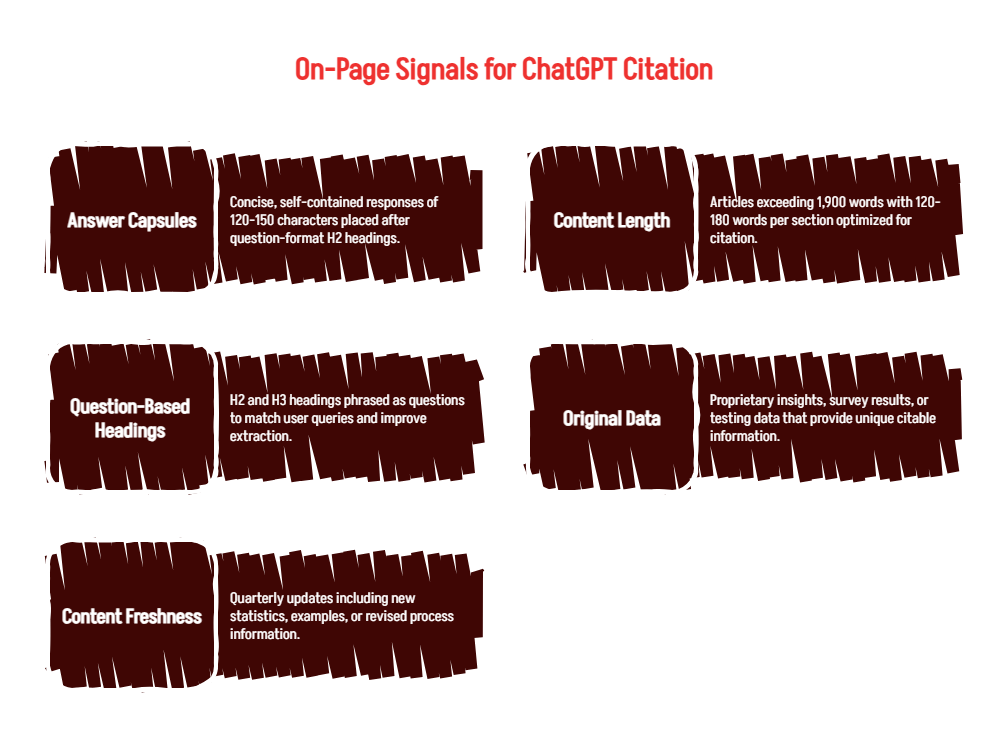
The pages most likely to earn citations from ChatGPT tend to share a handful of clear structural signals that make their content easier for AI systems to identify, extract, and reuse.
How Do Answer Capsules Make a Page Appear in AI Search Answers?
An answer capsule is a concise, self-contained response – roughly 120-150 characters – placed directly after a question-format H2. Research from Search Engine Land’s audit of 15 domains generating nearly 2 million monthly organic sessions found that answer capsules were the single strongest predictor of ChatGPT citation rates, more than any other structural or editorial factor tested.
The logic is straightforward. LLMs extract content at roughly the section level – vector chunk sizes typically range from 150-300 words per content block. A clear, self-contained answer positioned immediately after a recognizable question heading is exactly the format the model is looking for. It can pull the answer without having to make inferences from surrounding text.
What an answer capsule is not: a paragraph-length intro, a “we’ll cover this in the article” teaser, or a definition restated from Wikipedia. It’s the direct answer to the question in the heading, written in plain language, with enough specificity to stand alone.
Every major section of your content should have one. This is also the pattern that makes content more useful for humans, which is not a coincidence.
Does Content Length Matter for LLM Content Optimization?
Yes – but the relationship is more specific than “longer is better.” Research analyzing ChatGPT citation patterns found that articles over 2,900 words average 5.1 citations, while those under 800 words average 3.2. For smaller domains without high authority scores, content length has roughly 65% more impact on citation rates than it does for established domains.
The section length matters too. Pages structured with 120-180 words between headings receive around 70% more ChatGPT citations than pages with sections under 50 words – or sections that run too long without clear breaks.
The practical target: aim for 1,900+ words minimum on pages you want cited. Organize those words into clear sections. Don’t pad to hit a count – thin filler doesn’t help – but don’t artificially compress content that deserves depth either.
Why Do Question-Based Headings Improve AI Overview Content Performance?
When a user’s query matches your heading closely, the content beneath it becomes a direct citation candidate. Question-based headings have almost 7x more impact on citation rates for smaller domains compared to established ones – and the presence of FAQ sections within the main content nearly doubles the chances of being cited overall.
This isn’t just about keyword alignment. It’s about format compatibility. AI systems are built to answer questions. Content that structures itself around the same question format the user is asking is easier to match, extract, and cite.
Write H2s and H3s as questions wherever it makes sense for the content. Not every heading needs to be a question – forcing it creates awkward structure – but answer-intent sections should almost always be formatted this way.
The Role of Original Data in AEO Content Strategy
Original data is the second-strongest differentiator for cited pages, right behind answer capsules. An audit of 15 domains across multiple industries found that owned insights and original data ranked as the top editorial traits correlated with higher ChatGPT citation rates.
The reason is simple: if your content restates a statistic from another source, the AI can cite the original source directly. Original data gives the model something it can only get from you.
Original data doesn’t have to mean a commissioned research study. It means:
- Survey results from your own audience, even a small one
- Aggregated findings from client projects
- Testing data from your own experimentation
- Framed insights that take known information and apply a named perspective (“LYNX finding: across clients in competitive local markets, topical cluster builds outperform single page optimization 3 to 1”)
That last format – what some researchers call “owned insights” – appears to carry citation weight even when the underlying information is widely known. The framing and attribution create a citable unit the AI can reference with attribution.
For our clients in competitive verticals, we’ve been including proprietary benchmarks and framed takeaways directly in content – not burying them in a sidebar or a downloadable. The cited version of your page is usually the one that surfaces the specific claim first.
Content Freshness as an LLM Optimization Signal
Content updated in the past three months averages 6 citations versus 3.6 for outdated pages – nearly double. Refreshing content quarterly with new statistics, updated examples, or revised sections is one of the highest-return maintenance activities for AEO.
This is especially true for Perplexity, which uses retrieval-augmented generation (RAG) and maintains a continuously updated index. Fresh content can appear in Perplexity citations within days of publication. For ChatGPT, freshness matters more on fast-moving topics than evergreen ones, but it’s still a measurable factor across the board.
What counts as a meaningful update: new data, changed recommendations, updated steps or process information, and a revised dateModified in your schema. Changing a sentence or two and bumping a timestamp doesn’t count and probably doesn’t help.
The pages most worth refreshing are your current citation earners that are showing declining frequency. Those have already proven citation-worthiness – refreshing them is higher ROI than building new pages from scratch. This aligns with how we approach SEO growth forecasting – protecting existing momentum is usually the first priority, not chasing new ground.
The Two Comparison Tables You Need
On-Page Factors: AEO vs. Traditional SEO
| Factor | Traditional SEO Priority | AEO / AI Citation Priority |
| Heading structure | Keyword-rich H2s/H3s | Question-format H2s/H3s with answer capsules below |
| Content length | 1,000-2,000+ words for competitive terms | 1,900+ words; 120-180 words per section |
| Keyword use | Primary keyword density; LSI terms | Entity density; named sources, stats, proper nouns |
| Links in body copy | Internal and external links encouraged | Minimal links inside answer capsule text (correlated with higher citation rate) |
| Data and statistics | Helpful for E-E-A-T; third-party citations fine | Original or “owned” data strongly preferred; restated data cites the source, not you |
| Content updates | Annual or as needed | Quarterly minimum; meaningful updates only |
| FAQ section | Useful for featured snippets | Nearly doubles citation likelihood |
| Schema markup | FAQ, HowTo, Article schemas improve rich results | Indirect effect via Google’s Knowledge Graph; visible Q&A content matters more for ChatGPT/Perplexity |
Platform-Specific Citation Behavior
| Platform | Primary Citation Signals | Recency Weight | Reddit/Community Weight | Schema Impact |
| ChatGPT | Domain authority, backlinks, answer capsule format | Moderate | High (Reddit 5%+ citation share) | Indirect; not confirmed as direct trigger |
| Perplexity | Content freshness, answer format, entity authority | Very High (favors 30-90 day updates) | Moderate (Reddit ~24% of citations) | Helps parsing; FAQPage and HowTo schemas useful |
| Google AI Overviews | Traditional SEO signals + structured content | Moderate | High (Reddit 21% of citations) | Confirmed to use schema; JSON-LD recommended |
| Bing Copilot | Schema markup confirmed by Microsoft; traditional authority signals | Moderate | Moderate | Direct use of schema confirmed |
How to Write for AEO Instead of Just SEO: The Structural Changes
Most pages that rank well in Google aren’t automatically citation-ready. The problem is almost always structure, not content quality. Here’s what needs to change.
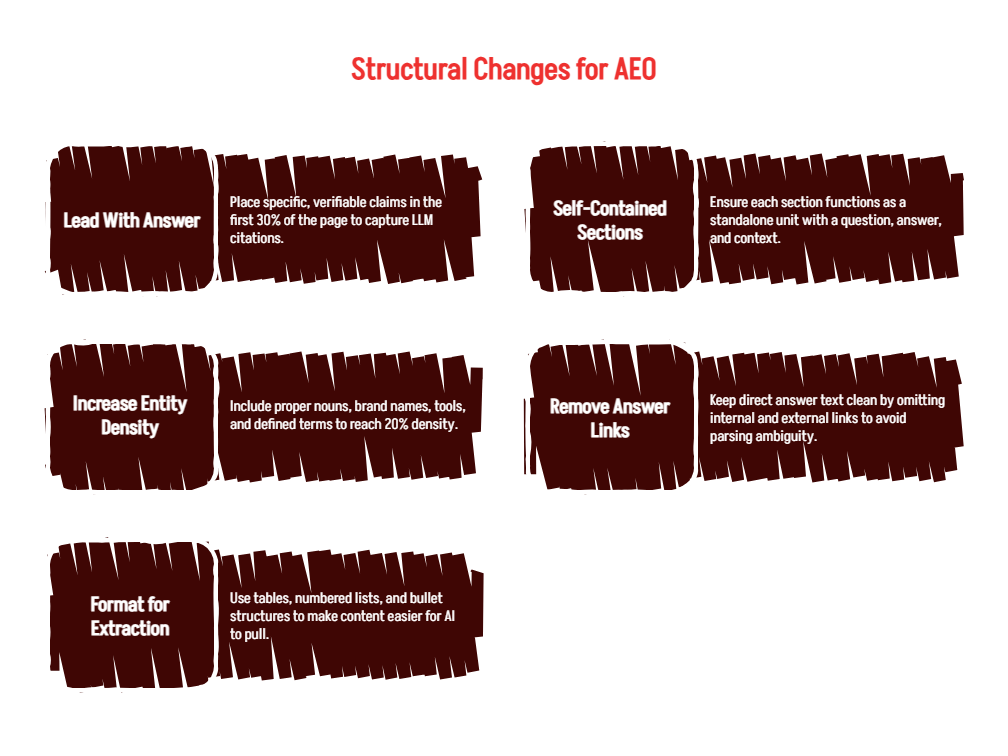
- Lead With the Answer: The first 30% of your page captures 44.2% of all LLM citations, based on analysis of verified ChatGPT citation distributions. If your most specific, verifiable claims are buried below lifestyle copy, brand stories, or a rambling intro, you’re structurally invisible to AI systems regardless of your domain authority. Lead with the direct answer. Expand below it.
- Make Sections Self-Contained: An AI system extracting your content doesn’t necessarily pull the full page. It pulls a chunk – typically 150-300 words around the relevant section. If your section only makes sense in the context of what came before it, it can’t be cleanly cited. Each section should work as a standalone unit: question heading, direct answer, supporting context.
- Increase Entity Density: Heavily cited content averages around 20% entity density – that means proper nouns, brand names, specific tools, named people, and defined terms. Generic marketing copy written for a broad wellness audience tends to sit at 5-8% entity density. The fix is specificity: named tools, specific methodologies, attributed data, proper citations.
- Remove Links From Answer Capsule Text: This one surprised a lot of practitioners when the data came out. Search Engine Land’s audit found that minimal linking inside the capsule text – especially omitting internal and external links – correlated with more ChatGPT referrals. The theory: links inside the answer create parsing ambiguity. Keep your direct answer clean. Add links after the capsule, in the supporting body.
- Format for Extraction: Tables, numbered lists, and labeled bullet structures are easier for AI systems to pull than dense narrative prose. That doesn’t mean dumbing content down – it means formatting so that a clearly defined concept or comparison is presented in a way a model can cleanly extract and attribute.
Schema Markup for Structured Content: What Helps
There’s a lot of noise around schema and AI citation. The honest summary: Microsoft has confirmed that schema markup helps Bing Copilot’s LLMs understand content, and Google uses it for AI Overviews. For ChatGPT and Perplexity, the evidence is less direct – LLMs tokenize JSON-LD as raw text rather than parsing it as structured data the way Google’s crawler does.
What schema actually does:
- Makes entities and relationships machine-readable for platforms that preserve structured data (confirmed: Bing Copilot, Google AI Overviews)
- Reduces ambiguity around brand, author, and content type, so extraction is cleaner when it happens
- Contributes to Google’s Knowledge Graph, which influences AI Overview selection
- Does not directly guarantee ChatGPT or Perplexity citations
The most useful schema types for AI visibility, in order of impact:
- FAQPage Schema: Structures Q&A content as standalone question-answer pairs. Each FAQ entry becomes an independently citable unit. The key is that the visible on-page content needs to mirror the schema – the formatted Q&A the user sees is what LLMs actually extract. Research from ZipTie found that LLMs tokenize JSON-LD as raw text rather than parsing it as structured data, which means the visible Q&A is the real extraction target – not the markup itself.
- Article / BlogPosting Schema: Establishes publication date, author, and content type. The dateModified field is specifically important for AI freshness evaluation.
- HowTo Schema: Structures process content as a sequence of labeled steps. Useful for instructional content where each step needs to be independently understandable.
- Organization and Person Schema: Establishes entity identity. Cross-referenced sameAs links to LinkedIn, Wikipedia, and other profiles help AI systems verify author and brand authority.
Use JSON-LD format for all implementations. Microdata and RDFa embed schema inside HTML tags, creating parsing conflicts that don’t help AI crawlers. JSON-LD keeps markup separate and clean. And only mark up content that’s actually visible on the page – schema that doesn’t match visible content can trigger penalties in Google and confuses AI systems that do parse it.
This connects directly to what we cover in our piece on how to add value to AI blog content – schema is part of the infrastructure, but the content substance is what actually earns citation.
Off-Page Signals for Perplexity Citation Optimization and ChatGPT Visibility
On-page optimization is necessary but not sufficient. The signals that determine whether an AI system trusts your domain enough to cite it in the first place are largely off-page.
Domain Authority Remains the Most Weighted Signal
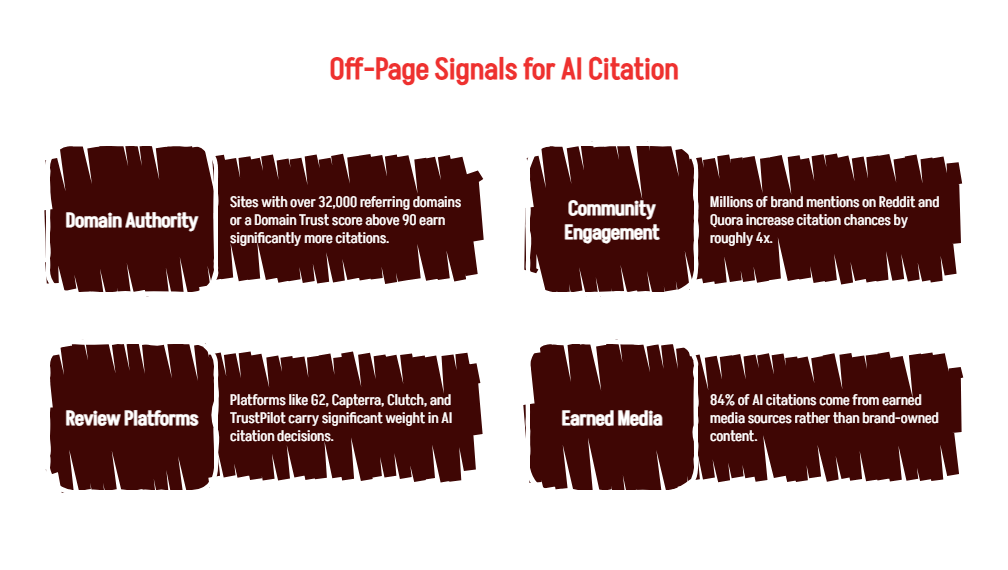
Sites with over 32,000 referring domains are 3.5x more likely to be cited by ChatGPT than sites with fewer than 200 referring domains. High-trust domains (Domain Trust score above 90) earn nearly four times more citations than low-trust sites. This isn’t new – it’s the same authority dynamic that drives traditional SEO – but it compounds for AI citation because authority is a threshold signal. Below a certain level, your content might not be retrieved at all.
The implication: AEO doesn’t replace link building. It runs alongside it.
Reddit and Community Engagement
This is where AI search diverges most sharply from traditional SEO. Domains with millions of brand mentions on Reddit and Quora have roughly 4x higher chances of being cited by ChatGPT than those with minimal community activity. For Perplexity specifically, Reddit accounts for roughly 24% of total citations.
The reason: AI systems are trained on and retrieve from community platforms because they contain authentic, experience-based answers written in natural language. A useful, specific Reddit comment answering a real question in a relevant subreddit builds the kind of community authority that AI systems are specifically calibrated to trust.
What this looks like in practice: genuine participation in subreddits relevant to your industry (r/SEO, r/marketing, r/startups, or vertical-specific communities). Answering questions with specific, useful responses. No promotional links – that destroys community trust and signal value. The answer is the product.
Review Platform Presence
For B2B brands specifically, platforms like G2, Capterra, Clutch, and TrustPilot carry significant weight in AI citation decisions. These platforms are heavily indexed by AI engines and frequently cited on commercial comparison queries. If a potential client asks ChatGPT “what’s the best SEO agency for SaaS companies,” the sources it pulls are often G2 and industry directories, not agency websites.
Collecting and maintaining reviews on these platforms isn’t just a sales motion anymore. It’s an AEO signal.
Earned Media Over Owned Content
Analysis of 25 million links across AI engines found that 84% of AI citations come from earned media sources – not brand-owned content or paid placements. This is the “third-party content problem” we see constantly with clients who publish exclusively on their own domains. The AI system asks: who else says this is a credible source? If the answer is no one, citation probability drops substantially.
Earned coverage in trade publications, contributed pieces in industry outlets, and expert quotes in relevant media are citation signals in their own right – not just traffic drivers.
We dive into how this plays out specifically for hemp brands in our piece on hemp brand SEO and AI search visibility, where third-party editorial coverage is one of the three primary gaps separating cited brands from invisible ones.
How to Measure Your AI Citation Footprint
You can’t optimize what you’re not tracking, and standard SEO metrics won’t tell you whether you’re getting cited in AI answers.
Here are the practical tracking approaches that actually work:
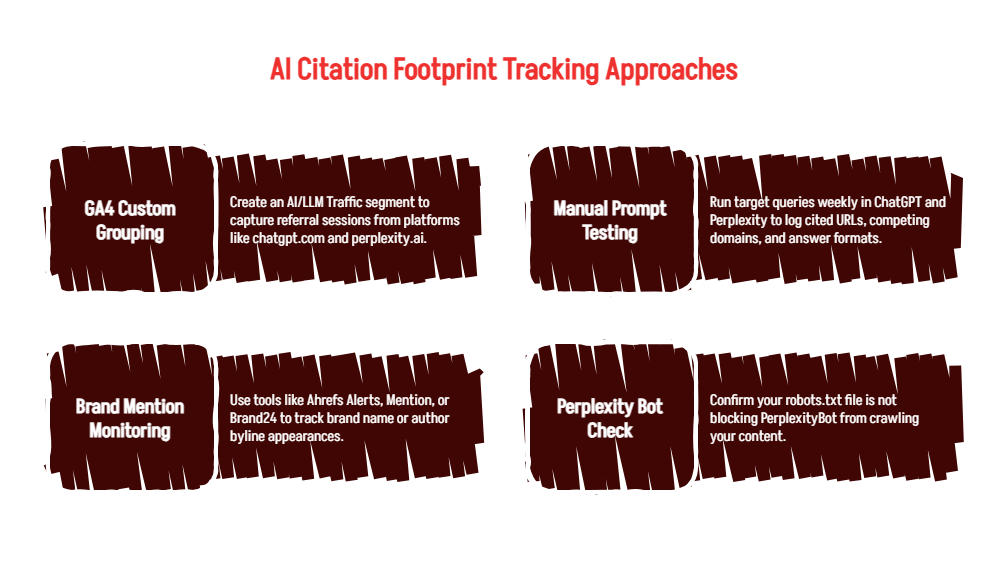
- GA4 Custom Channel Grouping: Create an “AI/LLM Traffic” segment that captures referral sessions from chatgpt.com, perplexity.ai, and other AI platforms. Compare this against Organic Search sessions and track conversion rates separately. AI-referred traffic tends to convert at a materially higher rate. Pixis’s GEO execution guide documents a 527% year-over-year jump in AI-referred sessions through mid-2025, which means there’s real volume to track now.
- Manual Prompt Testing: Run your target queries directly in ChatGPT and Perplexity weekly. Log which URL is cited (not just whether your domain appears), which competing domains show up, and the format of the answer the AI generates. Screenshot and archive these.
- Brand Mention Monitoring: Tools like Ahrefs Alerts, Mention, or Brand24 can track when your brand name or author bylines appear in third-party content. These are leading indicators of off-page authority building.
- Perplexity Bot Access Check: Confirm your robots.txt is not blocking PerplexityBot. If it is, Perplexity cannot crawl your content regardless of its quality.
The honest baseline: most businesses currently getting meaningful AI citation traffic are larger domains with strong traditional SEO foundations. Smaller and mid-sized sites can and do earn citations – especially for specific, niche queries where they have genuine depth and community presence – but building to a meaningful citation footprint takes time and consistent off-page effort.
For building a proper traffic model that accounts for AI citation effects on click-through rates, see our SEO growth forecasting guide.
What “Generative Search” and “Content for Generative Search” Actually Requires
Generative engine optimization (GEO) – sometimes used interchangeably with AEO, sometimes as a broader umbrella – was formalized in a 2024 academic paper from Princeton, Georgia Tech, and IIT Delhi presented at the ACM KDD conference. The paper, titled “GEO: Generative Engine Optimization” by Aggarwal et al., tested nine content optimization strategies across 10,000 queries and found that adding statistics increased AI citation visibility by up to 41%. Content optimized for entity clarity and structural formatting showed 30-40% higher AI citation rates overall compared to unoptimized content covering the same topics. HubSpot’s analysis of AEO trends found that traffic arriving from AI engines converts at 3x the rate of other sources – making the case for building this into your content strategy now, not later.
The practical overlap between GEO and AEO:
- Both require answer-first content structure
- Both reward topical depth across multiple pages (cluster architecture)
- Both depend on entity consistency – your brand name, key personnel, and descriptions should be identical across all directories, profiles, and third-party listings
- Both benefit from high domain authority and quality backlinks
Where they diverge: GEO thinking tends to extend further into technical infrastructure – ensuring AI crawlers can access your content, implementing proper entity graphs, and building the kind of cross-platform brand presence that AI systems can verify across sources.
The simpler way to think about it: if you’ve built solid SEO fundamentals and your content is genuinely the best answer to a specific question, AEO and GEO are mostly about removing the structural barriers that prevent AI systems from extracting and citing that answer.
A Practical AEO Content Checklist
Before publishing or updating a page you want cited in AI answers, run through this list:
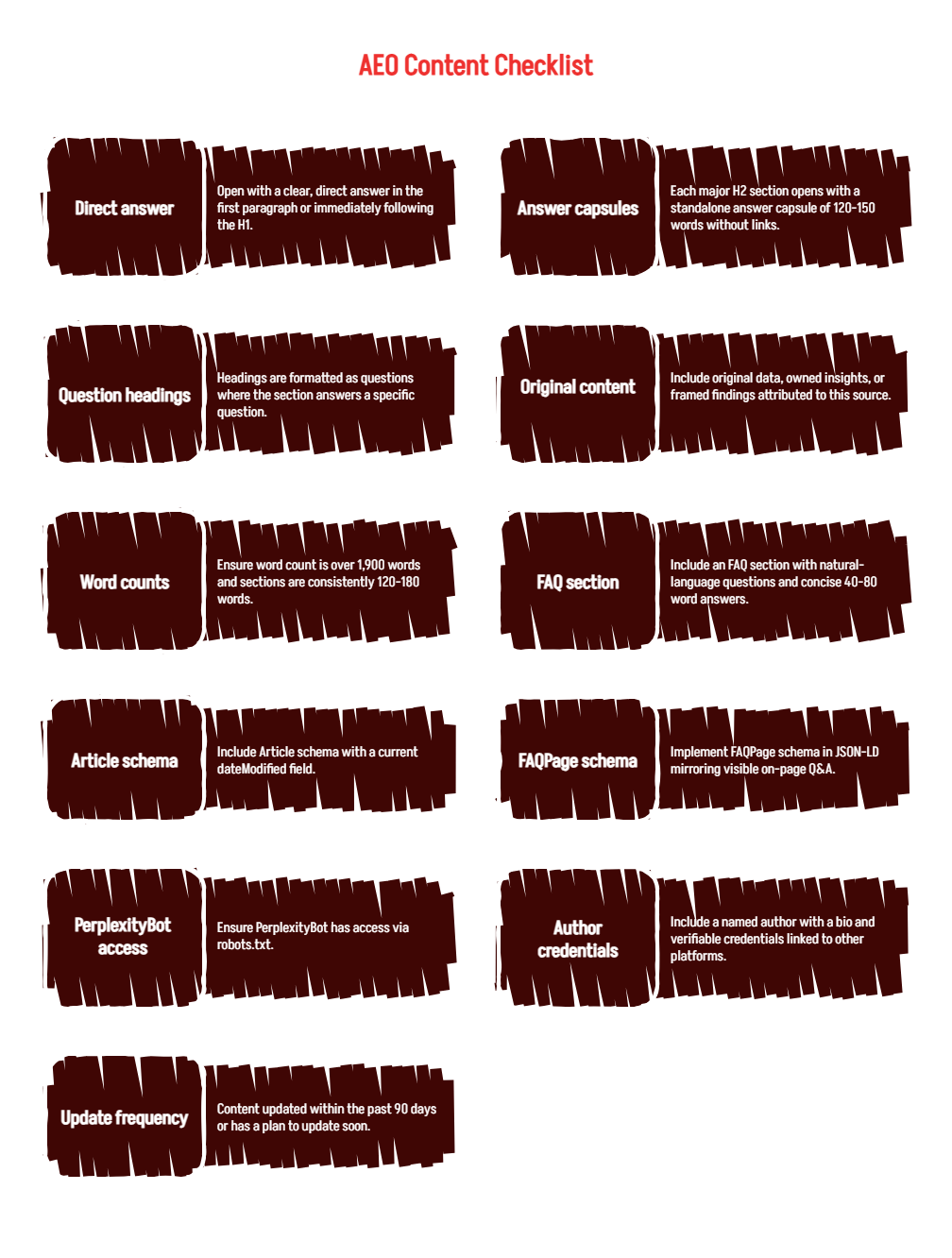
- Does the page open with a clear, direct answer in the first paragraph or immediately following the H1?
- Does each major H2 section open with a standalone answer capsule (120-150 words, no links inside the capsule text)?
- Are headings formatted as questions where the section is answering a specific question?
- Does the content include original data, owned insights, or framed findings that can only be attributed to this source?
- Is the word count over 1,900 words? Are sections consistently 120-180 words?
- Does the page include an FAQ section with natural-language questions and concise answers (40-80 words per answer)?
- Is there Article schema with a current dateModified field?
- Is FAQPage schema implemented in JSON-LD with content that mirrors visible on-page Q&A?
- Does PerplexityBot have access via robots.txt?
- Is there a named author with a bio and verifiable credentials linked to other platforms?
- Has the content been updated within the past 90 days (or is there a plan to update it soon)?
Conclusion: Earning AI Citations Is a System, Not a Checklist
The companies showing up in ChatGPT and Perplexity answers right now aren’t there by accident. They’ve either been doing solid SEO long enough that their domain authority crosses the citation threshold, or they’ve deliberately built AEO into their content production process, or both.
The gap between where most businesses are and where they need to be isn’t technical – it’s structural. It’s writing pages that lead with answers instead of burying them. It’s building community presence instead of only publishing on owned domains. It’s treating content freshness as a maintenance priority, not an afterthought.
The brands investing in this now are building compounding citation equity that gets harder for competitors to displace over time. The brands ignoring it are watching AI Overviews eat their click-through rates while their organic traffic reports look stable. Pew Research Center tracked 900 US adults’ real browsing activity in March 2025 and found that users encountering an AI Overview clicked a traditional search result only 8% of the time, versus 15% without one – a behavioral shift that’s baked in and not reversing.
If you want to build a content and AEO strategy that actually gets your brand cited across AI platforms – not just ranking in Google – that’s exactly what we do at LYNX. Have a look at our case studies or get in touch and we’ll tell you where your biggest citation gaps are.
Frequently Asked Questions
How Do I Get Cited in ChatGPT?
To get cited in ChatGPT, you need a combination of strong domain authority, answer-first content structure, and off-page credibility signals. The most actionable on-page step is adding an answer capsule – a concise, 120-150 word direct response – immediately under each question-format H2 heading. Off-page, building backlinks from authoritative sources, participating genuinely in relevant Reddit communities, and earning third-party editorial coverage all strengthen the authority signals ChatGPT weighs when selecting which pages to cite.
What Makes a Page Appear in AI Search Answers?
Pages that appear in AI search answers typically share these characteristics: they’re hosted on domains with meaningful backlink authority, they structure content with direct answers immediately following question-format headings, they contain original data or clearly attributed expert insights, their content was updated within the past 90 days, and they have a visible FAQ section. The combination of these factors – not any single one – is what pushes a page into AI citation territory.
How Do I Optimize My Content for Conversational AI Search?
Optimizing for conversational AI search means writing content that mirrors how people ask questions, not just how they search keywords. Use full-question headings instead of keyword phrases. Write each section as a self-contained answer to a specific question. Include a robust FAQ section at the bottom of your page. Keep paragraphs short and purposeful. Replace vague marketing language with specific, named, verifiable claims. The average ChatGPT prompt is 23 words long – your content needs to answer at that level of specificity, not at the level of a 3-word keyword.
Why Does ChatGPT Cite Some Pages and Not Others?
ChatGPT cites pages it can extract clean, credible answers from. The primary filters are domain authority (higher-authority domains are cited significantly more often), content structure (answer capsules and question-format headings make extraction easier), freshness (recently updated content outperforms outdated content), and original data (if your content restates a statistic from another source, ChatGPT may cite that source instead of yours). Content depth also plays a role – pages covering a topic across multiple well-structured sections are cited more than thin single-pass content.
What Is AEO and How Is It Different from SEO?
AEO stands for answer engine optimization. Traditional SEO targets ranking positions in a list of search results – success is measured by clicks to your page. AEO targets citation inclusion in AI-generated responses – success is measured by whether your content is quoted as a source in the AI’s answer, regardless of whether the user clicks. Both require high-quality content and domain authority, but AEO specifically requires structured answer formatting, original data, and off-page community presence that traditional SEO doesn’t emphasize as heavily.
How Do I Optimize for Perplexity Citation?
Perplexity citation optimization differs from ChatGPT in two key ways. First, Perplexity weights content freshness far more heavily – it favors content updated within the past 30-90 days, and its continuously updated index means fresh content can appear in citations within days. Second, you need to ensure PerplexityBot is allowed in your robots.txt file. Many sites accidentally block it during broad anti-scraping configurations. Beyond these Perplexity-specific factors, the same fundamentals apply: answer-first structure, topical depth, strong domain authority, and consistent entity information across your web presence.
Does FAQ Schema Help with AI Citations?
FAQ schema has an indirect effect on AI citations rather than a direct one. For Google AI Overviews and Bing Copilot, schema markup is explicitly used and helps AI systems understand your content structure. For ChatGPT and Perplexity, LLMs tokenize JSON-LD as raw text rather than parsing it as structured data, so the schema itself isn’t the trigger. What does help is the visible on-page Q&A content that the schema mirrors – properly formatted question-and-answer sections that each stand alone as a citable unit. The combination of visible FAQ formatting and FAQPage schema gives you the best coverage across all AI platforms.
How Long Should Content Be to Get Cited by AI?
Research shows a clear relationship between content length and AI citation rates. Articles over 2,900 words average 5.1 citations per page; articles under 800 words average 3.2. The minimum practical target is 1,900+ words for pages you want to compete for citations. More important than raw word count is how those words are structured: sections of 120-180 words between headings receive around 70% more citations than pages with very short sections or very long ones. The goal is depth and clarity, not padding.
What Is the Difference Between AEO and GEO?
AEO (answer engine optimization) and GEO (generative engine optimization) are related disciplines that are sometimes used interchangeably. AEO typically refers to on-page content optimization – structuring answers, using question-format headings, building FAQ sections – specifically to get cited in AI-generated responses. GEO tends to refer to the broader system, including technical infrastructure, entity graph building, cross-platform brand consistency, and ensuring AI crawlers can access your content. In practice, the two disciplines overlap significantly, and a complete AI search strategy requires both.