
Quick Answer: Google does not penalize a page for being written with AI. What gets penalized is a named pattern like scaled content abuse or site reputation abuse, which can happen with AI text, human text, or a mix of both. Most pages that “get penalized” in someone’s mind were never actually hit with a manual action or algorithmic demotion. They just failed to rank, which is a different problem with a different fix.
Key Takeaways
- Google does not penalize pages for using AI, but it can penalize spam patterns like scaled content abuse or site reputation abuse.
- A manual action appears in Google Search Console, while algorithmic demotions and poor rankings often require separate SEO diagnosis.
- Google’s AI guidance distinguishes useful AI-assisted content from mass-produced pages created mainly to manipulate search rankings.
- Ahrefs analyzed 600,000 pages and found AI involvement was common in top results, with no meaningful ranking correlation from AI percentage.
- AI-assisted pages should be edited, fact-checked, and strengthened with original data, firsthand experience, clear authorship, and accurate metadata.
- Warning signs include sharp URL spikes, near-duplicate pages, publishing faster than editorial review allows, and traffic that collapses shortly after ranking.
- Get in touch with Lynx SEO to audit your AI content pipeline and see exactly where your site stands before the next core update.
Every few months a new core update rolls through and someone’s traffic drops, and the first theory is always the same: Google must be punishing AI content.
It’s an easy story to believe because AI tools write so much of what gets published now, and a traffic drop after a big update feels personal. But a drop in rankings and an actual policy penalty are not the same event, and mixing them up sends people chasing the wrong fix for months.
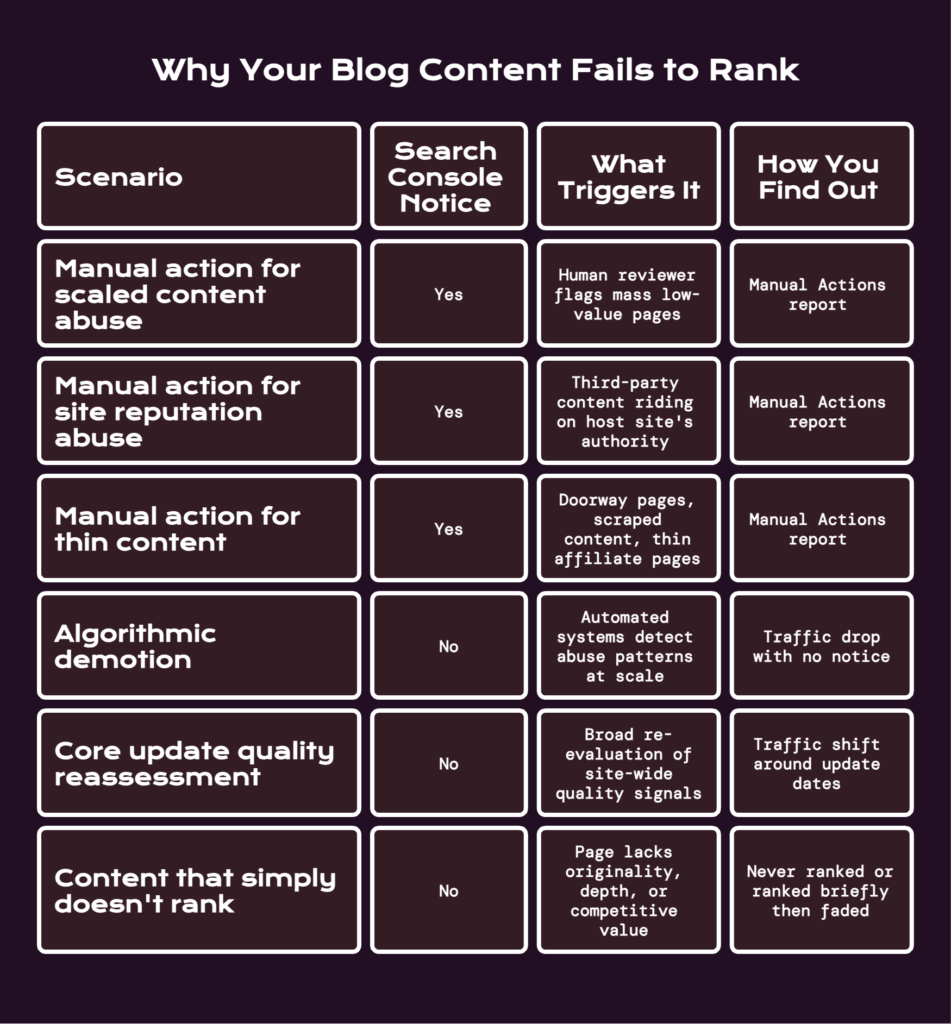
This gets confusing fast because the word “penalty” gets used for almost anything bad that happens to a site’s traffic. A page that never ranked well isn’t penalized, it’s just not competitive. A site that lost rankings during a core update might be experiencing a quality reassessment, not a punishment. A page that got hit with an actual manual action is a completely different situation with its own recovery process.
Sorting out which one you’re dealing with changes everything about how you respond, and that’s where the rest of this article is headed.
What Counts as AI Content in Google’s Eyes
Before getting into penalties, it helps to know what Google is even looking at when it crawls through a page.
The line between “AI content” and “human content” is blurrier than most people assume, since spell-checkers, grammar tools, and outline generators all technically involve automation. Google’s own guidance treats this as a spectrum rather than a yes-or-no switch.
Google’s documentation on generative AI draws a distinction between using AI to research and structure a page versus using it to mass-produce pages with no added value, and only flags the second one as a policy risk.
That means a page drafted by AI, then fact-checked and rewritten by someone with real experience in the topic, sits in a completely different category than a page an AI wrote and nobody looked at again. The tool used to produce the words matters less than what happened to the page after the first draft.
Penalty vs Not Ranking: Why They’re Not the Same Thing
A penalty is a specific, named action Google takes against a site for violating a spam policy. Not ranking is just the absence of a reason to rank, which happens to enormous amounts of content on the internet, regardless of who or what wrote it.
Confusing the two leads people to waste time either disavowing links that never hurt them or, worse, ignoring a real manual action because they assumed it was just “the algorithm being the algorithm.”
What a Manual Action Actually Looks Like
A manual action is the clearest form of penalty because a human reviewer at Google looked at your site and flagged it. Google’s Search Console documentation on manual actions confirms this happens when a person determines that pages on a site don’t comply with the spam policies, and it always shows up as a notification inside Search Console.
If you have never seen that notification, you have never had a manual action, no matter what your traffic chart looks like.
Algorithmic Demotions Explained
Algorithmic demotions are quieter and don’t come with a notification. Google’s spam policy documentation defines scaled content abuse as generating many pages primarily to manipulate rankings, and this can be enforced automatically by systems like SpamBrain without any human ever reviewing the specific site.
The official spam policies page is explicit that this applies “no matter how it’s created,” which means a human-written content farm and an AI-written one face the identical risk.
When Content Simply Fails to Compete
The third and most common category is content that never violated any policy and just isn’t good enough to beat what’s already ranking.
This is where a lot of people panic, because a page not ranking feels like punishment, even when nothing was ever flagged.
Google’s guidance on creating helpful, reliable, people-first content lays out self-assessment questions around originality, depth, and whether the content would be worth bookmarking, which is a quality bar rather than a spam rule.
If you inherited a site with a messy history and you’re not sure which of these situations you’re in, that diagnosis has to come first. We wrote about exactly this scenario in our piece on what to do when you inherit bad website SEO, which walks through how to tell a policy violation apart from a plain quality problem.
What Triggers a Real Penalty From Google
Now that the categories are separated, it’s worth looking at what actually crosses the line into a policy violation. These are named, defined patterns, not vague vibes about content feeling too automated.
Scaled Content Abuse
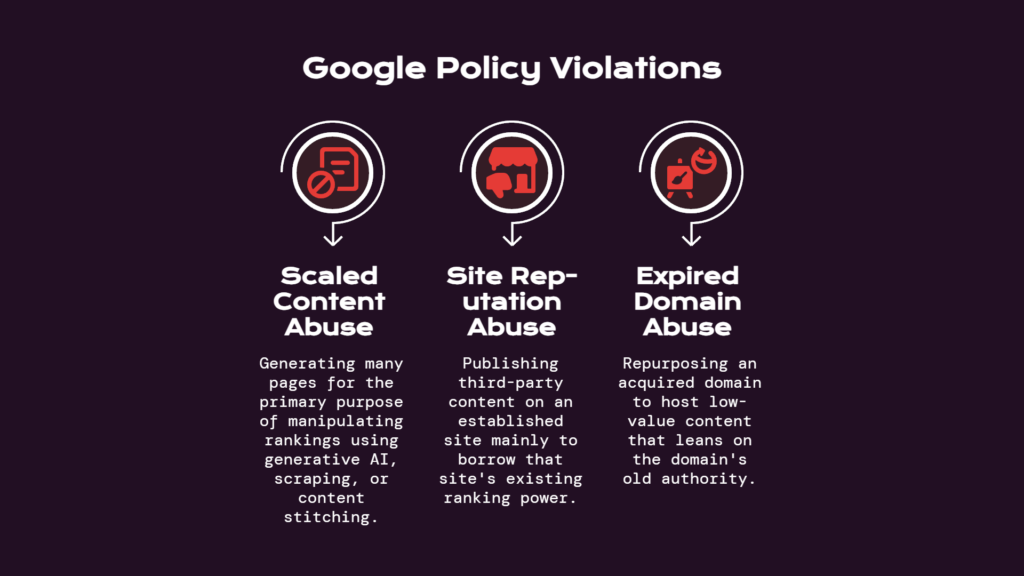
Google’s spam policy defines scaled content abuse as generating many pages for the primary purpose of manipulating rankings, and it names generative AI directly as one method alongside scraping and content stitching.
The keyword in that definition is “primary purpose,” since a large, genuinely useful set of pages built for real search intent is not automatically a violation just because it’s big. A franchise business publishing near-identical location pages with no unique local detail is a textbook example, which is part of why our guide on local SEO for franchises spends so much time on differentiation between locations rather than templated copy.
Site Reputation Abuse and Parasite SEO
Site reputation abuse happens when third-party content gets published on an established site mainly to borrow that site’s existing ranking power, according to Google’s spam policy documentation.
This one rarely involves AI directly, but AI has made it cheaper to produce the volume of third-party content that fuels this tactic.
Expired Domain Abuse
Expired domain abuse is buying a domain that used to serve a real purpose and repurposing it to host low-value content that leans on the domain’s old authority. Google’s documentation gives examples like affiliate content appearing on a domain that used to belong to a government agency. This one is less about AI specifically and more about the intent behind the acquisition, but AI has made it faster to fill an expired domain with hundreds of pages overnight.
There are legitimate ways of redesigning a site like this without losing SEO and this definitely isn’t one of them.
A few warning signs tend to show up together when a site is drifting toward one of these violations rather than just publishing a lot of content:
- A sharp spike in new URLs with no matching increase in unique, substantive information
- Pages that read fine individually but are nearly identical in structure across dozens or hundreds of URLs
- Content published faster than any editor could reasonably review it
- Traffic that spikes on long-tail terms right after publishing, then collapses within weeks
What the Data Says About AI Content and Rankings
Policy definitions are one thing, but actual ranking data is more convincing for anyone still on the fence. Ahrefs ran one of the more rigorous studies on this by pulling the top 20 results for 100,000 keywords and analyzing 600,000 pages with its AI content detector.
How Much AI Content Sits in the Top 10
The Ahrefs study of 600,000 pages found that AI involvement in top-ranking content is now the norm rather than the exception. Here’s what the breakdown looked like:
- 4.6% of top-ranking pages were categorized as pure AI content
- 13.5% were categorized as pure human content
- 81.9% were a mix of both, meaning most winning pages use AI for at least part of the process
- Human-only pages made up such a small share that “AI-free” content is closer to a niche category than a norm
Does the Percentage of AI Text Change Your Ranking
The most useful number in the whole study is the correlation between AI content percentage and ranking position, which came out to 0.011. That’s close enough to zero to say there’s no meaningful relationship in either direction and especially not on the success of your SEO campaign.
The researchers from Ahrefs did note that pages sitting at the very top spot leaned slightly toward less AI content, but the effect was described as very weak, not a rule you could build a strategy around.
If you want to track how your own AI-assisted pages perform against this backdrop, the right move is watching your actual ranking data rather than assuming a percentage of AI usage will predict anything.
How Google Detects Low Quality AI Content
Google isn’t running a simple “is this AI” checker on every page, and that’s a common misunderstanding worth clearing up. What it’s actually built is a system for spotting the patterns that tend to accompany low-effort content, whether a human or a machine produced it.
SpamBrain and Pattern Detection
SpamBrain is Google’s spam-detection system, and it looks at signals like unusual spikes in URL creation, repetitive structure across pages, and content that provides little value relative to what’s already indexed. None of these signals require knowing whether a page was written by AI.
They’re quality and intent signals that happen to catch a lot of unedited AI output because unedited AI output tends to produce exactly those patterns at scale.
Signals That Separate Helpful Pages From Filler
Google’s own self-assessment questions for helpful content ask whether a page provides original analysis, whether it’s the kind of thing someone would bookmark, and whether it demonstrates real firsthand knowledge of the topic.
These questions apply the same way to a page written entirely by a person as they do to one built with AI assistance.
A niche example worth mentioning here: regulated categories like cannabis face extra scrutiny on trust signals, which is why our piece on Canadian cannabis SEO and AI visibility spends extra time on sourcing and disclosure for exactly this reason.
How to Publish AI Content Without Risking a Penalty
None of this means AI content is risk-free to publish without a process. It means the risk comes from the process, not the tool, so building the right workflow is what actually protects you.
Editing and Fact Checking Before Publishing
Every claim, statistic, and specific detail in an AI draft needs a human check before it goes live, because AI models can produce confident-sounding text that’s factually wrong, which reduces the value of your article to a flat zero.
This single step is what separates a page that reads like unedited AI output from one that reads like it was made by someone who knows the subject. There is absolutely zero value of an article with hallucinated data.
Adding Original Data and First Hand Experience
Google’s own “Who, How, Why” framework for evaluating content puts heavy weight on demonstrated firsthand experience, which is something a generic AI draft can’t fabricate convincingly.
Original screenshots, first-party data, client results, or direct testing all give a page something none of the other search results have. This is the ingredient that turns an AI-assisted page into something with actual competitive value instead of a rehash of the top ten results.
Structuring Pages for E-E-A-T
Clear authorship, visible expertise, and transparency about how a piece of content was produced all contribute to the trust signals Google looks for. If you’re planning to scale content production with AI as part of a broader growth plan, mapping out what that scale should look like before you start publishing prevents a lot of cleanup later.
A short checklist to run against any AI-assisted page before it goes live:
- Every statistic or claim has been verified against its original source
- At least one piece of original data, example, or firsthand detail has been added
- The page has been edited by someone who understands the topic, not just proofread for grammar
- The page adds something a reader can’t already get from the top five results for the same query
- Structured data, titles, and metadata accurately reflect what’s actually on the page
Why Lynx SEO Helps You Scale AI Content Without the Risk
Lynx SEO exists for exactly the tension this article has been walking through: the pressure to publish at scale and the fear of getting it wrong. We work inside websites at the technical level, checking site architecture, crawl patterns, and content structure so that automation speeds up production without tripping the patterns Google actually watches for.
That means building editorial review steps into a content pipeline, verifying that pages carry real E-E-A-T signals, and setting up the kind of internal linking and structure that makes a large content set read as genuinely useful rather than mass-produced. We’ve done this across ecommerce, SaaS, finance, legal, and other industries where the margin for error is thin and competitors are already scaling their own content.
If your team is trying to figure out how much AI content is safe to publish and where your current setup stands, that’s a conversation worth having before your next core update lands, not after.
Get in touch with Lynx SEO and we’ll walk through your content pipeline together. There’s no reason to guess when a real audit can tell you exactly where you stand.
Frequently Asked Questions
Does Google Have an AI Content Detector?
Google has not confirmed a public-facing AI content detector used for ranking decisions. Its spam systems, including SpamBrain, look for behavioral patterns like scaled publishing and thin content rather than scanning text for AI fingerprints specifically. Third-party AI detectors exist but are not part of Google’s official ranking process.
Can AI Written Articles Rank on Page One?
Yes. Ahrefs found that 4.6% of pages in the top 20 results were pure AI content, and 86.5% contained some AI involvement. Ranking depends on whether the page satisfies search intent better than competing results, not on whether AI was involved in drafting it.
What Percentage of AI Content Is Safe to Publish?
There is no official percentage threshold from Google, and the Ahrefs correlation data (0.011) suggests percentage alone doesn’t predict ranking outcomes. The safer framing is whether every page, regardless of AI percentage, has been fact-checked and adds something original.
Will Editing AI Content Prevent a Penalty?
Editing reduces risk substantially because it catches factual errors and adds the kind of original insight Google’s helpful content guidance looks for. It does not guarantee immunity if the underlying strategy still involves mass-publishing near-duplicate pages, since that pattern is a policy violation regardless of how well each page reads.
How Long Does a Manual Action Recovery Take?
Google’s Search Console documentation notes that reconsideration reviews typically take several days to a few weeks after fixes are submitted, though link-related cases can take longer. Recovery time also depends on how thoroughly the underlying issue was fixed across all affected pages before requesting review.
Does Google Require AI Content Disclosure?
Google does not require a public disclosure label for AI-assisted content, but its guidance suggests sharing background on how automation was used when readers might reasonably ask. This is treated as a trust-building practice rather than a hard ranking requirement.
Sources Used for This Article
- Google Search Central: “Spam Policies for Google Web Search” – developers.google.com/search/docs/essentials/spam-policies
- Google Search Central: “Google Search’s Guidance on Generative AI Content on Your Website” – developers.google.com/search/docs/fundamentals/using-gen-ai-content
- Google Search Central: “Creating Helpful, Reliable, People-First Content” – developers.google.com/search/docs/fundamentals/creating-helpful-content
- Google Search Console Help: “Manual Actions Report” – support.google.com/webmasters/answer/9044175
- Ahrefs: “AI-Generated Content Does Not Hurt Your Google Rankings (600,000 Pages Analyzed)” – ahrefs.com/blog/ai-generated-content-does-not-hurt-your-google-rankings
