Quick Answer: An AI search visibility audit checks whether your brand actually shows up when people ask ChatGPT, Google AI Overviews, Perplexity, Gemini, and Copilot questions about your category. It measures brand mentions, citation sources, sentiment, and share of voice against competitors, then flags the technical and content gaps holding you back. Run one by building 20-30 real buyer prompts, testing them across every major AI platform, logging who gets cited and why, then repeating the process at least once a quarter.
Somewhere in the last two years, the way people research your business quietly changed. A prospect who used to type your category into Google and scroll ten blue links now asks ChatGPT the same question and gets a paragraph back, with two or three brands named and a handful of sources cited underneath. If your brand isn’t one of them, you don’t get a bad ranking. You get nothing. No impression, no click, no shot at the sale.
I’ve been running SEO campaigns for 15+ years now, going back to when I was a junior making $24k a year in Burlington, learning the trade from guys who’d been doing this since before Google was a household name. I’ve watched a lot of shifts in this industry. This one is different, because for the first time, you can rank #1 on Google for a keyword and still be completely invisible in the answer that actually gets read.
That’s the reason AI search visibility audits exist. It isn’t a rebrand of an SEO audit with a new coat of paint. It’s a genuinely different exercise, because the thing you’re being measured against, a generated answer instead of a results page, behaves nothing like a search index. Below is the exact process we use to audit a brand’s AI visibility at LYNX, the checklist behind it, the tools worth paying for, and the mistakes that make most DIY audits a waste of a Tuesday afternoon.
Key Takeaways
- An AI search visibility audit measures whether ChatGPT, Perplexity, Google AI Overviews, Gemini, and Copilot mention, cite, and accurately represent your brand, not just whether you rank on Google.
- Ranking well on Google does not guarantee AI citation. Ahrefs found that only around 12% of URLs cited by ChatGPT, Perplexity, and Copilot also rank in Google’s top 10 for the same query.
- A proper audit tracks five things at minimum: brand mentions, citation sources, sentiment, AI share of voice against competitors, and technical extractability.
- Research out of Princeton and Georgia Tech found that specific content changes, like adding statistics and citing sources, can lift visibility in AI-generated answers by up to 40%.
- Most brands should run a manual prompt audit first, then layer in a paid AI brand monitoring tool once they know exactly what they’re testing for.
- AI citations churn fast. A one-time audit goes stale within weeks, so a recurring monitoring cadence matters more than the initial snapshot.
- LYNX SEO can audit your AI search visibility, benchmark your brand against competitors, and turn citation, content, and technical gaps into a practical strategy for improving visibility across major AI platforms.
What Is an AI Search Visibility Audit?
An AI search visibility audit is a structured review of how, where, and how accurately your brand shows up inside AI-generated answers, across platforms like ChatGPT, Google AI Overviews, Google AI Mode, Perplexity, Gemini, and Microsoft Copilot.
Instead of tracking a ranking position for a keyword, you’re tracking inclusion: does the model mention your brand at all, does it cite your website as a source, and does it describe you accurately when someone asks a question your buyers would actually type or say out loud.
This is where an AI brand audit and a traditional SEO audit stop looking anything alike. A traditional SEO audit is built around your site: technical health, on-page optimization, backlink profile, keyword rankings.
An AI search visibility audit is built around the answer itself: what the model says about you, where it got that information, and how you stack up against the three or four competitors also fighting for the same sentence.
| Dimension | Traditional SEO Audit | AI Search Visibility Audit |
| What It Measures | Rankings, technical health, backlinks | Brand mentions, citations, sentiment, share of voice |
| Unit Of Success | Position on a results page | Inclusion inside a generated answer |
| Primary Data Source | Search Console, rank trackers | Manual prompt testing, AI visibility platforms |
| Update Frequency | Rankings shift, but slowly | Citations can shift by 40-60% month to month |
| Competitive Lens | Who outranks you | Who gets named or cited instead of you |
Neither one replaces the other. Google’s own guide to optimizing for generative AI features is direct about this: the fundamentals that get you ranked in classic search are still the foundation AI Overviews and AI Mode build on. What’s changed is that ranking well is no longer sufficient on its own. It’s table stakes for a completely different game happening on top of it.
Why AI Search Visibility Matters for Your Brand Right Now
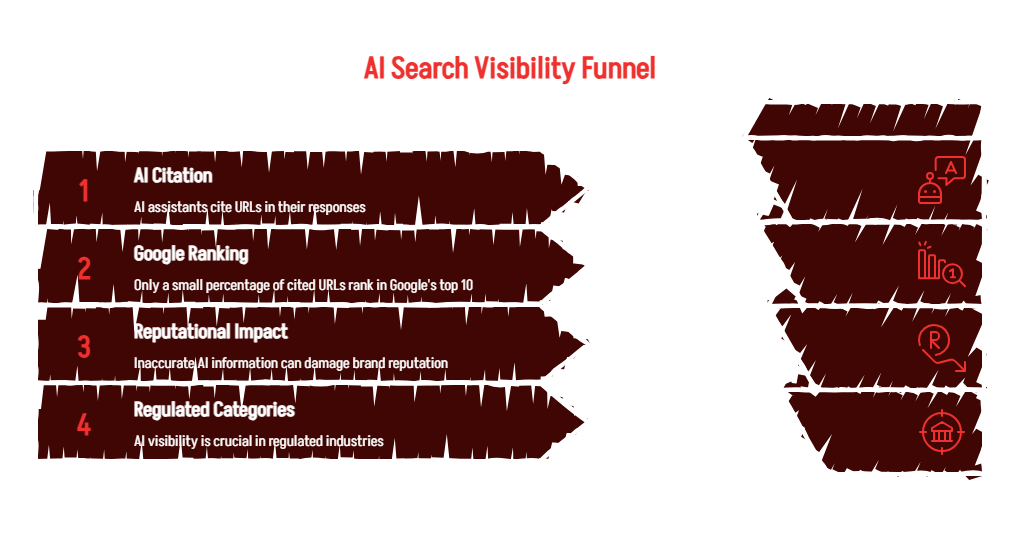
AI platforms now generate the equivalent of 56% of global search engine volume, according to a widely cited Search Engine Land analysis, which puts AI-driven sessions at roughly 45 billion a month worldwide against traditional search engines. That figure gets debated, and it should (methodology on this stuff always is), but the direction isn’t in question. ChatGPT alone has crossed 900 million weekly active users, and a meaningful chunk of that usage is invisible to a marketing team still watching Search Console and calling it a day.
Here’s the part that should actually get your attention: ranking well on Google barely moves the needle on whether AI cites you. Ahrefs ran the numbers across four major AI assistants and found that only about 12% of the URLs cited by ChatGPT, Perplexity, and Copilot also rank in Google’s top 10 for the same query, and 80% of what gets cited doesn’t rank anywhere in Google’s top 100 at all. Two different games, competing for the same buyer’s attention, scored on two completely different scoreboards.
There’s also a reputational angle most teams aren’t watching yet. A Forbes breakdown of AI visibility audit components flags accuracy of brand positioning as its own audit category, and for good reason. If a model is confidently telling prospects wrong things about your pricing, your service area, or what you actually do, that’s happening whether or not you’re watching. An audit is the only way you’d know.
This shows up hardest in regulated or high-restriction categories, where paid channels are limited or off-limits entirely and organic (now including AI) visibility carries more of the weight. We broke down exactly what that looks like for Canadian cannabis brands building AI visibility without Google Ads, and the same logic applies to finance, health, and a handful of other categories where the standard playbook doesn’t fully apply.
The AI Search Visibility Checklist: What to Audit
Before you open a single tool, decide what you’re actually checking for. Most audits fail here, not because the person running it did anything wrong technically, but because they never defined “visibility” beyond “does our name come up.” That’s one input out of several.
| Audit Area | What You’re Checking |
| Brand Presence | Does your brand appear at all across category, comparison, and problem-based prompts? |
| Citation Sources | Which pages or domains get cited when your brand comes up: yours, a competitor’s, a review site, a Reddit thread? |
| Accuracy | Is what the AI says about your pricing, positioning, and offerings actually correct? |
| Sentiment | When you’re named, is the tone positive, neutral, or negative, and where does the negative tone come from? |
| AI Share Of Voice | Out of every relevant answer in your category, what percentage mention you versus your competitors? |
| Technical Extractability | Can AI crawlers like GPTBot, PerplexityBot, ClaudeBot, and Google-Extended actually reach and parse your site? |
| Entity Consistency | Is your brand name, description, and positioning identical across your site, directories, and any press coverage? |
Every one of these rows becomes its own step in the process below.
How to Audit Your Brand’s AI Search Visibility, Step by Step
This is close to the exact sequence we run for clients before we touch a single page of content. It works whether you’re doing this in-house with a spreadsheet or feeding it into a paid platform later.
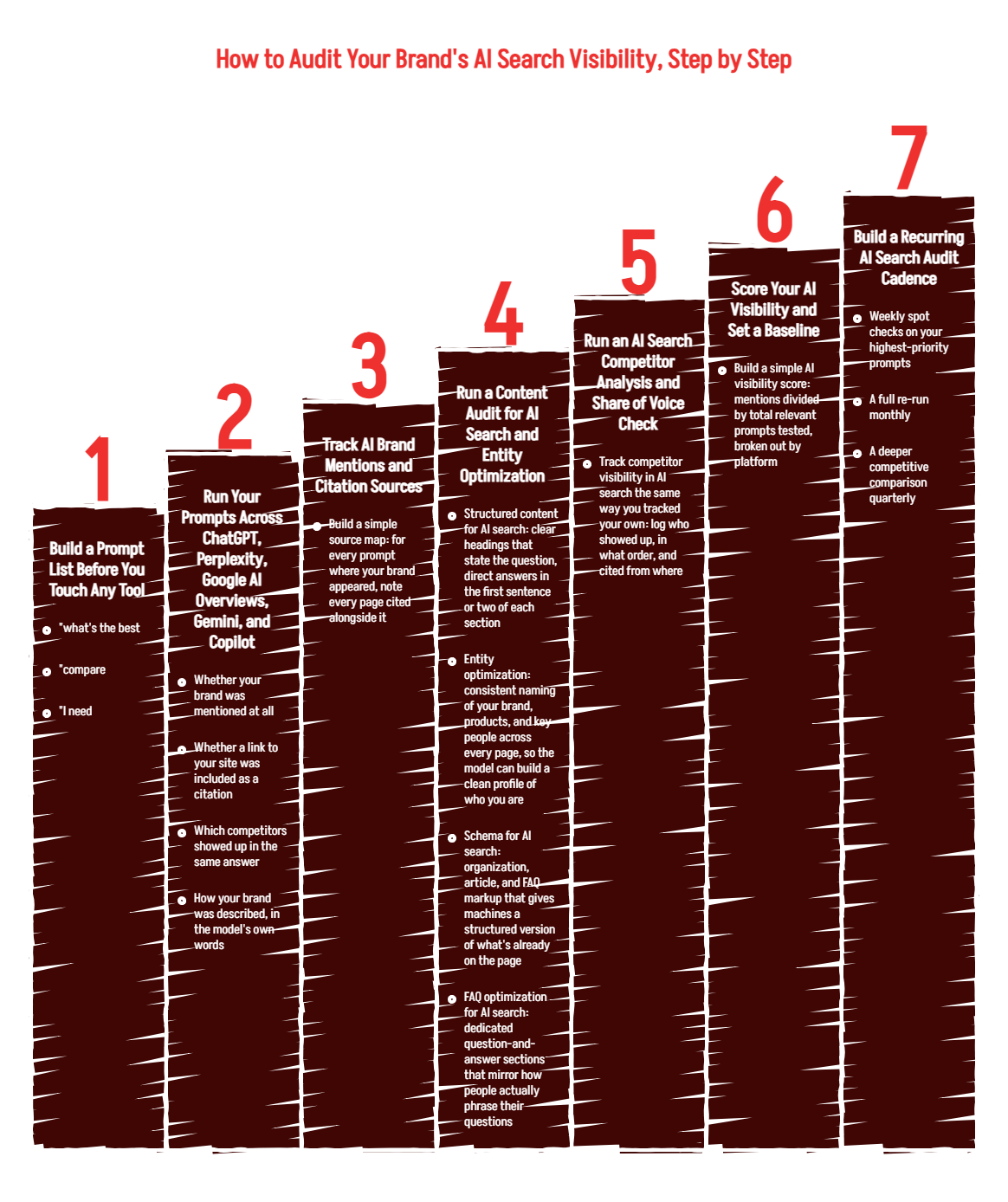
Step 1: Build a Prompt List Before You Touch Any Tool
Skipping this step is the single most common reason DIY audits produce useless data. Your prompt list should mirror how a real buyer researches your category before they know your brand name exists, not a list of your own target keywords with a question mark stapled on.
Build three types of prompts:
- Category prompts: “what’s the best [category] for [use case]”
- Comparison prompts: “compare [competitor A] and [competitor B] for [use case]”
- Problem prompts: “I need [outcome], what should I look at”
Aim for 20 to 30 prompts minimum. Pull the language from your own sales calls, support tickets, and reviews rather than guessing at how people phrase things. If you’ve ever inherited a brand’s marketing with no real documentation of how customers actually talk about the problem you solve, this step alone tends to surface it fast. We’ve walked through what that looks like more broadly in our piece on what to do after you’ve inherited a website with SEO problems, and the same diagnostic mindset applies here.
Step 2: Run Your Prompts Across ChatGPT, Perplexity, Google AI Overviews, Gemini, and Copilot
Run every prompt on every major platform and record what comes back. Don’t skip the ones you assume don’t matter. ChatGPT visibility tracking gets most of the attention because it has the largest user base, but Perplexity visibility tracking matters just as much for anything comparison-heavy, since Perplexity was built to cite sources on nearly every claim. Google AI Overviews tracking deserves its own line item too, because AI Overviews and classic Google rankings behave as semi-independent systems that don’t always move together.
For each platform, log:
- Whether your brand was mentioned at all
- Whether a link to your site was included as a citation
- Which competitors showed up in the same answer
- How your brand was described, in the model’s own words
Tools like Otterly.ai and Peec AI exist specifically to automate this step at scale once you’ve validated the manual process works. More on that in the tools section below.
Step 3: Track AI Brand Mentions and Citation Sources
This is where most of the actual insight lives. AI citation tracking isn’t just about whether you showed up, it’s about where the model pulled its information from. If competitors’ pages, review sites, or forum threads are consistently getting cited instead of your own domain, that tells you exactly where to focus content and outreach.
Build a simple source map: for every prompt where your brand appeared, note every page cited alongside it. Over enough prompts, patterns show up fast. Maybe G2 and Capterra are doing most of the work for your category. Maybe a five-year-old comparison post on a competitor’s blog keeps getting pulled because nothing newer has replaced it. That’s an actionable gap, not just a data point.
Step 4: Run a Content Audit for AI Search and Entity Optimization
A content audit for AI search asks a narrower question than a typical content audit: can a model extract a clean, citable answer from this page in a couple of sentences? Dense, well-written content that buries the actual answer under three paragraphs of preamble gets skipped over even when it’s technically accurate and well-researched.
Check for:
- Structured content for AI search: clear headings that state the question, direct answers in the first sentence or two of each section
- Entity optimization: consistent naming of your brand, products, and key people across every page, so the model can build a clean profile of who you are
- Schema for AI search: organization, article, and FAQ markup that gives machines a structured version of what’s already on the page
- FAQ optimization for AI search: dedicated question-and-answer sections that mirror how people actually phrase their questions
If you’re producing a lot of this content with AI assistance already, it’s worth reading our breakdown on how to add real value to AI-assisted blog content, since thin, derivative content is exactly the kind of thing models skip over regardless of how well it’s structured.
One more thing worth checking here: if you’ve redesigned your site recently, or you’re planning to, confirm the new build didn’t quietly break the technical access AI crawlers need. We cover this in more depth in how to redesign a website without losing SEO, and the same warning applies to AI crawlability, not just Google rankings.
Step 5: Run an AI Search Competitor Analysis and Share of Voice Check
An AI search competitor analysis answers a specific question: out of every relevant prompt in your category, what percentage names you instead of, or alongside, your competitors? That’s your AI share of voice, and it’s a far more useful number than “are we mentioned” in isolation, because a single mention against zero competitors named tells you something different than a single mention buried under four names ahead of yours.
Track competitor visibility in AI search the same way you tracked your own: log who showed up, in what order, and cited from where. If one competitor dominates a specific prompt category (say, every “best [category] for enterprise” prompt), that’s a signal about where their content and third-party coverage is stronger than yours, not a reason to panic about your overall standing.
Step 6: Score Your AI Visibility and Set a Baseline
Once you’ve run enough prompts across enough platforms, build a simple AI visibility score: mentions divided by total relevant prompts tested, broken out by platform. This becomes your baseline. Don’t worry about matching the exact scoring methodology of any particular paid platform. Ahrefs Brand Radar, Semrush’s AI Toolkit, and dedicated players like Profound all calculate this slightly differently, and none of these scores are standardized across tools. Pick one method, stay consistent with it, and track the trend rather than chasing an absolute number.
Step 7: Build a Recurring AI Search Audit Cadence
A single audit gives you a snapshot of a system that changes weekly. Citation sources for AI Overviews and ChatGPT alike can shift by 40% to 60% month over month depending on the platform, which means the brand that ran one audit in January and called it done has no idea what’s actually happening in July. Set a cadence: weekly spot checks on your highest-priority prompts, a full re-run monthly, and a deeper competitive comparison quarterly.
AI Search Visibility Tools Worth Paying For
Once the manual process above has told you what you’re actually looking for, a dedicated tool saves a genuinely absurd amount of time. Here’s where the category stands right now, though pricing on all of these moves fast enough that you should treat the numbers below as a starting point for research, not a final quote.
| Tool | Best For | Starting Price | Platforms Tracked |
| Otterly.ai | Small teams and freelancers wanting an affordable entry point | ~$29/month | ChatGPT, Google AI Overviews, Perplexity, Copilot |
| Peec AI | Agencies and mid-market teams needing multi-market tracking | ~€85-89/month | ChatGPT, Perplexity, Gemini, Google AI Overviews |
| Ahrefs Brand Radar | Teams already living inside Ahrefs for traditional SEO | ~$199/month per platform index | ChatGPT, Perplexity, Gemini, Google AI Overviews, Copilot |
| Semrush AI Toolkit | Semrush users wanting AI visibility bundled with existing SEO tracking | ~$199+/month (bundled) | ChatGPT, Perplexity, Google AI Overviews, Gemini |
| Profound | Enterprise teams needing the deepest citation database and API access | ~$99/month entry (limited), enterprise pricing above that | ChatGPT, Perplexity, Google AI Overviews, Gemini, Copilot, Claude, and more |
A quick gut check before you buy any of these: a monitoring tool tells you where the gaps are. It doesn’t close them. If nobody on your team is going to act on the citation gaps a tool surfaces, you’re paying for a dashboard, not an outcome.
Common Mistakes That Sink an AI Visibility Audit
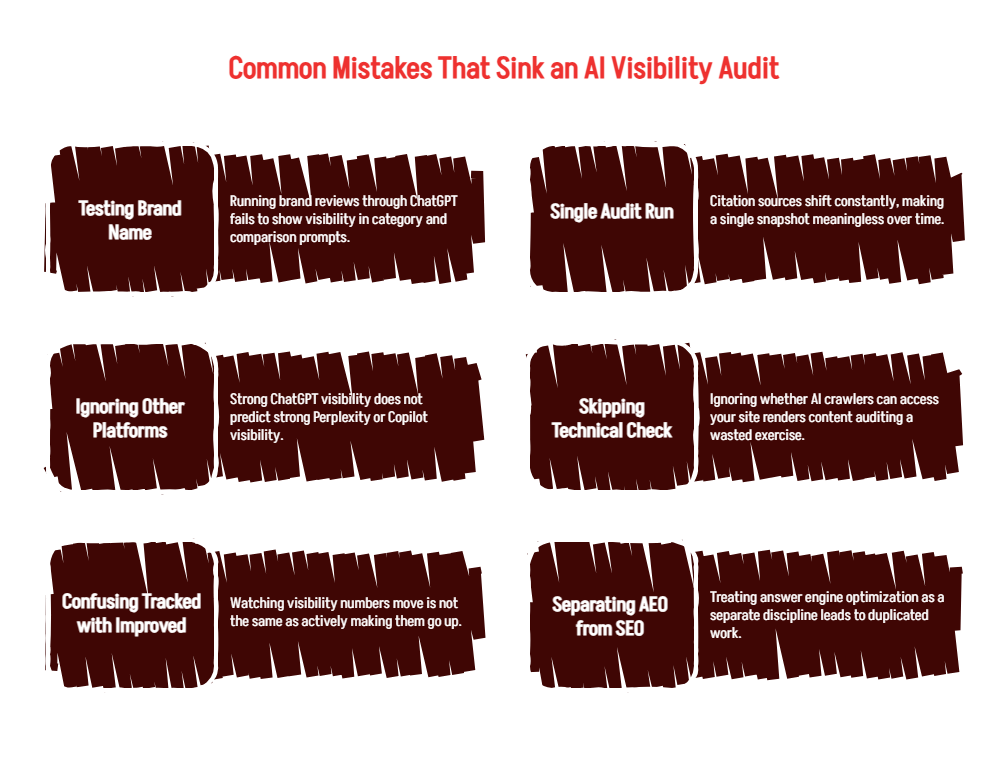
- Testing Only Your Brand Name: running “[Brand] reviews” through ChatGPT tells you almost nothing about whether you show up in the category and comparison prompts that actually drive new business.
- Running the Audit Once and Calling It Done: citation sources shift constantly, so a January snapshot is close to meaningless by July.
- Ignoring Perplexity and Copilot: each platform pulls from a different retrieval system, so strong ChatGPT visibility doesn’t predict strong Perplexity or Copilot visibility.
- Skipping the Technical Check: auditing content while ignoring whether AI crawlers can actually access your site is a wasted exercise. Robots.txt blocks and heavy JavaScript rendering can quietly wall you off entirely.
- Confusing Tracked with Improved: watching a visibility number move up and down in a dashboard isn’t the same thing as making it go up. Someone has to turn the gap into a content brief, a citation outreach list, or a technical fix.
- Treating AEO as a Separate Discipline from SEO: answer engine optimization and generative engine optimization sit on top of the same technical and content foundation as traditional SEO. Teams that treat them as an entirely new department tend to duplicate work that already exists.
How an AI Search Audit Fits Your Broader SEO and AEO Strategy
AI search optimization isn’t a replacement for SEO, and it isn’t really a separate strategy either. It’s a new layer of measurement sitting on top of work you’re likely already doing, or should be. The same technical health, content depth, and third-party authority that earn you rankings are the raw material AI models draw from when deciding what to cite.
That’s part of why we’ve started folding AI visibility checks directly into standard SEO reporting. If you want the fuller picture of what a complete SEO reporting cadence looks like, including where AI visibility fits alongside the metrics that actually connect to revenue, our guide on how to measure the success of an SEO campaign covers the full picture.
Worth noting too: this isn’t just theory. Academic research backs the idea that specific, testable content changes move the needle. The original Princeton and Georgia Tech GEO study tested nine optimization tactics across 10,000 real queries and found that techniques like adding statistics, citing sources, and including direct quotations improved visibility in generative engine answers by as much as 40%, with the effect varying meaningfully by industry.
It’s one of the few pieces of peer-reviewed research in a space that otherwise runs almost entirely on vendor blog posts and anecdote, which is exactly why it’s worth reading if you want to understand the mechanics rather than just the marketing language around them.
Marketer behavior is starting to catch up with the data too. A 2026 survey from Search Engine Land and Fractl found that over half of marketers now list GEO and AEO work among their top priorities for maintaining visibility, right alongside earned authority and expert content, both of which happen to be exactly what an AI visibility audit is designed to measure in the first place.
Conclusion
An AI search visibility audit isn’t a one-time box to check. It’s a recurring diagnostic that tells you whether the brand a model describes to your prospects actually matches the one you’re running. Most companies still don’t know the answer to that question, which means the ones who go find out first get a real head start on everyone still assuming their Google rankings have them covered.
If you’d rather have someone run this audit properly, benchmark it against your real competitors, and turn the gaps into an actual plan instead of a spreadsheet full of prompts, this is exactly the kind of work we do at LYNX SEO. Get in touch if you want a second opinion on where your brand actually stands.
Frequently Asked Questions
What Is AI Search Visibility?
AI search visibility is how often, how accurately, and how favorably your brand appears in the answers generated by AI platforms like ChatGPT, Google AI Overviews, Perplexity, Gemini, and Microsoft Copilot. It’s distinct from traditional search visibility because it measures inclusion inside a generated response rather than a position on a results page.
How Do You Audit AI Search Visibility?
Build a list of 20 to 30 real buyer prompts covering category, comparison, and problem-based questions. Run them across every major AI platform, log whether your brand is mentioned, cited, and accurately described, then compare the results against your top competitors. Repeat the process on a recurring cadence, since citation sources change frequently.
Why Does AI Search Visibility Matter?
Because a growing share of research and buying decisions now happen inside AI-generated answers instead of on a search results page. If your brand doesn’t appear in that answer, you don’t lose a ranking position, you lose the impression entirely. Ranking well on Google doesn’t guarantee AI citation either, so ignoring this layer means flying blind on a channel that’s already influencing your pipeline.
How Do You Measure Brand Visibility in AI Search?
Measure it across five dimensions: how often your brand is mentioned, which sources get cited alongside those mentions, how accurately you’re described, the sentiment of that description, and your AI share of voice compared to named competitors. Most teams start with manual prompt testing, then add a dedicated tracking tool once they know what they’re looking for.
How Do You Track AI Brand Mentions?
Manually, by running a consistent prompt list across ChatGPT, Perplexity, Google AI Overviews, Gemini, and Copilot on a set schedule and logging the results, or with a dedicated platform like Otterly.ai, Peec AI, Ahrefs Brand Radar, or Profound that automates prompt testing at scale and tracks changes over time.
How Do You Improve AI Search Visibility?
Start with the content AI models already have access to: make sure it directly answers real questions in the first sentence or two of each section, back claims with specific data and cited sources, and keep your brand entity consistent across your site and every third-party listing. Then work on earning mentions in the kind of third-party publications and review sites that AI systems already treat as trustworthy, since owned-site content alone rarely carries the same citation weight.
What Is the Difference Between SEO and AI Search Visibility?
Traditional SEO measures your position on a search results page using rankings, technical health, and backlinks as the core signals. AI search visibility measures whether you’re included and accurately represented inside a generated answer, which draws on a different retrieval process and doesn’t correlate closely with Google rankings. The two disciplines share a technical and content foundation, but they’re scored on entirely different systems.
What Tools Track AI Search Visibility?
Otterly.ai and Peec AI are common starting points for smaller teams and agencies. Ahrefs Brand Radar and Semrush’s AI Toolkit suit teams already using those platforms for traditional SEO. Profound sits at the enterprise end with the deepest citation database and API access. Pricing and platform coverage change often enough that it’s worth checking current specs before committing to any of them.
How Do AI Search Engines Choose Sources?
Most AI platforms use a retrieval process, often described as query fan-out, where the model generates several related sub-queries around the original question and pulls candidate sources for each one. From there, factors like content clarity, factual density, freshness, and domain authority influence which sources actually get cited in the final answer. Google has confirmed AI Overviews and AI Mode use this fan-out technique directly in its own documentation on the topic.
How Often Should You Audit AI Search Visibility?
Run a full audit at least quarterly, with lighter spot checks on your highest-priority prompts weekly or biweekly. Citation sources for major platforms can shift by 40% to 60% month over month, which means a single annual audit is already out of date within weeks of running it.
Sources
- Google Search Central: Guide to optimizing for generative AI features
- Google Search Central: AI features and your website
- Ahrefs: AI search overlap and citation study
- Ahrefs: How to audit your brand’s AI visibility
- Princeton University: GEO – Generative Engine Optimization
- Search Engine Land: AI assistants now equal 56% of global search engine volume
- Forbes: How to audit your brand’s AI visibility
- Search Engine Land: AI search adoption rises as consumer trust declines
