
Quick Answer: You rank for AI snippets by earning citation inside Google AI Overviews and AI Mode, not by adding special markup. For ecommerce, that means indexable product and category pages, complete Product structured data, a clean Merchant Center feed, and original content that answers buying questions directly. Google has confirmed there is no separate schema or file that makes a page eligible.
“AI snippets” is not a term Google uses, but it is what a lot of ecommerce marketers type when they mean AI Overviews, AI Mode, or the featured snippet that used to sit in the same spot. The distinction matters, because the three surfaces pull from different places and reward different work.
The uncomfortable part is that most of the advice circulating right now is invented. There is no AI schema. There is no llms.txt requirement. Google’s own documentation states plainly that no special structured data or machine-readable file is needed to appear in AI Overviews or AI Mode, only that a page be indexed and eligible to show with a snippet. Every vendor selling you a shortcut is selling you something Google says does not exist.
What does move the needle for online stores is less exciting and more work: product data completeness, page structure that survives extraction, entity clarity across your catalog, and enough independent corroboration that Google’s models treat your brand as a safe thing to recommend. We run this for retail and ecommerce clients, and the pattern is consistent. The stores that get cited are the ones whose product data is unambiguous and whose content says something a spec sheet cannot.
This guide covers what actually earns AI search visibility for ecommerce, in the order we would build it.
Key Takeaways
- Google requires no special markup, file, or schema for AI Overviews and AI Mode eligibility; a page only needs to be indexed and eligible to appear with a snippet.
- Shopping and transactional queries trigger AI Overviews far less often than informational ones, which means an ecommerce AI SEO strategy should target the research questions surrounding a purchase rather than the purchase query itself.
- Being cited inside an AI Overview is measurably better than being omitted from one, with Seer Interactive finding that cited brands earn 35% higher organic click-through rates than uncited brands on the same queries.
- Product structured data, including merchant listing properties and ProductGroup variant markup, is what makes ecommerce pages eligible for the shopping experiences that feed Google’s AI results.
- Google Merchant Center feed quality now functions as a ranking asset in its own right, because the Shopping Graph behind AI Mode holds more than 50 billion listings and refreshes over 2 billion of them every hour.
- If you want a team that builds this into your store rather than handing you a checklist, LYNX SEO builds ecommerce organic growth systems designed for AI search.
What Are AI Snippets, AI Overviews, and AI Mode?
Three different things get called AI snippets, and conflating them produces bad strategy.
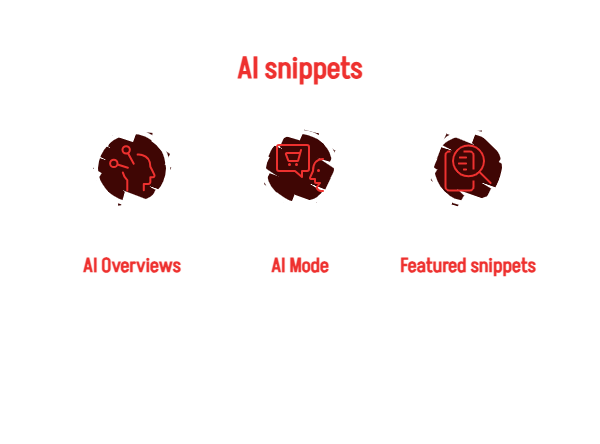
- AI Overviews are the generated summaries that appear above organic results on many queries, with citation links to supporting sources.
- AI Mode is the conversational search experience, where Google breaks a query into subtopics, runs parallel searches, and returns a synthesized answer with product panels for shopping intent.
- Featured snippets are the older extraction-based box that pulls a paragraph, list, or table verbatim from a single ranking page.
Pew Research’s browsing study of nearly 69,000 Google searches found that 88% of AI summaries cited three or more sources, with a median summary length of 67 words. That is the shape of the target: short, synthesized, multi-source.
A featured snippet rewards being the single best-formatted answer on the page that ranks first, while an AI Overview rewards being one of several sources whose claims agree with each other. Those are different games. The first is a formatting exercise. The second is a corroboration exercise.
Do AI Overviews Even Appear on Ecommerce Queries?
Less often than the panic suggests, and that is strategically useful.
Semrush’s study of more than 10 million keywords found that Shopping was among the industries with the lowest AI Overview presence, appearing on under 3% of tracked keywords in that category, alongside Real Estate and Arts & Entertainment. Google appears to be withholding generated summaries where users need prices, reviews, images, and buy buttons rather than a paragraph of synthesis.
The exposure sits one step earlier in the funnel. “Best merino base layer for skiing” triggers an AI Overview. “Buy Icebreaker 200 Oasis crew” does not. Your product pages are relatively protected; your buying guides, comparison content, and category-level research pages are not.
| Query Type | Example | AI Overview Likelihood | What Wins Visibility |
| Transactional / branded | “buy [product name] size medium” | Low | Product schema, Merchant Center feed, classic rankings |
| Category commercial | “best trail running shoes for wide feet” | High | Buying guides, comparison tables, third-party corroboration |
| Product research | “is merino wool warmer than synthetic” | High | Answer-first informational content, original testing |
| Post-purchase support | “how to wash merino base layers” | High | Clear how-to content on your own domain |
| Conversational / AI Mode | “warm base layer under $80 that ships this week” | Growing | Feed freshness, attribute completeness, structured data |
Ecommerce brands lose AI search visibility at the research stage and then blame the product page, which is why so many AI SEO audits start in the wrong place.
How to Rank in Google AI Overviews: What Google Says
Start with the primary source rather than the speculation.
Google’s guide to optimizing for generative AI features states that generative experiences are rooted in core Search ranking and quality systems, so existing SEO fundamentals continue to apply.
The accompanying Search Central post adds four things ecommerce teams routinely get wrong: keep crawling permitted at the CDN and robots level, make sure structured data matches the visible content on the page, support text with high quality images and video for multimodal search, and keep Merchant Center and Business Profile information current.
Google also warns against third-party tools claiming access to internal ranking or AI systems. No such access exists. Treat any product promising guaranteed AI Overview placement accordingly.
The eligibility baseline is narrow:
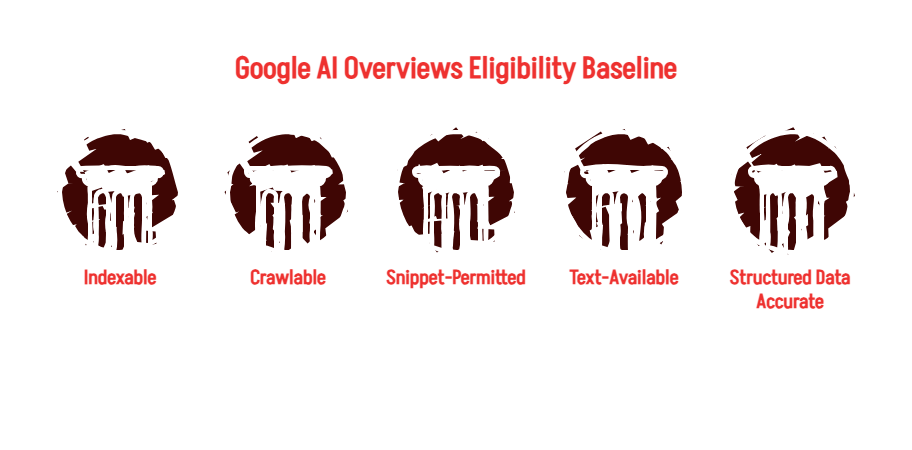
- Indexable: The page must be indexed and eligible to appear in Search with a snippet.
- Crawlable: Blocked crawling at the CDN, WAF, or robots.txt layer removes eligibility regardless of content quality.
- Snippet-Permitted: Restrictive nosnippet or max-snippet directives limit how your content can be featured.
- Text-Available: Content rendered only in images, or gated behind interaction, cannot be extracted.
- Structured Data Accurate: Markup must reflect what a user sees, or it becomes a liability rather than an asset.
The single most common cause of missing AI search visibility we find in ecommerce audits is not content quality, it is a crawl or rendering issue that quietly removed eligibility months earlier.
How to Optimize Product Pages for AI Search
Product pages fail AI extraction for a boring reason: they contain almost no unique text. A manufacturer description, a size chart, and a review widget is not something a generative system can cite, because ten other retailers have the identical paragraph.
What makes an AI-friendly product page:
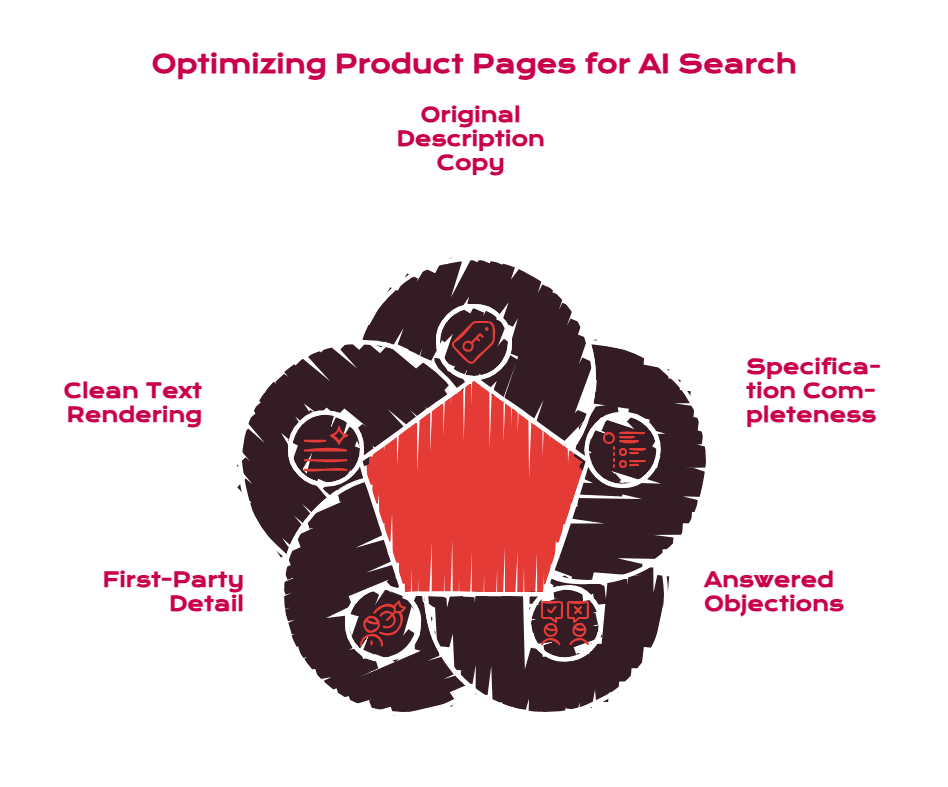
- Original Description Copy: Rewrite supplier text. Duplicated manufacturer descriptions give a model no reason to prefer you as a source, and they give Google no reason to treat your page as the canonical version of that product information.
- Specification Completeness: Materials, dimensions, weight, care, compatibility, country of origin. AI Mode queries are long and constraint-heavy, and a missing attribute is a filter you silently fail.
- Answered Objections On-Page: Sizing guidance, durability expectations, what it does not do. This is the content that gets pulled into comparison summaries.
- Real First-Party Detail: Testing notes, fit feedback patterns from your own reviews, usage guidance from your team. Non-commodity information is the only thing on a product page that a competitor cannot copy in an afternoon.
- Clean Text Rendering: If your key specs live inside a tabbed component that requires a click to render, assume they are invisible.
Platform matters here too. We cover the store-specific failure points in our breakdown of why Shopify stores struggle to show up in AI Overviews, most of which come down to template-level duplication rather than anything a merchant did wrong.
Product Schema for AI Search: Ecommerce Structured Data Done Properly
Structured data does not directly cause AI Overview citation. It does make your pages eligible for the shopping experiences that AI surfaces draw on, and it removes ambiguity about what you sell.
Google’s Product structured data documentation splits markup into two classes: product snippets for pages where a product cannot be purchased directly, and merchant listings for pages where customers can buy. Merchant listing markup carries the properties that matter commercially, including price, availability, shipping, and returns, and adding those required properties generally makes a page eligible for both feature sets.
The ecommerce markup stack worth implementing:
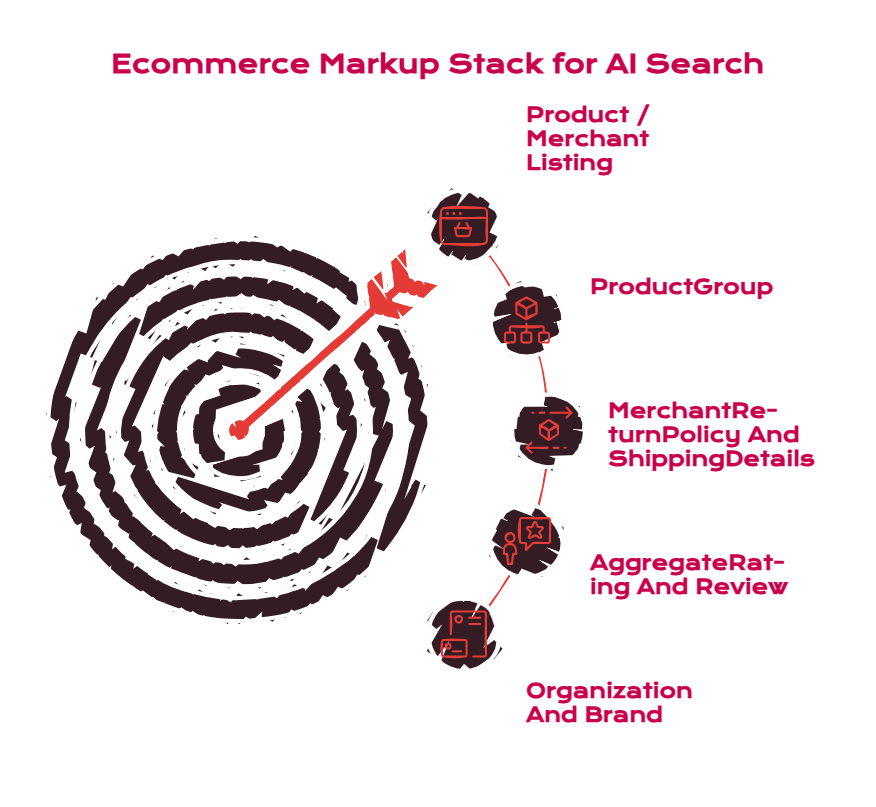
- Product / Merchant Listing: Name, image, description, brand, SKU, GTIN, offers with price, priceCurrency, and availability on every purchasable page.
- ProductGroup: Google’s product variant documentation specifies variesBy, hasVariant, and productGroupID to group sizes, colors, and materials under a parent product rather than presenting them as unrelated items.
- MerchantReturnPolicy And ShippingDetails: Nested under Organization for site-wide policies, or under Offer where a product differs.
- AggregateRating And Review: Only where real reviews exist and are visible on the page.
- Organization And Brand: The entity layer that connects your catalog to your brand across Google’s systems.
- BreadcrumbList: Cheap, and it clarifies category hierarchy for both crawlers and models.
Structured data that disagrees with the visible page is worse than no structured data at all, because it converts a neutral signal into a trust problem. Validate with the Rich Results Test and watch the Merchant listings and Product snippets reports in Search Console, not just your plugin’s dashboard.
Google Merchant Center Optimization and Product Feed Optimization
For AI Mode shopping, your feed does work your category pages used to do.
Google’s Shopping Graph, which powers the product panels inside AI Mode, holds more than 50 billion product listings, with over 2 billion of them refreshed every hour. A nightly feed in that environment means you are publishing stale prices and availability for most of the day, and stale data is how products get filtered out of conversational results that specify budget, stock, or delivery timing.
Feed priorities for AI search visibility:
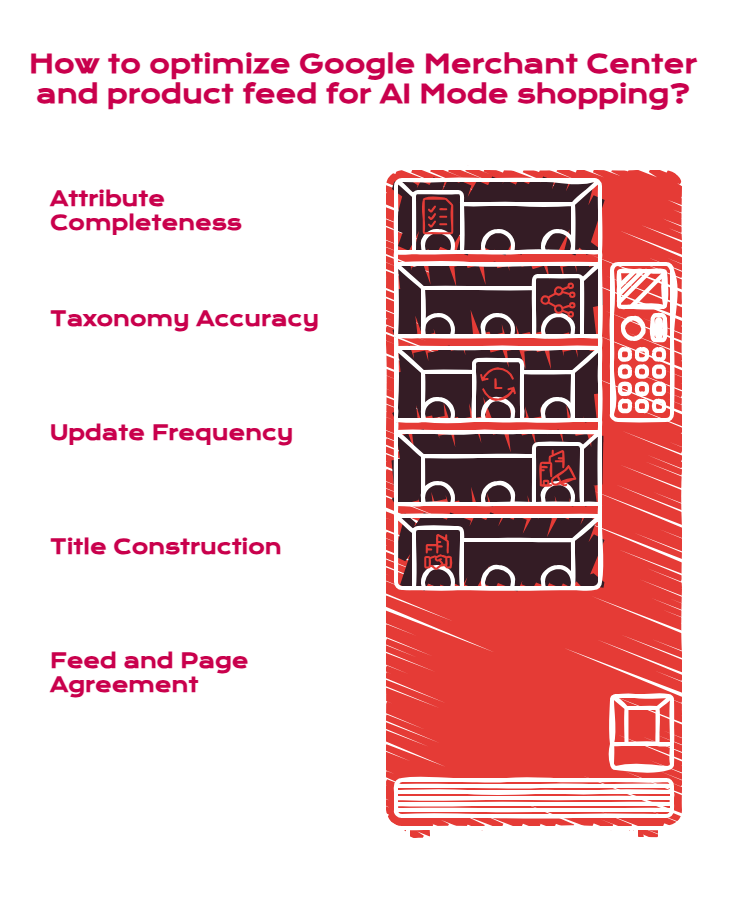
- Attribute Completeness: GTIN, brand, condition, color, size, material, gender, and age group. Optional attributes are only optional until a shopper’s query filters on one.
- Taxonomy Accuracy: Use Google’s product category taxonomy precisely rather than approximating. Miscategorization removes you from consideration sets you should win.
- Update Frequency: Move from scheduled fetches to Content API pushes for anything with intra-day price or stock movement.
- Title Construction: Front-load the attributes a shopper would actually say. Brand, product type, then the differentiating attribute beats a keyword-stuffed string.
- Feed And Page Agreement: Price, availability, and shipping in the feed must match the product page and its structured data. Disagreement across those three is one of the fastest ways to lose eligibility.
AI Overview Content Optimization: Answer-First Content for Ecommerce
This is where most stores have the largest gap, because ecommerce content programs were built for keyword rankings rather than extractable answers.
The format that gets cited is consistent: a question-shaped heading, a direct two-to-three sentence answer immediately beneath it, then the supporting detail. Burying the answer in paragraph four is how well-researched content loses to a thinner competitor that led with the conclusion.
| Page Type | Primary AI Target | Format That Earns Citation | Common Mistake |
| Buying guide | AI Overviews on “best [product]” | Comparison table, explicit “best for” labels, criteria stated up front | Affiliate-style listicle with no original testing |
| Category page | AI Mode product panels | Short intro answering the category question, then filtered products | Zero unique text above the grid |
| Product page | Product panels, comparison summaries | Complete specs, objections answered, original description | Manufacturer copy verbatim |
| Support content | AI Overviews on how-to queries | Numbered steps, one action per step | Steps split across multiple thin pages |
| Comparison page | AI Overviews on “X vs Y” | Table with explicit verdict, both options treated fairly | Obvious bias toward the product you stock |
Entity consistency matters more than keyword density. Use the same product names, category names, and attribute terminology across your feed, your schema, your category pages, and your content. Models resolve entities by corroboration, so a store that calls the same item three different names across three surfaces is competing against itself.
Most in-house ecommerce teams can build one or two of these page types properly before the calendar swallows them, which is usually the point where outside execution starts paying for itself.
Featured Snippet Optimization Still Matters for Ecommerce
Position zero did not disappear. On queries where Google withholds an AI Overview, and there are many of those in shopping, the featured snippet is still the top slot.
The optimization is mechanical. Paragraph snippets reward a 40 to 60 word direct answer immediately under a question heading. List snippets reward properly marked-up ordered or unordered lists with consistent item structure. Table snippets reward genuine HTML tables with clear headers, which is the same asset that gets pulled into AI Overview comparisons.
Content built for featured snippet extraction is already most of the way to being AI Overview citable, because both systems reward the same thing: a clean, self-contained answer that does not need the surrounding page to make sense.
Build once, target both. That is the argument for treating answer-first structure as a house style rather than a per-post tactic.
How to Get Cited in Google AI Overviews: Authority and E-E-A-T for Ecommerce
Formatting gets you extractable. Authority gets you selected.
The commercial case for citation is now measurable. Seer Interactive’s analysis of thousands of queries found that organic click-through rate on AI Overview queries fell 61%, from 1.76% to 0.61%, while brands cited inside the overview earned 35% higher organic click-through and 91% higher paid click-through than uncited brands on the same queries. Ahrefs’ analysis of 300,000 keywords using Search Console data put the position-one CTR decline at 58% when an AI Overview is present, up from the 34.5% they measured earlier.
Read those together and the strategy resolves itself. The click environment on AI Overview queries is worse for everyone, and materially less bad if you are the source being named.
What builds citation-worthy authority for an online store:
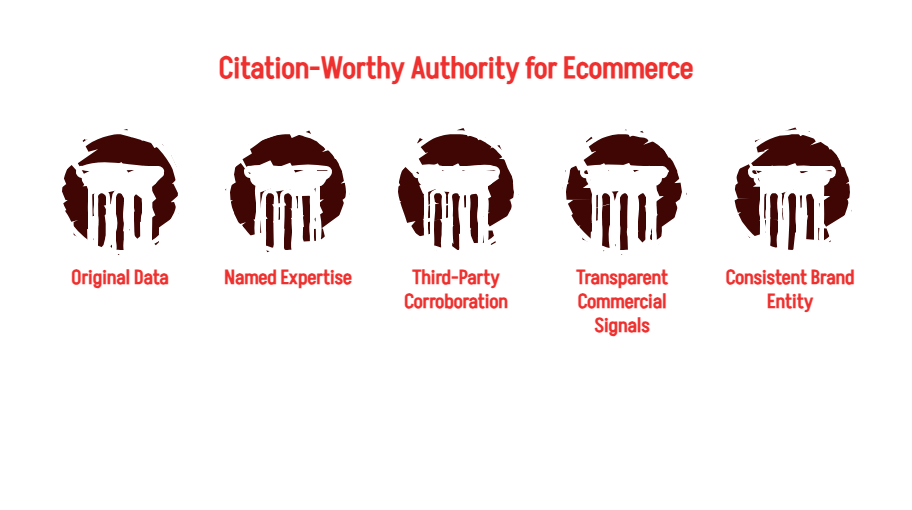
- Original Data: Fit surveys, durability testing, return-reason analysis, category buying patterns from your own order data. Anything a competitor cannot restate.
- Named Expertise: Real author attribution with real credentials, not a house byline on 400 posts.
- Third-Party Corroboration: Editorial mentions, reviews on independent sites, and inclusion in category roundups. Models weigh what others say about you, not only what you say about yourself.
- Transparent Commercial Signals: Visible returns, shipping, contact, and policy information. Trust signals are ranking signals in a system trained to avoid recommending sketchy merchants.
- Consistent Brand Entity: Same name, same description, same category positioning everywhere you appear.
This is the same discipline that drives visibility in other answer engines, which we walk through in how to get cited in ChatGPT and in our broader guide to getting more traffic and visibility from LLMs. It is also the core of the AI visibility and answer engine optimization work we run for clients.
How to Measure Ecommerce AI Search Visibility
You cannot manage citation rate if your only instrument is a clicks graph.
Google’s documentation confirms that traffic from AI Overviews and AI Mode is folded into overall Search Console performance data under the Web search type, which means there is no native filter isolating AI-driven impressions. The practical read is that Search Console tells you impressions are up and CTR is down, without telling you why.
What to track instead:
- Citation rate on your priority query set, checked on a fixed cadence rather than ad hoc.
- Impressions-to-clicks divergence at the query level, which is the fingerprint of an AI Overview appearing above you.
- Branded search volume, which tends to rise when a brand is being named inside summaries without being clicked.
- Assisted conversions and direct traffic from users who saw you cited and came back later.
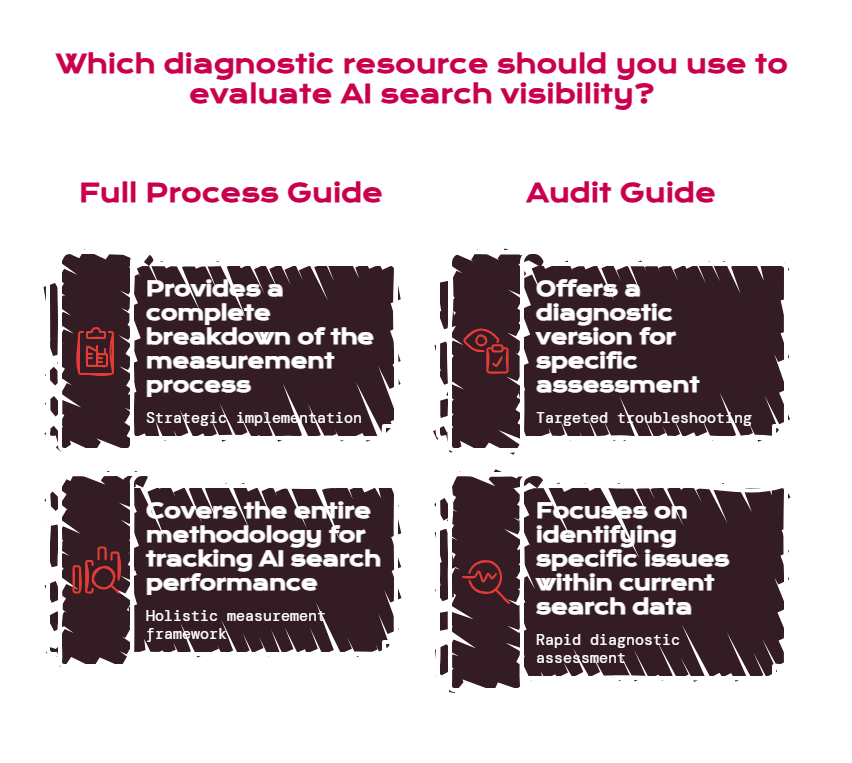
We break the full process down in how to measure AI search visibility, and the diagnostic version in our AI search visibility audit guide.
Treating citation rate as a first-class KPI is the only way to tell the difference between an AI SEO strategy that is working and a traffic chart that is falling for reasons outside your control.
Build the Boring Foundations, Then the Content
Ranking for AI snippets in Google is not a separate discipline bolted onto ecommerce marketing. It is the same technical and editorial work, executed to a higher standard, with citation rather than clicks as the success measure.
Get the eligibility layer right first: crawlable, indexable, snippet-permitted pages with accurate Product structured data and a feed that matches. Then build the research-stage content that AI Overviews actually pull from, in an answer-first format. Then earn the corroboration that makes a model comfortable naming your store. Skipping to step three is why so many ecommerce AI SEO projects produce content nobody cites.
If you would rather have this built than briefed, that is what we do. Talk to LYNX SEO and you get the full team, SEO Director, Strategist, Technical Lead, Designer, and Editor, for less than the cost of a single senior in-house hire. Our retail and ecommerce SEO programs and technical SEO work are built for exactly this.
Related Reading
- Shopify AI Overview Optimization: Why You’re Not Showing Up
- How to Audit Your Brand’s AI Search Visibility
- Get More Traffic and Visibility from LLMs
Frequently Asked Questions
How Do I Rank for AI Snippets in Google?
Make the page eligible, then make it citable. Eligibility means indexable, crawlable, and permitted to show a snippet, with structured data that matches visible content. Citability means an answer-first format, original information a competitor cannot copy, and enough third-party corroboration that Google’s systems treat your brand as a reliable source.
Is There Special Schema Markup for Google AI Overviews?
No. Google’s documentation states directly that no special schema.org structured data, machine-readable file, or AI-specific markup is required to appear in AI Overviews or AI Mode. Product structured data still matters for ecommerce, but it earns shopping feature eligibility rather than AI Overview placement specifically.
How Do AI Overviews Affect Ecommerce Click-Through Rates?
Badly on affected queries, and less badly if you are cited. Ahrefs measured a 58% drop in position-one CTR when an AI Overview is present, while Seer Interactive found cited brands earn 35% higher organic CTR than uncited brands on the same queries. Shopping queries trigger AI Overviews less often than informational ones, so exposure varies sharply by page type.
What Is the Difference Between AI Overviews and AI Mode for Ecommerce?
AI Overviews are generated summaries above standard results, weighted heavily toward informational queries. AI Mode is a conversational experience that breaks a query into subtopics and returns curated product panels for shopping intent, drawing on the Shopping Graph. Content strategy drives AI Overview citation; feed and structured data quality drive AI Mode product visibility.
How Do I Optimize Product Pages for AI Search?
Replace manufacturer descriptions with original copy, complete every specification attribute, answer sizing and durability objections on the page, and make sure specs render in text rather than inside a component that needs a click. Then confirm your Product schema matches what a shopper sees.
Does Product Schema for AI Search Include Variants?
Yes, and it is frequently missed. Google supports ProductGroup markup with variesBy, hasVariant, and productGroupID so size, color, and material options are understood as variations of one parent product rather than separate items. This also makes products eligible to display variant information in merchant listing experiences.
How Often Should I Update My Google Merchant Center Feed?
For anything with intra-day price or inventory movement, push updates through the Content API rather than relying on scheduled fetches. Google refreshes more than 2 billion Shopping Graph listings every hour, and conversational queries that specify budget or availability will filter out products whose data is out of date.
Do Featured Snippets Still Matter for Ecommerce SEO?
Yes. AI Overviews do not appear on every query, and the featured snippet remains the top position when they do not. Paragraph, list, and table snippet formats also happen to be the formats AI Overviews extract from, so optimizing for position zero and optimizing for AI citation are largely the same build.
Will Google Penalize AI-Generated Product Descriptions?
Google’s stated position is that it rewards helpful, original content regardless of how it was produced, and penalizes content produced primarily to manipulate rankings. Mass-generated descriptions that add nothing beyond the spec sheet fail on originality, not on authorship. We cover the detail in does Google penalize AI content.
How Does Ecommerce AI Search Visibility Differ From ChatGPT Visibility?
Google AI Overviews and AI Mode draw on Google’s index, Shopping Graph, and Merchant Center data, so feed quality is a direct input. ChatGPT and similar assistants rely more on training data, web retrieval, and third-party corroboration, with no feed to submit. The overlap is original content and brand mentions, which is covered in how to rank on ChatGPT.
Sources
- Google Search Central. “AI Features and Your Website.” Google Search Documentation. 2025. https://developers.google.com/search/docs/appearance/ai-features
- Google Search Central. “Top Ways to Ensure Your Content Performs Well in Google’s AI Experiences on Search.” 2025. https://developers.google.com/search/blog/2025/05/succeeding-in-ai-search
- Google Search Central. “Intro to Product Structured Data on Google.” Google Search Documentation. 2025. https://developers.google.com/search/docs/appearance/structured-data/product
- Pew Research Center. “Google Users Are Less Likely to Click on Links When an AI Summary Appears in the Results.” 2025. https://www.pewresearch.org/short-reads/2025/07/22/google-users-are-less-likely-to-click-on-links-when-an-ai-summary-appears-in-the-results/
- Ahrefs. “AI Overviews Reduce Clicks.” Ahrefs Blog. 2025. https://ahrefs.com/blog/ai-overviews-reduce-clicks/