Quick Answer: To rank on ChatGPT, two separate things need to work together. Your site needs to be indexed in Bing, since ChatGPT search retrieves from Bing’s index for live queries, and your content needs to be structured so it survives the selection step that happens after retrieval. Most brands stop at getting indexed and never fix the second half of that equation, which is why some pages get pulled into ChatGPT’s process and still never show up in an answer.
Key Takeaways
- Ranking on ChatGPT requires Bing indexing and content structured to survive retrieval, passage selection, and citation filtering.
- Answer engine optimization focuses on mentions and citations inside AI answers, while traditional SEO measures rankings, clicks, and search result positions.
- ChatGPT may answer from training data or live Bing-powered search, so brands need both technical visibility and broad entity authority.
- Retrieved pages are not automatically cited, making direct answer nuggets, schema markup, static HTML, fast loading, and passage-level structure important.
- Fan out queries expand user prompts into related searches, creating citation opportunities that may not appear in traditional keyword tools.
- Entity signals from Wikipedia, Wikidata, Crunchbase, Reddit, media mentions, and consistent brand information can improve AI search visibility.
- Get in touch with LYNX SEO to find exactly where your ChatGPT visibility is breaking down and identify the first fix worth making.
A prospect asks ChatGPT for the best options in your category, and a competitor’s name comes up three times before yours ever does. Your site ranks fine on Google. Your blog gets steady traffic. None of that seems to matter inside the chat window where a growing share of research now happens, and it’s not clear why.
The frustrating part is that few guides explain what’s actually going on. Some treat ChatGPT like a stranger version of Google and tell you to add more schema and move on. Others treat it like a black box that rewards vague brand authority, as if that were something a team could build without knowing what it means to the model in practice.
The actual logic behind this is more specific than either of those answers.
ChatGPT runs two mostly separate systems: one built from data it was trained on months ago, and one that goes out and searches the live web through Bing every time a question calls for it. Knowing which system is answering a given question changes where to spend time and budget, and that distinction is the part most guides skip entirely.
AEO and LEO and How They Differ From Traditional SEO
AEO stands for answer engine optimization, and LEO usually refers to LLM engine optimization.
Both describe the same underlying goal: getting a language model to name a brand, or pull directly from a page, when it answers a question a real buyer asked. Traditional SEO measures success in rankings and clicks, but a citation inside a ChatGPT answer often never produces a visit at all, so the old scorecard doesn’t apply cleanly.
This matters a lot more than what you might think.
Ranking first in Google puts a link in front of someone who still has to click, read, and decide it’s relevant. Being cited inside a ChatGPT answer means the model already made that judgment and handed the user a name, a claim, or a data point directly, sometimes with a link and sometimes without one.
None of this replaces SEO fundamentals. Strong Google rankings still correlate with ChatGPT citations. AirOps found pages ranking first on Google get cited roughly 3.5 times more often than pages outside Google’s top 20 results. What changes is the layer stacked on top of that foundation: retrieval mechanics, passage level structure, and off site signals that Google never weighted the same way.
How ChatGPT Finds and Cites Web Content
Before touching a single technical setting, there are two things happening here that you need to know. One explains why ChatGPT sometimes names a competitor from memory alone, with no live search involved. The other explains why a page published last week can outrank a page that’s held a strong Google position for years.
ChatGPT Training Data Vs Live Web Search: What Is the Difference
When ChatGPT answers from training data, it’s recalling patterns baked into the model during a training run that already happened, sometimes many months earlier.
There’s no live crawl involved, no way to submit a page for consideration, and no dashboard explaining why a brand got mentioned. If a company launched after that training cutoff, or changed its positioning significantly since, the model may simply not know it yet.
Live web search works differently.
When ChatGPT decides a question needs current information, it triggers a real time retrieval process that goes out, searches the web, and pulls candidate pages back before writing a response.
That retrieval process leans heavily on Bing’s index, since Seer Interactive’s analysis found 87% of SearchGPT citations matched Bing’s top organic results for the same question, compared with only 56% for Google.
Knowing which mode answered a given question changes the whole approach. A brand chasing training data recall needs press coverage, Wikipedia presence, and consistent mentions across the web well before anyone asks the question.
A brand chasing live search citations needs the more familiar technical SEO work of getting indexed, structured, and fast, since that’s the pool ChatGPT draws from in real time.
Why Being Retrieved and Being Cited Are Not the Same Thing
This is the problem that trips up almost every brand doing everything it thinks is right.
The same research from AirOps analyzed 548,534 pages ChatGPT retrieved across 15,000 prompts and found that only 15% of those pages ever showed up as a citation in the final answer.
The remaining 85% were pulled in, evaluated by the model, and quietly dropped before a user ever saw them.
Passing the first test, getting crawled, indexed, and considered, guarantees nothing about passing the second one. Citation rates also varied by question type in the same study, with product discovery and how-to queries earning citations far more often than comparison or validation questions. If your content sits in a category ChatGPT treats more cautiously, clear structure matters even more than usual.
For smaller brands wondering how a small website ranks in ChatGPT at all, this is actually reassuring news. Domain authority alone doesn’t decide the outcome, since the same research found sites in the DA 40 to 80 range earned citation rates comparable to much larger publishers once they were retrieved.
The highest authority sites got pulled into the retrieval pool more often, but weren’t selected at a proportionally higher rate once they got there.
Fan Out Queries and Why They Matter for AEO
ChatGPT rarely searches for the exact words someone typed. Instead, it expands a single prompt into several related searches behind the scenes, a process researchers call fan out, before assembling a final answer.
Across the AirOps dataset, 89.6% of prompts triggered two or more of these follow up searches, expanding 15,000 original prompts into more than 43,000 total queries.
Here’s the part that should change how content gets planned. Nearly a third of cited pages, 32.9% to be exact, were discovered only through one of these fan out queries and never through the original prompt at all.
Most of those fan out searches carry no measurable volume in a traditional keyword tool either, since 95% of them show zero search demand on their own.
Mapping out that wider set of supporting questions takes more legwork than a typical keyword list, but the process still borrows from familiar research habits.
Technical SEO Requirements for ChatGPT Search Visibility
None of the content work ahead matters if ChatGPT’s crawlers can’t reach a site in the first place. This section covers the groundwork: the settings, submissions, and speed benchmarks that decide whether pages even enter the retrieval pool. Skip this, and everything else in this guide ends up optimizing content that no model will ever see.
How to Get Indexed in Bing Webmaster Tools for ChatGPT
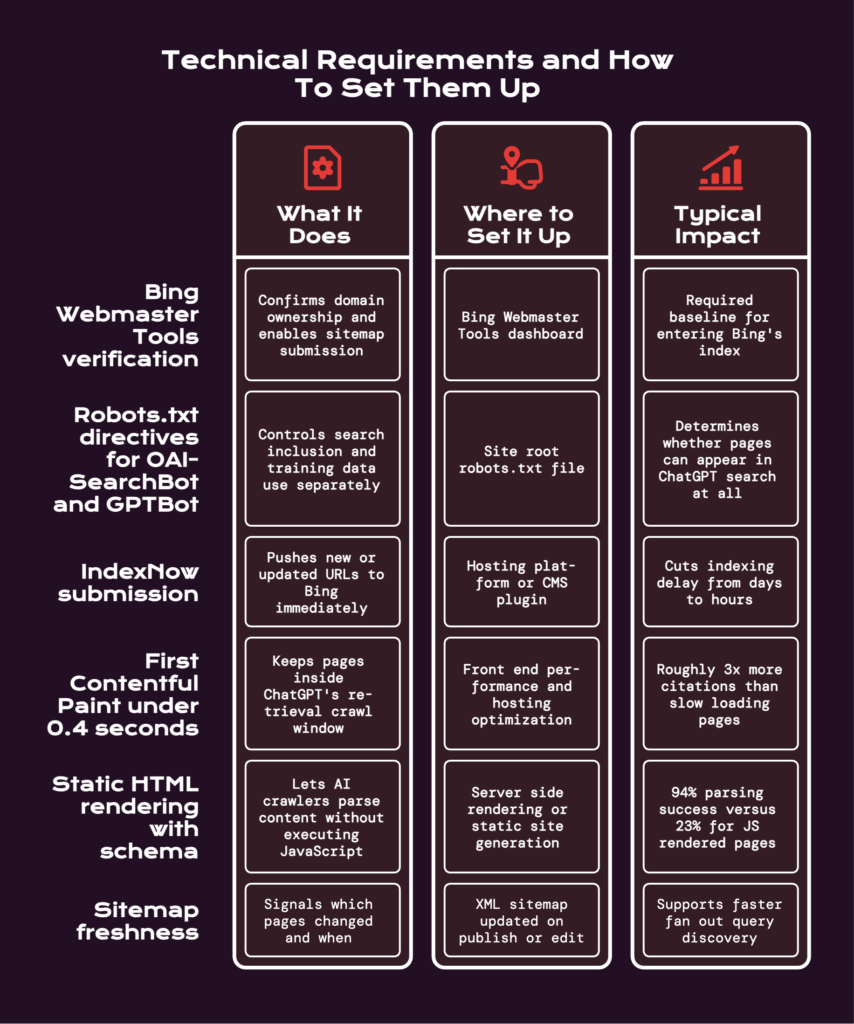
ChatGPT’s search feature is powered by Bing’s index for real time retrieval, not a separate crawl OpenAI runs on its own.
Seer Interactive’s research analyzed more than 500 citations and found 87% matched Bing’s top results for the same question, versus 56% for Google. If Bing hasn’t indexed a page, it effectively doesn’t exist for ChatGPT’s live search, no matter how well it performs elsewhere.
Getting into Bing’s index starts with verifying a domain in Bing Webmaster Tools and submitting a sitemap directly, rather than waiting for Bing’s crawler to find it on its own schedule.
This step gets treated as an afterthought by teams that have spent years focused entirely on Google Search Console. It takes ten minutes and opens the door to everything else in this section.
How to Allow OAI-Searchbot and GPTBot in Robots.txt
OpenAI runs separate bots for separate jobs, and treating them as a single setting is a common mistake.
According to OpenAI’s own documentation, OAI-SearchBot surfaces pages in ChatGPT’s search answers, while GPTBot crawls content that may be used for training future models, and each setting works independently in robots.txt. A site can allow OAI-SearchBot for search visibility while still disallowing GPTBot from using its content in future training runs.
That difference matters for any brand that wants search visibility without contributing content wholesale to model training. OpenAI notes it can take about 24 hours after a robots.txt change for its systems to adjust, so a mistake here doesn’t fail loudly, it just stays broken quietly for a day.
Sites that opt out of OAI-SearchBot entirely won’t be shown in ChatGPT’s search answers at all, though they can still appear as plain navigational links.
How to Use IndexNow for Faster Content Indexing
IndexNow is an open protocol that pushes new and updated URLs directly to Bing the moment they change, instead of waiting for Bing’s crawler to circle back on its usual schedule.
For a brand publishing timely content, that’s the difference between showing up in ChatGPT’s fan out queries within hours versus days later, after a competitor already claimed the citation.
This matters more for AEO than it did for traditional SEO, since ChatGPT’s retrieval layer favors sources reflecting current information over pages that simply rank well historically. Pairing IndexNow with a regular content refresh routine, rather than saving it only for brand new posts, keeps existing pages inside the retrieval window ChatGPT actually checks.
How Page Speed and Rendering Affect ChatGPT Citations
Speed and rendering method matter more for AI retrieval than most technical SEO checklists suggest. One analysis found pages with a First Contentful Paint under 0.4 seconds averaged 6.7 citations, compared with just 2.1 citations for pages loading in over 1.13 seconds, suggesting ChatGPT’s retrieval crawler applies something like a timeout that penalizes slow pages.
Rendering method carries an even larger gap in the same research. Static HTML with schema markup parsed successfully 94% of the time, while JavaScript rendered content succeeded only 23% of the time.
A site relying heavily on client side rendering for its core content is likely losing retrieval opportunities before content quality ever enters the conversation.
How to Structure Content for ChatGPT Citations
Getting crawled and indexed only earns a seat in the retrieval pool. Whether ChatGPT actually pulls a page into its answer comes down to how the content itself is written and organized. The three practices below have the clearest evidence behind them.
How to Write Answer Nuggets for AI Search
ChatGPT breaks pages into chunks and evaluates each one for whether it directly answers the question at hand. Content that buries its answer under scene setting or caveats tends to get passed over in favor of a competitor’s page that states the answer plainly in the first sentence or two of a section.
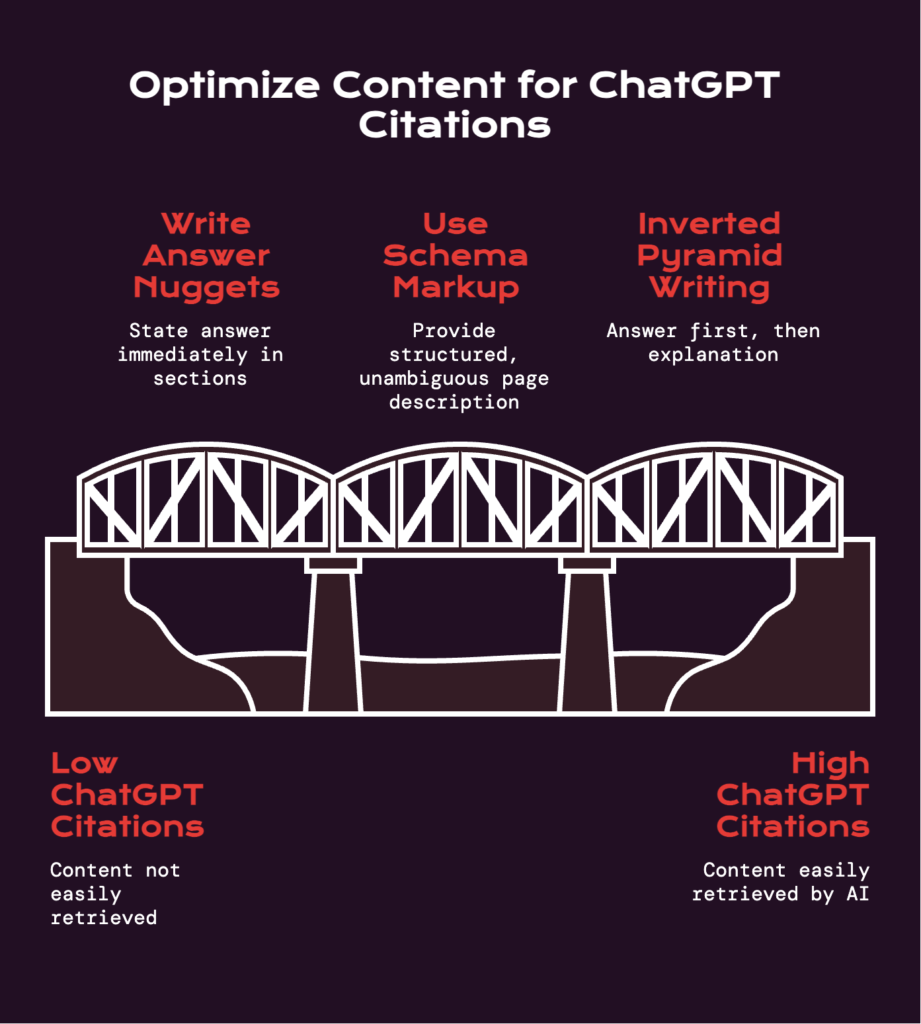
Writing what some practitioners call answer nuggets means treating each H2 or H3 as its own self-contained mini-answer. State the direct answer immediately, then use the following sentences to add supporting detail or reasoning.
This same discipline holds across a blog’s other content too, and it overlaps closely with the guidance in how to add value to AI blog content, since both come down to giving the reader, human or model, something concrete instead of padding.
Schema Markup for AI Search Optimization
Schema markup gives ChatGPT a structured, unambiguous description of what’s on a page instead of forcing the model to infer it from prose alone. Article, FAQ, and Author schema work as a reasonable baseline for most content, with comparison pages benefiting from Table schema and instructional content benefiting from HowTo schema.
None of this replaces good writing, but it removes ambiguity that costs a brand at the margin.
A page that clearly states through markup what it is, who wrote it, and what questions it answers gives the model one less reason to choose a competitor’s page instead when both cover similar ground.
Inverted Pyramid Writing for Passage Level SEO
Passage level retrieval means ChatGPT often cites a paragraph or two, not a full page, so the strongest passage in a piece of content needs to stand on its own. Writing in an inverted pyramid, answer first, then explanation, then supporting detail, matches how ChatGPT reads and extracts a passage far better than the slow build many blog posts still use before reaching the point.
This is a different discipline than writing for a person skimming a page top to bottom, since a person forgives a slow build in a way a retrieval system doesn’t. Sections written this way tend to perform well for both audiences anyway, since readers rarely mind getting the answer immediately.
How to Build Entity and Authority Signals for AI Search
Everything above assumes ChatGPT is running a live web search, but a meaningful share of answers still come straight from training data recall instead. Winning that half of the equation depends less on any single page and more on how consistently a brand shows up across the wider web.
Wikipedia, Wikidata, and Crunchbase Consistency for AEO
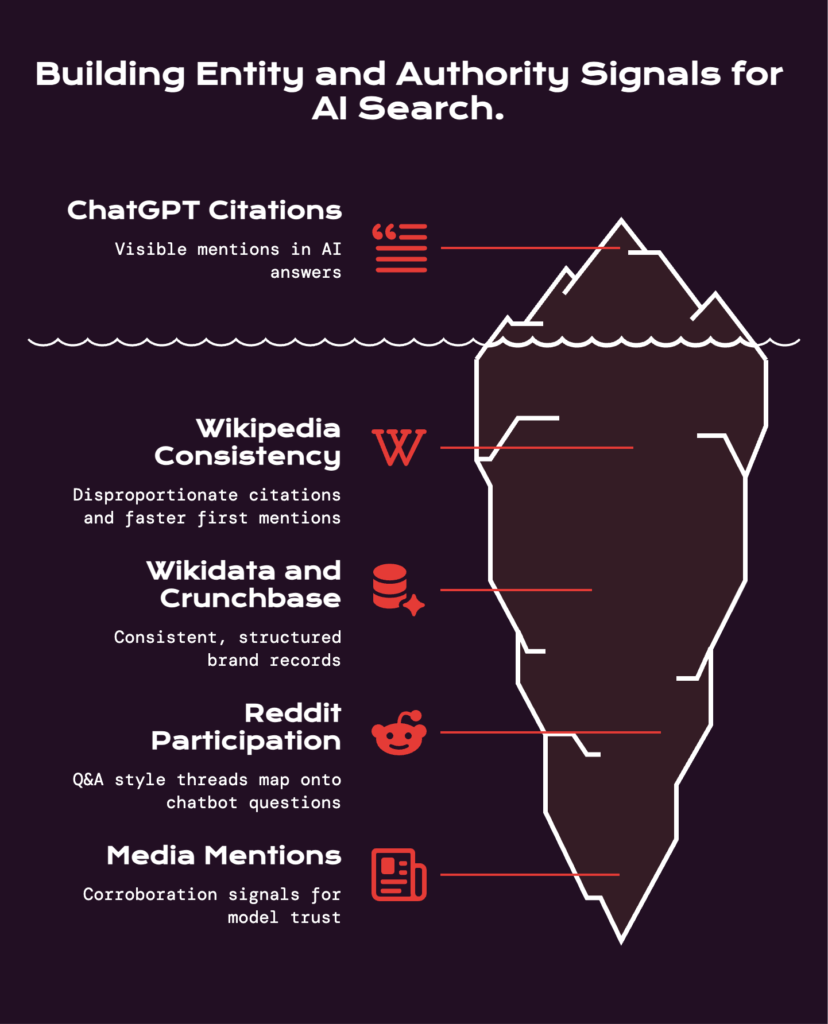
Wikipedia shows up disproportionately often in ChatGPT’s citations relative to its share of the web overall, and brands with an established Wikipedia page tend to earn their first citations noticeably faster than brands without one. Getting listed isn’t something a brand can simply submit its way into, since Wikipedia’s notability standards require independent coverage first, making this a longer term project rather than a quick technical fix.
Wikidata and Crunchbase play a supporting role by giving the model a consistent, structured record of a brand’s name, founding details, and category. Keeping those entries aligned with how a brand describes itself everywhere else reduces the chance the model pulls in a stale or incorrect description when the brand comes up.
Why Reddit Matters for ChatGPT Visibility
Reddit shows up constantly among the sources ChatGPT and other AI platforms cite, largely because Q&A style threads map closely onto the kinds of questions people ask a chatbot. Genuine, non-promotional participation in relevant threads, answering real questions rather than dropping a link, tends to build the kind of presence that gets surfaced later.
Obvious self-promotion tends to backfire here rather than help, since these models have gotten better at spotting inauthentic looking content over time. Treating Reddit as a place to help people, with a brand mentioned naturally where relevant, is a more durable approach than treating it as another distribution channel.
How to Earn Media Mentions ChatGPT Already Trusts
Independent press coverage, industry reports, and analyst mentions function as corroboration signals that help a model trust a claim about a brand rather than treating it as unverified. This is one of the few areas where traditional PR and modern AEO overlap almost completely, since a mention in a trusted outlet does double duty for both goals at once.
Prioritizing outlets a category already trusts, rather than chasing volume for its own sake, produces a stronger signal. One well-placed mention in a publication a model already treats as authoritative often outweighs a dozen mentions on lower trust sites.
How to Measure ChatGPT Visibility and AI Search Rankings
All of the work above is hard to justify without a way to see whether it’s working. Measuring AI visibility looks nothing like a familiar rank tracker, since there’s no single results page to check a position on.
Here’s how brands are approaching it in practice.
AEO Metrics That Matter Beyond Keyword Rankings
Traditional rank tracking assumes a stable results page with positions one through ten. ChatGPT doesn’t work that way, so more useful metrics include citation frequency across a fixed set of prompts, share of answer against named competitors, and how often a brand appears versus how often competitors do for the same questions.
Brands trying to see brand visibility in ChatGPT, or trying to increase visibility in ChatGPT searches, often start by running the same 15 to 20 prompts manually every week and logging the results by hand.
It’s tedious, but it establishes a ground truth baseline that no automated tool fully replaces on its own. This kind of disciplined tracking mirrors what already works in traditional reporting, similar in spirit to how to measure the success of an SEO campaign, just pointed at a different set of outputs.
How to Track Brand Mentions in ChatGPT With PromptWatch
PromptWatch is one option built for this kind of tracking, covering prompt tracking, citation analysis, and crawler level analytics across ChatGPT, Claude, Gemini, and Perplexity in one dashboard. It logs real user style prompts and shows when and how often a brand gets mentioned or cited in responses, alongside a visibility score meant to summarize performance over time.
Beyond straight tracking, it also includes a content gap view that shows where existing pages fail to cover what AI models are already answering, turning tracking data into a to-do list rather than just a report.
For a brand ready to move past manual prompt checking, starting a free trial with Promptwatch is a reasonable next step to see where the gaps actually sit.
Why LYNX SEO Gets Brands Cited, Not Just Indexed
Most of what separates a brand that gets cited from one that gets retrieved and dropped comes down to details that are easy to miss and expensive to guess at: robots.txt configuration across separate bots, Bing indexing alongside Google, content structured for passage level retrieval, and the entity signals that shape what a model already believes about a brand.
LYNX SEO builds all four pieces together instead of treating AEO as a bolt-on service, running technical audits, content architecture, and AI visibility work as one connected system rather than separate line items.
Every brand climbing from zero visibility into a real presence in ChatGPT answers went through the same unglamorous groundwork covered in this guide, just executed consistently instead of as a one-time fix. If a site is doing everything Google ever asked of it and still going unmentioned in ChatGPT, that’s a specific, fixable gap.
Get in touch with LYNX SEO (as seen on Design Rush) and find out exactly where your visibility is breaking down. A short conversation is often enough to spot the first fix worth making.
Frequently Asked Questions About Ranking on ChatGPT
What Is AEO in SEO?
AEO stands for answer engine optimization, the practice of structuring content and brand signals so AI tools like ChatGPT cite or mention a brand directly in a generated answer. It differs from traditional SEO because success is measured by citations and mentions inside a conversation, not by rankings or clicks on a results page.
Does ChatGPT Use Google or Bing for Search?
ChatGPT’s search feature retrieves live web pages primarily through Bing’s index as part of the OpenAI and Microsoft partnership, rather than running an independent crawl of the web. Google rankings still correlate with ChatGPT citations, but Bing indexing and rankings tend to predict citations more closely for live search queries.
How Long Does It Take to Rank on ChatGPT?
Technical fixes like Bing indexing and IndexNow submissions can affect retrieval within hours to days. Off page authority signals such as press coverage, Wikipedia presence, or Reddit mentions typically take several weeks to a few months to show up in citation patterns, since the model needs time to reprocess updated information about a brand.
Can Small Websites Rank on ChatGPT?
Yes. Domain authority alone does not decide whether a page gets cited once it enters ChatGPT’s retrieval pool, and mid authority sites are cited at rates comparable to much larger publishers. Clear structure, direct answers, and technical accessibility matter more at that stage than sheer site size or backlink volume.
Is AEO the Same as GEO?
AEO and GEO, short for generative engine optimization, are used interchangeably by most practitioners and describe the same underlying goal of getting cited inside AI generated answers. Some use LEO for large language model optimization in particular, but the practical work behind all three terms overlaps almost completely.
Do ChatGPT Citations Send Website Traffic?
Sometimes, but citations often function more like brand impressions than clickable links, since many ChatGPT answers summarize a source without linking to it directly. Traffic from AI platforms tends to run lower in volume than traditional organic search but often converts at a much higher rate.
What Is a Fan Out Query in ChatGPT Search?
A fan out query is one of several follow up searches ChatGPT runs internally while building an answer to a single prompt. Most fan out queries carry no measurable search volume in traditional keyword tools, meaning a meaningful share of citation opportunities sit entirely outside a standard keyword strategy.
Sources Used for This Article
- AirOps: “Influence of Retrieval Fanout and Google SERPs in ChatGPT” – airops.com/report/influence-of-retrieval-fanout-and-google-serps-in-chatgpt
- Seer Interactive: “87% of SearchGPT Citations Match Bing’s Top Results” – seerinteractive.com/insights/87-percent-of-searchgpt-citations-match-bings-top-results
- OpenAI: “Overview of OpenAI Crawlers” – developers.openai.com/api/docs/bots
- Erlin AI: “ChatGPT Search Optimization (2026 Guide)” – erlin.ai/blog/chatgpt-search-optimization
