Quick Answer: Most brands are missing from AI search citations because AI systems select sources on off-site brand signals rather than on rankings or page quality alone. Ahrefs found branded web mentions correlate with AI visibility roughly three times more strongly than backlinks. If nobody outside your own website talks about you, models have nothing to corroborate.
There is a specific and maddening version of this problem. You rank first for your category terms. Your pages are fast, structured, and technically clean. You have been publishing for years. And when someone asks ChatGPT or Google’s AI Mode for the best option in your category, a competitor you have never heard of gets named and you do not.
That is not a technical failure. It is a brand entity failure, and it responds to a completely different set of inputs than the ones your SEO dashboard tracks.
The evidence on this is unusually clear for such a new field. The signals that best predict whether an AI system mentions a brand are almost entirely off-site: how often the brand is talked about across the web, how consistently it is described, and whether independent sources corroborate what the brand says about itself. Backlinks and page volume, the two things most SEO programs are built around, correlate weakly by comparison.
We run AI visibility programs for brands in verticals where paid channels are restricted and organic is the whole business, so this is a problem we see constantly. The fix is slower than a technical fix and more durable once it lands.
This article covers why brands get skipped, in the order the causes actually rank.
Key Takeaways
- Ahrefs’ analysis of 75,000 brands found branded web mentions correlate with AI Overview visibility at 0.664, roughly three times stronger than backlinks at 0.218.
- The top three correlating factors in that study were all off-site brand signals rather than on-page or technical factors, which means brand visibility in AI search is largely earned outside your own website.
- Ranking in Google’s organic top 10 does not reliably transfer to AI citation, with Semrush finding AI Mode sidebar links overlapped with the top 10 on only about half of domains and a third of URLs.
- AI Overviews and AI Mode cite the same URLs only 13.7% of the time according to Ahrefs, so brand visibility has to be tracked per platform rather than as a single number.
- Roughly a third of AI responses in Ahrefs’ analysis named no brand or person at all, which means many categories have an unclaimed position rather than an entrenched incumbent.
- If you want a team building the off-site brand signals that AI systems actually weigh, LYNX SEO builds AI visibility programs around earned mentions rather than page tweaks.
Brand Mentions vs Page Citations: Two Different Problems
Worth separating before anything else, because the fixes diverge completely.
- A page citation is a link to a specific URL inside an AI answer. It is won at the page level: the page is reachable, the content is extractable, and it answers the sub-question the system was resolving. This is largely a technical and content-structure problem.
- A brand mention is your company being named in the answer text, with or without a link. It is won at the entity level: the model associates your brand with the category, and enough independent sources corroborate that association for it to surface confidently.
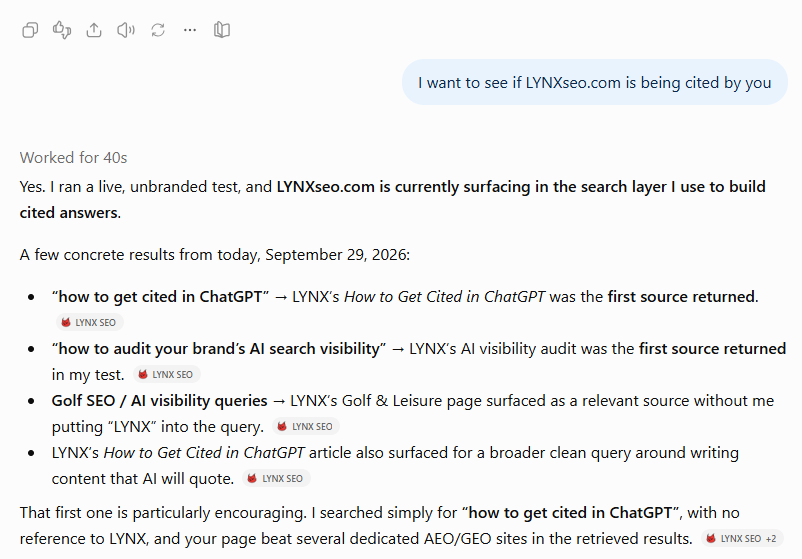
You can win page citations without brand mentions, and you can be mentioned constantly with no link to your site at all, which is why teams measuring only referral traffic conclude they are invisible when they are not.
Most brands asking why AI search does not mention them have the second problem. Their pages are fine. Their entity is thin.
How AI Search Engines Choose Citations
Different platforms make this decision differently, which is why a single AI visibility score is misleading.
| Platform | How It Selects Sources | What Moves Your Brand |
| Google AI Overviews | Grounded in Google’s index, weighted toward pages already performing in organic | Classic SEO plus brand mentions across the web |
| Google AI Mode | Query fan-out into sub-searches, then synthesis from a wider retrieval pool | Topical depth on sub-questions, entity clarity, off-site presence |
| ChatGPT | Search index plus parametric knowledge from training | Brand entity strength built through third-party mentions over time |
| Perplexity | Heavy real-time retrieval with dense citation per answer | Being present on the sources it retrieves, including community and review sites |
| Claude | Search index plus user-initiated retrieval | Clear, explanatory content on an accessible site |
The differences are measurable. Ahrefs’ analysis of hundreds of thousands of response pairs found that AI Overviews and AI Mode agreed on what to say roughly nine times out of ten while overlapping on only 13.7% of citations, and that AI Mode responses included about 2.5 times more brand and person entities than AI Overviews did. The same study found that 32.8% of responses named no brand or person at all.
That last number is the opportunity most brands miss. In roughly a third of AI answers nobody is being named, which means a large share of categories have a vacant position rather than an incumbent you have to displace.
Why Your Competitors Are Cited by AI and You Aren’t
The clearest public dataset on this is Ahrefs’ study of 75,000 brands, which measured which signals correlate with brand appearance in AI Overviews.
| Signal | Correlation With AI Visibility | What This Means Practically |
| Branded web mentions | 0.664 | How often your brand name appears across the web is the strongest single predictor |
| Branded anchor text | 0.527 | Being linked by name, not by keyword, carries weight |
| Branded search volume | 0.392 | People searching for you directly signals category standing |
| Referring domains (backlinks) | 0.218 | Links still help, at roughly a third the predictive strength of mentions |
| Branded ad traffic | 0.216 | Paid presence shows a weak positive relationship |
Ahrefs reported that the top three correlating factors were all off-site brand signals, and that brands in the highest quartile for web mentions earned up to ten times more AI Overview mentions than the next quartile down.
Two honest caveats, both of which Ahrefs states in the research itself. These are correlations, not proven causes, and large well-known brands naturally have both more mentions and more AI visibility, so brand strength itself may be the underlying driver. The correlations are also moderate to weak on the Spearman scale rather than overwhelming.
Even with those caveats, the directional finding is hard to argue with, and it is uncomfortable for most SEO programs. The signal that best predicts whether an AI system names your brand is the one your content calendar and your link-building targets were never designed to produce.
Reason 1: Your Brand Has Too Few Off-Site Mentions
This is the dominant cause, and it is structural rather than fixable by editing your website.
Language models build brand understanding from co-occurrence. If your company name appears next to your category, next to your use cases, and next to your competitors across enough independent sources, the association forms. If the only place your brand is described is your own domain, there is nothing to corroborate.
Where those mentions need to exist:
- Editorial Coverage: Trade publications and mainstream outlets your category actually reads. One placement in a genuinely relevant publication outperforms ten in a generic one.
- Third-Party Roundups And Comparisons: “Best X for Y” content published by someone other than you. This is where category consideration sets are formed.
- Review And Directory Platforms: Category-appropriate review sites, where structured, repeated brand-plus-category language accumulates.
- Community Discussion: Forums and communities where practitioners in your field actually talk. Genuine participation, not seeded threads.
- Video Content: Creator reviews, comparisons, and tutorials that name your product. The transcript is what gets read.
- Expert Commentary: Your named people quoted in other people’s articles, which builds the person entity alongside the brand.

The unifying property is that you do not control any of them. That is precisely why they carry signal. This is digital PR and link building work reframed around mentions rather than link equity, and the reframe matters: an unlinked mention that would have been discarded under an old link-building brief is a full-value asset here.
Reason 2: Your Brand Entity Is Ambiguous
Models have to resolve who you are before they can recommend you. Ambiguity kills that.
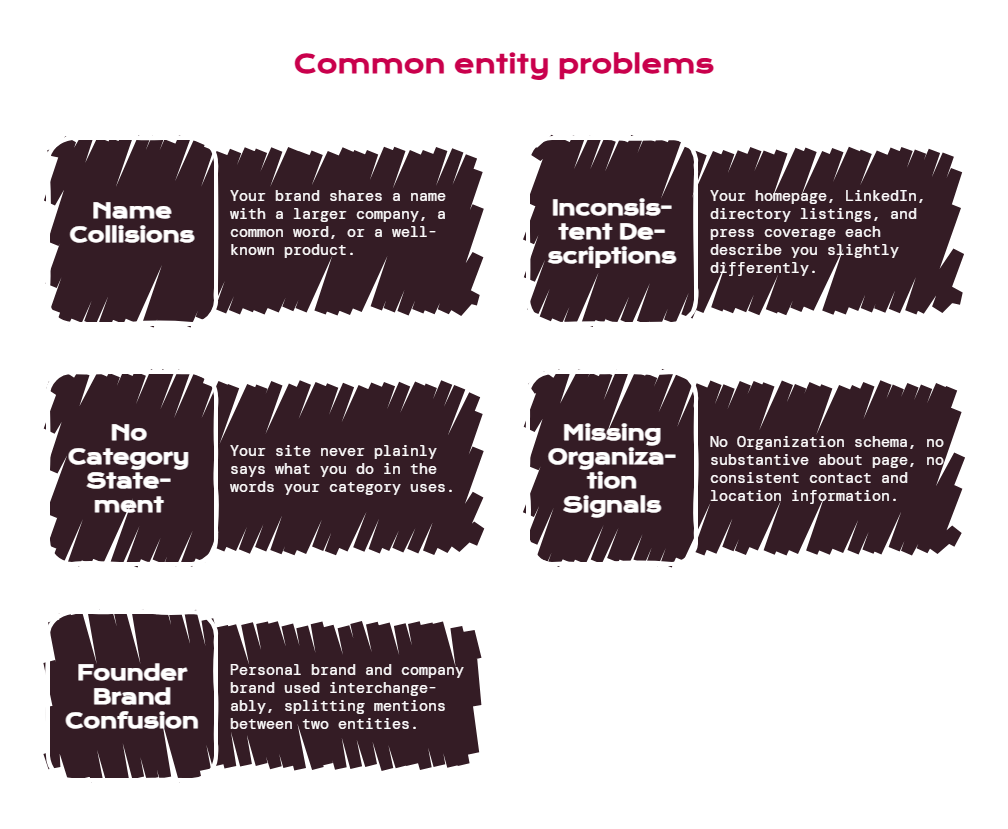
Common entity problems, in rough order of how often we find them:
- Name Collisions: Your brand shares a name with a larger company, a common word, or a well-known product. The model resolves to the bigger entity every time.
- Inconsistent Descriptions: Your homepage, your LinkedIn, your directory listings, and your press coverage each describe you slightly differently. Nothing agrees, so nothing consolidates.
- No Clear Category Statement: Your site never plainly says what you do in the words your category uses. Positioning language that avoids the obvious noun is an entity liability.
- Missing Organization Signals: No Organization schema, no substantive about page, no consistent contact and location information across profiles.
- Founder And Brand Confusion: Personal brand and company brand used interchangeably, so mentions split between two entities and neither accumulates.
The fix is repetitive rather than clever. One brand name, one one-line description, one category statement, repeated identically everywhere you appear. Entity consolidation is the cheapest AI visibility work available and the least interesting to do, which is why almost nobody does it properly.
Reason 3: Your Rankings Don’t Transfer to AI Citations
A lot of brands are missing from AI answers precisely because they assumed rankings would carry them.
The overlap between organic rankings and AI citations is real but partial, and the studies disagree sharply on how partial. Semrush’s AI Mode study found that sidebar links in AI Mode overlapped with Google’s top 10 on about 51% of domains and 32% of URLs, while the additional links appearing below responses showed much tighter overlap at 89% of domains. Other analyses using different query sets and methods have put the AI Mode overlap far lower.
Treat the specific percentages as directional rather than settled, because methodologies vary too much for a single number to be meaningful. The consistent finding across all of them is the one that matters: a top-ten ranking is one input into a system that runs several searches and assembles an answer from a wider pool than any single results page.
Google’s own guide to optimizing for generative AI features confirms these experiences are rooted in core Search ranking and quality systems, so rankings are not irrelevant. They are necessary and insufficient, which is a different problem from the one most teams are solving for.
Reason 4: You’re Absent From the Sources AI Systems Read
Your brand can be mentioned frequently and still miss, if the mentions are in places the retrieval layer never surfaces.
Independent citation studies consistently find that AI answers lean heavily on third-party sources rather than brand-owned properties, and that a small number of high-frequency domains carry outsized influence over how categories get described. The specific rankings shift constantly and vary by platform, which is why we treat published lists as a starting point rather than a target list.
The practical approach is to find yours rather than borrow someone else’s. Run your priority prompts across ChatGPT, AI Overviews, AI Mode, and Perplexity, record every domain cited in the answers where competitors appear, and count them. That list is your actual citation surface. Getting mentioned on the domains that already appear in your category’s answers is more direct than pursuing generic authority.
The fastest route into an AI answer is usually not your own website, it is the third-party page the model is already reading when it builds that answer.
Reason 5: Nobody Has Written the Comparison You Would Win
A structural gap that affects newer and smaller brands disproportionately.
If the comparison content in your category does not include you, you cannot be surfaced by a system synthesizing from that content. This is not a quality judgment on your product. It is an absence problem, and it compounds, because each roundup that omits you makes the next one likelier to omit you too.
Three ways to break it:
- Publish The Comparison Yourself, Fairly: Content that treats competitors accurately gets cited more than content that does not, because a model synthesizing a comparison needs balanced source material. Handling your own category honestly, including where you are not the right choice, produces a genuinely citable asset.
- Give Roundup Authors A Reason: Reach out to the people writing category roundups with something specific, such as original data, a free tier, or a differentiated use case. Editors include what is easy to describe.
- Create The Category Slice: If you cannot win “best CRM”, win “best CRM for regulated financial advisors”. Narrower comparisons have fewer incumbents and are easier to originate.
How to Increase Brand Mentions in AI Search
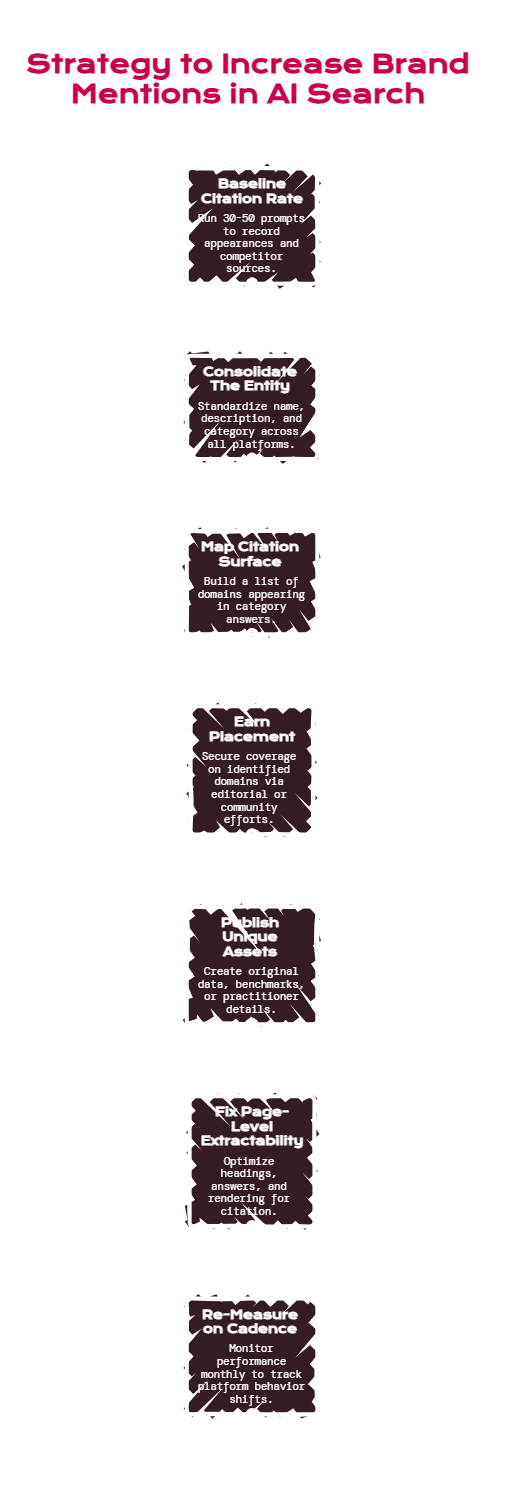
The sequence that works, in priority order.
- Baseline Your Citation Rate: Run 30 to 50 priority prompts across each platform and record where you appear, where competitors appear, and which sources get cited.
- Consolidate The Entity: One name, one description, one category statement across your site, schema, and every profile you control.
- Map Your Citation Surface: Build the list of domains actually appearing in your category’s answers, from your own tracking rather than a generic list.
- Earn Placement On Those Domains: Editorial coverage, roundup inclusion, review platform presence, and genuine community participation, prioritized by what already surfaces.
- Publish Something Only You Have: Original data, benchmarks, or practitioner detail from your own operations. This is the asset that makes coverage easy for others to write.
- Fix Page-Level Extractability: Question headings, self-contained answers, clean rendering. This converts brand awareness into linked citations. Our guide to getting cited in ChatGPT covers the page mechanics.
- Re-Measure On A Cadence: Monthly at minimum. Platforms shift retrieval behavior with little notice.
Steps one through three take weeks. Steps four and five take quarters, and never really finish. Most in-house teams complete the audit, produce a clear picture of the gap, and then stall on the earned media work because it needs relationships and time nobody has spare. That stall is where an outside team earns its fee.
How to Measure AI Brand Visibility and Share of Voice
Referral traffic is the wrong primary metric here, and using it will make a working program look like a failing one.
The gap between how much AI platforms read and how much they send back is well documented. Cloudflare’s analysis of crawl-to-refer ratios across AI platforms showed those ratios spanning orders of magnitude between operators, with some platforms making enormous numbers of page requests for every referral sent. The specific figures move constantly. The structural point does not: you can be read and named heavily while receiving almost no measurable clicks.
Track these instead:
- Brand Mention Rate: The share of your priority prompts where your brand is named, measured per platform.
- Share Of Voice: Your mention rate against named competitors on the same prompt set.
- Cited Source Inventory: Which domains appear in the answers for your category, and whether you are on them.
- Sentiment And Framing: Whether you are named as a recommendation, a caveat, or an also-ran.
- Branded Search Volume: A reliable proxy for AI exposure that produced no click.
- Assisted Conversions And Direct Traffic: Where the commercial value of an unclicked mention eventually shows up.
The mechanics are in how to measure AI search visibility and the structured version in our AI search visibility audit guide. For the broader reporting question, see which SEO metrics actually tell you something.
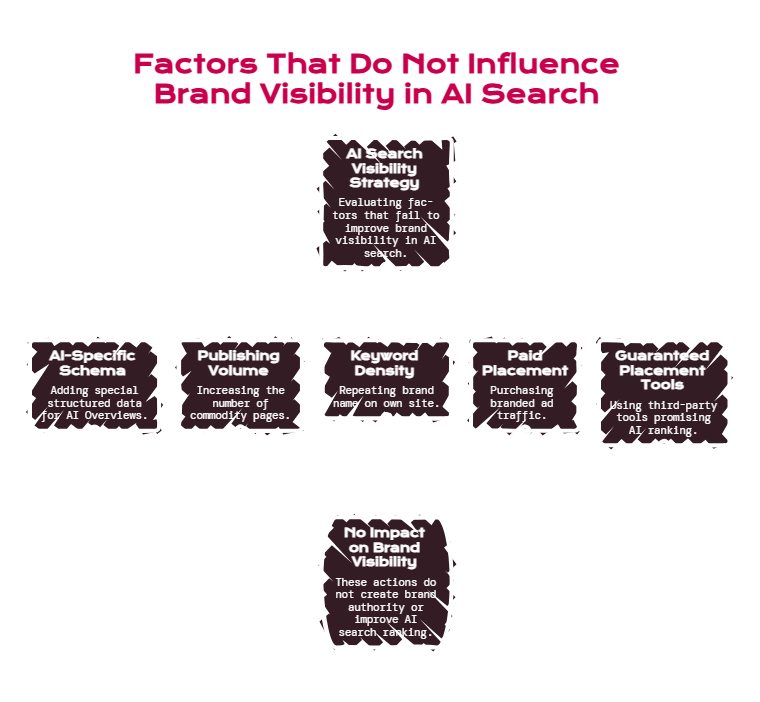
What Doesn’t Move Brand Visibility in AI Search
Stated plainly, because budget is going into all of these.
- AI-Specific Schema: Google’s AI features documentation states no special structured data or machine-readable file is needed for AI Overviews or AI Mode. Schema describes your content accurately. It does not create brand authority.
- Publishing Volume: Ahrefs’ correlation data found content volume among the weakest signals. More commodity pages does not equal more mentions.
- Keyword Density And Brand Name Repetition: Repeating your own name on your own site is not corroboration.
- Paid Placement: Branded ad traffic showed a weak correlation in the same dataset. You cannot buy your way into the answer.
- Tools Promising Guaranteed Placement: Google explicitly warns against third-party tools claiming access to internal ranking or AI systems.
Conclusion: Brand Visibility Is Earned Off Your Own Site
If your brand is missing from AI search citations, the most likely reason is that not enough independent sources describe you clearly enough for a model to name you with confidence.
That is a slower problem than a technical one and a more durable advantage once solved. Consolidate your entity so every description agrees. Find the domains your category’s answers actually cite and get onto them. Publish something nobody else can restate. Make your own pages extractable so awareness converts into linked citations. Then measure mention rate and share of voice per platform, because referral traffic will not tell you whether any of it is working.
The brands winning here are not the ones with the biggest content programs. They are the ones the rest of the internet already talks about accurately.
If you want that built rather than briefed, that is what we do. Talk to LYNX SEO and you get the full team, SEO Director, Strategist, Technical Lead, Designer, and Editor, for less than the cost of a single senior in-house hire. Our AI visibility and answer engine optimization work and content strategy programs are built around exactly this problem.
Usually because too few independent sources describe your brand clearly enough for a model to name it confidently. Ahrefs found branded web mentions correlate with AI visibility roughly three times more strongly than backlinks, and the top three correlating signals were all off-site. If the only place your brand is described is your own website, there is nothing to corroborate. ChatGPT draws on both its search index and knowledge baked into training, so brand entity strength built through third-party mentions matters more than page-level optimization. A site with excellent pages and almost no independent coverage will underperform a competitor with weaker pages and broader category presence. Because rankings and AI citations are selected differently. Studies measuring the overlap between organic top-10 results and AI citations disagree on the exact figure but agree the overlap is partial, particularly in AI Mode, which fans a query into sub-searches and assembles from a wider pool. Your competitor is likely being mentioned more often across the web, which is the stronger predictor. Consolidate your entity so every description of you matches, identify which third-party domains already appear in your category’s AI answers, earn placement on those specific domains, and publish original data that gives others a reason to cite you. Then make your own pages extractable so awareness converts into linked citations. They help, at roughly a third the predictive strength of unlinked brand mentions according to Ahrefs’ 75,000-brand analysis. Backlinks still drive traditional rankings, which feed AI Overviews. The strategic shift is that a mention without a link, which an old link-building brief would have discarded, is now a full-value asset. Making your brand unambiguous to systems trying to resolve who you are. One brand name, one description, one category statement used identically across your site, schema, profiles, and press coverage. Name collisions with larger entities and inconsistent self-descriptions are the two failures we find most often. Entity consolidation and page extractability can show movement in weeks. Earned mentions and third-party coverage run on a multi-quarter timeline, because they depend on other people publishing. Any provider promising fast brand-level results is selling something Google explicitly warns about. Yes, substantially. Ahrefs found AI Overviews and AI Mode cite the same URLs only 13.7% of the time despite reaching similar conclusions. Perplexity cites densely and retrieves in real time, while ChatGPT leans more on entity strength accumulated over time. Track each platform separately rather than reporting one blended score. Our guide to ranking on ChatGPT covers the platform-specific detail. Substantially, through two mechanisms. It gives AI systems a reason to name you as the source of a specific claim, and it gives journalists and roundup authors something easy to cite, which produces the third-party mentions that drive the entity signal. A single proprietary statistic often outperforms a long guide that restates available information. The mechanics are identical, but the difficulty varies sharply. Regulated verticals face thinner third-party coverage and higher trust thresholds, which makes the earned-mention layer slower to build. We wrote a vertical version of this in hemp brand SEO and AI search visibility, and the ecommerce platform version in Shopify AI Overview optimization.Frequently Asked Questions
Why Is My Brand Missing From AI Search Citations?
Why Doesn’t ChatGPT Mention My Brand?
Why Are My Competitors Cited by AI When I Rank Higher?
How Do I Get My Brand Mentioned by AI Search Engines?
Do Backlinks Help With AI Citations?
What Is Entity Optimization for AI Search?
How Long Does It Take to Improve AI Brand Visibility?
Is AI Brand Visibility Different Across ChatGPT, Perplexity, and Google?
Does Original Research Increase Brand Mentions in AI Search?
Does This Problem Differ by Industry?
Related Reading
- Get More Traffic and Visibility from LLMs
- How to Get Cited in ChatGPT: Write Pages AI Will Quote
- How to Audit Your Brand’s AI Search Visibility
Sources
- Ahrefs. “An Analysis of AI Overview Brand Visibility Factors (75K Brands Studied).” Ahrefs Blog. 2025. https://ahrefs.com/blog/ai-overview-brand-correlation/
- Ahrefs. “AI Overviews vs AI Mode.” Ahrefs Blog. 2025. https://ahrefs.com/blog/ai-overviews-vs-ai-mode
- Semrush. “How Google’s AI Mode Compares to Traditional Search and Other LLMs.” Semrush Blog. 2025. https://semrush.com/blog/ai-mode-comparison-study
- Google Search Central. “Google’s Guide to Optimizing for Generative AI Features on Google Search.” Google Search Documentation. https://developers.google.com/search/docs/fundamentals/ai-optimization-guide
- Cloudflare. “The Crawl Before the Fall of Referrals: Understanding AI’s Impact on Content Providers.” Cloudflare Blog. 2025. https://blog.cloudflare.com/ai-search-crawl-refer-ratio-on-radar/