Quick Answer: SEO for craft breweries is the work of making one business findable across five separate search journeys at once: taproom visits, event and private bookings, beer education, retail availability, and city occasion planning. Done right, it compounds fast. LYNX took a Canadian craft brewery from a 33% year-over-year organic decline to +509% year-over-year click growth in twelve months, with average position improving from 18.2 to 7.9 and 17 new featured snippets and AI Overviews won in a single month.
| Result | Before | After |
| Blog organic clicks (YoY) | 568 | 3,460 (+509%) |
| Blog impressions (YoY) | 41,700 | 199,000 (+379%) |
| Blog average position | 18.2 | 7.9 |
| Sitewide average position | 16.4 | 7.4 |
| Sitewide impressions (YoY) | 186,000 | 284,000 (+53%) |
| Google AI impressions | Negligible | 75,000+ |
Most brewery SEO advice online is the same eight bullet points recycled since 2019. Claim your profile, post on social, get some reviews. None of it is wrong. None of it is a strategy.
I run brewery and beverage accounts at LYNX, and this guide is built on one of them: a Canadian craft brewery with a taproom, kitchen, tours, an event space and a retail beer catalog, which was losing organic visibility when we picked it up.
Everything below is the actual playbook, with the actual Search Console screenshots attached. Names redacted, numbers untouched.
Key Takeaways
- Brewery SEO Is Five Jobs, Not One: Taproom, events, beer education, retail and occasion planning each need their own pages, keywords and conversion path.
- Content Around The Brewery Beats Content About The Brewery: The single biggest win was a city guide with no beer in it. It went from 21 clicks to 1,049 clicks in one month.
- The Curve Compounds: +20% at 60 days, then +234%, +357% and +509%. Brewery SEO strategy rewards patience in a way paid media never will.
- Beer Education Owns The Answer Layer: Style and glassware questions produced 17 new snippets and AI Overviews in one month across roughly 3,700 monthly searches, at an average keyword difficulty of 20.
- Money Pages Rise With The Blog: Taproom, kitchen, tours, events and contact pages all grew alongside the content program.
- Position Moves Before Clicks Do: Blog average position improved 10.3 places. That is the leading indicator worth watching.
- Age Gates Are The Cheapest Fix With The Biggest Payoff: Googlebot does not click buttons. Fixing this alone can unlock an entire site.
Want this run on your brewery instead of reading about it? LYNX is a specialist craft brewery SEO agency, and brewing is one of several regulated and specialist verticals we build organic growth systems for. Tell us the site and we will show you where the demand is leaking.
The Results: What a Real Brewery SEO Strategy Produced in 12 Months
The numbers show how quickly the strategy turned a steep organic decline into sustained, compounding search growth.
The Growth Curve
The account came to LYNX with organic traffic falling 33% year over year. Strong brand, weak search. Here is how the recovery ran.
| Milestone | Year-over-year organic change |
| Starting position (inherited) | -33% |
| 60 days in | +20% |
| April 2026 | +234% |
| May 2026 | +357% |
| June 2026 | +509% |
Individual posts spike. Programs curve. This is a curve.
Blog Performance, Year Over Year
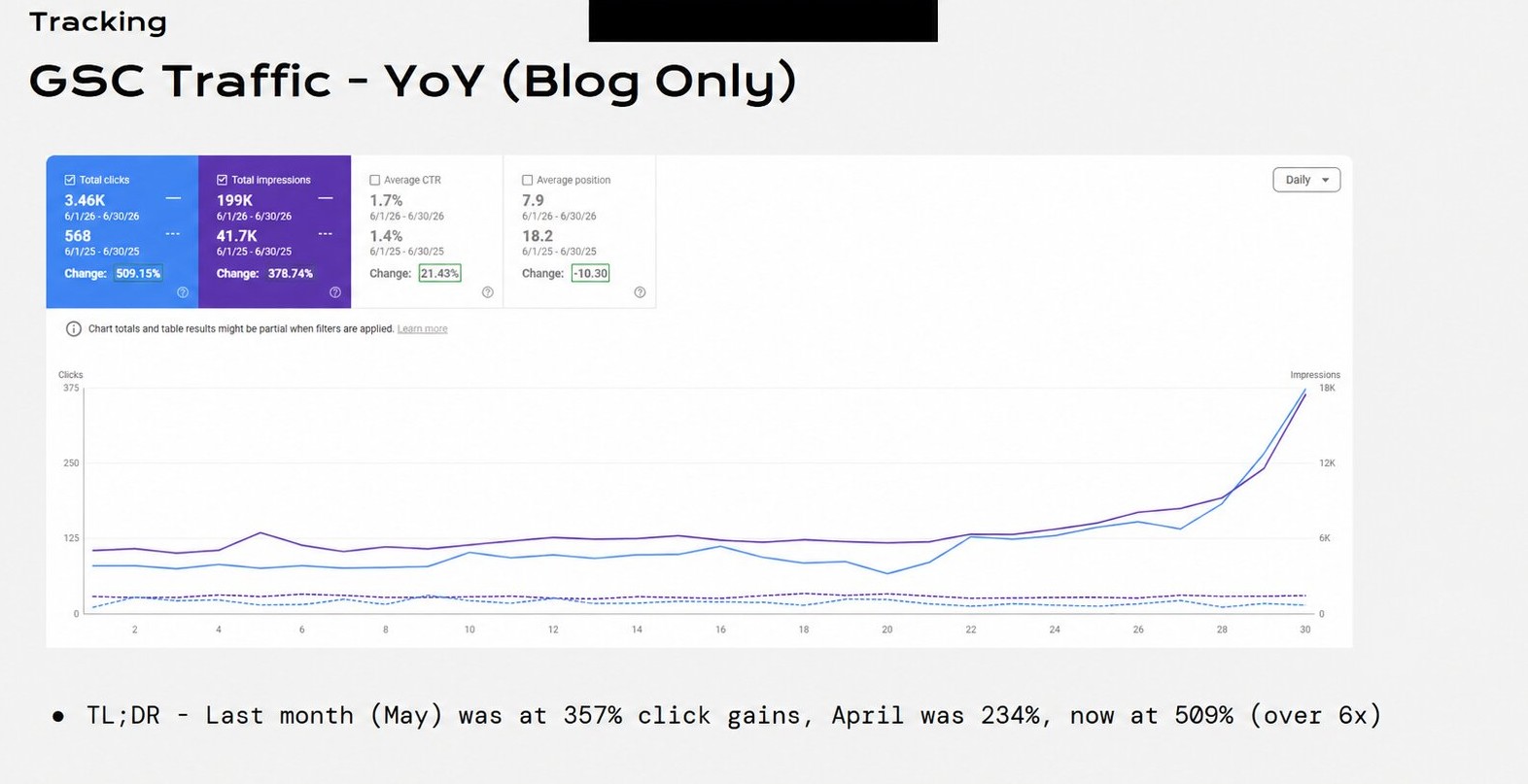
| Metric | Jun 2025 | Jun 2026 | Change |
| Total clicks | 568 | 3,460 | +509.15% |
| Total impressions | 41,700 | 199,000 | +378.74% |
| Average CTR | 1.4% | 1.7% | +21.43% |
| Average position | 18.2 | 7.9 | 10.3 places better |
Three things worth pulling out of that table:
- Position Is The Mechanism: 18.2 to 7.9 is page two to page one, averaged across every blog URL on the site. Clicks are the outcome of that shift, not the cause.
- CTR Went Up, Not Down: On the blog specifically, click-through rate improved 21.43% at the same time as impressions grew nearly 5x. Rankings improved and the content earned a higher share of the clicks available to it.
- Net New Volume: +2,892 organic clicks and +157,300 organic impressions per month, from content alone.
The blog also went from a rounding error to a primary channel. In June 2025 it accounted for roughly 4% of the site’s organic clicks. Twelve months later it was around 23%.
Sitewide Performance, Year Over Year

| Metric | Jun 2025 | Jun 2026 | Change |
| Total clicks | 13,600 | 15,100 | +10.92% |
| Total impressions | 186,000 | 284,000 | +52.98% |
| Average position | 16.4 | 7.4 | 9.0 places better |
Reading it properly: the site is now visible on roughly 98,000 more searches per month than a year earlier, at an average position nine places higher. Sitewide CTR settles lower during a shift like this because the site moved from a narrow, brand-heavy footprint into broad category demand. That is the trade you want. Brand impressions convert at a very high rate and cap out immediately. Category impressions convert lower and scale indefinitely.
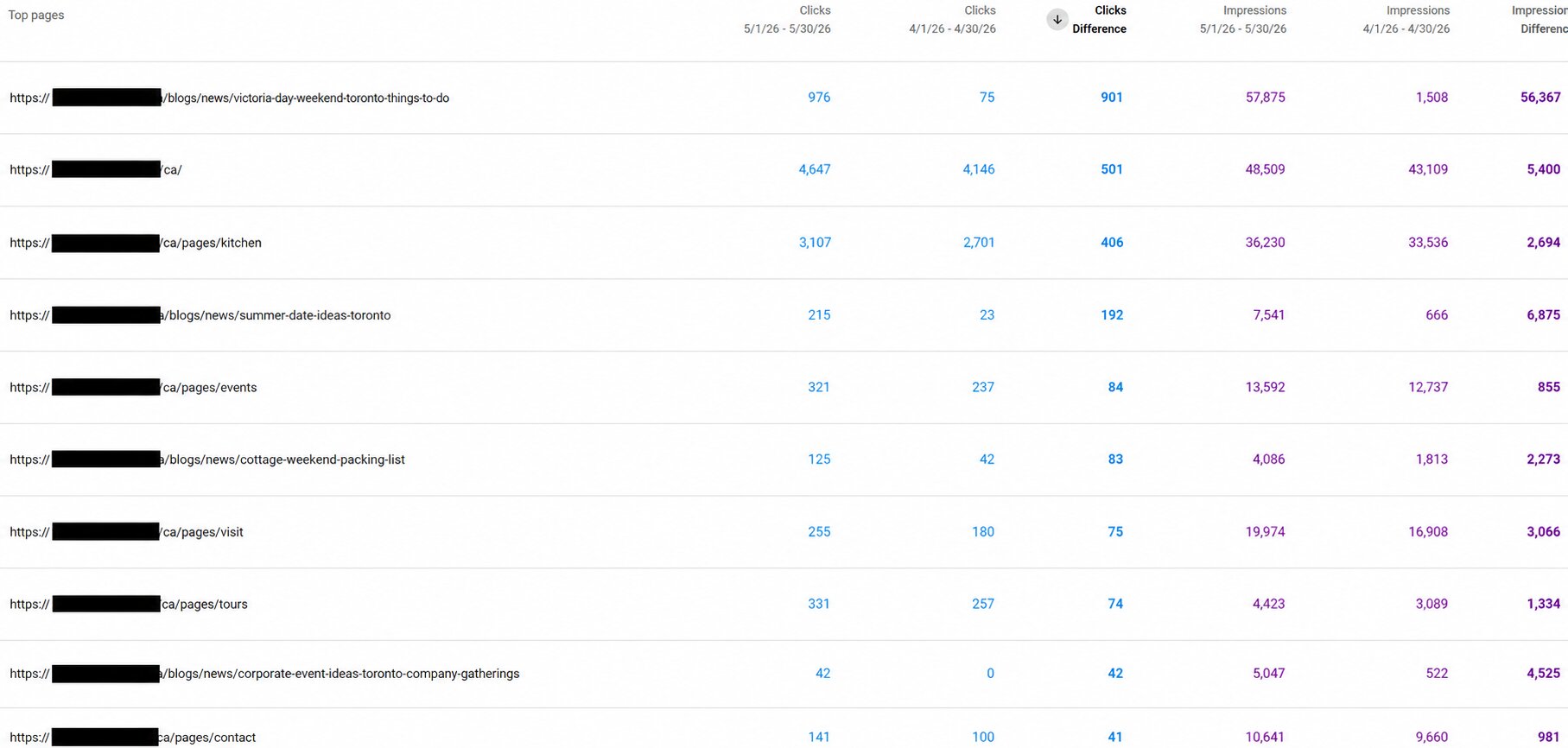
Top Gaining Pages: April to May 2026
| Page | Apr clicks | May clicks | Click gain | Impression gain |
| Long-weekend city guide | 75 | 976 | +901 | +56,367 |
| Homepage | 4,146 | 4,647 | +501 | +5,400 |
| Kitchen page | 2,701 | 3,107 | +406 | +2,694 |
| Summer date ideas guide | 23 | 215 | +192 | +6,875 |
| Events page | 237 | 321 | +84 | +855 |
| Cottage packing list | 42 | 125 | +83 | +2,273 |
| Visit page | 180 | 255 | +75 | +3,066 |
| Tours page | 257 | 331 | +74 | +1,334 |
| Corporate event ideas guide | 0 | 42 | +42 | +4,525 |
| Contact page | 100 | 141 | +41 | +981 |
| Top 10 total | +2,399 | +84,370 |
Top Gaining Pages: May to June 2026

| Page | May clicks | Jun clicks | Click gain | Impression gain |
| Holiday activities guide | 21 | 1,049 | +1,028 | +35,090 |
| Homepage | 4,647 | 5,266 | +619 | +3,421 |
| Kitchen page | 3,107 | 3,531 | +424 | +3,433 |
| World Cup watch guide | 0 | 285 | +285 | +5,981 |
| Summer date ideas guide | 215 | 391 | +176 | +7,613 |
| Cottage packing list | 125 | 248 | +123 | +3,681 |
| Tailgate page | 134 | 244 | +110 | +489 |
| Beer collection page | 261 | 365 | +104 | +1,802 |
| Pre and post-game guide | 127 | 208 | +81 | +2,775 |
| Taproom page | 139 | 200 | +61 | +3,943 |
| Top 10 total | +3,011 | +68,228 |
Across those two months alone: +5,410 incremental organic clicks and +152,598 incremental impressions from the top ten movers.
Two patterns are doing all the work here:
- City Guides Lead: A long-weekend guide (13x clicks, 38x impressions), a holiday guide (50x clicks, 88x impressions), a summer date ideas guide (17x clicks over two months), a cottage packing list, a World Cup watch guide that went from zero to 285 clicks in its first full month. None of them are about beer.
- Money Pages Follow: Kitchen, tours, taproom, tailgate, events, contact and the beer catalog all climbed in the same window. Content that pulls the right audience onto the site lifts the pages that convert them, provided the internal linking is deliberate.
Keyword Movement
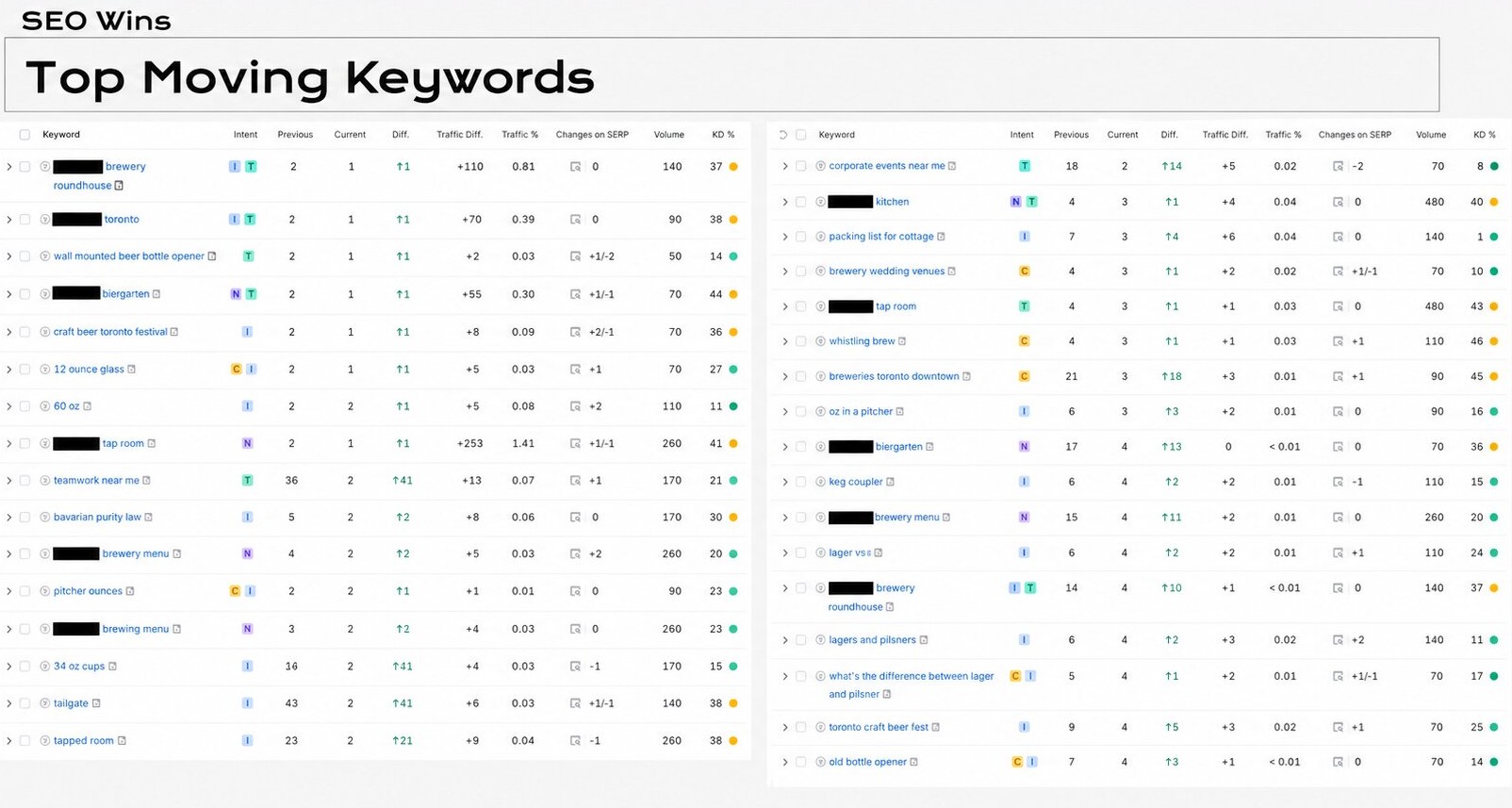
Position distribution across the tracked set:
| Final position | Keywords | Notable movers |
| Position 1 | 8 | City craft beer festival, glassware volume terms, brand taproom term |
| Position 2 | 9 | Corporate events near me (from 16), tailgate (from 43), tap room (from 23) |
| Position 3 | 7 | Breweries downtown (from 21), cottage packing list (from 7), brewery wedding venues |
| Position 4 | 9 | Lagers and pilsners, keg coupler, lager vs pilsner, city craft beer fest |
Selected non-brand movers, with volume and difficulty:
| Keyword theme | Position change | Monthly volume | KD |
| Tailgate | 43 → 2 (+41) | 140 | 38 |
| Team/group venue near me | 36 → 2 (+34) | 170 | 21 |
| Tap room | 23 → 2 (+21) | 280 | 38 |
| Breweries downtown | 21 → 3 (+18) | 90 | 45 |
| Corporate events near me | 16 → 2 (+14) | 70 | 8 |
| Cottage packing list | 7 → 3 (+4) | 140 | 1 |
| Bavarian purity law | 5 → 2 (+3) | 170 | 30 |
| City craft beer fest | 9 → 4 (+5) | 70 | 25 |
| Lagers and pilsners | 6 → 4 (+2) | 140 | 11 |
| Keg coupler | 6 → 4 (+2) | 110 | 15 |
| Brewery wedding venues | 4 → 3 (+1) | 70 | 10 |
| Glassware and pour volume cluster | Positions 1-3 | 90 to 260 each | 11-27 |
Combined estimated traffic gain from that keyword set alone: roughly 600 additional monthly visits, with the single largest contributor being a branded taproom term moving from position 2 to position 1 (+253 estimated visits, 320 monthly searches). Brand terms are not free. They are just cheaper than category terms, and they are worth defending.
The glassware cluster looks like junk traffic and is not. “How many ounces in a pitcher” is a question asked while planning a group visit. Low difficulty, real volume, sitting directly upstream of a taproom booking, and nobody else in the category was answering it properly.
Featured Snippets and AI Overviews
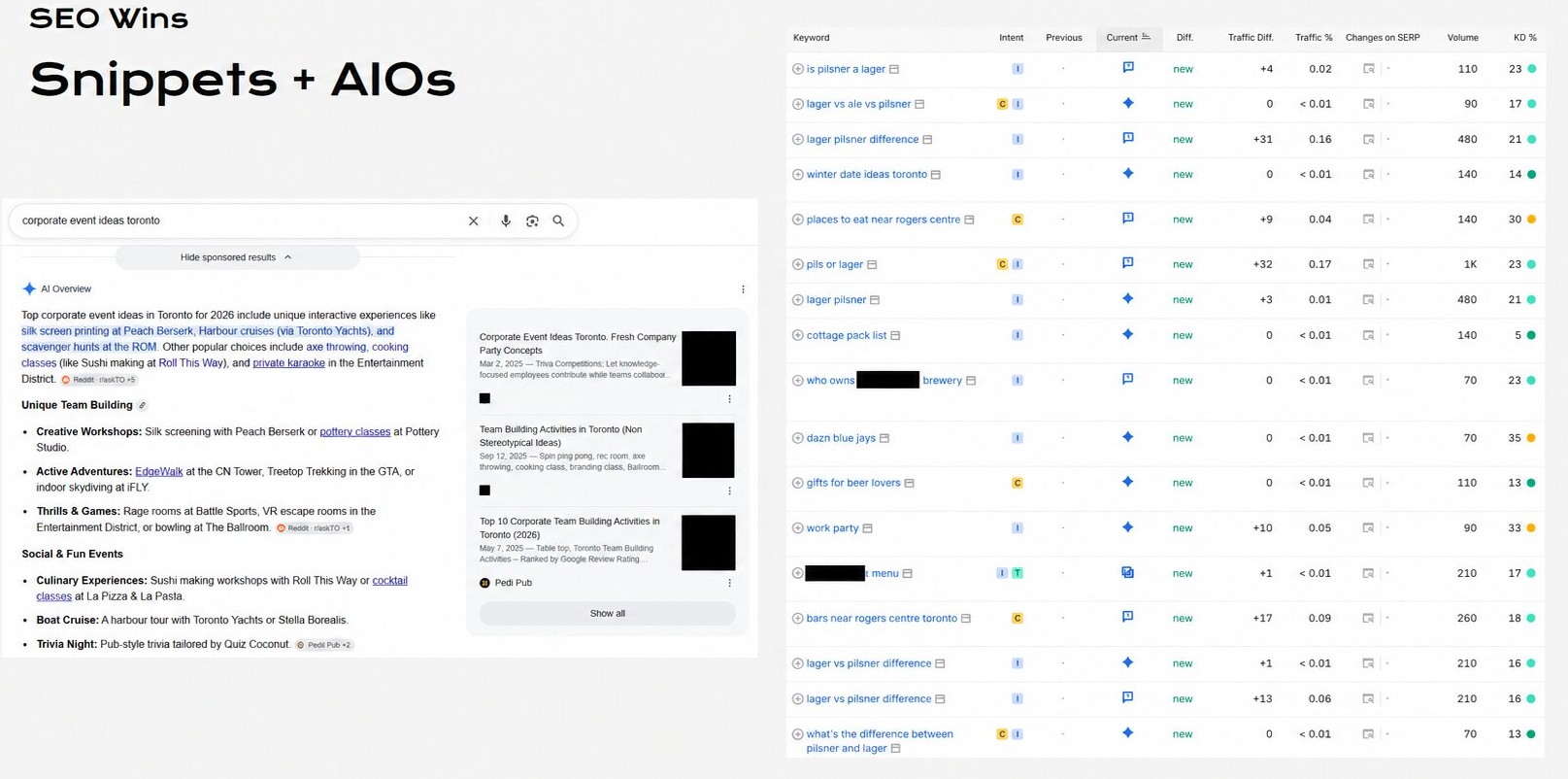
| SERP feature won | Count |
| AI Overviews | 9 |
| Featured snippets | 7 |
| Other rich features | 1 |
| Total new placements | 17 |
| Query theme | Monthly volume | KD | Feature |
| Pils or lager | 1,000 | 23 | Featured snippet |
| Lager pilsner difference | 480 | 21 | Featured snippet |
| Lager pilsner | 480 | 21 | AI Overview |
| Bars near the stadium | 260 | 18 | Featured snippet |
| Lager vs pilsner difference | 210 | 16 | AI Overview + snippet |
| Places to eat near the stadium | 140 | 30 | Featured snippet |
| Winter date ideas | 140 | 14 | AI Overview |
| Cottage pack list | 140 | 5 | AI Overview |
| Gifts for beer lovers | 110 | 13 | AI Overview |
| Is pilsner a lager | 110 | 23 | Featured snippet |
| Work party | 90 | 33 | AI Overview |
| Lager vs ale vs pilsner | 90 | 17 | AI Overview |
| Difference between pilsner and lager | 70 | 13 | AI Overview |
Combined monthly search volume across the new placements: roughly 3,700. Average keyword difficulty: 20.
The AI Overview screenshot is the one I would frame. On a commercial corporate-events query, the brewery’s blog post is sitting in Google’s AI Overview source panel next to Reddit threads and competing venues. That page had zero clicks two months earlier. The account has since cleared 75,000+ Google AI impressions and shows above major publishers and category competitors on relevant searches.
What Actually Drove the Growth
In order of contribution:
- Technical Unblocking. Crawl access, age gate behavior, indexation of blog and product URLs.
- Architecture Separation. Taproom, kitchen, events, tours, tailgate and retail each given their own indexable page and their own intent.
- City And Occasion Content. Seasonal guides published six to eight weeks ahead of the moment they target.
- Beer Education Content. Evergreen style, spec and glassware questions structured for snippet and AI Overview extraction.
- Deliberate Internal Linking. Every guide routed into the taproom, kitchen, events or catalog page it naturally supports.
- Local Entity Work. Google Business Profile, categories, reviews, citations and location signals kept current.
LYNX built and ran this program. If you want the same diagnostic on your brewery, our craft brewery SEO team will map where your demand is leaking before you commit to anything.
Why SEO for Craft Breweries Works Differently
Craft breweries have to rank for several very different customer needs, often at the same time and across the same website.
Five Search Journeys, One Website
A dentist has one journey. A brewery has five, and they all compete for the same nav bar.
| Journey | What the searcher wants | Example queries | Page that should win |
| Taproom and same-day visit | Somewhere to drink in the next two hours | breweries near me, taproom in [city], brewery with food, dog friendly brewery | Google Business Profile plus a real taproom page |
| Events and private bookings | A venue with a capacity number | brewery wedding venues, corporate event ideas, work party venues, private event space | A dedicated event page, separate from the taproom |
| Beer education | To understand a style or spec | lager vs pilsner, is pilsner a lager, ounces in a pitcher, what is a keg coupler | Educational content plus proper product pages |
| Retail availability | To buy your beer elsewhere | where to buy [beer], [brand] near me, beer delivery | Stockist and category pages |
| Occasion and city planning | Something to do this weekend | things to do this long weekend, summer date ideas, where to eat before the game | Blog content built around the city |
The answer layer (AI Overviews, snippets, chatbot recommendations) is not a sixth journey. It is a filter applied across all five.
The most common structural mistake in craft brewery digital marketing is collapsing all of this into one “Visit Us” page and one “Our Beers” page. The event planner and the Thursday-night drinker land on the same URL, and that URL ranks properly for neither. We wrote about the identical pattern in golf website design, where tee times, weddings, the restaurant and the pro shop all fight over three pages. The diagnosis transfers directly.
The Market Case for Doing This Now
- Craft’s share of the US beer market by volume rose to 13.4% in 2025 even as the overall category fell 5.7%, per the Brewers Association’s national beer sales data. Craft retail dollar sales held at $28.0 billion.
- Craft drinkers visited breweries 5.5 times on average over the previous twelve months, up from 5.1, and 58% bought more of a brewery’s product after visiting the taproom, up from 51%, according to the BA’s 2026 consumer survey.
- The BA’s 2026 midyear report found consumer engagement strengthening even while volume stayed under pressure.
- In Canada, brewery counts have levelled off after a decade of expansion, per CBC’s reporting on the sector, which means the remaining demand is concentrating rather than disappearing.
Read together: demand is still there, it is being redistributed toward breweries people can find, and every taproom visit you win through search is also a distribution asset.
Brewery Website Optimization: The Technical Layer
Brewery website optimization has a specific set of failure modes. Clear these and everything downstream gets easier.
Age Gates: The Cheapest Fix With the Biggest Payoff
Google’s John Mueller has said legal interstitials are fine as long as Google can index the content without doing anything special. “Anything special” covers most implementations in the wild, because Googlebot does not click buttons or fill in date fields.
| Implementation | Crawlable? | What happens |
| Redirect to a separate /age-verification URL | No | Every URL on the site resolves to the same gate page |
| Full content replacement in the DOM | No | Google renders the page and finds a form |
| User agent detection (bot sees content, human sees gate) | No | This is cloaking. Manual action risk |
| Cookie-set-then-redirect | No | Crawler never sets the cookie, never reaches content |
| JavaScript or CSS overlay on already-loaded content | Yes | Content loads, modal layers on top. This is the pattern that works |
| No gate on editorial and blog URLs | Yes | Usually appropriate. An article on lager vs pilsner is not a product page |
How to test it in five minutes:
- Open Search Console, URL Inspection, and enter a deep page (a blog post, not the homepage).
- Run “Test Live URL,” then open the rendered HTML.
- If you see your age form and not your article, you found the problem.
- Check the Page Indexing report for “Page indexed without content,” which is the classic symptom.
Compliance constraints do not have to cost you visibility. The same discipline applies in any regulated vertical, which we cover in our cannabis SEO strategy guide and across the other regulated industries LYNX works in.
Minimum Viable Brewery Site Architecture
- Homepage
- Taproom / visit page (hours, parking, seating, dog policy, accessibility)
- Kitchen / food menu as HTML, never a PDF or an image
- Events and private bookings (capacity, floor plans, pricing bands, form)
- Tours (times, price, duration, booking link)
- Beer catalog, with individual pages for core brands
- Where to buy / stockists, with indexable text
- Blog
- About, with the real story and the real people
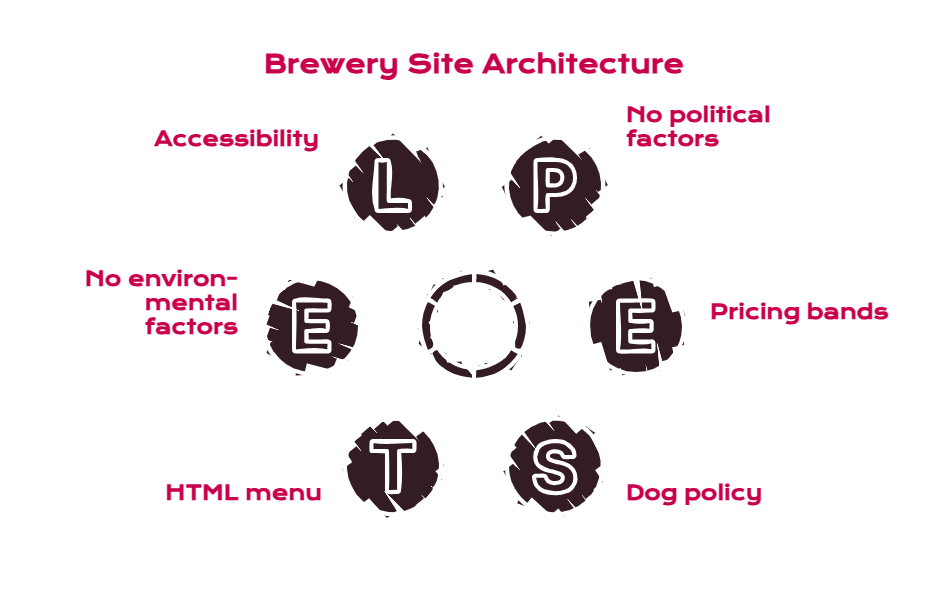
Every one of those pages in our case study account moved independently in the top-gaining reports. That only happens when each intent has somewhere to land.
Structured Data for Breweries
Schema.org has a dedicated Brewery type under FoodEstablishment. Google’s local business structured data guidance tells you to use the most specific subtype available, and most brewery sites do not.
| Schema type | Where it goes | Key properties |
| Brewery | Location and taproom pages | address, geo, openingHours, telephone, priceRange, hasMenu, acceptsReservations |
| Organization | Homepage or about page | logo, sameAs, foundingDate |
| Event | Tastings, tours, releases, live music | name, startDate, location, offers |
| Product / Offer | Individual beers and merch | name, description, offers, availability |
| BreadcrumbList | Sitewide | itemListElement |
| FAQPage | Optional | Google retired FAQ rich results in May 2026. Harmless to keep, no longer a SERP lever |
Google now requires events to have a physical location for the event rich result, which suits breweries perfectly. Note also that Google’s AI features documentation states there is no special structured data requirement for AI Overviews or AI Mode. Schema is a clarity tool, not a shortcut.
Seasonal and Retired Releases
Do not delete the page when the seasonal sells out. Keep the URL, mark it unavailable, link to what is in stock, and update the same page next year. A five-year-old page for your annual autumn release with accumulated links will outrank a brand new one every time.
Speed, Because Brewery Sites Are Image-Heavy
Google’s Core Web Vitals thresholds are the target:
| Metric | Good threshold | Common brewery culprit |
| Largest Contentful Paint | Under 2.5 seconds | Uncompressed hero image of the taproom at dusk |
| Interaction to Next Paint | Under 200 ms | Booking widgets and third-party reservation scripts |
| Cumulative Layout Shift | Under 0.1 | Image galleries and age-gate modals without reserved space |
Most brewery search happens on a phone, often on patio wifi, often at the exact moment someone is choosing between you and the place two blocks over.
Not sure which of these is costing you the most? LYNX runs a technical and demand diagnostic before writing a single page. Start here.
Brewery Local SEO and Taproom SEO
This is where same-day revenue lives.
Google states that local results are based primarily on relevance, distance and prominence. You cannot change distance. You control the other two entirely.
Whitespark’s 2026 Local Search Ranking Factors survey, covering 47 practitioners across 187 factors, puts roughly 32% of local pack influence on Google Business Profile signals and around 20% on reviews, with recency and engagement both rising in weight.
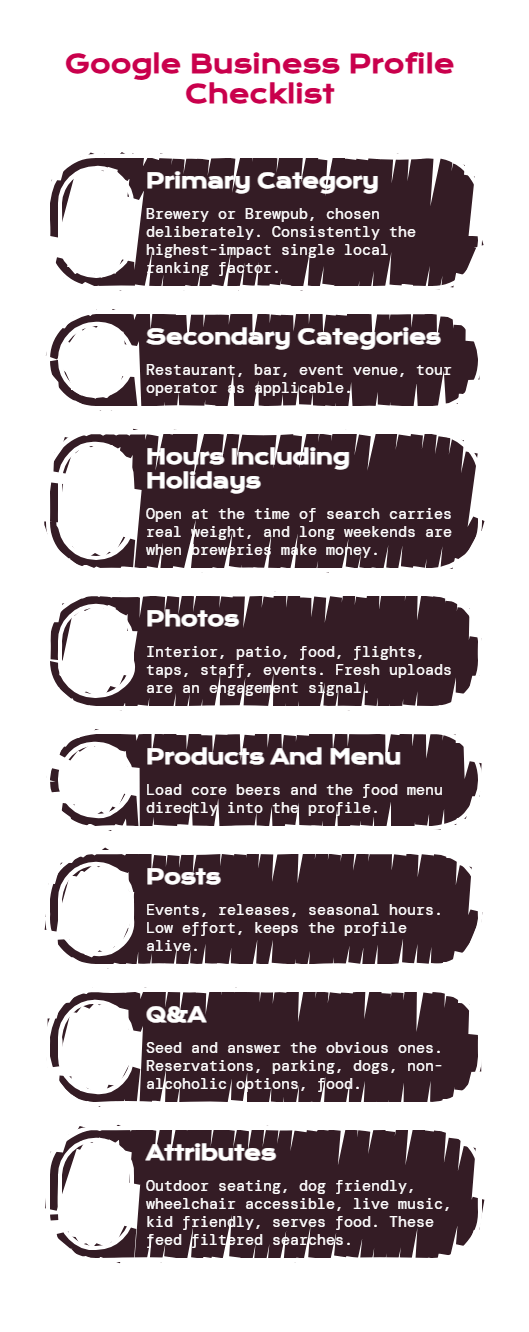
Google Business Profile Checklist
- Primary Category: “Brewery” or “Brewpub,” chosen deliberately. Consistently the highest-impact single local ranking factor.
- Secondary Categories: Restaurant, bar, event venue, tour operator as applicable.
- Hours Including Holidays: “Open at the time of search” carries real weight, and long weekends are when breweries make money.
- Photos, Continuously: Interior, patio, food, flights, taps, staff, events. Fresh uploads are an engagement signal.
- Products And Menu: Load core beers and the food menu directly into the profile.
- Posts: Events, releases, seasonal hours. Low effort, keeps the profile alive.
- Q&A: Seed and answer the obvious ones. Reservations, parking, dogs, non-alcoholic options, food.
- Attributes: Outdoor seating, dog friendly, wheelchair accessible, live music, kid friendly, serves food. These feed filtered searches.
Reviews
Volume, recency, rating and response rate all count toward prominence. More importantly, reviews are how a human picks between two breweries that both appeared in the map pack.
- Build the ask into the operation: servers at the right moment, follow-ups on event bookings, a line in the tour confirmation email.
- Respond to everything, including the bad ones, without getting defensive.
- Watch recency. A steady trickle beats a burst followed by silence.
Split the Taproom Page From the Event Page
The most common taproom SEO mistake is one page serving both “I want a beer tonight” and “I need a venue for 60 people in November.”
In our case study account, corporate events near me moved from position 16 to position 2 and brewery wedding venues holds position 3, because the event space has its own page with capacity numbers and a booking form. The taproom page is then free to be a taproom page.
We break the full split down in our local SEO for breweries taproom and event space playbook, including how to structure the event page so it converts rather than just ranks.
Citations and Local Authority
Consistent name, address and phone across the majors, plus the ones that matter in beer:
- Untappd, BeerAdvocate, RateBeer
- Your provincial or state brewers association
- Regional tourism boards and convention bureaus
- Local “best breweries in [city]” roundups
- Event listing sites and festival organizer pages
- Food and drink sections of local publications
That last group is underrated. Curated best-of lists rank highly as a citation factor and they are exactly what AI systems pull from when someone asks a chatbot where to drink.
Brewery SEO Strategy: Keyword Research That Maps to Revenue
Most brewery keyword research produces a list with your brewery name in it. That is a screenshot of a tool, not a brewery SEO strategy.
| Bucket | Intent | Example terms | Difficulty | Revenue distance |
| Local head terms | Ready to visit | breweries near me, [city] brewery, best craft beer [city] | High, map pack takes most clicks | Immediate |
| Local modifiers | Ready to visit, with a constraint | brewery with food, dog friendly brewery, brewery patio, brewery near [landmark] | Medium, frequently easy wins | Immediate |
| Event and group | Planning, high ticket | brewery wedding venues, corporate event ideas, private event space, work party | Low to medium, badly served | High value, 2-12 weeks out |
| Beer education | Researching | lager vs pilsner, is pilsner a lager, ounces in a pitcher, keg coupler | Low, wins snippets and AI Overviews | Builds authority and citations |
| Occasion and city planning | Planning a day out | things to do this long weekend, summer date ideas, where to eat before the game | Low to medium, seasonal | Medium, enormous at volume |
| Retail availability | Ready to buy | where to buy [beer], [brand] near me, beer delivery | Low for brand, medium for category | Immediate |
Two rules I apply:
- If you cannot name the page and the action, the keyword does not go on the list.
- Track brand and non-brand separately, always. Rising totals with 80% branded share is not growth. Non-brand click share is the honest number for beer brand organic traffic.
Craft Beer Content Marketing: Two Engines
This is where the case study numbers came from. Craft beer content marketing works when you run two engines at once.
Engine One: City and Occasion Content
Write about the city and the reasons someone would be in it. Long weekends, holidays, date ideas, stadium-adjacent food and drink, tailgating, cottage weekends, tournament watch guides.
Results from the case study:
| Content type | Peak monthly clicks | Growth |
| Holiday activities guide | 1,049 | 21 → 1,049 in one month (50x) |
| Long-weekend city guide | 976 | 75 → 976 in one month (13x) |
| Summer date ideas guide | 391 | 23 → 391 over two months (17x) |
| Cottage packing list | 248 | 42 → 248 over two months (6x) |
| World Cup watch guide | 285 | 0 → 285 in first full month |
| Corporate event ideas guide | 42 and climbing | 0 → 42, plus an AI Overview citation |
Three rules if you run this play:
- Be Genuinely Useful First. Recommend other places, including competitors. A list of ten things to do where all ten are your brewery is not a guide, and neither readers nor Google treat it as one.
- Link Into Money Pages Deliberately. This is why the kitchen, tours and taproom pages grew alongside the blog.
- Publish Six To Eight Weeks Early. Indexing and ranking take time. The holiday guide that hit 1,049 clicks was live and accumulating impressions well before the weekend it targeted.
Seasonal content is an annuity, not a firework. Refresh each guide before its season returns and it re-earns its traffic every year off a stronger base. The long-weekend guide that pulled 976 clicks in year one starts year two with authority, links and history already banked.
Engine Two: Beer Education
Evergreen, low difficulty, and quietly the most powerful thing on the site for AI visibility.
| Question cluster | Why it works |
| Lager vs pilsner, is pilsner a lager, lager vs ale | Highest snippet and AI Overview capture rate in the account |
| Glassware and pour volumes (pitcher ounces, glass sizes) | Group-planning intent, KD 11-27, almost no real competition |
| Equipment (keg couplers, bottle openers, tap systems) | Buying and hosting intent, links naturally to retail |
| Brewing standards and history (purity laws, style origins) | Authority signals, earns links from beer publications |
Most of what currently ranks for these terms is thin affiliate content or a forum thread from 2014. A brewery answering them properly outranks all of it, and this cluster produced the majority of the 17 new answer-layer placements.
The Publishing Calendar
| Quarter | Priority content |
| Q1 | Winter date ideas, Valentine’s, St. Patrick’s, spring release preview, two beer education pieces |
| Q2 | Spring and summer long weekends, patio season, festivals, wedding and event content ahead of booking season, cottage and camping |
| Q3 | Summer holidays, sports season guides, tailgating, corporate and holiday party content published early (planners book in September for December) |
| Q4 | Holiday parties, gifts for beer lovers, winter releases, and a full refresh of every seasonal post from the previous year |
You do not need volume. You need the right posts live at the right time. If AI is in your drafting process, our guide on making AI blog content worth reading covers how to keep it from producing the usual sludge, and Google’s helpful content guidance is still the clearest statement of the bar.
Want the content engine built and run for you? This is exactly what LYNX ships for brewery clients. See how it works.
Beer Brand Organic Traffic Beyond the Taproom
Two surfaces most breweries neglect entirely.
Retail and Stockist Pages. Someone researches your beer, likes what they read, and hits a dead end because “Where to Buy” is a map embed with no indexable text. Build regional pages with real retailer names, real copy, and measurable outbound click events so you can prove to distribution partners that search moves shelf product.
Direct Ecommerce. Category pages targeting style and occasion terms, product pages with real descriptions rather than the copy off the can, and structured data on both. In the case study, the beer catalog page gained 104 clicks month over month from content and internal linking alone, with no ad spend. Many brewery sites run on Shopify, which has its own quirks in the answer layer, covered in our guide to Shopify AI Overview optimization.
Craft Brewery Digital Marketing in AI Search
This is no longer theoretical for beer. The Brewers Association published When AI Picks the Brewery in The New Brewer in 2026, documenting that drinkers are using AI tools to decide which brewery to visit and what beer to buy, and that generative models pull primarily from openly accessible sources like news and review sites rather than social feeds.
Scale check: Google reports that AI Overviews now has over 2.5 billion monthly active users and AI Mode has passed one billion. Pew Research Center’s browsing study of 900 US adults found that when an AI summary appears, people click a traditional result far less often. Being inside the answer is now the visibility.
What Gets a Brewery Cited
| Lever | Why it matters | What to do |
| Extractable content | AI Overviews cluster on question-format, informational queries | Question-shaped heading, direct answer immediately beneath, detail after |
| Off-site brand mentions | Ahrefs’ study of 75,000 brands found branded web mentions correlate at 0.664 with AI Overview visibility, versus 0.218 for backlinks | Local press, city guides, beer publications, awards, festival coverage |
| Entity clarity | Models need consistent facts before recommending | Consistent NAP, schema, About page, sameAs links |
| Third-party corroboration | A homepage claim is not enough | Reviews, roundups, tourism listings, association profiles |
| Foundational SEO | Google’s AI optimization guide states AI features run on core Search ranking systems | Everything else in this guide |
Worth noting: Ahrefs found brands in the top quartile for web mentions average over ten times more AI Overview mentions than the quartile below. Semrush’s analysis of 10 million-plus keywords confirms AI Overviews skew toward low-difficulty, question-shaped, informational terms, which is exactly where the beer education cluster sits.
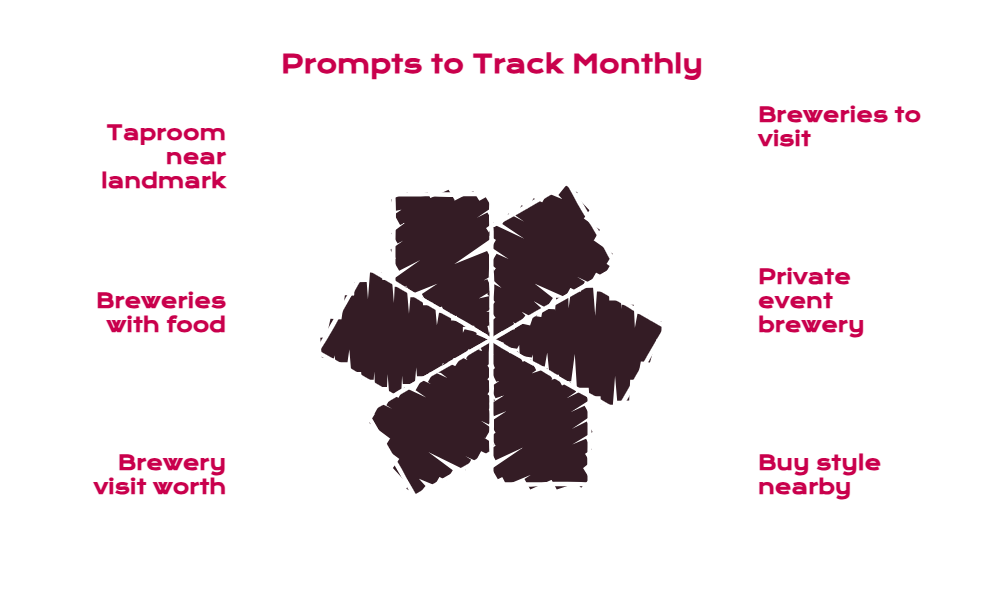
Prompts to Track Monthly
- “What breweries should I visit in [your city]?”
- “Best brewery for a private event in [your city]”
- “Where can I buy [your style] near me?”
- “Is [your brewery] worth visiting?”
- “Breweries with food in [your city]”
- “Best taproom near [local landmark]”
Google is also rolling out generative AI performance reports in Search Console, which show impressions from AI features directly. Check whether your property has it.
Link Building and Brand Mentions for Breweries
Breweries have easier link acquisition than almost any other local business and almost universally waste it.
What works:
- Collaboration Brews: Every collab is a press release, two brewery sites linking to each other, and coverage in beer media.
- Festival Participation: Organizer sites link to participants. Ask.
- Awards And Competitions: Medal announcements get syndicated widely.
- Local Press On Real News: Expansions, anniversaries, new taprooms, charity partnerships.
- Tourism And City Guides: Regional boards and convention bureaus are usually delighted to include a brewery and rarely get asked.
- Unlinked Mention Reclamation: Find every place your name appears without a link. In the AI era, even the ones you cannot convert carry weight.
- The Content Itself: Genuinely good city guides get picked up and cited.
What does not: paid links from beer blog networks, guest posts on sites with no readership, and directory blasts.
Measuring Brewery SEO
| Metric | What it tells you | Source |
| Non-brand organic clicks | Whether you are reaching new people | GSC, query filter excluding brand |
| Average position, non-brand set | Whether the program is working before clicks show it | GSC |
| GBP calls and direction requests | Whether visibility becomes visits | GBP performance report |
| Event and booking form submissions | Direct revenue attribution | GA4 plus CRM or booking tool |
| Stockist outbound clicks | Whether search supports distribution | GA4 custom events |
| Menu and hours page views | Pre-visit intent, strong foot traffic proxy | GA4 |
| Snippet and AI Overview ownership | Share of the answer layer | Semrush, Ahrefs, manual prompt checks |
| AI feature impressions | Visibility inside AI Overviews and AI Mode | Search Console generative AI report |
| Review volume, velocity, rating | Prominence, and the human decision | GBP |
The two that matter most to a brewery owner: non-brand clicks and GBP direction requests. One says the funnel is filling. The other says people are getting in the car. Our full framework is in how to measure the success of an SEO campaign.
How to Market a Brewery Online: The First 90 Days
| Window | Focus | Actions |
| Days 1-30 | Unblock | Audit the age gate with live URL inspection. Fix crawl blockers. Complete GBP with correct primary category, hours, photos, attributes and products. Convert the PDF menu to HTML. Set up GSC and GA4 with conversion events on booking and contact forms. |
| Days 31-60 | Structure | Split taproom, events, tours and kitchen into separate pages with real content, capacity numbers and pricing bands. Deploy Brewery, Organization, Event and Product schema. Build the stockist page with indexable text. Start a review generation routine. |
| Days 61-90 | Publish | Ship one seasonal city guide timed six to eight weeks ahead, one beer education piece on a low-KD question cluster, one event-focused page. Internal link everything into money pages. Begin outreach for local guides and roundups. Split brand and non-brand tracking. |
| Day 90+ | Compound | Publish, refresh, earn mentions, monitor the answer layer, keep the profile alive. |
Brewery SEO Mistakes That Cost the Most
- Menu As A PDF Or Image: Google cannot read it well, AI cannot cite it, and your customers cannot use it on a phone.
- One Page For Every Journey: Taproom, events, tours and food crammed into “Visit Us.”
- Deleting Seasonal Product Pages: Throwing away accumulated authority every single year.
- Untested Age Gates: The single most expensive unforced error in this vertical.
- Only Writing About Your Own Beer: Low volume, low intent, no reason for anyone outside your existing fan base to read it.
- Ignoring Event And Group Search: Highest ticket value, lowest competition, and almost nobody builds a proper page.
- Treating Social Follower Count As The Primary Metric: Community is worth real money. It does not build search or AI visibility, because those systems mostly cannot see it.
- Stale Google Business Profile: Old photos, wrong holiday hours, unanswered questions and reviews.
- Judging The Program At Month Three: This account ran -33%, +20%, +234%, +357%, +509%. Cutting at month three would have looked like a failure.
Conclusion
The breweries winning search right now are not the ones with the best beer or the biggest budget. They are the ones that recognized their website has five jobs instead of one, cleared the technical junk so Google could see the whole site, and published content answering what people in their city are actually searching for.
That combination took the account in this guide from a 33% year-over-year decline to +509% year-over-year click growth, with sitewide average position improving from 16.4 to 7.4, +152,598 incremental impressions across two months of top-page movement, 33 keywords driven into the top four, 17 new snippets and AI Overviews in a single month, and 75,000+ Google AI impressions. No paid media behind any of it.
Everything above is the real brewery SEO strategy, not a teaser. You can run it yourself if you have the time and someone who can talk to your developer.
Work With a Craft Brewery SEO Agency
If you would rather spend that time running the brewery, this is what we do. LYNX built and ran the program in this case study, and we work with breweries, brewpubs, taprooms and beverage brands across Canada and the US.
- See how we map brewery demand at LYNX Craft Brewery SEO
- Browse the other specialist and regulated verticals we work in
- Or just tell us what is broken at LYNX SEO and we will show you where your demand is leaking
Frequently Asked Questions
How Do I Improve SEO for My Brewery?
Start with three things in order. Confirm your age gate is not blocking Googlebot, since this is the most common and most damaging technical issue in the category. Split your taproom, events, tours and food content into separate indexable pages, and complete your Google Business Profile with the correct primary category, current hours, fresh photos and attributes. Then publish content targeting searches happening around your brewery, such as city occasion guides and beer education questions, rather than only content about your own beers. Those three moves cover most of what drives brewery organic visibility.
Does Craft Beer Content Marketing Actually Work?
Yes, and the returns beat expectations because so few breweries do it properly. In the account documented here, blog clicks grew 509% year over year, impressions grew 379%, and average blog position improved from 18.2 to 7.9. The top performers were city occasion guides and beer education pieces, not product announcements. Craft beer content marketing works when it targets what people in your market are already searching, links into your taproom and event pages, and gets refreshed each season rather than published once and abandoned.
How Do Breweries Get Found in Google Search?
Through two systems running in parallel. The local pack and Google Maps are driven by relevance, distance and prominence, which means your Google Business Profile, categories, reviews and local citations. Standard organic results are driven by crawlability, page structure, content depth and inbound authority. Brewery local SEO brings the same-day visitor searching “brewery near me.” Organic search brings the event planner, the person researching beer styles, and the visitor planning their weekend three days ahead.
What Does a Good Brewery Website Need for SEO?
Crawlable content behind a non-blocking age gate, separate indexable pages for taproom, kitchen, events, tours and the beer catalog, an HTML menu rather than a PDF, Brewery and Organization schema, Event schema on your calendar, a stockist page with real text, compressed images that pass Core Web Vitals, and a blog. Every page needs a clear conversion action: directions, a booking form, a reservation link or a retailer lookup. That is the baseline for brewery website optimization.
What Is the Difference Between Brewery Local SEO and Taproom SEO?
They overlap heavily. Brewery local SEO is the broader discipline covering your Google Business Profile, citations, reviews and location signals across the whole business. Taproom SEO is the subset focused specifically on winning same-day visit intent for the drinking space itself, including hours, attributes, seating, dog policy and food availability. A brewery with an event space, tours and a retail catalog needs brewery local SEO applied across all of those, with taproom SEO as one workstream inside it.
How Long Does a Brewery SEO Strategy Take to Show Results?
Google Business Profile improvements can move within one to two weeks. Technical fixes like unblocking an age gate can show indexing changes within a month. Content-driven growth compounds. In this case study the trajectory ran from -33% year over year to +20% at 60 days, then +234%, +357% and +509% across the following three months. Average position improves before clicks do, so use position on your non-brand keyword set as the early signal.
What Are the Best Keywords for a Craft Brewery?
The highest value clusters are local modifiers (brewery with food, dog friendly brewery, brewery patio, brewery near a landmark), event and group terms (brewery wedding venues, corporate event ideas, private event space, work party), beer education questions (lager vs pilsner, is pilsner a lager, ounces in a pitcher), and city occasion terms (things to do this long weekend, summer date ideas, where to eat before the game). Head terms like “breweries near me” are worth chasing through your Google Business Profile, since the map pack absorbs most of those clicks. Your website effort pays better in the modifier and question clusters where competition is thin.
Do Age Gates Hurt Brewery SEO?
They can, badly, depending on the build. Googlebot does not click buttons or fill date fields, so any gate that redirects to a separate verification URL or replaces page content will stop your site being crawled properly. Google has confirmed legal interstitials are fine as long as content can be indexed without special action, which in practice means a JavaScript or CSS overlay on already-loaded content. Test it with a live URL inspection in Search Console on a deep page and check whether the rendered HTML shows your content or your age form.
How Can a Brewery Show Up in AI Overviews and ChatGPT?
Two levers. Make content extractable by using question-shaped headings with a direct answer immediately beneath. Then build off-site brand presence, because research across 75,000 brands found branded web mentions correlate far more strongly with AI Overview visibility than backlinks do. For a brewery that means local press, city guides, beer publications, festival coverage, awards and best-of roundups. In the case study, this combination produced 17 new snippets and AI Overviews in one month and 75,000+ Google AI impressions.
How Much Does Craft Brewery Digital Marketing Cost?
It varies by market competition, site condition and scope. A single-location brewery focused on local visibility sits at the lower end. A brewery with multiple locations, direct ecommerce, a distribution footprint and an event business needs more, because each is a separate search journey with its own requirements. The more useful question is what a qualified visitor is worth. With craft drinkers averaging 5.5 brewery visits a year and 58% buying more of a brewery’s product after a taproom visit, organic acquisition math tends to work out well against paid channels.
Should I Hire a Brewery SEO Agency or Do It In-House?
If you have someone internally with the time, the technical comfort to work with your developer, and the discipline to publish consistently for a year, in-house works and this guide covers the substance. Most brewery teams do not have that capacity, because the person who would own it is also running events, social, packaging and the taproom schedule. A specialist brewery SEO agency makes sense when the backlog is the bottleneck rather than the knowledge, or when the site has multiple search journeys and none are being served properly.
What Should a Brewery Measure to Know if SEO Is Working?
Non-brand organic clicks and average position on your non-brand keyword set are the clearest health indicators, because branded traffic says nothing about acquisition. Alongside those, track Google Business Profile direction requests and calls, event and booking form submissions, stockist outbound clicks, menu and hours page views, and your ownership of featured snippets and AI Overviews. Rankings alone are a leading indicator, so report them as an early signal rather than a result.
How Do I Market a Brewery Online Without a Big Budget?
Prioritize in this order: fix the age gate and crawl blockers (free, just developer time), complete the Google Business Profile properly (free), split your taproom and event pages (a day of work), convert the PDF menu to HTML (an hour), then publish one seasonal city guide and one beer education piece per quarter. That sequence covers the majority of what produced the results in this guide, and none of it requires ad spend. Consistency over twelve months matters more than volume in any single month.