
Quick Answer: Golf website design should be built around the specific type of golf business and what visitors need to do next. Public courses need fast tee time booking, private clubs need clear membership information, resorts need stay-and-play planning, and instructors need direct lesson booking. The best golf websites combine those conversion paths with fast mobile performance, strong local SEO, and a structure built for search visibility.
Golf website design has to solve a different problem for every type of golf business. Public courses need fast tee time booking, private clubs need membership inquiries, resorts need to sell the trip, and instructors need booked lessons. A generic golf website template can get you online, but it often falls short on booking integrations, mobile speed, and the local SEO signals that help golfers find you.
I’m Mike Terry, and I’ve spent more than 15 years building and fixing websites for local businesses, including before starting LYNX SEO. Golf is one of our specialties, and one of the biggest mistakes I see is treating every golf business like it needs the same site.
This piece breaks down what each type of golf business actually needs, where golf website templates fall short, and the SEO and technical groundwork that helps a site show up in search and the AI tools golfers increasingly use to find places to play.
Key Takeaways
- Just 40% of golfers handle their tee time bookings mainly online, a fraction of the 80 to 90% booking rate golfers show for flights, hotels, and rental cars.
- Roughly one in three golfers describe course websites and booking platforms as too clunky, unreliable, or inconvenient to bother with, which points to a booking-experience problem more than a demand problem.
- A website that looks professionally designed and fits its subject matter earns measurably higher credibility scores than one that does not, based on Stanford’s long-running web credibility research.
- Giving each core service, tee times, memberships, events, and lessons, its own dedicated page is the single highest-scoring factor for local organic search rankings, according to Whitespark’s 2026 Local Search Ranking Factors survey.
- LYNX SEO builds golf websites and the search strategy behind them as one system, from booking flow to AI visibility, for courses, clubs, resorts, academies, and tournaments. See how we approach golf and leisure SEO.
Why Golf Website Design Isn’t One Job, It’s Five
Golf website design gets treated as one category, but it is not. A public golf course lives or dies on tee time volume. A private country club lives or dies on membership inquiries and event bookings. A resort is selling a trip, not a single round. An instructor or academy is selling trust in one person’s coaching. A tournament site exists for a few intense weeks a year and then goes quiet. Five different businesses, five different homepages, five different reasons someone actually converts.
The U.S. golf market makes this worth getting right. There were roughly 16,000 golf courses across 14,000 facilities in the country at the end of 2025, and total golf engagement reached 48.1 million Americans that year, a record. That is a lot of businesses competing for the same growing pool of golfers, and the ones with a website built around their specific model tend to capture a disproportionate share of it.
At LYNX, golf sits inside a short list of specialist verticals we go deep in, and our golf and leisure SEO work starts by figuring out which of these five businesses we are actually looking at, because the design brief, the content plan, and the keyword targets change completely depending on the answer.
Golf Course Website Design and Development: What Public and Municipal Courses Need
For a public or municipal course, the website’s only real job is turning a visitor into a booked tee time without a phone call. That sounds simple until you look at how most course sites actually perform.
The National Golf Foundation found that just 40% of golfers handle their tee time bookings mainly online, a fraction of the 80 to 90% booking rate golfers show for flights, hotels, and rental cars. About two out of every three calls a course fields are simple reservation and pricing questions, and roughly one in three golfers say course websites and booking platforms are too clunky, unreliable, or inconvenient to bother with.
Good golf course website development, and golf course web design in general, means the booking widget sits above the fold, current rates and course conditions are visible without a login, and the scorecard, GPS yardages, and weather are one click away. If your booking system lives behind a slow third-party redirect, you are paying for the design and still losing the golfer at the door.
Country Club Website Design and Golf Club Web Design: Membership Comes First
A private club’s website is selling something different: fit and value to someone who has not decided whether they belong there yet. Country club website design that leads with a photo gallery and no pricing signal creates hesitation instead of an inquiry.
The membership section needs to answer the questions a prospect is too polite to ask a member directly. At minimum, that means:
- Membership Types and Pricing: even a range, since total silence on cost reads as exclusionary rather than premium.
- Amenities and Family Fit: pools, dining, junior programs, and anything that answers whether the club works for the whole household.
- Events and Private Bookings: weddings, corporate outings, and tournaments, since these often fund the club as much as dues do.
- A Clear Inquiry or Tour Request Path: one obvious next step, not five competing contact forms.
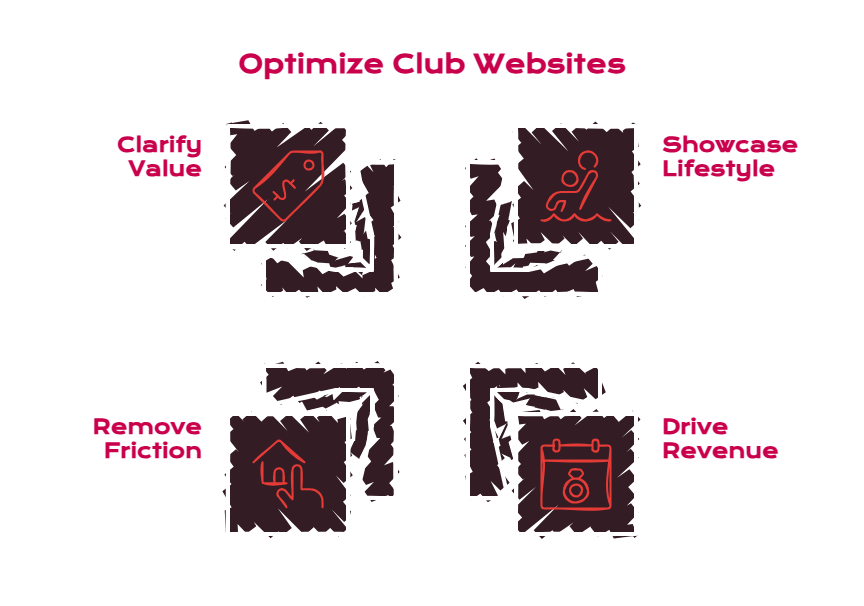
Whether you call it golf club website design, golf club web design, or country club website design, the membership clarity requirement does not change. The dollar amount does. Every club, from a nine-hole community course to a six-figure initiation private facility, needs a prospect to leave the site understanding what it costs and who it is for.
Golf Resort Website Design: Selling the Whole Trip, Not Just the Round
A golf resort is competing with the entire trip, not just the tee time. Golf resort website design has to connect the course to lodging, dining, and the regional draw that got someone searching in the first place, ideally inside one stay-and-play page rather than three disconnected ones.
The visitor comparing resorts is asking about group rates, travel time, and what else there is to do, not just slope rating. A site that only shows the course misses the actual decision being made, and loses the booking to a competitor that built its site around the full trip instead of just the round.
Golf Instructor and Golf Academy Website Design: Turning Visitors Into Booked Lessons
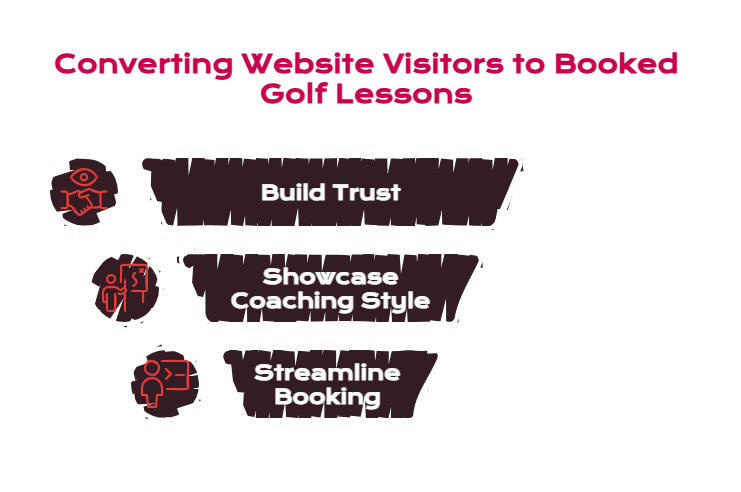
Golf instructor website design and golf coach website design are personal brand problems dressed up as small business ones. A prospective student is evaluating one person’s coaching style and credentials, not a facility, so the site needs to build trust fast. Video or swing analysis samples do more convincing than a paragraph describing a teaching philosophy ever will.
The booking step matters just as much as the pitch. Golf academy website design and golf professional website design should let a visitor book a real lesson slot directly, not fill out a “contact for availability” form and wait. Every extra step between interest and a booked lesson is a chance for that student to book with someone else instead.
Golf Tournament Website Design: One Buried Page Is Not a Strategy
Golf tournament website design and golf tournament web design get treated as an afterthought bolted onto the main course site, and it shows. A tournament page buried three clicks deep, with no registration link and no sponsor visibility, undersells an event that might be the club’s biggest single revenue day of the year.
Whether it is an annual charity scramble or a recurring member-guest, a tournament needs its own registration flow, a sponsor page that actually earns sponsors coming back, and a results or leaderboard archive that gives the event a history instead of starting from zero every year.
| Business Type | Primary Visitor Goal | Website Must-Have |
| Public or Municipal Course | Book a tee time fast | Live booking widget above the fold |
| Private Club or Country Club | Understand fit and value | Membership pricing range plus a tour request path |
| Golf Resort | Plan a full trip | Stay-and-play packages linked to lodging |
| Golf Instructor or Academy | Evaluate the coach | Direct lesson booking plus video proof |
| Tournament or Event | Register and get event details | Dedicated registration and sponsor page |
Golf Website Templates vs. Custom Golf Website Design: Where the Line Actually Matters
A golf website template can get a course online quickly, and for a very small operation with simple needs, that can be a reasonable starting point. The tradeoff is flexibility. Templates tend to fall short in the areas that have the biggest impact on bookings, search visibility, and the overall customer experience.
Where Golf Website Templates Start to Fall Short
Common limitations include:
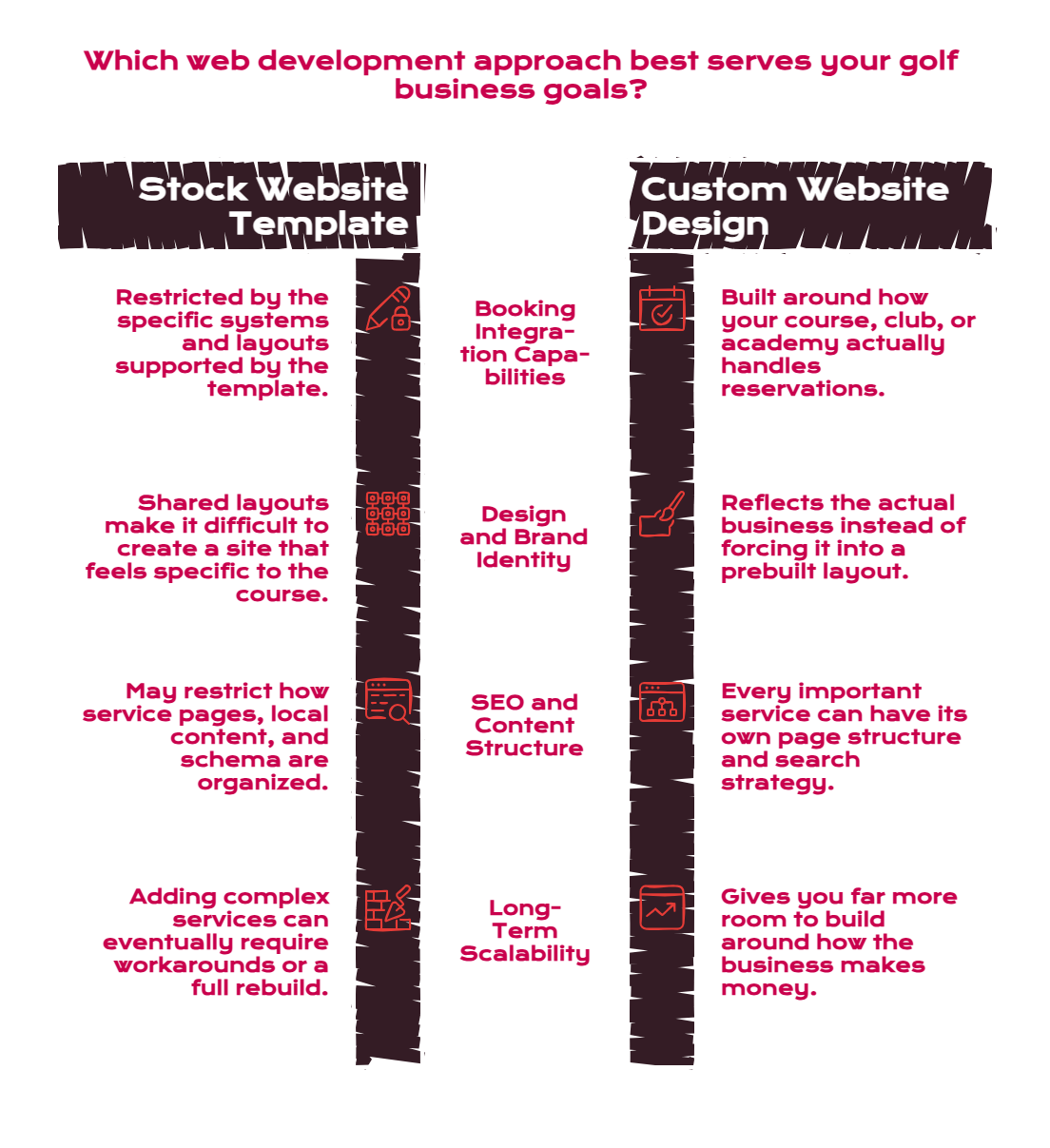
- Booking Integrations: you are limited by the systems and layouts the template supports.
- Page Speed: bloated themes, plugins, and third-party tools can make optimization harder.
- Design Flexibility: shared layouts make it difficult to create a site that feels specific to the course or club.
- SEO Structure: templates may restrict how service pages, local content, schema, and internal links are organized.
- Long-Term Growth: adding memberships, tournaments, lessons, resort packages, or other services can eventually require workarounds or a full rebuild.
Stanford’s long-running web credibility research helps explain why that matters. In its most-cited study, people rated a site as more believable when it “looks professionally designed” and when the design fits its subject matter. Confusing navigation and broken links, meanwhile, sharply reduced credibility.
A stock golf website template shared with hundreds of other businesses can struggle to create that same sense of professionalism and specificity, no matter how polished the photography is.
Where Custom Golf Website Design Earns Its Cost
Custom golf website design becomes more valuable when the site needs to do more than simply establish an online presence. The biggest advantages usually come down to three areas:
- Better Booking Flows: the site can be built around how your course, club, or academy actually handles reservations and inquiries.
- More Flexible Content and SEO: every important service can have its own page structure, search strategy, and supporting content.
- A More Distinct Brand Experience: the design reflects the actual business instead of forcing it into a prebuilt layout.
For a small operation with basic needs, a template may be enough. For a golf business that depends heavily on bookings, memberships, events, lessons, or organic search, custom design gives you far more room to build around how the business actually makes money.
| Factor | Golf Website Template | Custom Golf Website Design |
| Booking Integration | Limited to the template’s built-in options | Built around your actual tee sheet or membership system |
| Design Uniqueness | Shared with hundreds of other sites | A distinct visual identity for your business |
| Page Speed Control | Fixed by the template vendor | Optimized for your specific content and images |
| SEO and Content Flexibility | Rigid page structure | Dedicated pages per service, custom schema |
| Long-Term Return | Lower upfront cost, capped functionality | Higher upfront cost, compounding organic return |
The Technical Side of Golf Website Development Nobody Wants to Talk About
None of the design decisions above matter if the site is slow. Google’s own guidance sets specific, public thresholds for what counts as a good page experience: Largest Contentful Paint under 2.5 seconds, Interaction to Next Paint under 200 milliseconds, and Cumulative Layout Shift under 0.1. A golf site that misses those numbers is fighting its own search rankings before content even enters the picture.
Mobile matters even more than usual in golf. Golfers are checking rates and tee times from the parking lot, not a desktop, and mobile devices already generate well over 60% of all web traffic, climbing above 90% in some industries. A responsive golf course website is not optional at this point. It is the primary version of the site most visitors will ever see.
Before a golf website development project ships, run it through this list:
- Core Web Vitals: test loading speed, responsiveness, and visual stability on the actual booking and rates pages, not just the homepage.
- Mobile Booking Flow: confirm a golfer can book a full tee time on a phone in three taps or fewer.
- Weather and Course Condition Widgets: make sure third-party embeds are not the thing slowing the whole page down.
- HTTPS and Secure Checkout: non-negotiable for any site processing green fee or membership payments.
What the Best Golf Course Websites Get Right (Real Golf Website Examples)
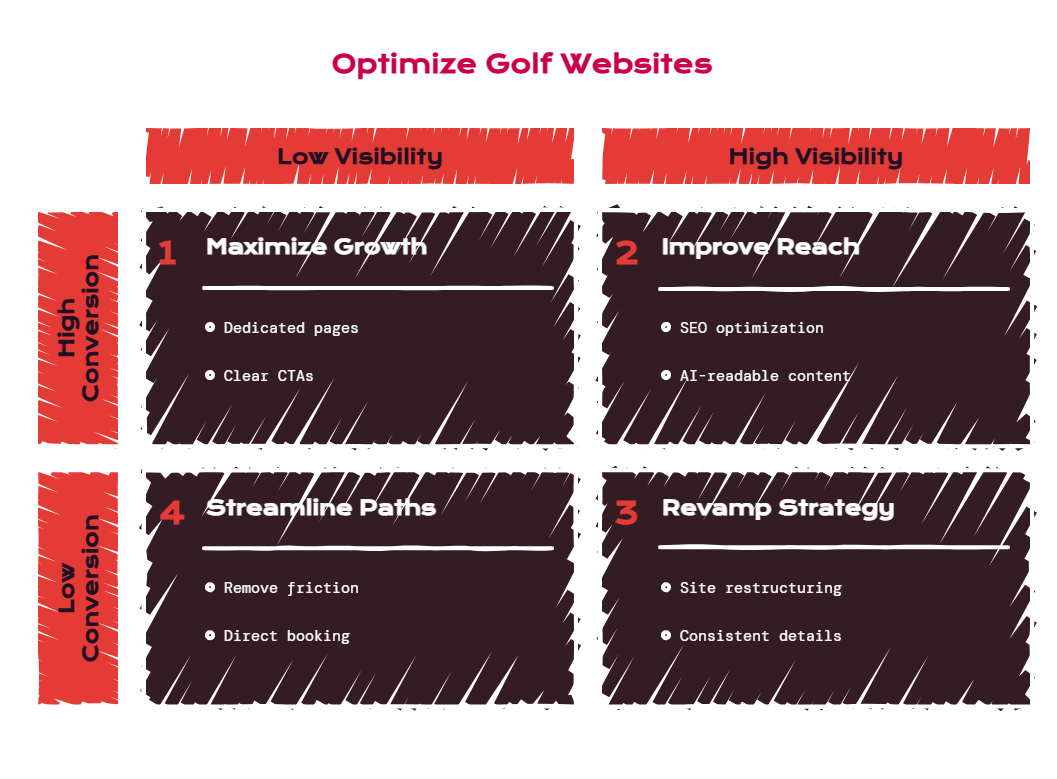
Look at the best golf course websites in any market and the same pattern shows up: they make it easy for each type of visitor to find exactly what they came for. Tee times, memberships, events, lessons, and other core services are given their own dedicated pages instead of being crammed onto one crowded homepage.
That structure matters for usability, but it also matters for search.
Give Every Core Service Its Own Page
A golfer searching for a tee time has a different intent than someone comparing memberships or planning a corporate tournament. The website should reflect that.
At minimum, the main services should have dedicated pages for things like:
- Tee Times: availability, rates, booking policies, and a clear reservation path.
- Memberships: membership types, benefits, pricing guidance, and an inquiry or tour CTA.
- Events and Tournaments: event options, group details, registration, and sponsorship information.
- Lessons and Instruction: instructor profiles, lesson options, pricing, and direct booking.
- Dining or Amenities: where relevant, separate information for restaurants, practice facilities, pools, or other club amenities.
This is not just a design preference. Whitespark’s 2026 Local Search Ranking Factors survey of 47 local search experts scored having a dedicated page for each service as the single highest-impact factor for local organic search rankings, ahead of backlinks and on-page keyword placement.
Make the Next Step Obvious
The strongest golf website examples also remove unnecessary friction between finding information and taking action. Someone ready to play should not have to hunt through several menus to find the booking system. A prospective member should not have to dig through a generic contact page just to request a tour.
Each important page should have one clear next step that matches the visitor’s intent, such as Book a Tee Time, Request a Membership Tour, Book a Lesson, or Register for the Tournament.
The homepage can introduce the course or club, but it should work primarily as a gateway into these more focused pages.
Build for AI Search as Well as Google
The best golf website examples increasingly treat AI visibility as part of the design brief rather than something added after launch.
Golfers can now ask ChatGPT or Google’s AI search features questions such as “best beginner-friendly public course near me” or “golf courses with lessons near Atlanta.” For a golf business to have a chance of appearing in those answers, its website needs to make important information easy for search and AI systems to identify.
That means using:
- Clear page titles and descriptive headings.
- Dedicated pages for individual services and offerings.
- Direct answers to common golfer questions.
- Specific information about location, course type, amenities, pricing, and audience.
- Consistent business details throughout the site.
- Structured content that clearly connects the course with the services it provides.
A visually impressive golf website still has value, but design alone is not enough. The strongest sites combine presentation, conversion paths, local SEO, and AI-readable content so golfers can find the business, understand what it offers, and take the next step without friction.
We have written in detail about how brands earn traffic and visibility from LLMs and the specific signals that determine whether AI answer engines actually cite a page, and the same principles apply directly to golf.
If you want the deeper mechanics of how ChatGPT retrieves and cites content, or want to know exactly where a club currently stands, our guide to auditing a brand’s AI search visibility walks through the process step by step.
Golf Website Redesign: How to Modernize Without Losing Rankings or Bookings
A golf website redesign can improve speed, usability, booking flow, and search visibility, but it also carries real risk if it is treated purely as a visual refresh. Rankings built over years can disappear quickly if URLs change without redirects, important pages get removed, or a new booking platform breaks the crawl paths search engines and AI systems were using to find rates, tee times, memberships, and other core information.
The goal should be to modernize the site without throwing away the authority and visibility the existing one has already earned.
Protect Existing Rankings Before Changing the Site
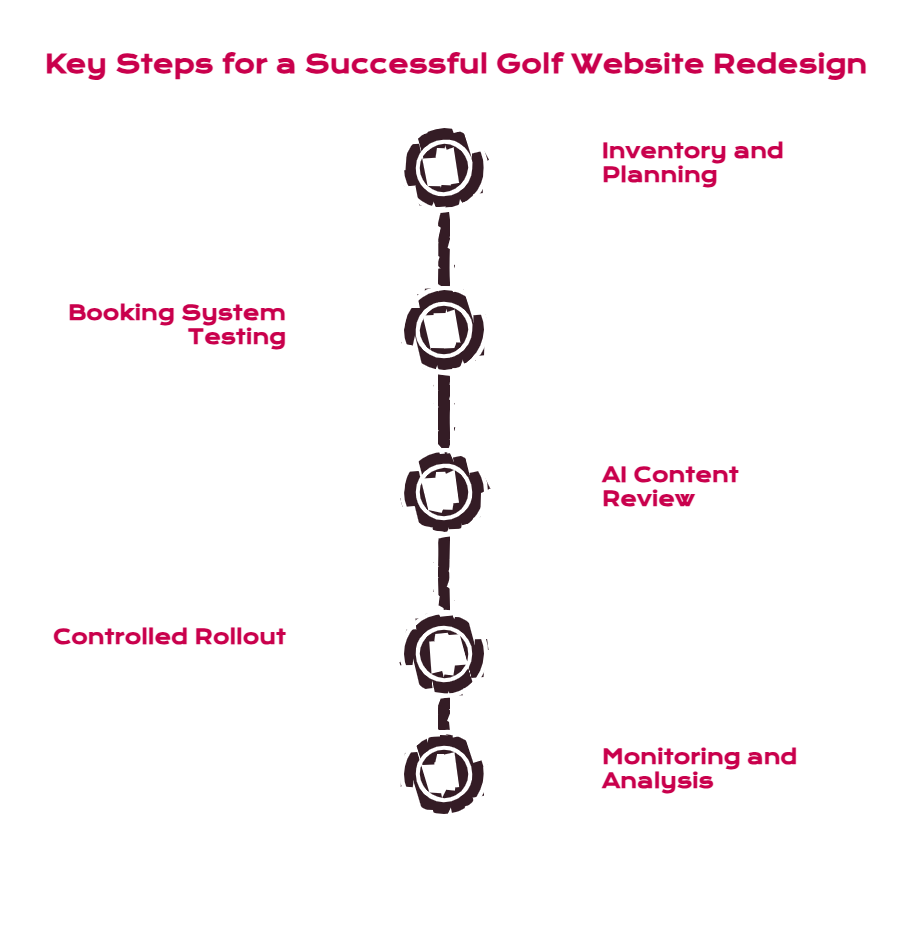
Before development begins, inventory the current site and identify which pages already generate organic traffic, backlinks, bookings, or inquiries. Those URLs should either stay in place or be redirected carefully to the closest relevant replacement.
A redesign plan should account for:
- Existing URLs: map every important URL to its new location before launch.
- 301 Redirects: redirect removed or renamed pages to the most relevant replacement rather than sending everything to the homepage.
- Page Content: preserve useful content, rankings, and topical relevance instead of replacing proven pages simply because the design is changing.
- Internal Links: update navigation and internal links so Google and visitors can still reach important pages easily.
- Metadata: carry over strong title tags, headings, and descriptions where they are still relevant.
- Tracking: make sure analytics, conversion tracking, and booking attribution continue working after launch.
A redesigned homepage means very little if the pages responsible for bringing golfers into the site disappear in the process.
Keep the Booking Experience Working Throughout the Redesign
For a golf course, the booking system is one of the most important parts of the website. Replacing it without testing the full customer journey can turn a better-looking site into a worse-performing one.
Test the new booking flow on desktop and mobile before launch, including rates, availability, account creation, checkout, confirmation emails, and any third-party redirects. If possible, keep the existing booking flow live until the replacement has been fully tested.
The same applies to membership inquiries, lesson bookings, tournament registration, and other revenue-generating forms.
Use AI Content Carefully During the Rewrite
Plenty of clubs now lean on AI tools to help draft new page copy during a redesign, and there is nothing inherently wrong with that. The problem starts when large amounts of AI-generated copy are published unedited, with no one checking whether the information is accurate, useful, or specific to the course.
Generic descriptions of “world-class greens” and “an unforgettable golf experience” add very little for golfers or search engines. New content should reflect what the course actually offers, including real amenities, rates, policies, memberships, instruction, events, and local context.
We cover exactly where that line sits in our breakdown of whether Google penalizes AI content, and golf websites follow the same pattern.
Launch Carefully and Watch What Changes
Before launching a redesign, map every existing URL to its replacement, test the booking flow, confirm analytics are working, and crawl the new site for broken links or missing pages.
Where possible, avoid changing every element of the site at once. A controlled rollout makes it much easier to identify the source of a problem if rankings, traffic, or bookings suddenly move in the wrong direction.
After launch, watch:
- Organic traffic to important landing pages.
- Keyword rankings for tee times, memberships, lessons, and local golf searches.
- Booking and inquiry conversion rates.
- 404 errors and redirect issues.
- Core Web Vitals and mobile performance.
- Indexing in Google Search Console.
A successful golf website redesign should leave the course with a faster, easier-to-use site without forcing it to rebuild its search visibility from scratch.
Conclusion: Your Golf Website Should Work as Hard as Your Course Does
A golf website is not one project. It is five different ones depending on whether you are running a public course, a private club, a resort, an academy, or a tournament, and the businesses winning online right now stopped pretending otherwise. Fast booking flows, membership pages that answer the pricing question, and a technical foundation that passes Core Web Vitals are not nice extras. They are the difference between a site that generates revenue and one that just exists.
I have spent 15-plus years watching general web shops promise a site that “does everything,” and golf is exactly the kind of vertical where that promise falls apart first. It is seasonal, it has multiple audiences competing for the same homepage, and it needs local SEO and AI visibility work layered on top of the design rather than bolted on later. That is true whether we are talking about golf or the other regulated and niche categories where a generic playbook does not hold up, like the platform-specific rules we broke down for cannabis brands building SEO strategy in 2026.
At LYNX, our work across a short list of demanding verticals, including golf and leisure businesses specifically, means we build the site and the search strategy as one system instead of two vendors handing off a half-finished job.
If you would rather spend your time running the course than debugging a booking widget, that is exactly the kind of full-service SEO and web work we do at LYNX. Get in touch and we will tell you straight whether a redesign, a rebuild, or just a technical cleanup is the right next move for your business.
Frequently Asked Questions
What Does Golf Website Design Cost?
Costs vary widely based on complexity. A simple template-based site for a small course can run a few thousand dollars, while a custom golf website design with booking integration, membership portals, and ongoing SEO work typically runs into five figures, with the SEO and content work continuing as a monthly investment after launch.
Is a Golf Website Template Ever a Good Choice?
For a very small or seasonal operation with a tight budget, a golf website template can be a reasonable starting point. The tradeoff is limited booking integration, shared design with other sites on the same template, and less control over the page speed and structure that support search rankings.
What Should a Golf Club Website Include for Prospective Members?
At minimum, a membership types and pricing overview, amenities and family-fit information, an events and private booking section, and one clear path to request a tour or inquiry. Prospects who cannot find pricing or a clear next step tend to move on to a club that made it easier.
How Long Does a Golf Course Website Redesign Take?
A straightforward redesign typically takes six to twelve weeks depending on booking system integration and content volume. Rushed redesigns that skip URL mapping and redirects tend to cost more time later, once rankings and bookings drop and the team has to diagnose what broke.
What Is the Best Golf Course Website Builder for Small Operations?
The right golf course website builder depends on your booking provider and budget. What matters more than the specific platform is whether it supports a fast, mobile-first booking flow and gives you real control over page structure, since a locked-down builder can limit SEO just as much as a static template.
Do Golf Tournament Websites Need Their Own Page?
Yes, at minimum a dedicated page, and often a dedicated microsite for large or recurring events. A tournament buried inside a general events tab tends to get skipped by both search engines and the golfers and sponsors trying to register.
How Important Is Mobile Design for a Golf Website?
Very important. Most golfers check rates, tee times, and directions from a phone rather than a desktop, and a responsive golf course website that fails on mobile loses both bookings and search visibility, since page experience and mobile usability both factor into how Google ranks a site.
Can a Golf Instructor Website Handle Direct Lesson Bookings?
Yes, and it should. A calendar or booking widget embedded directly on a golf instructor website removes the back-and-forth of a contact form and captures a student while their interest is highest, rather than losing them to the wait for a reply.
Does Golf Website Design Affect SEO Rankings?
Directly. Page speed, mobile responsiveness, and site structure are all ranking factors on their own, and a well-designed site also makes it easier to build the dedicated service pages and local content that drive local search visibility for a golf business.
How Often Should a Golf Website Be Redesigned?
Most golf businesses benefit from a full redesign every three to five years, with smaller updates to booking systems, imagery, and content happening continuously in between. Waiting much longer than five years usually means the site is competing against a stale technical foundation as much as a stale look.
Related Reading
- Get More Traffic and Visibility from LLMs
- How to Get Cited in ChatGPT: Write Pages AI Will Quote
- How to Audit Your Brand’s AI Search Visibility (2026 Guide)
Sources
- National Golf Foundation. “Golf’s $100 Million Phone Problem.” 2025.
- National Golf Foundation. “Golf Industry Facts.” 2026.
- Stanford Persuasive Technology Lab and Makovsky and Company. “Stanford-Makovsky Web Credibility Study 2002.” 2002.
- Google Search Central. “Understanding Core Web Vitals and Google Search Results.” 2025.
- Search Engine Journal. “An In-Depth Guide and Best Practices for Mobile SEO.” 2024.
- Whitespark. “Local Search Ranking Factors 2026.” 2025.