Quick Answer: Local SEO for breweries means showing up in Google’s Map Pack and organic results when someone nearby searches for a brewery, taproom, or event venue. The core levers are your Google Business Profile, consistent citations, location-specific pages on your website, review velocity, and structured data. The part most brewery SEO guides skip: taprooms and brewpub event spaces have a dual-intent problem. You need to rank for “brewery near me” AND “private event venue near me” – and those are separate search journeys that need separate pages, separate keyword strategies, and sometimes separate sections of your GBP.
The craft beer industry is crowded, and it’s only getting more competitive. According to the Brewers Association’s 2024 industry report, there were 9,796 operating U.S. craft breweries that year, including 3,552 brewpubs and 3,936 taproom breweries. That’s before you count the ones that opened this year, the ones that have been quietly dominating Google for five years, and every other taproom within driving distance of your customer’s couch.
Here’s the thing: volume doesn’t win. Visibility does.
Research from Google and Think with Google shows that 46% of all searches have local intent, and queries like “brewery near me” often convert into visits the same day. These aren’t browsers – they’re people who’ve decided they’re going out and are actively choosing where. If your taproom isn’t showing up in that moment, someone else’s is.
Most brewery SEO content covers the basics: claim your Google Business Profile, get some reviews, maybe start a blog. That’s fine as a starting point. But what nobody addresses cleanly is the dual-intent challenge that taprooms and brewpub event spaces face. You’re not running a simple bar. You’re running a destination that needs to rank for “beer near me” on a Tuesday night and “private event space in [city]” when a company is planning their holiday party.
Those are fundamentally different search intents, different keyword sets, and different conversion paths – and they need to be treated separately. This is the playbook that addresses both.
Key Takeaways
- Your brewery Google Business Profile is the single highest-leverage local SEO asset you have – most breweries underuse it significantly
- Taproom local SEO and brewery event space SEO require separate pages, separate keywords, and separate conversion paths on your website
- Review velocity matters more than overall star rating for local ranking – a brewery with 400 reviews at 4.6 stars will almost always outrank one with 80 reviews at 4.8
- Structured data (LocalBusiness + Event schema) helps Google understand both sides of your business and can unlock rich results in search
- NAP consistency across every directory isn’t optional – it’s foundational infrastructure
- Local content targeting neighborhood-level search terms is one of the least competitive, highest-ROI moves most breweries aren’t making
- Citations on beer-specific platforms (Untappd, BeerAdvocate, RateBeer) carry extra weight in this niche on top of standard local directories
Why Craft Beer Local SEO Is a Dual-Intent Problem
Most local businesses have one primary search intent to capture. A dentist needs to rank for “[city] dentist” and variations of it. A pizza place needs “pizza near me.” Simple.
A taproom with an event space has two completely separate customer journeys happening at the same time:
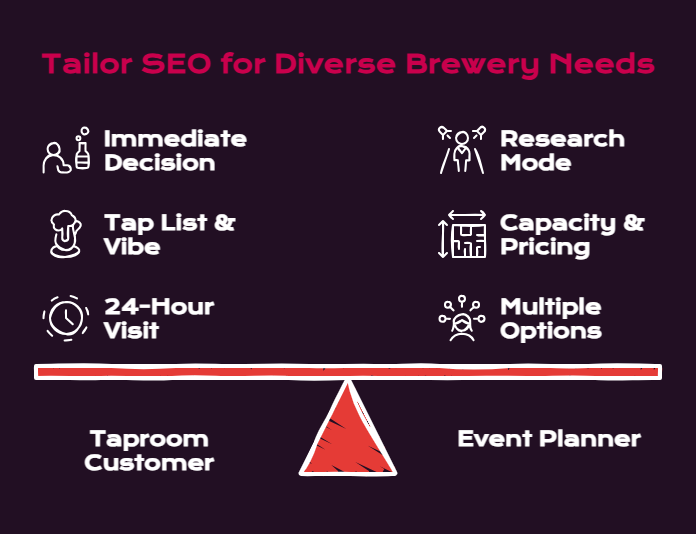
Journey 1 – The Taproom Customer: Someone nearby wants a pint. They search “breweries near me,” “craft beer [city],” “taproom near me,” or specific styles like “IPA brewery [neighborhood].” They’re making a decision right now. They want to see your hours, your tap list, your vibe, and probably your reviews. According to Google’s own research, 76% of people who search for something nearby visit a business within 24 hours.
Journey 2 – The Event Planner: A marketing coordinator is planning a corporate event. A couple is looking for a rehearsal dinner venue. A birthday organizer wants somewhere with character. They search “brewery event venue [city],” “private event space brewery,” or “corporate event brewery venue.” They’re in research mode, comparing multiple options, and need to see capacity, catering info, pricing, photos of events, and a way to contact you.
The problem: most brewery websites treat these as the same visitor. They don’t. They have different intents, different timelines, and different things they need to see before converting. Your local SEO strategy needs to address both – with separate pages, separate keyword targeting, and separate content.
This is where taproom local SEO and brewery event space SEO need to diverge on your site. If you’re only ranking for the taproom terms, you’re leaving the event business to whoever has a dedicated page for it. And that event booking revenue is usually where the real margin is.
Brewery Google Business Profile: The Foundation of Taproom Local SEO
Google’s local search algorithm uses three key components to determine which businesses appear in local search results: proximity, relevance, and prominence. The Whitespark 2026 Local Search Ranking Factors report, compiled from 47 local SEO experts, identifies your GBP primary category as the single most influential factor for local pack rankings. Get this right first before anything else.
Setting Up Categories the Right Way
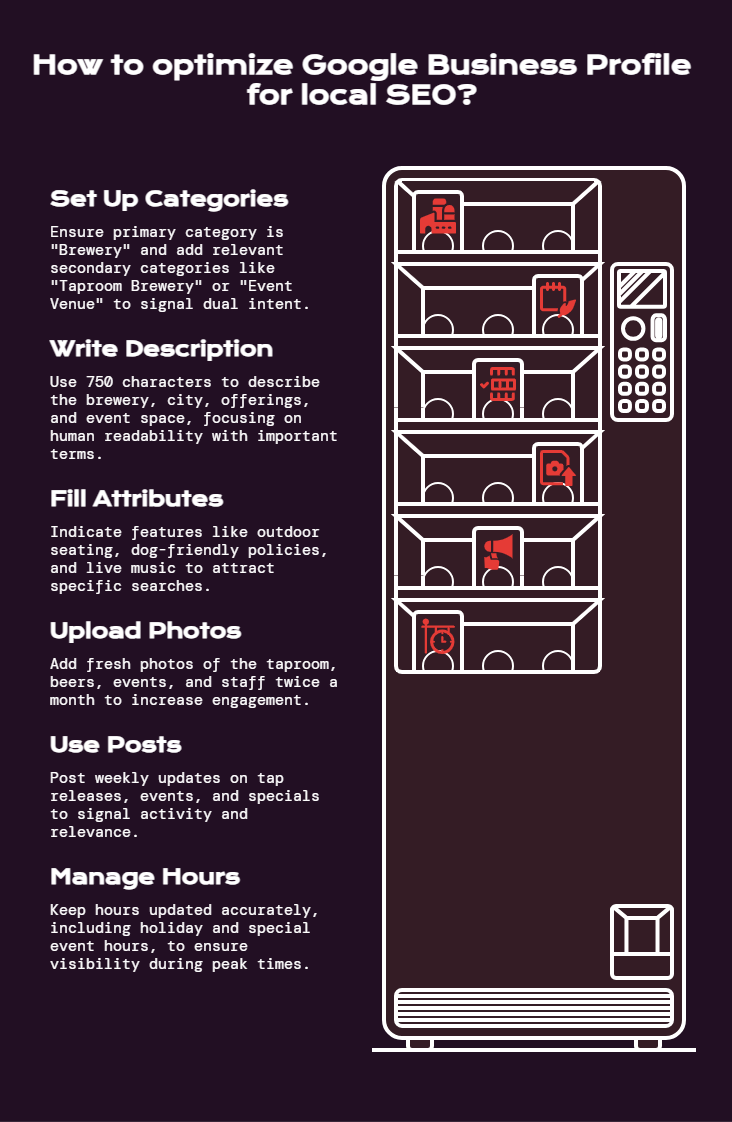
Your primary category should be “Brewery.” That’s non-negotiable if brewing is your core business. From there, you can add secondary categories based on what you actually offer:
- Taproom Brewery
- Bar
- Restaurant (if you serve substantial food)
- Event Venue (if private events are a significant part of your revenue)
- Wedding Venue (if you do weddings specifically)
BrightLocal’s analysis of local ranking factors confirms that choosing the correct categories is fundamental – if the business category is incorrect, it may not rank at all for the desired keywords. Adding “Event Venue” as a secondary category is how you start signaling to Google that you serve that second search intent without abandoning your brewery identity.
One thing worth knowing: the August 2025 spam update specifically targeted keyword stuffing in business names. Google is suspending profiles that add keywords not found in their legal name or signage. Your business name in GBP should match exactly what’s on your sign.
The GBP Description and Attributes
You get 750 characters for your business description. Use them. Work in your city, your neighborhood, what you brew, what makes your taproom distinctive, and – if relevant – that you offer private event space. Don’t make it a keyword dump. Write it for a human first, then check that the important terms are in there.
The attributes section is where most breweries leave points on the table. GBP lets you indicate things like outdoor seating, dog-friendly policies, live music, private event space availability, food service, and more. Every attribute you fill in is a relevance signal for a different subset of searches – someone looking for “dog-friendly brewery near me” or “brewery with outdoor seating” will be filtered partly based on these attributes.
Photos and Posts: The Active Profile Advantage
Google’s own data shows that businesses with photos get 42% more requests for directions and 35% more website clicks. Add new photos at least twice a month – freshness is a ranking signal.
What to upload:
- Taproom interior and exterior (multiple angles, multiple times of day)
- Specific beer shots – pints, cans, flights
- Events you’ve hosted (with permission if people are in them)
- Food if you serve it
- Staff working – makes it feel human
- Your event space set up for different occasions (corporate, birthday, wedding-adjacent)
The Posts feature is where things get interesting for dual-intent businesses. Post your new tap releases, upcoming events, and specials every week. These posts appear directly in your GBP listing and signal to Google that your business is active and relevant – most of your competitors aren’t doing this, which makes it easy differentiation.
For a brewery with an event space, use posts strategically: weekly taproom updates (new releases, events, hours changes), dedicated posts for ticketed public events, and periodic “event space” posts showcasing recent private events or promoting the booking option.
Hours Management: Don’t Let This Tank Your Ranking
The Whitespark Local Search Ranking Factors research flags business hours accuracy as one of the most underrated ranking signals – more influential than many on-page factors. Businesses that are open when a user performs a search are more likely to show up in that search.
Keep your hours updated religiously: holiday hours, special event hours, closed for a private event. Google needs accurate information. If someone searches for you on a Friday night when you’re showing as closed because you forgot to update your hours, you’re invisible at the highest-intent moment of the week.
Review Strategy: The Local Ranking Lever Most Breweries Get Wrong
The BrightLocal Local Consumer Review Survey confirms that reviews are one of the most significant ranking signals in local SEO – and the Whitespark 2026 ranking factors study found reviews have grown in importance for local pack rankings, from 16% of weighted factors in 2023 to 20% today.
The counterintuitive part: it’s not about having a perfect score. A brewery with 400 reviews at 4.6 stars will almost always outrank one with 80 reviews at 4.8, all else being equal, because recency and volume both matter more than the precise rating.
Building a Review System That Actually Works
You need a system, not a hope. A few things that actually work:
- Train front-of-house staff to mention reviews at the end of a good interaction. Not a script, just a natural prompt: “If you enjoyed tonight, a Google review goes a long way for us.”
- Put a QR code on your receipts, table tents, and anywhere near the exit that links directly to your GBP review page (not your homepage – the actual review submission page).
- Follow up with customers who book private events via email. They’re already in your system, they had a good experience, and they’re exactly the kind of detailed reviewer that future event clients want to see.
- Respond to every review within 48 hours – positive and negative. The Brewers Association’s guide to getting more Google reviews makes the case that when people are deciding between a few breweries, reviews are often the deciding factor – and they influence rankings too.
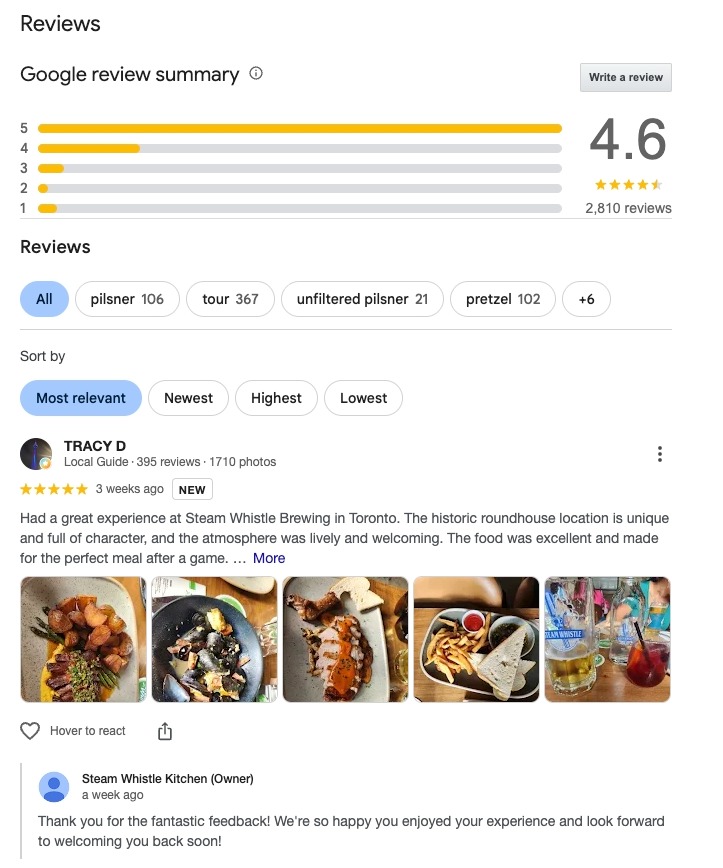
A negative review with a thoughtful, professional response often reads better to a potential customer than a negative review with silence. Don’t avoid negative reviews – address them.
Beer-Specific Review Platforms
For craft beer businesses, the standard review ecosystem extends beyond Google. Platforms like Untappd, BeerAdvocate, and RateBeer carry real weight for your brewery’s online presence. These platforms show up in search results and serve as citation sources that reinforce your legitimacy in the niche. Untappd in particular is where your core craft beer audience lives – an active, verified presence there signals to both Google and potential customers that you’re the real deal.
Website Architecture for Taproom Local SEO and Brewery Event Space SEO
Your GBP does a lot of the heavy lifting in the Map Pack. But your website is what ranks in organic results, what people land on after clicking through, and what converts visitors into either taproom guests or event bookings. Most brewery websites are not built to do all of this.
The Pages You Need (And Most Breweries Don’t Have)
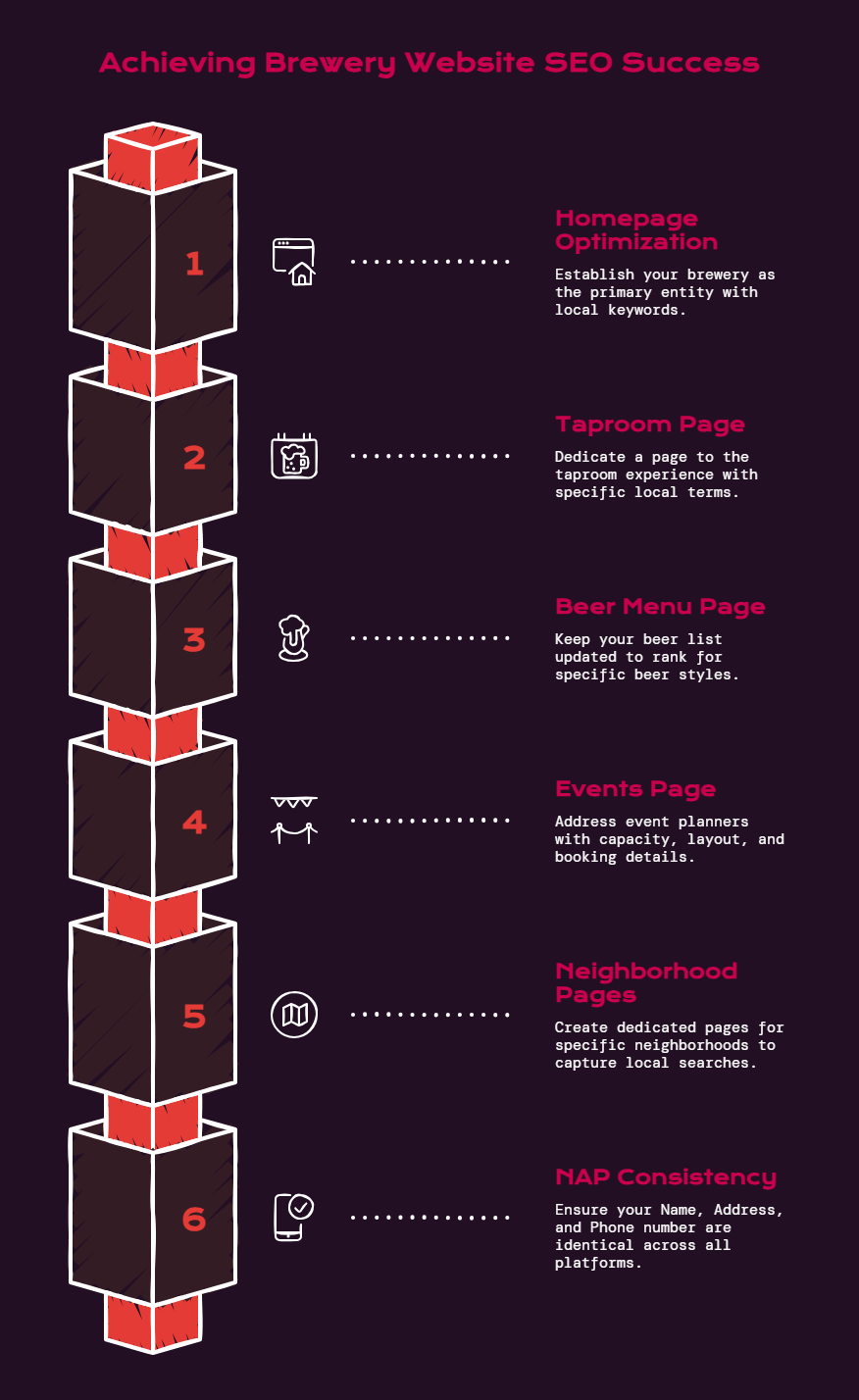
Here’s how to structure a brewery website to capture both search intents:
Homepage: Positions your brewery as the primary entity. Lead with your city, your name, your core identity. Target your highest-volume local term (“craft brewery in [city]”) but don’t over-optimize.
Taproom Page: Dedicated to the taproom experience. Hours, current tap list, food (if any), parking, what to expect. Target taproom-specific terms: “taproom [city],” “[neighborhood] taproom,” “brewery taproom near me.” This page should include your full NAP (Name, Address, Phone) in text, not just an image.
Beer Menu / Tap List Page: Keep this updated. People search for specific styles: “hazy IPA brewery near me,” “sour beer taproom [city].” If your tap list is on its own indexed page and updated regularly, you can rank for these long-tail terms.
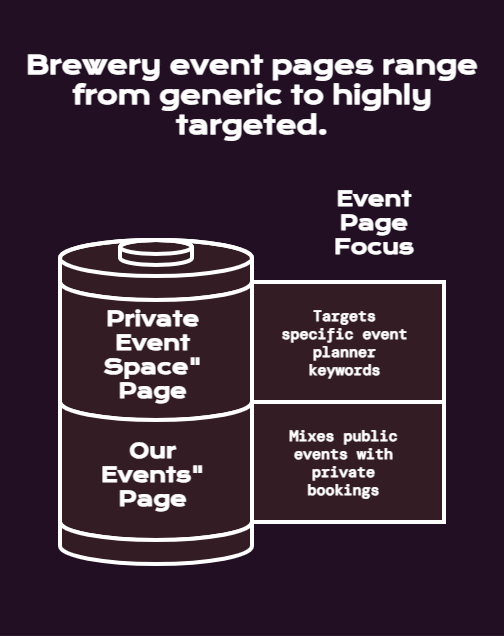
Events / Private Events Page: This is the page that captures the second search intent. It needs to address the event planner directly: capacity, layout options, catering/food arrangements, equipment included, booking process, and photos of events you’ve hosted. Target terms like “brewery event venue [city],” “private event space [city],” and “corporate event brewery.” This page should have its own conversion path – an inquiry form or a calendar booking link.
Neighborhood/Location Landing Pages: If you’re in a large metro and people search by neighborhood, a dedicated page for “[neighborhood] brewery” can rank for terms your homepage can’t. Don’t create thin placeholder pages – these need real, unique content.
The NAP Consistency Rule
NAP stands for Name, Address, Phone number. It needs to be identical everywhere it appears: your website, your GBP, Yelp, Untappd, BeerAdvocate, Apple Maps, Bing Places, TripAdvisor, local chamber of commerce listings, and anywhere else you’re listed.
BrightLocal’s research on local business discovery shows that 62% of consumers would avoid using a business if they found incorrect information about it online. Inconsistent NAP is one of the most common and most damaging local SEO mistakes breweries make. Run a citation audit through a tool like Moz Local or BrightLocal, fix the inconsistencies, and then monitor quarterly.
Targeting Craft Beer Local SEO Keywords: What to Go After (and What to Ignore)
Keyword strategy for craft beer local SEO is about understanding the difference between terms that send someone to your taproom tonight versus terms that pull in an event planner who’ll book six months out.
Here’s a breakdown of the keyword clusters worth targeting:
| Keyword Category | Example Terms | Target Page | Intent |
| Primary taproom | “brewery near me,” “craft brewery [city],” “taproom near me” | Homepage / Taproom page | Visit tonight |
| Neighborhood | “[neighborhood] brewery,” “brewery near [landmark]” | Location landing page | Visit tonight |
| Beer style | “IPA brewery [city],” “sour beer taproom [city]” | Tap list / Taproom page | Visit tonight |
| Event venue | “brewery event venue [city],” “private event space brewery” | Events page | Planner research |
| Specific event type | “corporate event brewery [city],” “brewery wedding venue” | Events page | Planner research |
| Activity-based | “brewery with live music [city],” “dog-friendly taproom [city]” | Homepage / Taproom page | Visit planning |
| Experience | “brewery tour [city],” “beer tasting experience [city]” | Tours/Events page | Experience seeker |
The middle of that table – event venue terms – is where most taproom websites are completely invisible. A brewery that has both a great taproom and a dedicated event space but only ranks for taproom terms is leaving serious revenue on the table.
Also worth targeting: hyperlocal searches that your homepage can’t rank for. A dedicated local landing page – “Craft Brewery in [Neighborhood]” or “Taproom Near [Nearby City]” – gives you a shot at ranking for hyper-local searches that your homepage can’t compete for. Two or three of these, done properly, can capture a meaningful slice of local traffic that nobody else in your market is going after.
Don’t know where to start with keyword research? The guide to finding SEO keywords for your website covers the process from scratch.
Local Citation Building for Breweries and Brewpubs
Citations are mentions of your business’s NAP across the web. They tell Google you’re a real, established business with a consistent presence. For breweries specifically, the citation ecosystem includes both general local directories and niche beer platforms.
Where to Get Listed
The standard directories every local business needs:
- Google Business Profile (primary)
- Apple Maps / Apple Business Connect
- Bing Places
- Yelp
- Facebook Business Page
- TripAdvisor
- Foursquare
Brewery and hospitality-specific platforms that carry extra relevance:
- Untappd (critical for craft beer – verify your venue and keep beers updated)
- BeerAdvocate
- RateBeer
- Local tourism and food/drink directories in your city
- Local chambers of commerce
- “Best of [city]” roundup pages where you can get mentioned or listed
Structured Data for Brewery Websites: Getting Both Intents Indexed Properly
Structured data (schema markup) is how you explicitly tell search engines what your pages are about. For a brewery with an event space, this matters more than most local businesses because you’re trying to signal two distinct business functions to Google.
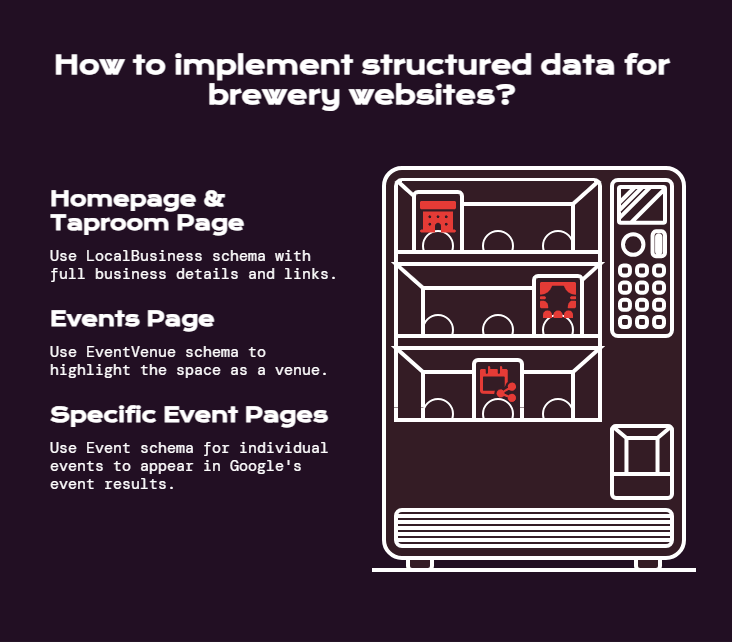
Search Engine Journal’s guide to local schema identifies two key schema types for businesses like breweries: LocalBusiness schema, which supplies essential business details like name, hours, and services, and Event schema, which highlights local events directly tied to the user’s location and query.
For a brewery, here’s how to apply this practically:
On your homepage and taproom page: Use LocalBusiness schema (or BrewingCompany if your CMS supports it) with full NAP, hours, geo coordinates, price range, and links to your GBP and social profiles.
On your events page: Use EventVenue schema to signal that this page is specifically about your space as a venue. Pair it with your LocalBusiness schema.
For specific upcoming events (trivia nights, beer releases, live music): Use Event schema on individual event pages or listings. This makes those events eligible to show up in Google’s event results and rich snippets. Research from hospitality schema implementation studies shows that pages using structured data with LocalBusiness schema can see around a 30% increase in click-through rates after markup is validated.
Use Google’s Rich Results Test to validate your markup before and after implementation. It’s free and takes about two minutes.
Local Content Strategy: How to Rank for “Brewery Near Me” Beyond the Map Pack
The Map Pack captures most of the local clicks, but organic rankings below it still matter – especially for longer-tail queries, event-related searches, and any query where the searcher is doing research rather than making an immediate decision.
Content that actually works for local SEO for breweries:
Beer style guides tied to your city: “Best IPAs in [City]: What’s on Tap This Season” targets both beer enthusiasts and local search intent, gets shared in craft beer communities, and can earn links from local food and drink publications.
Event recaps with photos: After hosting a corporate event, birthday party, or public event at your taproom, write a short post about it. Tag the neighborhood, mention what made the space work for that type of event, include photos. This content targets long-tail event queries and builds your portfolio of social proof for future planners.
Neighborhood context content: “Craft Beer in [Neighborhood]: What to Know Before You Visit” pairs your brewery with local context, mentions nearby restaurants, parking, transit. This type of content earns mentions from local lifestyle publications and neighborhood blogs.
FAQ pages for both intents: A taproom FAQ (hours, parking, dog policy, age restrictions) and a separate event FAQ (minimum booking, catering policy, AV setup, pricing range) serve two different audiences and can rank for specific question-based searches.
Content that earns links is content that other sites want to reference. For the broader playbook on how to create content that actually adds value and earns attention, this guide on adding value to AI blog content covers the principle well. The same signal-to-noise thinking applies whether you’re writing for SEO or trying to get a link from a local craft beer journalist.
Brewery Event Space SEO: Ranking for the High-Value Second Intent
Let’s go deeper on the event side, because this is where the money is and where most brewery SEO falls completely flat.
A corporate event booking might be worth $5,000-$20,000 in revenue. A wedding or rehearsal dinner, more. A series of monthly private events can be a meaningful portion of annual revenue for a taproom. And yet, most brewery websites have a single “events” page that mixes their public calendar with a buried paragraph about private bookings. That’s not a strategy. That’s an afterthought.
What a Real Brewery Event Venue Page Needs
- A Clear Headline That Targets the Search Term: “Private Event Space at [Brewery Name] in [City]” – not “Our Events” or “Celebrate With Us.”
- Capacity and Configuration Details: Standing room, seated dinner, cocktail-style, ceremony layout. Planners need specific numbers.
- What’s Included: Tables, chairs, AV equipment, bar setup, outside catering policy, in-house food options. Everything a planner needs before they call.
- Photo Gallery of Actual Events: Not beer shots. Actual event setups – corporate, birthday, wedding-adjacent. Planners want to see their event in the space.
- Testimonials from Event Clients Specifically: “We hosted our company holiday party here and…” is worth more than a hundred “great beer” reviews for this audience.
- A Direct Inquiry Form or Booking Link: Don’t make them hunt for a contact page.
- Schema Markup: EventVenue schema and LocalBusiness schema, both implemented correctly.
The keyword targeting for this page is different from your taproom pages. Think about what an event planner actually types:
- “brewery event venue [city]”
- “private event space brewery [city]”
- “brewery private dining [city]”
- “corporate event venue brewery”
- “brewery rehearsal dinner [city]”
- “brewery birthday party venue [city]”
These terms have meaningful search volume and much lower competition than taproom-focused terms, because almost no breweries have dedicated, optimized pages for them. This is a real gap in the market.
For context on how this kind of niche local keyword targeting works in other industries, the home service franchises local SEO guide covers the same dual-audience targeting principle in a different context.
Brewpub Local Search Optimization: The Hybrid Challenge
A brewpub is a specific animal. You’re brewing beer on-site, serving food, operating like a restaurant, and potentially hosting events – all under one roof. From a local search standpoint, this creates an interesting keyword opportunity: you can rank for both brewery/taproom search intent AND restaurant/dining search intent in the same market.
A brewpub should be targeting:
- “brewpub [city]” and “brew pub [city]” (yes, the two-word version gets searched too)
- “brewery restaurant [city]”
- “craft beer restaurant [city]”
- “brewery with food [city]”
- “dinner brewery [city]”
- “family-friendly brewery [city]” (if you are)
The brewpub GBP setup should reflect this hybrid nature. Your primary category might be “Brewpub” (a specific GBP category) or “Brewery” depending on which revenue stream dominates, with “Restaurant” and “Bar” as secondary categories. The website architecture for a brewpub needs to serve dining intent more explicitly than a taproom-only operation.
Here’s a comparison of how to differentiate the SEO approach by business type:
| Signal | Taproom | Brewpub | Brewery with Event Space |
| Primary GBP Category | Brewery | Brewpub | Brewery |
| Secondary GBP Categories | Bar, Event Venue | Restaurant, Bar, Event Venue | Bar, Event Venue, Wedding Venue |
| Core Website Pages | Taproom, Beer Menu | Dining Menu, Beer Menu, Taproom | Taproom, Events/Private Events, Beer Menu |
| Primary Keyword Focus | Taproom/brewery terms | Brewery + restaurant/dining terms | Taproom terms + event venue terms |
| Content Priority | Beer releases, taproom events | Food features, beer releases, events | Taproom content + event portfolio content |
| Schema Priority | LocalBusiness, Event | LocalBusiness, Restaurant, Event | LocalBusiness, EventVenue, Event |
Technical Local SEO for Brewery Websites
You don’t need a developer for most of this, but you do need to make sure these basics are solid.
Mobile speed is non-negotiable. Most taproom searches happen on a phone, often while someone’s already out. According to Google’s consumer insights research, 76% of mobile local searchers visit a business within 24 hours – and a slow site loses them before they even see your tap list. Run your site through Google’s PageSpeed Insights and prioritize mobile performance.
Your menu needs to be an indexed HTML page. If your beer menu or food menu is a PDF, Google can’t read it and customers on mobile can’t easily access it without downloading a file. Put it on a proper web page with text.
Location information in actual text. Your address, phone number, and hours should appear as readable text somewhere on every page of your site (usually the footer). Don’t put this information only in images or maps embeds.
Clean title tags and meta descriptions. Every page needs a unique title tag that includes your primary keyword for that page. Your homepage title tag for a brewery in Hamilton might be: “Craft Brewery in Hamilton, ON | [Brewery Name] | Taproom + Events.” Your event page title tag: “Private Event Venue at [Brewery Name] | Brewery Event Space Hamilton.” Keep title tags under 60 characters.
Internal linking between related pages. Your taproom page should link to your beer menu. Your homepage should link to your events page. Your beer releases posts should link back to your taproom page. For a deeper look at how website changes can affect your SEO infrastructure, this guide on redesigning a website without losing SEO is worth reading before you touch anything structural.
Local Link Building for Craft Beer Businesses
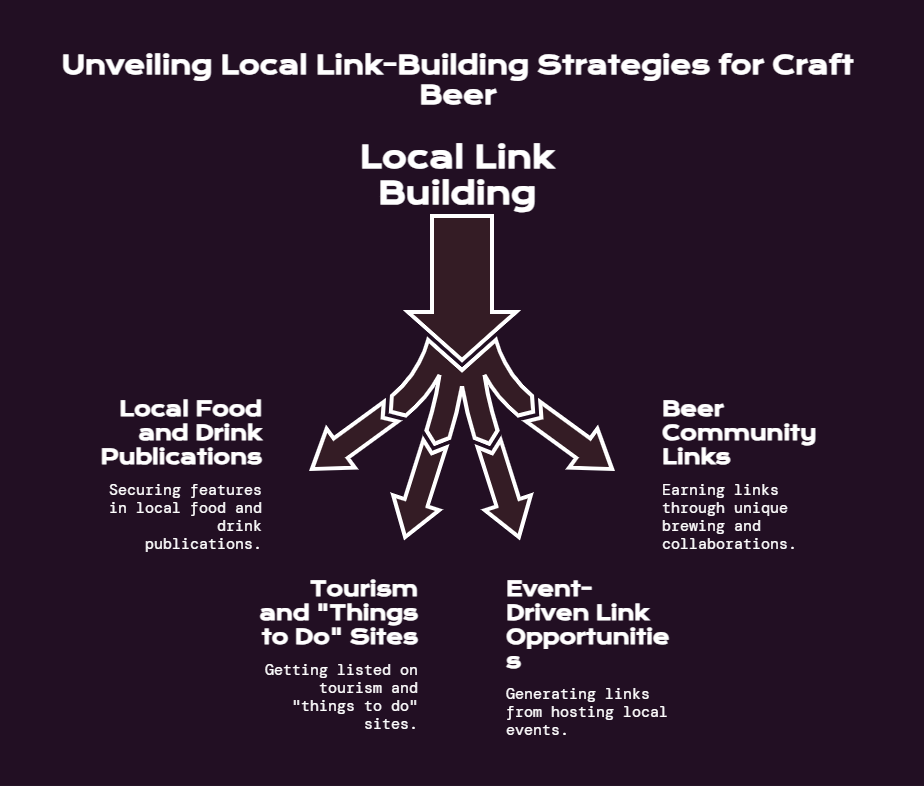
Links from other websites still matter for local SEO authority. For breweries, the link-building playbook has a few natural paths that other local businesses can’t always access.
Local food and drink publications: Every mid-to-large city has a food and drink magazine, blog, or news section that covers new openings, seasonal menus, and local picks. A “best local IPAs” or “best taprooms in [city]” feature is worth reaching out for. Send samples. Invite them for a visit. These placements earn real links and real referral traffic.
Tourism and “things to do” sites: Tourism boards, city guides, and “best things to do in [city]” sites are natural listing targets for taprooms. Many have free listings. Some have editorial features. Get on the free ones first, then reach out for editorial coverage.
Event-driven link opportunities: When you host an event – a charity fundraiser, a collaboration with a local restaurant, a beer festival, a community event – you generate link opportunities from the co-organizers, the charity, the media covering it, and local event calendars. Hosting events isn’t just good for business; it’s a link-building strategy.
Beer community links: If you’re doing interesting brewing – unusual ingredients, collaboration brews, experimental styles – the craft beer press pays attention. Publications like Craft Brewing Business, Good Beer Hunting, and regional beer publications do features worth pursuing.
The principle applies here that applies to all link building: do something genuinely interesting and make it easy for the right people to write about it. The real estate SEO keywords guide is a useful reference for how keyword-driven content can double as link-building content in other high-competition local niches – the same logic translates directly to craft beer.
Tracking What’s Actually Working: Brewery Local SEO Metrics
You can’t manage what you don’t measure. For local SEO, the metrics that matter are different from standard web analytics.
The Brewers Association’s local SEO guide for brewery owners points out that direction requests from your GBP are the clearest signal your local SEO is driving foot traffic. Track these alongside the following:
- Direction requests from GBP: Tracks how often people are literally navigating to your location from your listing.
- Calls from GBP: How often people call from your listing. Event inquiries often come by phone first.
- GBP website clicks: How often people click through from your listing to your site.
- Map Pack position: Where you rank in the 3-pack for your primary keyword. Use a tool like Local Falcon to track position across your geographic area, not just from your own address.
- Organic ranking for target keywords: Track your taproom page, your events page, and any neighborhood landing pages separately.
- Event page conversions: Form submissions, booking link clicks, or calls that originate from the event page specifically.
Monthly reporting on these numbers tells you which parts of the strategy are working and where to push harder. A brewery getting map impressions but not direction requests has a GBP conversion problem. A brewery ranking well for taproom terms but not event venue terms has a content gap on the events page.
Conclusion
The breweries that are going to win local search over the next few years aren’t the ones with the most aggressive ad budgets. They’re the ones that build a genuinely complete local SEO infrastructure: an optimized GBP that’s actually maintained, a website architecture that serves both the “I want a beer tonight” searcher and the “I need to book a venue” planner, clean citations across the full directory ecosystem, a review velocity that compounds month over month, and structured data that tells Google exactly what you offer.
The dual-intent problem is real and most of your competitors aren’t solving it. A well-optimized brewery event space page targeting the right keywords is sitting in a market with almost no competition in most cities. That gap won’t stay open forever.
The full playbook is here. The question is execution.
If you’d rather put the time into brewing and running your taproom, LYNX handles exactly this kind of local SEO work – from GBP setup and citation audits to event page strategy and ongoing ranking management. Take a look at what we do at LYNX SEO.
Frequently Asked Questions
What Is Local SEO for Breweries and Why Does It Matter?
Local SEO for breweries is the process of optimizing your online presence so your brewery, taproom, or brewpub appears prominently when nearby customers search for craft beer, taprooms, or event venues in your area. It covers your Google Business Profile, your website, citations across directories, reviews, and the content you publish. According to Google and Think with Google research, 76% of people who search for something nearby visit a business within 24 hours – meaning the customers you capture through local SEO are among the highest-intent, closest-to-converting customers you’ll ever get.
How Do I Rank My Taproom Higher on Google Maps?
To rank higher on Google Maps, focus on the three factors Google uses: relevance, proximity, and prominence. You control relevance through your GBP categories, description, and website content. Proximity is largely fixed by your location. Prominence is where the work happens: per the Whitespark 2026 Local Search Ranking Factors report, review signals now account for 20% of local pack ranking weight. Beyond reviews, consistent NAP across all directories, active use of GBP Posts, updated photos, and a well-optimized website all contribute to prominence signals.
How Do I Rank for “Brewery Near Me” Without Using That Exact Phrase on My Site?
You don’t need to write “brewery near me” on your website. Google infers local intent from device location data and applies it to searches for category terms like “craft brewery,” “taproom,” and “brewpub” without the phrase “near me” being present. What you need is a properly set up GBP with your location verified, your NAP consistent across the web, and your website making clear what city and neighborhood you’re in through its content, title tags, and structured data.
What Should a Brewery Google Business Profile Include?
At minimum: your verified business name (exactly as it appears on your sign), address, phone number, website, accurate hours including holiday variations, your primary category (Brewery) and relevant secondary categories, a complete 750-character description that includes your city and what you offer, and high-quality photos updated at least twice a month. Per Google’s own data, profiles with photos get 42% more direction requests. For breweries with event spaces, also add “Event Venue” as a secondary category and respond to every review.
How Does Taproom Local SEO Differ from Brewery Event Space SEO?
Taproom local SEO targets customers making a same-day decision about where to get a drink. The keywords are proximity-driven (“brewery near me,” “taproom [city]”), the conversion is quick, and the content needed is your hours, tap list, vibe, and reviews. Brewery event space SEO targets planners who are researching over days or weeks. The keywords are venue-specific (“brewery event venue [city],” “private event space brewery”), the conversion takes longer, and the content needed is capacity details, photos of events you’ve hosted, what’s included, and an inquiry form. These need separate pages, separate keyword strategies, and separate measurement.
How Long Does Local SEO for a Brewery Take to Show Results?
GBP optimization moves the needle relatively quickly – improved visibility can appear within a few weeks. Ranking movement for website pages and citation impact takes longer, typically 4-6 months of consistent work depending on your market competition and starting authority. For a new brewery or one starting from scratch, expect 3-6 months before you see meaningful ranking movement. For an established brewery with an existing GBP and website, targeted optimizations often produce faster results.
Should a Brewpub Do SEO Differently Than a Taproom?
Yes. A brewpub needs to capture both brewery/taproom search intent and restaurant/dining search intent. Your GBP setup, category selection, website architecture, and keyword targeting all need to reflect both functions. A brewpub should have both a beer menu page and a food menu page as separate indexed pages, should target terms like “brewery restaurant [city]” and “brewpub [city]” alongside taproom terms, and should consider “Restaurant” as a secondary GBP category alongside “Brewery.”
What Citation Sites Are Most Important for Craft Beer Local SEO?
The non-negotiables for any local business: Google Business Profile, Apple Business Connect, Bing Places, Yelp, Facebook. For craft beer specifically, add: Untappd (verify your venue, keep beers updated – this is where your core audience lives), BeerAdvocate, RateBeer, and TripAdvisor. Beyond that, local food and drink guides, your city’s tourism board, and any neighborhood business directories are worth pursuing. Per the Whitespark 2026 ranking factors research, presence on expert-curated “best of” lists is the highest-weighted citation signal for AI search visibility.
What Schema Markup Should a Brewery Use?
Use LocalBusiness schema (or BrewingCompany if your platform supports it) on your homepage and taproom page, with full NAP, hours, geo coordinates, and price range. Add EventVenue schema on your private events page. For individual events you’re hosting publicly (trivia nights, beer releases, live music), use Event schema on those pages or listings. Search Engine Journal’s guide to local schema recommends using Google’s Rich Results Test to validate before deployment.
Can I Do Brewery Local SEO Myself?
Yes, especially the fundamentals. Claiming and optimizing your GBP, building a review system, submitting to key directories, and writing proper title tags and descriptions are all DIY-able with some time and focus. Where most brewery owners hit a ceiling is on technical SEO, structured data implementation, competitive keyword research, and ongoing content production at scale. That’s where agency support tends to produce better ROI – not because the tactics are impossible to learn, but because the time cost of doing it all properly adds up fast when you’re also running a brewery.
Sources
- A Brewery Owner’s Guide to Local SEO (Without the Jargon) – Brewers Association
- Rich Results Test – Google Search Console
- Local SEO Schema: A Complete Guide To Local Structured Data & Rich Results
- How to Get More Google Reviews Without Being Awkward – Brewers Association
- Annual Craft Brewing Industry Production Report