Quick Answer: Google does not allow paid cannabis ads for THC products in the US – organic SEO is your only scalable channel. For hemp brands and CBD topicals, limited paid options exist via LegitScript certification in select states. Across all cannabis categories, organic search, local SEO, dispensary directories, and structured content marketing are the tactics that actually move the needle in 2026.
If you run a cannabis brand and you’ve tried to get traction through Google Ads, Meta, or TikTok, you already know the frustration. Accounts get flagged. Campaigns get rejected. You play by the rules and still end up suspended. And the kicker? Most of the guidance out there is either wrong, outdated, or written by people who’ve never actually run a cannabis marketing operation.
What you actually need is a clear-eyed breakdown of what each major platform allows right now – not what they allowed in 2022, and not speculation about what federal rescheduling might eventually open up. Then you need a practical cannabis SEO strategy built around what actually works in this environment.
That’s what this is. I’ve worked in SEO for over 15 years and spent a meaningful chunk of that time in regulated industries where the standard playbook doesn’t apply. Cannabis is its own category. The rules are stricter, the stakes are higher, and the operators who win are the ones who stop waiting for the platforms to open up and start building organic infrastructure that compounds regardless of what happens in Washington.
Key Takeaways
- Google organically ranks cannabis content without restriction – paid ads are a different story entirely.
- Hemp-derived CBD topicals can run on Google Ads in California, Colorado, and Puerto Rico with LegitScript certification; THC products cannot.
- Canada has a live Google Ads pilot program running through end of 2026 for legal cannabis products.
- Meta allows educational cannabis content but bans paid promotion; TikTok bans cannabis content almost categorically in paid channels.
- X (Twitter) is the only major social platform that allows paid cannabis advertising for verified, licensed brands in legal states.
- Reddit organic is the most underused high-intent channel in the cannabis space right now.
- AI search (ChatGPT, Perplexity, Google AI Overviews) applies YMYL safety filters to cannabis content – structuring for GEO visibility requires a different approach than standard SEO.
- Local SEO and Google Business Profile optimization remain the single highest-return tactic for dispensaries.
- Cannabis brands that start building organic authority now will hold a compounding advantage over competitors still waiting for paid channels to open.
- Cannabis is just one of the many industries that LYNX SEO specializes in.
What Google Actually Allows for Cannabis Content in 2026
Let’s start with the platform that matters most.
The distinction that trips up most cannabis brands is the difference between organic search and paid advertising on Google. These are completely separate systems with completely different rules.
Organic Search: No Restrictions
Google does not restrict cannabis content in organic search results. Search engines index publicly available web pages through algorithmic ranking – no ad reviewer applies cannabis-specific rules to your organic content. You can rank for “best dispensary near me,” “cannabis edibles for sleep,” “THC gummies Ontario,” and thousands of similar queries without Google restricting your ability to appear.
This is the whole reason cannabis SEO strategy matters. When paid channels are blocked, organic search becomes the primary acquisition engine – and it rewards brands that invest early and consistently. 42% of cannabis users report discovering a brand through Google search, which makes organic rankings the single most important discovery channel available to the industry.
What you still need to comply with in organic: no false health claims, proper age-gating, and compliance with state and local advertising regulations. But the algorithm itself doesn’t penalize you for being in cannabis.
Google Ads: Mostly Off-Limits, With Narrow Exceptions
Paid cannabis advertising on Google is a different world. Google’s advertising policy prohibits ads for substances that alter mental state for recreational purposes, as well as products marketed to facilitate recreational drug use. This applies regardless of whether cannabis is legal in your state.
The exceptions are narrow but real:
CBD Topicals in Select US States: Google allows ads for topical, hemp-derived CBD products with 0.3% THC or less. These brands must apply to advertise, obtain LegitScript certification, and target California, Colorado, and Puerto Rico only. Ingestible CBD, supplements, food additives, and inhalants remain prohibited regardless of certification.
The Canada Pilot: Google launched a limited Search-only pilot program in Canada for legally permitted cannabis products in August 2025, and has extended it through the end of 2026. This is genuinely significant for Canadian operators – it’s the first time Google has opened a paid channel for cannabis at this scale. It’s also a signal the company is testing the waters for broader policy changes. Watch this one closely.
For US THC brands: plan around organic. The paid door is not opening anytime soon, and the Trump rescheduling executive order hasn’t produced any actual regulatory change as of mid-2026.
Read more about LYNX’s SEO and AEO services.
Platform-by-Platform: What Each Channel Allows for Cannabis Content Marketing
Understanding what each platform permits – and where the actual opportunities are – is the foundation of any workable marijuana SEO or cannabis content marketing strategy.
Meta (Facebook and Instagram)
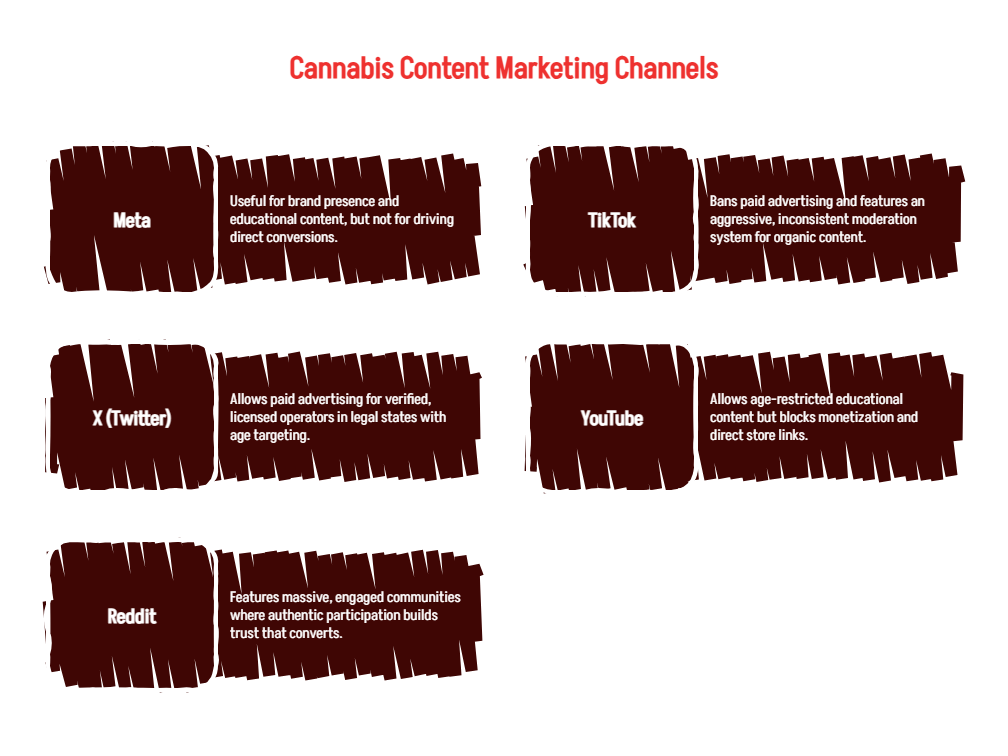
Meta’s position on cannabis is complicated. In mid-2025, the platform finally lifted longstanding restrictions on the search terms “cannabis” and “marijuana” across both networks. Organic brand accounts can now exist and post educational content more freely.
Paid advertising is a different story. Meta does not have a formal LegitScript-equivalent certification pathway for cannabis. Even brands that have found their way into the narrow approvals Meta does grant face inconsistent enforcement – ad accounts get flagged, organic posts deemed promotional get removed, and the appeals process is opaque.
What works on Meta in 2026: educational content about hemp farming, cannabinoid science, and industry topics without direct product promotion; retargeting campaigns for users who’ve already visited your site; brand-awareness campaigns that don’t explicitly push product sales. Direct product links, price mentions, and transactional copy are the fastest ways to get your account flagged.
Bottom line: Meta is useful for brand presence, not for driving direct conversions on cannabis products.
TikTok
TikTok bans paid cannabis advertising globally. Organic educational content gets through in some cases, but even non-intoxicating hemp content gets flagged regularly. Anyone telling you they have a TikTok workaround for cannabis is going to get your account banned. The platform’s moderation system is aggressive, inconsistent, and not worth building a strategy around.
X (Twitter)
X is the only major social platform that allows paid cannabis advertising for verified, licensed operators in legal states with 21+ targeting requirements in place. It’s not a channel most cannabis marketers have built out, which means the competition is lower than you’d expect. If you’re in the US with proper licensing, this is worth testing.
YouTube
YouTube allows age-restricted educational content but blocks monetization and direct store links for cannabis. Good for brand awareness and long-form educational content that builds trust. Not a direct conversion channel.
Reddit: The Most Underused Channel in Cannabis Right Now
This one gets overlooked constantly, and it shouldn’t. Reddit’s cannabis communities are massive and deeply engaged: r/trees has 2.1 million members, r/CBD has 82,000, and r/cannabis has 55,000, with millions of combined members sharing product experiences, strain reviews, and brand recommendations daily. Reddit’s organic channel has no ad reviewer gatekeeping what you can say.
People on Reddit are actively asking for product recommendations. “Best dispensary in [city],” “anyone tried [brand] concentrates,” “which hemp flower vendors are legit” – these threads exist in volume and they drive real purchasing decisions. A cannabis brand that participates authentically in these communities – not spamming, not posting “check out our store” links, but actually contributing value – builds the kind of trust that converts.
Reddit’s paid ad platform is a different story. Manual approval is required and most campaigns are rejected. The organic play is where the real opportunity is.
The table below summarizes where each major platform stands on cannabis content:
| Platform | Organic Cannabis Content | Paid Cannabis Ads | Notes |
| ✅ No restrictions | ⚠️ CBD topicals only (CA, CO, PR) | Canada pilot through Dec 2026 | |
| Facebook / Instagram | ⚠️ Educational content only | ❌ Banned for cannabis | No formal certification pathway |
| TikTok | ⚠️ Limited; flagged frequently | ❌ Banned globally | Highest enforcement risk |
| X (Twitter) | ✅ Allowed | ✅ Licensed brands, 21+ targeting | Only major platform allowing paid |
| YouTube | ✅ Age-restricted educational | ❌ No monetization or store links | Brand awareness only |
| ✅ No organic restrictions | ❌ Manual approval; most rejected | Best organic community channel |
Cannabis SEO Strategy 2026: What Organic Tactics Actually Work
Now the part that matters. If paid channels are restricted, the question becomes: where does a cannabis brand actually build sustainable traffic?
Local SEO and Google Business Profile
For dispensaries, local search optimization is the highest-return tactic available. Google’s local pack rankings are determined by three factors: relevance, distance, and prominence. You can influence all three.
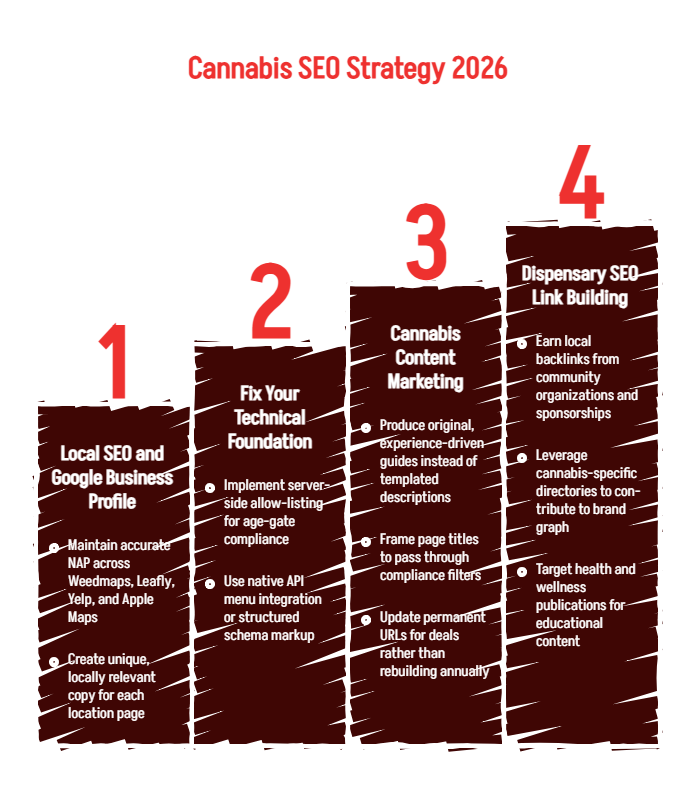
A fully optimized Google Business Profile – accurate NAP (name, address, phone), high-quality geotagged photos, consistent categories, active responses to reviews, and product posts – drives a significant share of foot traffic. We’ve seen dispensary accounts where 60% of all organic traffic comes directly from GBP clicks. That’s an asset competitors can’t buy their way into. Real cannabis brands have documented 96% sales increases in 60 days and 119% jumps in website clicks year-over-year from implementing disciplined local SEO – results that are only possible because the paid channel void forces operators to actually get good at organic.
Beyond the GBP itself: NAP consistency across Weedmaps, Leafly, Yelp, and Apple Maps is non-negotiable. Inconsistencies across directories suppress local rankings. And unlike most other industries, cannabis brands benefit from being listed on niche directories like Weedmaps and Leafly because these platforms have significant domain authority and appear in the same search results your potential customers are scrolling through. According to Pew Research Center, 79% of Americans now live in a county with at least one licensed cannabis dispensary – the market is right there, and local search is how they find who to buy from.
One nuance that trips up multi-location operators: don’t copy-paste the same content across location pages. Each page needs unique, locally relevant copy with neighborhood references, local FAQs, and delivery zone information where applicable. Thin, duplicated location pages are a ranking liability in 2026.
If you want to understand how local ranking signals interact with broader SEO strategy, this guide on local SEO for home service franchises covers the underlying framework in detail – a lot of the same principles translate to multi-location cannabis operations.
Dispensary SEO: Fix Your Technical Foundation First
Most cannabis sites have technical issues that silently kill their organic potential. The two most common:
Age gates that block crawlers. An age-gate that prevents Googlebot from indexing your content is a complete organic blackout. The fix is server-side allow-listing: serve the age-gate to human visitors, and let verified crawlers through. You stay compliant, and Google can actually see your pages.
iFrame menus. If your product menu lives inside a third-party iFrame (from Dutchie, Jane, Treez, or similar), Google can crawl that content in most cases — but attribution is the real problem. Content served inside an iframe is generally credited to the domain hosting the iframe source, not the domain it’s embedded on. In practice, that means every search for your own products is building ranking equity for Dutchie or Jane, not for you. The fix is to get your menu content attributed to your own domain: a native menu integration, a proxied setup that serves the menu from your own domain instead of theirs, or Product and Offer schema markup that exposes your inventory as structured data search and AI crawlers can read and attribute to you directly. This is also the single biggest lift for GEO visibility — a topic we’ll get to shortly.
These technical issues are fixable, but you need to prioritize them before investing heavily in content. A well-written blog post on a site Google can’t properly crawl doesn’t help anyone.
Cannabis Content Marketing: What Ranks
Google’s helpful content signals have been baked into the core ranking algorithm since the 2024 and 2025 updates. Thin, templated content – the 500-word strain descriptions copied from wholesale catalogs – gets penalized. What earns rankings in 2026 is original, experience-driven content that genuinely helps someone make a decision.
For dispensaries and cannabis brands, that looks like: first-hand product guides, dosing explainers with real specificity, strain comparison content that goes beyond basic terpene lists, local consumption law breakdowns, and educational content that answers the questions consumers are actually typing into Google.
The framing matters here. Page titles like “Buy Cheap Weed” trigger content filters. Page titles like “A Consumer’s Guide to Terpenes for Sleep” or “How to Choose the Right CBD Concentration for Anxiety” serve the same buyer but pass through without issues. Same product, different approach.
For keyword research specific to the cannabis space, the process isn’t dramatically different from any other niche – but the stakes of targeting the wrong terms (or phrasing them in ways that trip compliance filters) are higher. A full breakdown of how to find SEO keywords for a website covers the methodology in detail.
The tactics below have consistently moved the needle across dispensary and hemp brand accounts:
- Educational Strain Guides: Long-form, specific, written from actual product experience – not generic descriptions
- Local Consumption Law Content: State and local regulation breakdowns that answer real questions consumers search before buying
- Product Category Pages: “Edibles [city],” “concentrates [neighborhood],” “indica gummies [market]” – built with transactional intent and proper keyword targeting
- Deals and Promotion Pages: Built on permanent URLs that get updated rather than rebuilt each year; a URL with two years of age will always outrank a new one
- FAQ Content: Answers to the exact questions consumers type into Google – these are also the highest-probability content type to appear in AI Overviews
Dispensary SEO Link Building: Where You Actually Get Backlinks
Link building in cannabis is genuinely harder than in most industries. Mainstream sites won’t touch you in many cases, and the link farm / directory-spam approach that worked years ago now actively hurts rankings.
What works: local backlinks from community organizations, event sponsorships, chamber of commerce memberships, and partnerships with adjacent businesses. Each local link tells Google your business is embedded in its community. Cannabis-specific directories – Weedmaps, Leafly, PotGuide, Nugg – contribute to your brand graph even if many of those links are nofollow. A documented case study of a dispensary SEO campaign showed organic traffic quadrupling in six months through a combination of local link building, content, and technical fixes – and that was without access to any paid channels.
For hemp brands with product that crosses into wellness and lifestyle, there’s a real opportunity to earn links from health publications, wellness blogs, and lifestyle media. The frame has to be educational and non-promotional to get through editorial standards at most outlets.
The broader link building playbook shares a lot with other verticals. The principle is the same: earn links that are genuinely relevant, from real sites, through content worth citing or relationships worth maintaining.
Marijuana SEO and the AI Search Problem
This is where a lot of cannabis brands are quietly losing ground without realizing it.
AI search – Google AI Overviews, ChatGPT, Perplexity, Gemini – applies what Google’s quality rater guidelines call a YMYL (Your Money or Your Life) gate to content that could affect a person’s health, financial stability, or safety. Cannabis and hemp content, even for federally legal products with third-party testing and compliant labeling, gets classified in this tier.
The practical result: a hemp brand can have solid technical SEO and decent keyword rankings in traditional search, and still be nearly invisible in AI-generated answers on the queries that matter most. Standard SEO and GEO (Generative Engine Optimization) overlap significantly but diverge in ways that are specific to regulated categories.
Research from Gartner projected that traditional search engine traffic would drop 25% by 2026 as users shift toward AI agents and chatbots. For cannabis and hemp brands, that shift hits harder than for most categories because the AI safety filters that restrict paid channels are applying similar logic to organic AI visibility. The LYNX piece on hemp brand SEO and AI search visibility breaks down exactly how this YMYL filtering plays out in practice and what cited hemp brands are doing differently.
LYNX has covered this problem in depth for hemp brands specifically. The short version of what cited brands do differently: entity discipline (consistent canonical terminology for your products across your site, schema, press materials, and industry profiles), structured content that directly answers specific user questions, and off-site corroboration through Leafly, Weedmaps, local press, and YouTube content that AI systems can pull from as validation sources.
The table below contrasts what traditional SEO and GEO optimization actually require for cannabis brands:
| Signal | Traditional SEO Priority | GEO / AI Visibility Priority |
| Keyword targeting | High – exact and phrase match | Moderate – entity and topic authority matters more |
| Schema markup | Useful for rich results | Critical – structured data is how AI reads your inventory |
| E-E-A-T signals | Important | Highest priority – AI systems lean heavily on expertise signals |
| Off-site corroboration | Backlinks | Citations in directories, press, and video platforms AI uses |
| Content structure | H-tags, meta, internal linking | Question-answer format, direct answers AI can extract |
| Product data | On-page optimization | Crawlable, schema-marked, not locked in iFrames |
For a deeper look at how to structure content for both traditional rankings and AI citation visibility, the post on how to add value to AI blog content is worth reading alongside the hemp brand GEO piece.
Hemp Brand Organic Search: A Specific Playbook
Hemp brands operating in the US have a slightly different situation than THC dispensaries. The product is federally legal. Paid channels have some narrow openings. And the organic SEO opportunity is real – but the AI visibility problem discussed above is more pronounced because the product category sits in a gray zone that safety filters treat inconsistently.
The tactical priorities for hemp brand organic search in 2026:
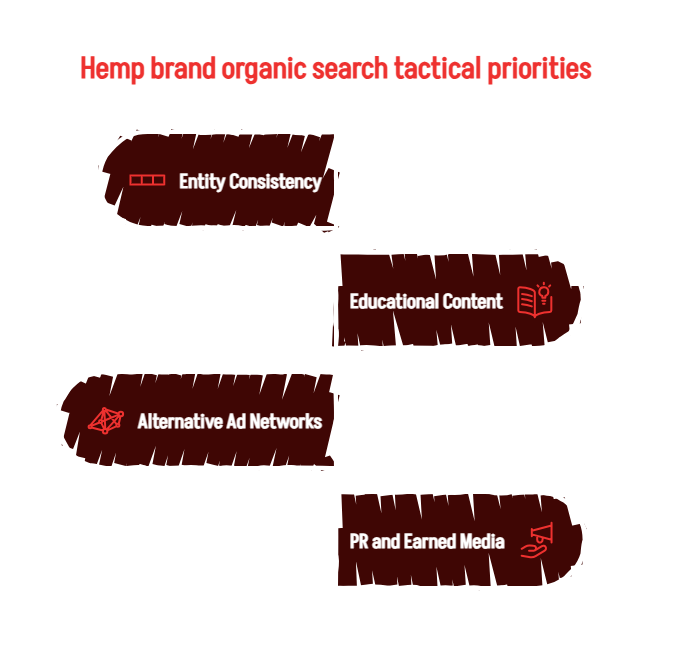
Entity Consistency: Pick canonical terminology for every product and use it everywhere – owned site, schema, press materials, social bios. If your brand uses “hemp-derived THC,” “cannabis beverage,” “delta-9 seltzer,” and “THC drink” interchangeably depending on the audience, AI systems can’t pin down what you sell and won’t cite you reliably. Consistency across all touchpoints is what makes you citable.
Educational Content at Scale: Hemp brands have more latitude to create content about wellness, formulation, third-party testing, and regulatory compliance than THC dispensaries. Build that content seriously. Reviews, dosing guides, ingredient breakdowns, and sourcing transparency all serve double duty: they build organic rankings and they give AI systems something substantive to cite.
CBD Digital Marketing Through Alternative Ad Networks: For brands that can’t access Google Ads, cannabis-specific ad networks like Mantis run display, native, and connected TV campaigns across publisher sites that allow cannabis content. It’s not Google, but it provides a paid distribution channel while organic authority compounds.
PR and Earned Media: Mainstream publications are more willing to cover hemp brands than THC operators, especially on wellness, sustainability, and regulatory angles. Earned placements in real publications create both backlinks and the kind of off-site corroboration that improves AI visibility. This is one of the highest-leverage activities for hemp brands in the current environment.
Cannabis Google Restrictions: The Rescheduling Situation
A lot of cannabis brands have been waiting on federal rescheduling to change the paid advertising landscape. Here’s the honest picture.
In December 2025, President Trump issued an executive order directing the Attorney General to expedite rescheduling from Schedule I to Schedule III. The Controlled Substances Act doesn’t give the president authority to unilaterally reschedule a drug – that requires a formal DEA rulemaking process. As of mid-2026, that process has not been completed.
Even if rescheduling goes through, platform policies aren’t required to change immediately – they’ll make their own decisions on cannabis advertising based on their risk tolerance, legal analysis, and user safety frameworks. The Canada pilot suggests Google is watching, but don’t build your strategy around a paid channel that doesn’t exist yet.
The brands that build organic authority now will be positioned to scale fast if paid channels open. The brands that wait for paid channels will be starting their SEO from scratch in a more competitive environment. Build the foundation now, and you benefit from both outcomes.
Conclusion
Cannabis marketing restrictions are genuinely frustrating, and they affect real businesses. But the brands winning in this space in 2026 have mostly stopped fighting the restrictions and started building around them.
Organic search rewards long-term consistency. Local SEO compounds over time. Well-structured content earns both traditional rankings and AI citation visibility. And the cannabis category is still relatively early in building the kind of serious, authority-driven content that earns links and shows up in AI-generated answers.
The window to build a meaningful organic advantage in this space is open right now. Most cannabis websites are still running on thin content, iFrame menus that Google can’t crawl, and inconsistent local citations. The bar to outperform them isn’t as high as it looks.
If you want to see how we approach cannabis SEO strategy for brands in competitive markets, our case studies show the full picture – strategy, execution, and what the results actually look like. Or if you’d rather talk through what this looks like for your specific market and business model, we’re straightforward about what’s realistic.
Frequently Asked Questions
Does Google Allow Cannabis Content to Rank Organically in 2026?
Yes. Google’s organic search does not restrict cannabis content. There is no algorithmic penalty for being in the cannabis industry. Dispensaries, hemp brands, and CBD retailers can rank for cannabis-related keywords, local search terms, and educational queries without restriction. The separation to understand is between organic rankings (no restrictions) and Google Ads (heavily restricted for cannabis). You can rank organically for “dispensary near me” while being completely ineligible to run a paid search campaign for the same term.
What SEO Tactics Actually Work for Cannabis Brands?
The tactics that consistently perform in 2026 are: local SEO and Google Business Profile optimization for dispensaries; educational long-form content targeting buyer-intent queries; product category pages built with transactional keywords; technical fixes like server-side age-gate allow-listing and crawlable menu architecture; and link building through local organizations, event sponsorships, and cannabis industry directories. For AI search visibility, structured content that directly answers questions and consistent entity signals across all brand properties are the additional layer.
How Do Hemp Brands Market Themselves Without Paid Ads?
Organic search is the primary channel – educational content about product benefits, formulation, third-party testing, and compliance builds both rankings and trust. Reddit organic participation in hemp and CBD communities drives high-intent traffic. PR and earned media placements in wellness and lifestyle publications build both authority and backlinks. For paid options, LegitScript-certified CBD topical brands can access Google Ads in California, Colorado, and Puerto Rico. Cannabis-specific ad networks like Mantis provide display and native advertising outside the major platform restrictions.
What Platforms Can Cannabis Brands Use for Organic Visibility?
Google organic search is the most valuable, followed by Google Business Profile for local visibility. Reddit communities like r/trees, r/CBD, and r/hempflowers have millions of engaged members and no organic restrictions. YouTube allows educational and age-restricted content. Facebook and Instagram allow educational posts from brand accounts but restrict promotional content. X (Twitter) is the most permissive major platform for paid advertising. Cannabis-specific directories like Weedmaps and Leafly drive meaningful discovery and contribute to local SEO authority.
What Are the Cannabis Google Restrictions on Paid Ads?
Google prohibits paid ads for THC products and most cannabis products in the US regardless of state legality. Exceptions: topical hemp-derived CBD with 0.3% THC or less can advertise in California, Colorado, and Puerto Rico after obtaining LegitScript certification and completing Google’s application process. Ingestible CBD, supplements, food additives, and inhalants remain prohibited even with certification. Google is running a live Search-only pilot program in Canada for legally permitted cannabis products through the end of 2026.
Is Dispensary SEO Different From Regular SEO?
The fundamentals – relevance, authority, page experience – are the same. The cannabis-specific differences are the technical constraints (age-gate compliance, iFrame menu limitations), the absence of paid channel support for competitive analysis, and the compliance requirements around health claims. Dispensary SEO also has a heavier local search component than most verticals because the purchase journey is hyperlocal. Google Business Profile optimization, local citation building, and neighborhood-specific content all play a bigger role than they would for a national e-commerce brand.
How Does Cannabis Marketing Fit Into AI Search in 2026?
AI search platforms apply YMYL (Your Money or Your Life) safety filters to cannabis and hemp content, which can suppress organic AI visibility even when traditional SEO metrics look healthy. Brands that get cited in AI Overviews, ChatGPT responses, and Perplexity answers typically have: consistent entity signals across all brand properties, structured content that directly answers specific questions, schema markup that makes product data crawlable, and off-site corroboration through trusted directories and publications. GEO (Generative Engine Optimization) is the emerging discipline that addresses this layer specifically.
How Long Does Cannabis SEO Take to Show Results?
Local ranking improvements can appear within a few months for dispensaries in less competitive markets. Organic keyword rankings typically take six to twelve months in competitive urban markets. The compounding nature of organic search means that brands investing consistently now will be in a significantly stronger position in two to three years than brands that delay. Paid channels can accelerate results when they become available, but organic authority built through SEO doesn’t disappear when a channel closes.
What Is the Best Cannabis Content Marketing Strategy?
The most durable cannabis content marketing approach in 2026 combines hyperlocal content for dispensary SEO (location pages, deals pages, neighborhood guides) with educational authority content that earns backlinks and AI citation (strain guides, regulatory explainers, dosing content). The key differentiator is writing from genuine experience: specific, useful, and structured to answer questions at the exact detail level consumers are searching for. Generic content doesn’t rank, and it definitely doesn’t get cited by AI systems.
Sources
- Gartner Predicts Search Engine Volume Will Drop 25% by 2026, Due to AI Chatbots and Other Virtual Agents
- Cannabis Dispensary SEO: Quadrupling a Dispensary’s Organic Traffic in 6 Months! – The HOTH
- Most Americans live in a legal marijuana state, have a cannabis dispensary in their county | Pew Research Center
- Reddit Marketing for CBD & Cannabis: Growth Without Ads | Ranqer
- Advertising Hemp & CBD on Google, Meta & TikTok in 2026: What’s Allowed
- Update to Cannabis-Related Content Policy (January 2026) – Advertising Policies Help
- Dangerous products or services – Advertising Policies Help
- Cannabis Marketing: What You Need to Know in 2026