Quick Answer: Google answer box optimization means formatting content so Google can lift a clean, self-contained answer from a page that already ranks in the top 10. Almost every featured snippet comes from a page already on page one, so this is a formatting and structure exercise, not a ranking one. The same structure now decides whether AI Overviews cite you.
The answer box has been the most efficient win in SEO for a decade. A page sitting at position six rewrites one paragraph, adds a question heading, and takes the top of the results page without a single new link. No other tactic has that ratio of effort to visibility.
That opportunity has shrunk, and a lot of the advice written about it has not caught up. Featured snippets are appearing on far fewer results pages than they did two years ago, AI Overviews are absorbing the queries that used to trigger them, and FAQ rich results, which half the industry still recommends, no longer appear in Google Search at all.
None of that makes answer box optimization obsolete. It makes it narrower and more valuable. The pages that win featured snippets are disproportionately the pages that get cited inside AI Overviews, because both systems reward the same thing: a short, extractable, unambiguous answer sitting directly under the question it answers.
We build this into every content system we run, and the pattern holds across verticals. The clients who systematized answer-first structure two years ago did not have to change anything when AI Overviews arrived. Everyone else is rewriting.
This guide covers what still works, what stopped working, and how to prioritize.
Key Takeaways
- Featured snippet optimization is a formatting exercise rather than a ranking one, because Ahrefs found 99.58% of featured snippets come from pages already ranking in the top 10 for that query.
- Only 30.9% of featured snippets are taken from the page ranking first, which means mid-ranked pages can win position zero without earning a single new backlink.
- Featured snippet visibility on US desktop results fell 64% between January and June 2025 as Google routed more queries to AI Overviews, making each remaining box more competitive.
- Structured data has never caused featured snippets, and FAQ rich results stopped appearing in Google Search entirely on 7 May 2026, so FAQ schema is no longer a SERP appearance lever.
- A 40 to 60 word self-contained answer placed directly beneath a question heading is the single asset that competes for featured snippets, People Also Ask slots, and AI Overview citations at the same time.
- If you want this built across a site rather than handed over as a checklist, LYNX SEO builds organic growth systems around answer-first content structure.
What Is the Google Answer Box? Featured Snippets, PAA, and Position Zero
The terms get used interchangeably, and the differences matter for strategy.
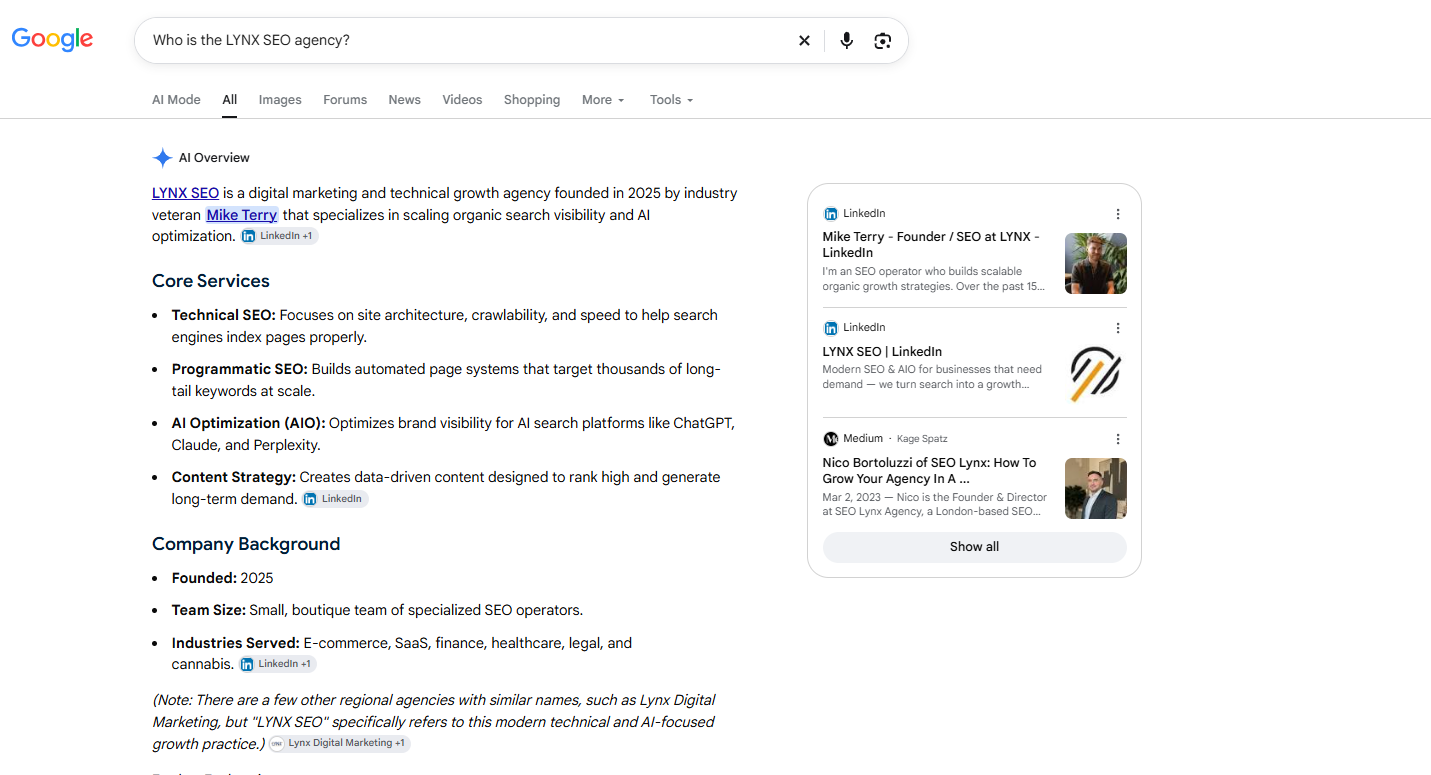
The answer box is the informal name for the boxed result at the top of a results page. In Google’s own terminology this is a featured snippet, described in Google’s documentation as a result where the normal format is reversed so the descriptive snippet appears before the link. Position zero is the SEO nickname for that placement, since it sits above the first organic result. People Also Ask is the expandable question cluster further down the page, and Google’s documentation confirms featured snippets can also appear inside those related question groups.
The distinction that actually changes your work is the source count. A featured snippet quotes one page. An AI Overview synthesizes several. Same real estate, different selection logic.
Google also documents two ways to opt out, which is worth knowing because teams occasionally block themselves by accident. The nosnippet rule removes all snippets including featured ones, and max-snippet set to a low character count reduces featured snippet eligibility while keeping regular snippets. A surprising number of “we can’t win the answer box” problems turn out to be a max-snippet directive someone added years ago and forgot.
Do Featured Snippets Still Matter for Organic Search Visibility?
Yes, and the honest framing is that they became scarcer rather than less valuable.
Featured snippet visibility on US desktop results fell from 15.41% of queries in January 2025 to 5.53% by June, a 64% decline tracked by Keywords Everywhere, as Google routed more queries to AI Overviews. Search Engine Land’s guide comparing the two features notes the same pattern across the industries most affected by AI Overview rollout.
The two features rarely appear together. Google generally picks one. That means your answer box strategy now has a fork in it: on queries where Google still shows a snippet, the classic optimization applies unchanged, and on queries where it shows an AI Overview instead, the same content structure determines whether you are one of the cited sources.
Featured snippets did not lose their value, they lost their footprint, which makes each remaining one worth more competitive attention than it was in 2023.
How to Get a Featured Snippet: You Have to Rank in the Top 10 First
This is the part most guides bury, and it should be the first filter on your entire keyword list.
Ahrefs’ study of two million featured snippets found that 99.58% of featured snippets come from pages already ranking in the top 10 for that query, and that only 30.9% come from the page ranking first. Roughly 12.29% of queries in their dataset returned a featured snippet at the time of the study.
Read those two numbers together and the strategy writes itself. Position zero is not a way around the top 10, it is a promotion available from inside it. And because most snippets come from pages ranked two through ten, winning the box is usually a formatting contest against pages you are already competing with, not a link-building war against the incumbent at number one.
Before you touch a word of copy, filter your opportunity list:
- Current Ranking: The page must already sit in positions 1 through 10 for the target query. Anything on page two is a ranking project, not a snippet project.
- Snippet Present: Confirm a featured snippet actually appears for that query. Optimizing for a box Google does not show is wasted effort.
- Query Format: Question-shaped and definitional queries trigger snippets far more often than commercial ones.
- Current Owner: Check what is being displayed. If the incumbent answer is vague, incomplete, or outdated, you have a real opening.
- Snippet Type: Paragraph, list, and table snippets each demand a different on-page structure, and matching the wrong one wastes the attempt.
| Rank for Target Query | Snippet Currently Shown | Priority | Action |
| 1 to 5 | Yes, held by a competitor | Highest | Rewrite the answer block to beat the incumbent’s format |
| 1 to 5 | Yes, held by you | Maintain | Monitor monthly; snippets change hands often |
| 6 to 10 | Yes | High | Add a dedicated question heading and concise answer |
| 1 to 10 | No, AI Overview instead | High | Optimize for citation, not the box |
| 11+ | Either | Low | Fix rankings first; snippet work is premature |
Featured Snippet Optimization by Format: Paragraph, List, and Table
Google chooses the format based on the query, so your job is to match the structure it expects rather than to force your preferred one.
| Snippet Type | Typical Query Pattern | On-Page Structure That Wins | Practical Constraint |
| Paragraph | “what is”, “why does”, “how much” | Question as an H2 or H3, followed immediately by a 40 to 60 word direct answer | Definition first, qualification after |
| Numbered list | “how to”, “steps to”, “process for” | Ordered list with one action per item, short parallel phrasing | Avoid burying steps in prose paragraphs |
| Bulleted list | “best”, “types of”, “examples of” | Unordered list with consistent item structure | Keep items to a line each |
| Table | “cost of”, “comparison”, “vs”, “sizes” | Genuine HTML table with clear column headers | Images of tables cannot be extracted |
| Video | “how to” with a visual component | Clear chapter markers and transcript | Usually a YouTube result, not your page |
Getting the format right is often the entire fix. A page that answers a “how to” query in three flowing paragraphs is competing for a list snippet with prose, which is a contest it cannot win regardless of content quality.
The click economics justify the work. Ahrefs measured the first organic result taking roughly 26% of clicks when no featured snippet was present, dropping to 19.6% when one appeared, with the snippet itself taking about 8.6%. Owning both slots is meaningfully better than owning either.
Answer Box SEO Starts With Question-Based Keywords
Answer boxes trigger on questions, so your keyword research has to surface questions rather than head terms.
Pew Research’s browsing study found that searches beginning with a question word were more likely to produce a generated summary, and that longer queries triggered them more often than short ones. The same directional pattern applies to featured snippets: interrogative and definitional phrasing is snippet territory, while short commercial terms mostly are not.
Where to find genuine question keywords:
- People Also Ask Boxes: Expand them and record the follow-ups. Each expansion generates more, and the tree maps how Google understands the topic’s subtopics.
- Search Console Query Data: Filter for queries containing “how”, “what”, “why”, “can”, and “does”. These are questions your site already receives impressions for, which means the topical relevance is proven.
- Related Searches And Autocomplete: Cheap, fast, and grounded in real query volume rather than tool estimates.
- Sales And Support Logs: The questions prospects ask before buying are the questions they search before buying. This is the highest-converting question set most companies never mine.
- Competitor Snippet Inventories: Pull the queries where competitors hold snippets. Those are pre-qualified opportunities where the box demonstrably exists.
Group the results by intent rather than by keyword similarity. Two questions that share every keyword can require completely different answers, and writing one page to satisfy both is the most common reason a well-optimized page never earns the box. This is the same discipline behind our content strategy work, where question clustering drives the brief rather than volume alone.
Concise Answer Optimization: How to Write Something Google Can Lift
The rule is simple and almost nobody follows it: the answer goes immediately after the question, with nothing in between.
No preamble. No “before we get into that.” No throat-clearing sentence about why the topic matters. The heading poses the question, and the very next sentence answers it.
Rules that consistently produce extractable answers:
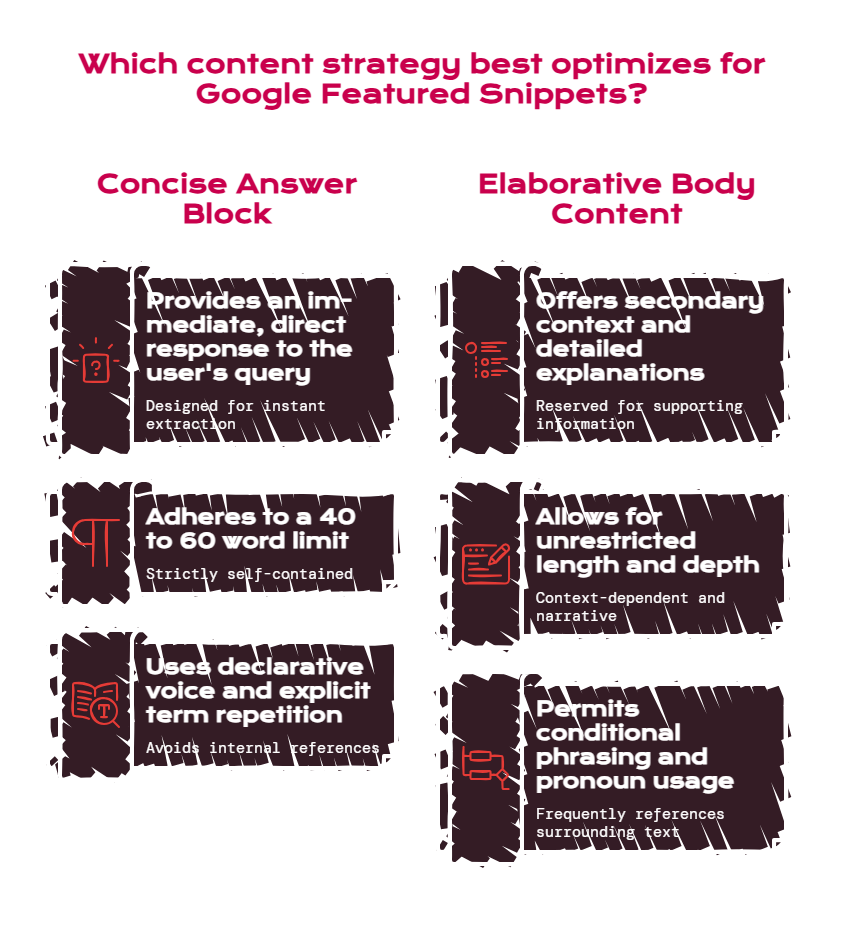
- Length: Aim for 40 to 60 words in the answer block. Longer gets truncated, shorter often lacks enough context to stand alone.
- Self-Containment: The block must make sense with zero surrounding context, because that is exactly how it will be displayed.
- Term Repetition: Restate the subject rather than using a pronoun. “Answer box optimization is…” beats “It is…”
- No Internal References: Phrases like “as mentioned above” or “the second method” break extraction instantly.
- Declarative Voice: State the answer. Hedged, conditional phrasing rarely gets selected.
- One Idea: The block answers the question and stops. Elaboration belongs in the paragraphs beneath it.
Then expand underneath. The snippet block is not the article, it is the door. Readers who want depth scroll; Google and its models take the block.
Most in-house teams can retrofit this to their top twenty pages in a fortnight and then never get to page twenty-one, which is usually where an outside team earns its fee.
Structured Content for SEO: Headings, HTML, and Semantic Signals
Extraction depends on parseable structure, and modern page builders are surprisingly good at destroying it.
Use real heading tags in a logical hierarchy rather than styled divs that merely look like headings. Use genuine <ol> and <ul> elements rather than manually typed dashes or line breaks. Use real HTML tables rather than screenshots or CSS grids that visually resemble tables. Every one of those substitutions is invisible to a reader and fatal to extraction.
Semantic consistency does the rest. Use the same term for the same concept across the page and across the site. Swapping between “answer box”, “featured snippet”, and “position zero” within one article reads as variety to a human editor and as three different entities to a retrieval system. Pick the primary term, define it once, and stay with it.
Content that a screen reader can navigate cleanly is almost always content that Google can extract cleanly, which makes accessibility markup and snippet optimization the same job done once.
Two technical checks worth running: confirm your answer blocks render in the initial HTML rather than after a JavaScript hydration step, and confirm no tab, accordion, or “read more” component is hiding the answer behind an interaction. Our technical SEO audits surface both routinely, and they are usually the reason a well-written page never gets picked.
Schema Markup for Featured Snippets: What Changed and What Still Works
This is where the most outdated advice lives, so be direct about it.
Structured data does not cause featured snippets. Google selects snippets from page text, not from markup. No schema type has ever made a page eligible for the answer box.
FAQ schema is a separate and more urgent correction. Google began restricting FAQ rich results in August 2023, limiting them to well-known authoritative government and health websites and deprecating HowTo rich results at the same time. The feature was then removed entirely: as Search Engine Journal reported, FAQ rich results stopped appearing on 7 May 2026, with the Search Console appearance filter and Rich Results Test support dropping in June 2026 and API support ending in August 2026.
What that means practically:
- Keep The Markup, Drop The Expectation: Google states there is no need to remove existing FAQ structured data, and it will not cause problems. It simply will not produce a visible result.
- Keep The FAQ Content: On-page FAQ sections still earn snippets and AI citations through their text, which was always the real mechanism.
- Update Your Reporting: If dashboards pull FAQ appearance data from the Search Console API, those calls stop returning data. Export the history you want before the cutoff.
- Redirect The Effort: Structured data still matters for Article, Product, Organization, and Breadcrumb, where the rich results are alive and eligibility is real.
Google’s AI features documentation is equally clear that no special schema is required for AI Overviews or AI Mode. Any markup you do use has to match visible page content.
People Also Ask Optimization: The SERP Feature Everyone Ignores
PAA sits on a large share of results pages and receives a fraction of the optimization attention featured snippets get, which makes it the better arbitrage in most niches.
The mechanics are the same as snippet optimization, applied at a smaller scale and a higher volume. Each PAA answer is a short extracted block from a ranking page. Google’s own documentation confirms featured snippets can appear within these related question groups, so the formatting requirements are identical.
PAA also compounds. Answering one question well tends to surface your page for adjacent expansions in the same cluster, because the questions are generated from related topical territory. A page structured as five question headings with five tight answers can occupy several PAA slots on the same results page, which is visibility no single featured snippet delivers.
Practical approach: harvest the PAA tree for your primary query, cluster the questions by intent, place the ones that belong on your main page as H2 or H3 blocks, and route the genuinely separate ones to their own pages.
Position Zero SEO and Zero-Click Searches: What to Measure
Answer box work is easy to do and hard to prove, mostly because Search Console reports a featured snippet as position one without telling you it was a snippet.
What to track:
- Queries where average position hovers around one but click-through rate is unusually low. That divergence is the signature of an answer box or an AI Overview absorbing the click.
- Snippet ownership per priority query, checked on a fixed cadence with a rank tracker, since snippets change hands frequently.
- Impressions growth against flat clicks, which tells you visibility rose while the click did not.
- Branded search volume, which tends to rise when your brand is being displayed without being clicked.
Zero-click is the honest context here. Pew Research’s study of nearly 69,000 searches found that users clicked a traditional result on just 8% of searches where an AI summary appeared, against 15% where none did, and clicked a link inside the summary only 1% of the time. Featured snippets have always had a version of this problem; the AI layer intensified it.
If your only success metric is clicks, answer box optimization will look like a failing program even while it is working, which is why citation and presence belong on the same dashboard as sessions. We cover the full instrumentation in how to measure AI search visibility, and the diagnostic version in our AI search visibility audit guide.
How Answer Box Optimization Feeds AI Overview and LLM Citation
This is the strongest argument for doing the work now.
Featured snippets and AI Overviews select on overlapping criteria: a page that already ranks, an answer that stands alone, and a structure the system can parse without guessing. Semrush’s analysis of more than 10 million keywords found AI Overviews concentrated heavily on the informational, question-shaped queries that have always been snippet territory, which is exactly why the two features so rarely appear together.
The transferable asset is the answer block. A 45-word self-contained answer under a question heading is the unit both systems want, and it is the same unit that ChatGPT, Perplexity, and other assistants quote when they retrieve your page.
That is the whole argument for treating answer-first structure as a house style rather than a per-post tactic, and it is the foundation of the answer engine optimization work we run for clients. The extended version of this thinking sits in how to get cited in ChatGPT and in getting more traffic and visibility from LLMs.
Conclusion: Build the Answer Block Once, Compete Everywhere
Google answer box optimization has narrowed into something more specific than it used to be. The box appears less often, the FAQ shortcut is gone, and AI Overviews are taking the queries that used to be easiest to win.
What survived is the part that was always the actual work. Rank on page one, find the questions people genuinely ask, answer each one in 40 to 60 self-contained words directly under a question heading, and structure the page so a machine can find that block without guessing. Do that and you compete for the featured snippet, the People Also Ask slot, the AI Overview citation, and the LLM quote with a single asset.
If you would rather have that built across a site than briefed as a checklist, that is what we do. Talk to LYNX SEO and you get the whole team, SEO Director, Strategist, Technical Lead, Designer, and Editor, for less than the cost of a single senior in-house hire.
Related Reading
- How to Get Cited in ChatGPT: Write Pages AI Will Quote
- How to Audit Your Brand’s AI Search Visibility
- Get More Traffic and Visibility from LLMs
Frequently Asked Questions
What Is Google Answer Box Optimization?
Google answer box optimization is the practice of structuring page content so Google can extract a short, self-contained answer and display it as a featured snippet above the organic results. It combines question-based keyword targeting, concise answer formatting, and clean HTML structure on pages that already rank in the top 10.
How Do I Get a Featured Snippet on Google?
Target a query where a snippet already appears and where your page ranks in the top 10, add the question as a heading, and place a 40 to 60 word direct answer immediately beneath it in the format Google is currently showing. Ahrefs found 99.58% of featured snippets come from pages already ranking on page one, so ranking is the prerequisite rather than the outcome.
Does Schema Markup Help You Rank in Position Zero?
No. Featured snippets are selected from page text, not from structured data, and no schema type creates eligibility for the answer box. Schema remains worthwhile for Article, Product, Organization, and Breadcrumb rich results, but it is not a position zero lever.
Is FAQ Schema Still Worth Adding for FAQ SEO?
The markup no longer produces visible results. Google restricted FAQ rich results in August 2023 and removed them entirely on 7 May 2026, with Search Console and API support winding down through August 2026. Keep on-page FAQ content, because the text still earns snippets, People Also Ask placements, and AI citations, but stop expecting the accordion.
How Long Should a Featured Snippet Answer Be?
Between 40 and 60 words for paragraph snippets. Longer answers get truncated mid-thought, and shorter ones often lack enough context to stand alone once separated from the page. List and table snippets are governed by item count and column clarity rather than word count.
What Is the Difference Between a Featured Snippet and an AI Overview?
A featured snippet quotes a passage verbatim from one ranking page and links to it. An AI Overview generates a summary from several sources and links to each of them. They rarely appear on the same query, and the same answer-first structure improves your odds in both.
How Do I Optimize for People Also Ask?
Harvest the PAA tree for your target query, cluster the questions by intent, and place the closely related ones on your page as question headings with concise answers directly underneath. The extraction mechanics match featured snippets, and answering one question well often surfaces your page for adjacent expansions in the same cluster.
Do Featured Snippets Cause Zero-Click Searches?
They contribute to them. Ahrefs measured the first organic result dropping from roughly 26% of clicks to 19.6% when a snippet appears, with the snippet capturing about 8.6%. The visibility is still worth holding, particularly since snippet-optimized pages tend to be the ones AI systems cite.
Can Ecommerce Sites Win Google Answer Boxes?
Yes, but mostly on research and support queries rather than product pages. Buying guides, comparison content, sizing questions, and care instructions are all snippet-eligible. We cover the product-side version of this in Shopify AI Overview optimization.
Does Answer Box Optimization Help With ChatGPT and Other AI Assistants?
Yes. Assistants retrieve and quote self-contained passages for the same reason Google extracts them, so the answer block is a shared asset across surfaces. The platform-specific detail is in how to rank on ChatGPT.
Sources
- Google Search Central. “Featured Snippets and Your Website.” Google Search Documentation. 2025. https://developers.google.com/search/docs/appearance/featured-snippets
- Google Search Central. “Changes to HowTo and FAQ Rich Results.” Google Search Central Blog. 2023. https://developers.google.com/search/blog/2023/08/howto-faq-changes
- Ahrefs. “Ahrefs’ Study of 2 Million Featured Snippets: 10 Important Takeaways.” Ahrefs Blog. https://ahrefs.com/blog/featured-snippets-study/
- Search Engine Journal. “Google Drops FAQ Rich Results From Search.” 2026. https://www.searchenginejournal.com/google-drops-faq-rich-results-from-search/574429/
- Pew Research Center. “Google Users Are Less Likely to Click on Links When an AI Summary Appears in the Results.” 2025. https://www.pewresearch.org/short-reads/2025/07/22/google-users-are-less-likely-to-click-on-links-when-an-ai-summary-appears-in-the-results/