Quick Answer: The best SEO companies for the food and beverage industry match their skills to your business model, prove results with data you can verify, and take claims compliance seriously. A packaged food brand, a DTC beverage company, a craft brewery, a restaurant group, and a B2B ingredient supplier each need different SEO strengths, so the right food and beverage SEO agency is the one with proven experience in your specific model. Look for strong product and category page work, a plan for retailer and marketplace competition, a written claims review process, and technical skill with age gates, recipes, and seasonal catalogs.
Search for the best SEO agencies for food brands and you’ll find two kinds of results: directories and “top 10” lists that rank firms by reviews and client logos, and agency service pages describing their own offer. Most of them treat food and beverage as one industry, and most lean heavily toward restaurant SEO.
That’s the first problem. A frozen food manufacturer selling through grocery chains, a canned cocktail brand shipping DTC, and a neighborhood bakery all sit under the food and beverage umbrella, but they share almost none of the same SEO priorities. An agency that’s excellent at Google Maps rankings for restaurants may have no idea how to handle product schema across 400 SKUs, retailer “where to buy” pages, or the legal limits on what a beverage brand can say about health benefits.
We’re the LYNX SEO team. We work across regulated and consumer verticals, including hemp, craft beverage, retail and ecommerce, and golf and leisure, and we get evaluated by food and beverage prospects regularly. This guide is the framework we’d want any buyer to use, on us or anyone else. It covers how to match an agency to your business model, the ten criteria that matter most, the questions to ask, how to score firms, the red flags specific to food and beverage, and how to run a paid pilot before signing a long retainer.
It’s not a list of agencies. It’s a way to judge them.
Key Takeaways
- Food and beverage SEO covers at least six distinct business models, from CPG manufacturers to restaurants to B2B ingredient suppliers, and each one requires different SEO skills from an agency.
- US online grocery sales reached a record $12.7 billion in December 2025, and online accounted for 19% of total grocery spending that month, according to Brick Meets Click.
- The FTC’s Health Products Compliance Guidance applies to health claims about foods, and the FTC states it can take action against ad agencies as well as the brands they work for.
- Google’s guidance says legally required age verification screens are acceptable, but redirecting every URL to a single age-gate page can remove all other pages from search results.
- Google’s AI optimization guide says optimizing for generative AI search is still SEO and that unique, non-commodity content matters more than any other factor it describes.
Why Food and Beverage SEO Needs a Specialist
Food and beverage looks like an easy SEO vertical from the outside. Everyone eats, search volume is huge, and product categories are easy to understand. In practice, it’s one of the more complicated consumer verticals to get right, for three reasons.
Online Grocery Has Changed Where Food Brands Compete
Shoppers now buy food online at a scale that didn’t exist a few years ago. Brick Meets Click reported that US online grocery sales reached a record $12.7 billion in December 2025, up 32% year over year, and later data showed July 2026 eGrocery sales up 21.5% year over year. Brick Meets Click also put online at 19% of total grocery spending by the end of 2025.
For food and beverage brands, that shift cuts both ways. More people search for products online, but the results for a brand’s own product names are increasingly crowded with retailer listings, marketplace pages, and delivery apps. A food and beverage SEO company has to plan for the fact that your brand’s biggest search competitors are often your own retail partners.

Food and Beverage Claims Carry Legal Risk
Food content is full of claims: “supports immunity,” “boosts energy,” “gut-friendly,” “clean,” “natural.” Many of those claims have legal definitions or substantiation requirements. The FDA’s guidance on structure/function claims explains that such claims on conventional foods must focus on effects derived from nutritive value, and the FDA treats claims about disease differently.
Advertising claims fall under the FTC. The FTC’s Health Products Compliance Guidance explicitly covers foods and requires competent and reliable scientific evidence for health-related claims. It also notes that the FTC can pursue ad agencies, retailers, and others involved in deceptive marketing, not just the brand.
That matters when you hire an SEO agency, because SEO agencies write a lot of content. An SEO company that writes “boosts immunity” into a beverage category page to chase search volume is creating legal exposure for your brand. The best food and beverage SEO agencies build a claims review step into their content process. (Nothing here is legal advice; your regulatory counsel should set the rules the agency follows.)
Beverage Alcohol Has Its Own Rulebook
Beer, wine, and spirits brands add another layer. The Alcohol and Tobacco Tax and Trade Bureau (TTB) regulates alcohol beverage advertising, and its 2024 industry circular on social media advertising confirms that its advertising regulations apply to advertisements in any media, including social media. State laws add their own requirements, and many alcohol brands use age verification on their websites.
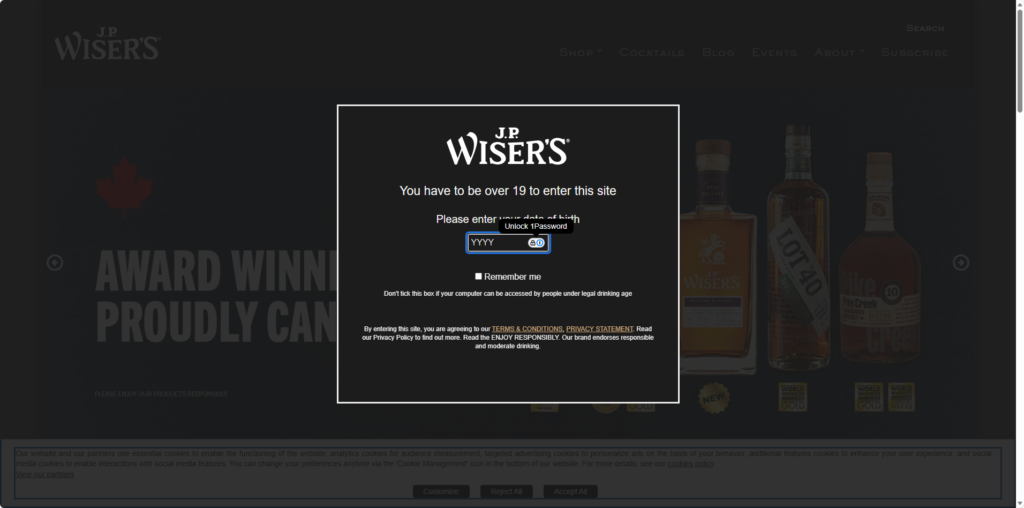
Age gates are where SEO often breaks. Google’s guidance on avoiding intrusive interstitials exempts legally required interstitials such as age verification, but recommends showing them as an overlay on the page content.
It warns that redirecting all incoming requests to a separate page for consent means every page except that one drops out of search results, because that’s the only page Googlebot can reach. We’ve seen breweries and spirits brands lose most of their organic visibility this way without realizing why.
Start With Your Business Model: Food and Beverage Is Not One Industry
Before comparing agencies, get clear on which kind of food and beverage business you are. This single step eliminates most mismatches. An agency with a strong track record in one model can be a poor fit for another.
| Business Model | Primary SEO Goal | What the Agency Must Prove | Common Agency Failure |
| CPG and Packaged Food Brands | Brand and product visibility that supports retail sales | Product data, where-to-buy strategy, retailer SERP competition | Treating the brand site like a DTC store with nothing to sell |
| DTC Food and Beverage Ecommerce | Organic revenue from product and category pages | Ecommerce SEO, subscriptions, catalog and variant handling | Chasing recipe traffic that never converts |
| Beverage Alcohol (Breweries, Wineries, Distilleries) | Brand search, taproom visits, where-to-buy, DTC where legal | Age gate handling, TTB-aware content, local SEO | Age gates that block crawling entirely |
| Restaurants and Hospitality | Local visibility, reservations, orders | Google Business Profile, reviews, menus, multi-location pages | Generic content with no local signals |
| B2B Food Manufacturers and Ingredient Suppliers | Qualified leads from buyers and R&D teams | Technical B2B content, specification pages, lead tracking | Consumer-style content that attracts the wrong audience |
| Functional, Hemp-Derived, and Regulated Products | Visibility within strict claims and platform rules | Compliance-safe content, platform restrictions, trust signals | Health claims that create legal and platform risk |
SEO for Packaged Food Brands and CPG Food SEO
Most packaged food brands sell primarily through retailers, so their websites exist to build demand and point buyers to the shelf, physical or digital. SEO for packaged food brands centers on product pages that answer real questions (ingredients, allergens, nutrition, sizes, uses), a “where to buy” experience that actually helps, and content that captures category searches before a shopper picks a brand.
An SEO agency for CPG brands should understand that the goal isn’t always a transaction on your own site. It should be able to show you how it measures success when sales happen at a retailer: branded search growth, where-to-buy clicks, retailer referral traffic, and visibility for category terms.
Food Ecommerce SEO and Beverage Ecommerce SEO for DTC Brands
DTC food and beverage brands need classic ecommerce SEO done well: clean category architecture, strong product page SEO, product structured data, variant handling for flavors and pack sizes, and a sensible approach to subscriptions and bundles. Google’s Product structured data documentation distinguishes merchant listing markup for pages where customers can buy from product snippet markup for pages where they can’t, and a food ecommerce SEO agency should know which applies to each of your templates.
The trap for DTC brands is content that attracts the wrong visitors. A recipe post can bring in 50,000 visits a month and sell almost nothing if it has no clear connection to your product. Our retail and ecommerce SEO programs start from category and product pages for exactly this reason.
SEO for Beverage Brands in Beer, Wine, and Spirits
Beverage alcohol brands need an agency that understands age verification, TTB advertising rules, state-by-state shipping restrictions, and the mix of taproom, retail, and DTC channels many producers run at once. A craft brewery might need local SEO for its taproom, where-to-buy pages for distribution, event visibility, and brand search, all at the same time.
Our SEO for craft breweries guide walks through how different that playbook is from generic food marketing, and it’s the approach behind our craft brewery SEO work. If you run a beverage alcohol brand, ask any agency to show you how it has handled age gates and alcohol advertising rules for other clients.
Restaurants, Taprooms, and Hospitality
Restaurants, cafes, taprooms, and hospitality venues live and die by local search. The priorities are a complete Google Business Profile, a steady flow of recent reviews, crawlable menus (not image-only PDFs), accurate hours, and unique location pages for multi-location groups. The same applies to clubs and resorts where dining is part of the experience; our golf and leisure SEO work regularly covers clubhouse dining and event spaces alongside tee times and memberships.
Reviews carry more weight than ever. BrightLocal’s Local Consumer Review Survey 2026 found that 97% of consumers read reviews for local businesses and that use of ChatGPT and similar AI tools for local recommendations rose from 6% to 45% in a year. Any food SEO agency working with restaurants should have a clear review strategy, not just a posting schedule.
B2B Food Manufacturers and Ingredient Suppliers
SEO for food manufacturers that sell to other businesses is a different discipline entirely. Buyers are procurement teams, R&D food scientists, and foodservice operators searching for specifications, certifications, minimum order quantities, and technical documentation. The content has to be precise and the success metric is qualified leads, not traffic.
This is much closer to B2B pipeline SEO than consumer food marketing. The approach we describe in our guide to data centre SEO that generates pipeline (technical buyer content, specification pages, and lead attribution) transfers directly to ingredient and co-packing suppliers, even though the industries look nothing alike.
Functional, Hemp-Derived, and Regulated Food and Beverage Products
Functional beverages, supplements sold as foods, and hemp-derived edibles and drinks carry the highest claims risk in the category. They also face platform restrictions that can limit paid advertising, which makes organic search even more valuable. Our cannabis SEO strategy guide covers how platform rules shape what works in these categories, and our ecommerce SEO case study for a hemp brand shows what compliance-aware ecommerce SEO can produce: more than a million clicks for a brand operating under strict content limits.
What to Look for in a Food and Beverage SEO Agency
Once you know your model, use these ten criteria to evaluate every food and beverage SEO company on your shortlist. Each includes a way to verify it, because a claim you can’t check is just a sales line.
1. Proof From Food, Beverage, or Adjacent Regulated Verticals
Google’s guidance on whether you need an SEO recommends asking prospective SEOs for examples of previous work and success stories, asking about their experience in your industry, and checking business references. For food and beverage, go a step further and ask for evidence that matches your business model.
What Good Evidence Looks Like
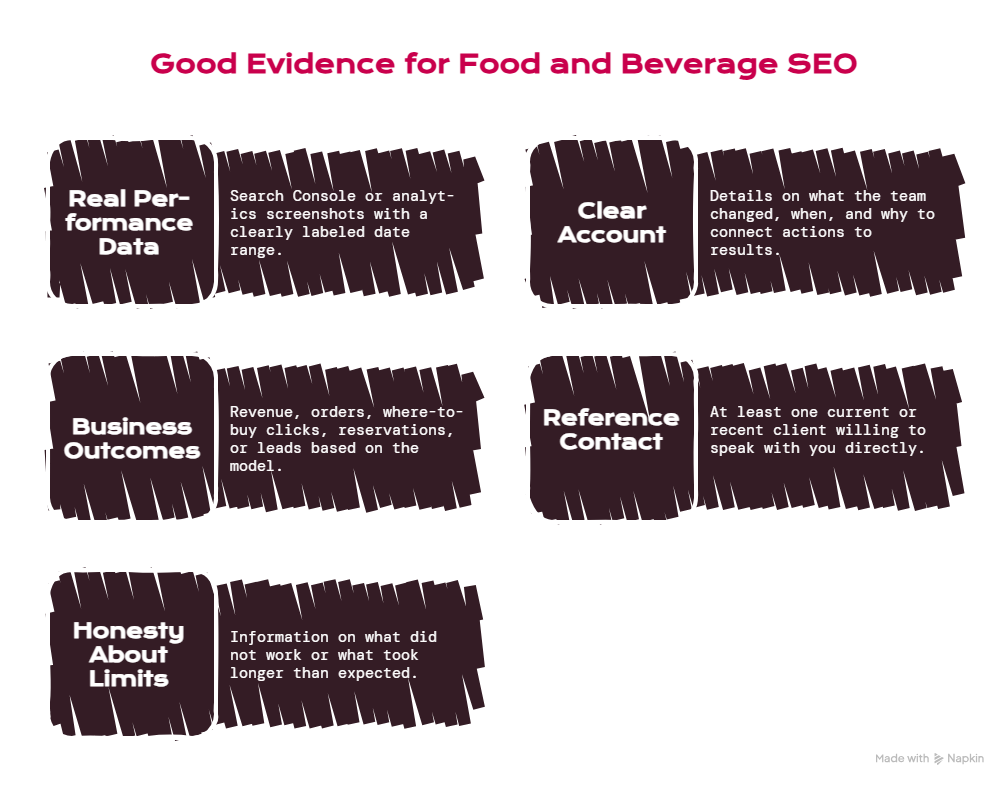
Strong evidence from a food and beverage SEO company usually includes:
- Real Performance Data: Search Console or analytics screenshots with a clearly labeled date range, not cropped charts with no axes.
- A Clear Account of the Work: What the team changed, when, and why, so you can connect actions to results.
- Business Outcomes: Revenue, orders, where-to-buy clicks, reservations, or leads, depending on the model.
- A Reference You Can Call: At least one current or recent client willing to speak with you directly.
- Honesty About Limits: What didn’t work, or what took longer than expected.
Why Adjacent Vertical Experience Counts
You won’t always find an agency with a case study in your exact niche. That’s fine, if the adjacent experience transfers. Experience with hemp-derived products transfers well to functional beverages because both involve claims discipline and platform restrictions. Craft brewery experience transfers to wineries and distilleries because both involve age gates, alcohol rules, and taproom or tasting room local search. Retail ecommerce experience transfers to DTC food because the catalog problems are the same. Ask the agency to explain which parts of its experience apply to you and which don’t.
2. Claims Discipline and a Written Compliance Workflow
This is the criterion most food and beverage buyers never think to ask about, and the one that can cause the most damage. Ask every agency how it handles health, nutrition, and functional claims in content.
Questions to Ask About Claims Review
Ask who writes and reviews content that touches on health or nutrition, whether the agency keeps a list of approved and prohibited claims for each client, how it sources nutrition and ingredient facts, and whether your regulatory or legal team gets final approval. A strong agency will describe a documented workflow. A weak one will say its writers “know to be careful.”
Also ask how the agency handles keyword opportunities that involve claims. There’s often real search volume for “drinks that boost immunity” or “foods that lower cholesterol.” A specialist food and beverage SEO consultancy will tell you when a keyword is off-limits for your brand, even if the volume is tempting.
3. Food Product Page SEO and Beverage Product Page SEO Skills
Product pages are where most food and beverage brands leave the most visibility on the table. They’re often thin, image-heavy, and built from packaging copy that answers none of the questions shoppers actually search.
Product Data That Shoppers Search For
A food or beverage product page that ranks and converts usually includes:
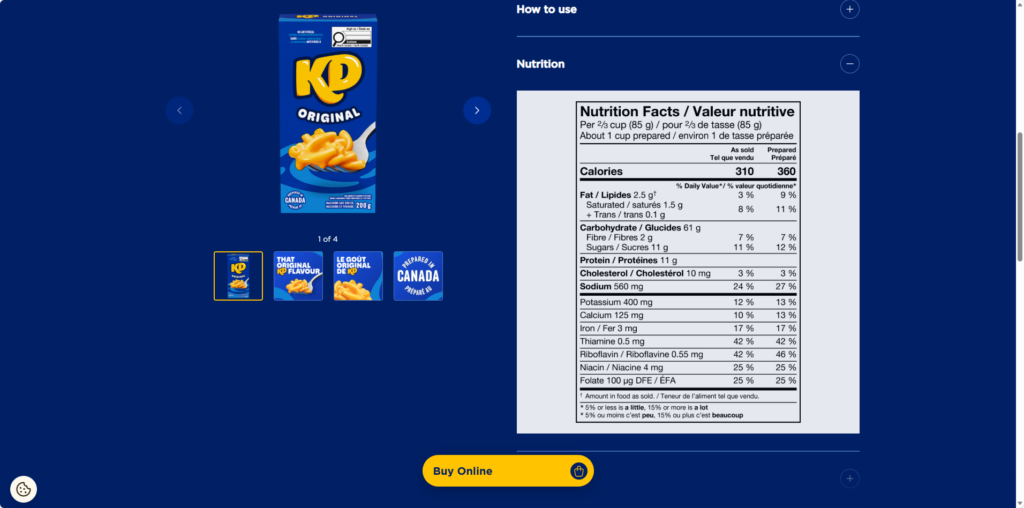
- Ingredients and Allergens: Full ingredient lists and allergen information as crawlable text, not just an image of the label.
- Nutrition Information: Key nutrition facts in text or a table, with serving sizes.
- Formats and Sizes: Pack sizes, flavors, and variants, each clearly described.
- Usage and Pairing Guidance: How to use, cook, serve, or pair the product.
- Certifications: Organic, gluten-free, kosher, halal, non-GMO, or other certifications the product actually holds.
- Where to Buy or Buy Now: A clear path to purchase, online or in store.
Food Category Page SEO and Beverage Category Page SEO
Category pages target the broader searches that come before a product decision, such as “high-protein snacks” or “non-alcoholic craft beer.” Ask the agency how it would structure your categories, what copy it would add, and how it would handle filters for dietary needs and flavors. Our technical SEO services often start with this category architecture, because it shapes how every product page performs.
4. A Clear Plan for “Where to Buy” and Retailer Competition
For CPG food and beverage brands, retailers, marketplaces, and delivery apps often outrank the brand for its own product names. That’s not always bad (a sale at a retailer is still a sale), but brands should decide deliberately which searches they want to own.
Ask each agency what it would do with your where-to-buy page, how it would handle product searches where retailers dominate, and how it measures success when the sale happens elsewhere. A strong answer includes a crawlable where-to-buy experience, product pages that answer questions retailer listings don’t, and tracking for outbound retailer clicks. A weak answer ignores the retailer layer entirely.
5. Recipe and Usage Content That Earns Its Place
Recipe content is the default food marketing tactic, and it’s often misused. Recipe searches are dominated by large publishers and food blogs, and recipe traffic frequently has no connection to buying a specific product.
Recipe content works for a food brand when the recipe genuinely features the product, answers a real usage question, and gives the visitor a reason to buy. Google’s Recipe structured data documentation explains that recipe markup is for content about preparing a specific dish and can make recipes eligible for rich results in Search and Google Images. An agency should know how to implement it properly, and also when recipe content isn’t worth the investment.
Google’s guide to optimizing for generative AI features adds a useful filter. It contrasts commodity content based on common knowledge with non-commodity content that offers unique expert or experienced takes, and it warns that creating pages for every query variation primarily to manipulate rankings can violate Google’s scaled content abuse policy.
Five hundred generic recipes are commodity content; twenty recipes developed by your own culinary team around your products are not. A strong SEO content strategy for food brands starts from that distinction.
6. Technical SEO That Handles Age Gates, Catalogs, and Seasonality
Food and beverage sites break in predictable ways. Ask the agency to name the technical issues it would check first on your site. For most food and beverage brands, the list should include:
Age Gate Test (Beverage Alcohol)
Ask the agency to explain how your age gate is implemented and whether Google can crawl the content behind it. You can check this yourself: search for a distinctive sentence from one of your product pages in Google. If it doesn’t appear and your site uses a full-page redirect age gate, the gate is likely blocking indexing.
Catalog and Seasonal Issues
Limited-edition and seasonal products (holiday flavors, summer beverages, seasonal releases) get added and removed constantly. An agency should have a plan for discontinued product URLs, seasonal category pages that return every year, and out-of-stock products that shouldn’t disappear from search during peak demand.
Menus, PDFs, and Media
Restaurants and beverage brands frequently publish menus, tasting notes, and spec sheets as PDFs or images. An agency should know when to convert those into crawlable HTML and how to keep heavy product imagery from slowing pages.

7. Local SEO Depth for Physical Locations
If you have any physical footprint (restaurants, taprooms, tasting rooms, retail shops, farm stores), local SEO is likely your highest-converting channel. Ask the agency how it manages Google Business Profiles, reviews, local landing pages, menus, events, and multi-location consistency. Ask to see a local SEO report from another client, and check whether it tracks actions like calls, direction requests, and reservations rather than just rankings.
8. Link Building and Digital PR That Fits Food Media
Food and beverage brands have excellent digital PR potential: product launches, founder stories, sourcing stories, awards, and seasonal releases all interest food journalists and trade publications. They’re also targets for low-quality link sellers offering guest posts on generic “lifestyle” sites.
Google’s spam policies prohibit link schemes, and paid guest posts placed purely for links fall squarely into that category. Ask any agency for 10 or more links it has earned for food, beverage, or consumer brands in the last six months, and open every page. Good links come from food media, trade publications, local news, and genuine partner sites. Brand-safe link building and digital PR for food and beverage brands earns coverage with stories, not payments.
9. AI Search Approach Grounded in Google’s Guidance
Food and beverage is a natural fit for AI answers: “what’s a good non-alcoholic beer for a party,” “best gluten-free pasta,” “what wine goes with salmon.” Every agency now sells some version of AI visibility, so ask how theirs works.
Google’s AI optimization guide says that from Google Search’s perspective, optimizing for generative AI search is still SEO. It lists llms.txt files, “chunking” content, rewriting content just for AI systems, and seeking inauthentic mentions as things site owners can ignore for Google Search. It also says Merchant Center feeds and Google Business Profiles can help products and businesses appear in AI responses, which is directly relevant to food and beverage brands.
A credible AEO and LLM visibility program for a food or beverage brand focuses on accurate product data, consistent brand information across the web, distinctive content, and clean site architecture. We’ve looked at the architecture side in our analysis of whether website structure affects ChatGPT visibility. If an agency’s AI plan starts with llms.txt and paid Reddit mentions, Google has already told you how much that’s worth.
10. Transparency, Ownership, and Reporting
Google’s hiring guidance recommends granting only restricted Search Console access during an audit, avoiding anyone who guarantees a number-one ranking, and remembering that the site owner is responsible for everything a hired SEO does. Before signing, confirm in writing that your brand owns its Search Console property, analytics, content, and any tools set up on its behalf, and that the agency will document every change it makes to your site.
Reporting should match your business model. A CPG brand should see branded search, category visibility, and where-to-buy clicks. A DTC brand should see organic revenue by category. A restaurant group should see calls, directions, and reservations by location. A B2B supplier should see qualified leads. If an agency proposes the same ranking report for all of them, it hasn’t thought about your business.
Questions to Ask Food and Beverage SEO Companies
Use these questions in every intro call. The answers tell you more than any pitch deck.
| Question | A Strong Answer Sounds Like | A Red Flag Answer Sounds Like |
| “Which of our business models have you worked with?” | Specific examples matched to your model, with honest gaps named | “We work with all food and beverage businesses” |
| “How do you handle health and nutrition claims?” | A documented review process with your legal team as final approver | “Our writers know to be careful” |
| “What would you do with our where-to-buy page?” | A plan for crawlability, retailer links, and click tracking | No view on retailer competition at all |
| “Is recipe content right for us?” | “It depends,” followed by a clear test based on product fit | “Yes, we’ll publish 20 recipes a month” |
| “How would you check our age gate?” | A specific test of crawlability and implementation | Unfamiliar with the issue |
| “Show me links you earned last quarter.” | Real URLs on food, trade, or local media | Metric screenshots with no pages to open |
| “How will you measure success for us?” | KPIs tied to your model: revenue, retail clicks, reservations, or leads | Rankings and traffic only |
| “What would you advise us not to do?” | A concrete recommendation against something, with a reason | They can’t name anything |
How to Score Top Food and Beverage SEO Agencies
Most “top food and beverage SEO agencies” lists weight reviews, years in business, and client logos. Those are easy to count and weak at predicting results. This scorecard weights what actually matters for food and beverage brands, based on what we’ve seen across consumer and regulated verticals. Adjust the weights for your model, but keep the verification column.
| Criterion | Suggested Weight | How to Verify It |
| Business Model Fit and Verified Results | 25% | Case studies and references matched to your model, with real data |
| Claims Discipline | 15% | A written compliance workflow and sample claims list |
| Product and Category Page Expertise | 15% | Sample product page recommendations for one of your SKUs |
| Technical SEO (Age Gates, Catalogs, Seasonality) | 15% | A short written diagnosis of your site’s technical issues |
| Link Building and Digital PR Standards | 10% | Review of 10 or more recently earned links |
| AI Search Approach | 10% | Compare their plan against Google’s published AI guidance |
| Transparency, Ownership, and Reporting | 10% | Contract terms and a sample report built for your model |
Score each shortlisted agency from 1 to 5 on every criterion, multiply by the weight, and total the results. Have two people score independently. Where scores differ by more than a point, gather more evidence before deciding.
Red Flags When Hiring a Food SEO Agency or Beverage SEO Agency
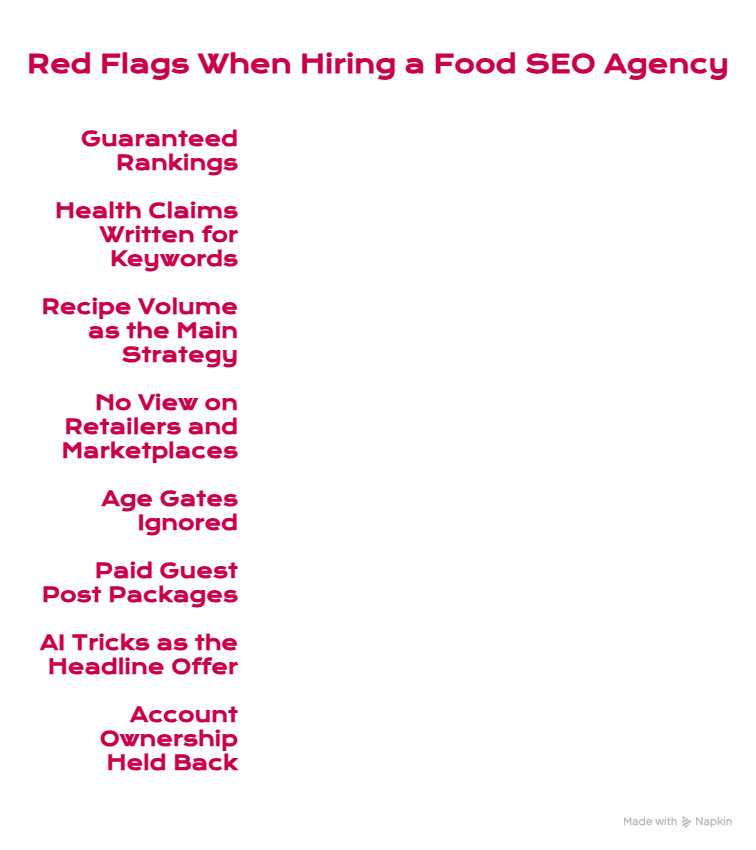
Some warning signs apply to any SEO hire, and Google lists several. Others are specific to food and beverage. Slow down or walk away if you see any of these:
- Guaranteed Rankings: Google states that no one can guarantee a number-one ranking, so any agency that promises one is misinformed or misleading you.
- Health Claims Written for Keywords: Content plans built around terms like “boosts immunity” or “detox” without a claims review process create regulatory risk for your brand.
- Recipe Volume as the Main Strategy: A plan to publish dozens of generic recipes a month is a traffic play that rarely connects to sales and can drift into scaled content abuse.
- No View on Retailers and Marketplaces: An agency that doesn’t mention retailer or marketplace competition hasn’t looked at your brand’s search results.
- Age Gates Ignored: For alcohol brands, an agency that doesn’t ask about your age verification setup may miss the single biggest technical risk on your site.
- Paid Guest Post Packages: Links sold in bundles on generic lifestyle sites violate Google’s spam policies and put your brand in places your customers wouldn’t expect.
- AI Tricks as the Headline Offer: Services built around llms.txt files, content chunking, or manufactured mentions contradict Google’s own guidance.
- Account Ownership Held Back: Any hesitation about your brand owning its Search Console, analytics, and content is a reason to stop.
How to Run a Paid Pilot With a Food and Beverage SEO Company
The safest way to hire a food and beverage SEO company is to buy a small, defined piece of work first. A 60 to 90 day paid pilot shows you how an agency thinks and delivers before you commit to a year-long retainer.
What the Pilot Should Include
A strong pilot for a food or beverage brand usually includes:
- A Technical Audit: Prioritized findings covering crawlability, age gates if relevant, product and category templates, and seasonal product handling.
- A Brand Search Audit: A review of who ranks for your brand and top product names, including retailers, marketplaces, delivery apps, and review sites, with a plan for each.
- A Claims and Content Review: An assessment of existing content for claims risk and commodity content, with recommendations your legal team can review.
- One Category or Product Line Optimization: Work on a single revenue-driving category or product line so you can measure movement.
- A Seasonal Content Calendar: A plan built around your launches, holidays, and seasonal demand, starting early enough for pages to rank in time.
- Agreed Success Measures: Defined in advance and matched to your business model.
How to Judge the Pilot
Judge the pilot on the quality of the diagnosis, the clarity of communication, how well the agency respected your claims and brand guardrails, and early movement on the chosen category. Big ranking gains in 60 to 90 days are a bonus, not a requirement. What you should see is a team that found real issues, explained them clearly, and delivered what it promised.
Most in-house teams can handle pieces of this themselves. The hard part is doing all of it together, across a full catalog, while seasonal launches keep coming, which is usually where a specialist team earns its fee.
Choosing a Food and Beverage SEO Company That Fits Your Business
The best SEO companies for the food and beverage industry aren’t the ones with the most reviews or the longest client lists. They’re the ones whose experience matches your business model, who can show you real results, who treat health and alcohol claims as a legal matter rather than a copywriting choice, who know how to handle product pages, retailer competition, age gates, and seasonal catalogs, and who approach AI search as an extension of good SEO.
Start by identifying your model. Use the criteria and questions in this guide, score each agency on evidence rather than reputation, and run a paid pilot before committing to a long retainer. Any food and beverage SEO agency worth hiring, including ours, should welcome that level of scrutiny.
Work With a Specialist SEO Team for Food, Beverage, and Regulated Consumer Brands
If you’d like to put LYNX through this process, we’re happy to be tested. Our industry-specific SEO work spans craft beverage, hemp, retail and ecommerce, hospitality, and other regulated verticals, and our full range of SEO and AEO services covers technical SEO, content, digital PR, and AI visibility under one roof.
Get in touch with the LYNX SEO team to start with a scoped pilot. You get an SEO Director, Strategist, Technical Lead, Designer, and Editor, for less than the cost of a single senior in-house hire.
Related Reading
- Ecommerce SEO Case Study: 1M Clicks for a Hemp Brand
- SEO for Craft Breweries: The Complete Guide (2026)
- Cannabis SEO Strategy 2026: What Works on Which Platform
Frequently Asked Questions
What Do the Best SEO Companies for the Food and Beverage Industry Have in Common?
The best SEO companies for the food and beverage industry share a few traits: experience matched to the client’s specific business model, verifiable results with real performance data, a documented process for reviewing health and nutrition claims, strong product and category page skills, and an AI search approach that follows Google’s published guidance. The best food and beverage SEO agencies also plan for retailer and marketplace competition and report on metrics tied to revenue, retail clicks, reservations, or leads rather than rankings alone.
—
How Much Do Food and Beverage SEO Services Cost?
The cost of food and beverage SEO services depends on the business model, catalog size, number of locations or markets, technical complexity, and how much content and digital PR the program includes. A single-location restaurant needs a very different scope than a national CPG brand with hundreds of SKUs or a beverage company selling in multiple states. The most useful way to evaluate food and beverage SEO pricing is to compare the monthly fee against the revenue, retail demand, reservations, or leads that improved organic visibility would produce.
—
How Long Does SEO Take for Food and Beverage Companies?
SEO for food and beverage companies typically produces meaningful ranking movement within three to six months for mid-competition keywords, based on what the LYNX team sees across the accounts it manages, with technical fixes and local SEO improvements often showing results sooner. Seasonal food and beverage products need content published several weeks before demand peaks, so the full value of seasonal SEO work may not appear until the same season the following year.
—
Should a Food Brand Hire a Food and Beverage Marketing Agency or a Specialist SEO Company?
A food brand should hire a food and beverage marketing agency when it needs creative, social, packaging, and paid media handled together, and a specialist SEO company when organic search is a priority channel that needs senior technical and content expertise. Many full-service food and beverage marketing agencies offer SEO as a secondary service, sometimes with junior staffing. Food brands can also combine the two, using a marketing agency for brand and creative and a specialist food and beverage SEO company for organic search.
—
Can SEO for Food Brands Compete With Amazon, Walmart, and Instacart Listings?
SEO for food brands can compete with Amazon, Walmart, and Instacart listings on searches where the brand offers something retailer pages don’t, such as detailed ingredient and allergen information, usage guidance, brand story, and product comparisons. Food brands rarely outrank major retailers on every product search, and they don’t always need to, since a sale at a retailer still counts. The goal of food brand SEO is to own the searches that matter most to the brand and give shoppers a reason to visit the brand’s site.
—
Do Food and Beverage Brands Need Recipe Content for SEO?
Food and beverage brands need recipe content for SEO only when the recipes genuinely feature their products and give readers a reason to buy. Generic recipe content competes with large publishers and food blogs and often brings traffic that never converts. A small number of original recipes developed around a brand’s products, with proper Recipe structured data, usually outperforms a large volume of generic recipes for food and beverage brands.
—
How Should Beverage Alcohol Brands Handle Age Gates for SEO?
Beverage alcohol brands should handle age gates for SEO by displaying the age verification screen as an overlay on top of page content rather than redirecting every visitor to a separate age-gate URL. Google’s guidance exempts legally required age verification from its intrusive interstitial guidelines but warns that redirecting all requests to a single consent page can remove every other page from search results. Beverage alcohol brands should confirm the setup with their SEO agency and legal counsel so it meets both search and legal requirements.
—
Is an SEO Agency Responsible for Health Claims in Food Content?
An SEO agency can share responsibility for health claims in food content, because the FTC’s Health Products Compliance Guidance notes that the FTC can take action against ad agencies and others involved in deceptive marketing, not just the brand. Food and beverage brands remain responsible for the claims on their websites. Brands should require any SEO agency to follow a documented claims review process and give the brand’s regulatory or legal team final approval over health and nutrition content.
—
Do Food and Beverage Brands Need Separate AEO or GEO Services?
Food and beverage brands do not need AEO or GEO services as a separate discipline from SEO. Google’s guidance on generative AI features says that optimizing for generative AI search is still SEO, and it notes that Merchant Center feeds and Google Business Profiles can help products and businesses appear in AI responses. Food and beverage brands get the most AI visibility from accurate product data, consistent brand information, distinctive content, and strong technical foundations inside one SEO program.
—
Should Food and Beverage Brands Add an AI Recipe or Product Assistant to Their Website?
Food and beverage brands should add an AI recipe or product assistant only if it answers customer questions accurately and quickly enough to improve the shopping experience. A slow or unreliable assistant frustrates visitors, and running costs grow with traffic. Food and beverage brands evaluating an AI assistant should review latency and cost tradeoffs when optimizing LLM performance before committing, and should keep core product information in crawlable page content either way.
—
What Should a Food and Beverage SEO Consultancy Deliver in the First 90 Days?
A food and beverage SEO consultancy should deliver a prioritized technical audit, a brand search audit covering retailer and marketplace competition, a claims and content review, work on at least one priority category or product line, and a seasonal content calendar within the first 90 days. Large ranking gains in the first 90 days are not guaranteed for food and beverage brands, but clear diagnosis, sensible priorities, and on-time delivery should be.
—
Does Local SEO Matter for Food Manufacturers Without Storefronts?
Local SEO matters less for food manufacturers without storefronts, since Google Business Profiles are designed for businesses customers can visit or that serve customers in a defined area. Food manufacturers with factory stores, tasting rooms, or farm shops should still maintain accurate Business Profiles for those locations. Most food manufacturers without storefronts get more value from product page SEO, where-to-buy pages, and B2B content aimed at retail buyers and distributors.
Sources
- Google Search Central. “Do you need an SEO?” 2026. https://developers.google.com/search/docs/fundamentals/do-i-need-seo
- Google Search Central. “Optimizing your website for generative AI features on Google Search.” 2026. https://developers.google.com/search/docs/fundamentals/ai-optimization-guide
- Federal Trade Commission. “Health Products Compliance Guidance.” 2022. https://www.ftc.gov/business-guidance/resources/health-products-compliance-guidance
- Brick Meets Click. “U.S. eGrocery Sales Surge 32% YOY to a Record $12.7 Billion in December 2025.” 2026. https://www.brickmeetsclick.com/presses/u-s-egrocery-sales-surge-32-yoy-to-a-record-12-7-billion-in-december-2025
- Google Search Central. “Avoid intrusive interstitials and dialogs.” 2026. https://developers.google.com/search/docs/appearance/avoid-intrusive-interstitials