Quick Answer: Website structure affects ChatGPT visibility in two separate ways. Site-level structure (internal links, URL patterns, navigation, redirects) decides whether OpenAI’s crawlers can find, fetch, and keep re-checking your pages. Page-level structure (heading hierarchy, paragraph length, self-contained sections) decides whether the words on an already-crawled page get pulled into an answer. A site can have one of these working well and the other failing badly, and most SEO advice treats them as the same thing.
Key Takeaways
- Website structure affects ChatGPT visibility through crawl-layer access and page-level extractability, which often fail for different reasons.
- OpenAI uses separate agents, including GPTBot for training, OAI-SearchBot for search answers, and ChatGPT-User for live user-triggered fetches.
- Blocking OAI-SearchBot can remove pages from ChatGPT search answers, while blocking GPTBot does not directly affect search visibility.
- Crawl-layer issues include stale sitemaps, 404s, redirect waste, poor internal linking, deep URL paths, and incorrect robots.txt rules.
- Page-level structure improves citation chances through clear heading hierarchy, answer-first paragraphs, short standalone sections, semantic HTML, lists, and tables.
- JavaScript-rendered content can be invisible to AI crawlers, making server-side rendering or static generation important for key pages.
- Get in touch with LYNX SEO to identify whether crawl access, page structure, or JavaScript rendering is limiting your ChatGPT visibility.
You’ve probably heard two agencies give two completely different answers about the same problem. One tells you the whole site needs a rebuild before ChatGPT will ever mention your brand. Another tells you to slap an FAQ section on your homepage and call it done. Meanwhile a competitor with a thinner, less polished site keeps showing up in AI answers and you don’t, and nobody on your team can point to the exact reason why.
Website structure gets blamed for nearly every AI visibility problem, but the phrase covers two systems that break in completely different ways.
One is about whether a crawler ever reaches your page in the first place. The other is about whether the words on that page get lifted into an answer once the page has already been found. Mixing the two together is how teams end up rebuilding a navigation menu when the real problem was a JavaScript-rendered pricing table the whole time.
What “Website Structure” Means When AI Is the One Reading It
Traditional SEO treats structure as one topic: hierarchy, internal links, headings, all filed under the same heading. That grouping made sense when a single crawler (Googlebot) handled discovery, rendering, and ranking in one continuous pipeline.
AI answer engines split that pipeline apart. A separate bot finds your page, a separate index stores it, and a separate model reads it at the moment someone asks a question. Structure is only one of several factors affecting AI search visibility in ChatGPT, alongside things like domain authority and content freshness, but it’s the one most teams get wrong first because it operates at two different layers instead of one.
Because those layers are handled by different systems with different rules, the structure choices that help you get found are not the same choices that help you get quoted.
How ChatGPT Gets to Your Pages in the First Place
Before you touch a single heading, it helps to know what’s actually reaching your server, since most guides on how to rank in ChatGPT search skip this part completely. ChatGPT doesn’t have one bot doing everything the way Googlebot does. It runs a small set of separate agents, each with its own job, and confusing them is one of the most common technical mistakes brands make when trying to fix their AI search visibility.
The Three Bots Behind ChatGPT’s Search Results
OpenAI’s own crawler documentation lays out three distinct user agents, and each one controls a different part of your relationship with ChatGPT. GPTBot crawls content that may be used to train OpenAI’s foundation models, and disallowing it in robots.txt tells OpenAI that a site’s content should not be used for training.
OAI-SearchBot is the one that surfaces websites inside ChatGPT’s search features, and sites that opt it out of crawling will not appear in ChatGPT’s search answers, though they can still show up as plain navigational links.
ChatGPT-User fires only when a live user’s question triggers a page visit. It is not used for automatic crawling of the web, and it does not determine whether a site can appear in search results.
That last point trips up a lot of technical teams. Blocking ChatGPT-User does nothing to your search visibility. Blocking OAI-SearchBot removes you from ChatGPT’s search answers entirely, and OpenAI notes it can take about 24 hours after a robots.txt change for their systems to adjust.
If your developer blocked “ChatGPT” as one generic bot a year ago, there’s a real chance you disallowed the wrong agent and never noticed.
- GPTBot: training data collection, safe to block without hurting search visibility
- OAI-Searchbot: powers ChatGPT’s search feature and citations, blocking this removes you from answers
- ChatGPT-User: live, user-triggered page fetches, not controlled by search opt-out rules
Why an Index Sits Between Your Site and ChatGPT’s Answers
ChatGPT doesn’t search the open web from scratch every time someone asks a question. Search industry analysis of ChatGPT’s retrieval pipeline has consistently found that its search feature draws heavily on Microsoft Bing’s index rather than an independent crawl of the entire internet, which means getting indexed by OAI-SearchBot is only half the equation if Bing has never properly indexed your pages either.
It also matters that search doesn’t fire on every single query. Semrush’s clickstream analysis found ChatGPT’s search feature activates on just 34.5% of queries as of February 2026, down from 46% in late 2024, meaning most responses still rely on training data alone. That number is way too low to assume every user question is a live retrieval opportunity.
The same analysis found over 30% of all ChatGPT referral traffic goes to just 10 domains. The sites that do get pulled into that search layer tend to dominate it.
That concentration raises an obvious question for smaller brands: how does a small website rank in ChatGPT when referral traffic clusters so heavily around a handful of domains?
Semrush’s comparison of AI Mode and traditional search found a strong domain-level correlation between organic rankings and AI citations, even though the exact URLs cited rarely match the top 10 results word for word. In practice, that means the groundwork you’d do to find the right SEO keywords for your website still shapes whether a smaller domain earns enough trust to get pulled into that concentrated set of AI-cited sources, even without the referring-domain count of a major publisher.
The Structure Layer That Decides If You Get Crawled At All
This is the part of structure that traditional SEO already understands, applied to a set of bots that behave nothing like Googlebot. Get this layer wrong and no amount of clever heading structure on the page itself will matter, because the page never gets a fresh look in the first place.
Crawl Efficiency and the 404 Problem
Vercel and MERJ’s analysis of AI crawler traffic found that ChatGPT’s crawler spends 34.82% of its fetches on 404 pages, with an additional 14.36% following redirects, compared to Googlebot spending only a fraction of that on dead ends. That single number says a lot about how these crawlers pick their paths.
The same study noted that, excluding robots.txt requests, these crawlers frequently attempt to fetch outdated assets from static folders. That points to a real gap in how they select and validate URLs.
For your site, this means stale internal links, orphaned old URLs still sitting in your sitemap, and broken redirect chains waste a meaningful share of every crawl budget these bots give you.
A site that redesigned pages six months ago and never cleaned up the old paths is actively burning through the limited attention an AI crawler pays it, on pages that don’t even exist anymore. This is exactly the kind of technical debt that shows up when a brand has inherited a website with years of unresolved SEO issues from a previous team or agency.
What Internal Linking Does for AI Discovery
In classic SEO, internal linking distributes authority across a site and helps Google understand which pages matter most. For AI crawlers, the job is more basic and more mechanical: links are how OAI-SearchBot and similar bots discover that a page exists at all, and how they know to come back and check it again.
That’s a different value proposition than “internal links pass ranking power,” and it changes how you should prioritize them.
A page that’s only reachable through a search box, or buried five clicks deep with no links pointing to it from anywhere else on the site, may simply never get crawled by a bot that isn’t running a full sitemap-driven traversal the way Google does. If you’re rebuilding a site and worried about losing ground during the process, this is one of the first things worth auditing before you redesign a website without losing your existing SEO value.
Site Depth, Silos, and Navigation Hierarchy
Flat, shallow structures with clear categories tend to get crawled more completely than deep, matrix-style architectures where the path to a page changes depending on where you start. This isn’t a new idea in SEO, but it’s one of the more overlooked chatgpt ranking factors, since these bots have shown far less sophistication in their URL selection than Google has spent two decades refining.
- Shallow Hierarchy: fewer clicks from the homepage to any given page, more consistent crawl coverage
- Clean, Predictable URL Patterns: fewer wasted fetches on dead paths or duplicate parameters
- Updated Sitemaps: a direct signal of which pages currently exist and which ones no longer do
| Structure Element | What It Controls | Why AI Crawlers Care | Quick Fix |
| Internal linking | Page discovery and re-crawl frequency | Bots follow links to find new or updated pages | Link new pages from at least one high-traffic page within a week of publishing |
| URL depth and silos | How completely a site gets covered | Shallow paths get crawled more consistently | Keep priority pages within three clicks of the homepage |
| 404 rate and redirects | Wasted crawl fetches | Nearly 35% of ChatGPT’s fetches hit dead pages | Audit and update your sitemap after every redesign |
| Robots.txt bot rules | Which agents can reach you at all | Blocking the wrong bot removes you from search entirely | Confirm OAI-SearchBot is explicitly allowed |
| Sitemap freshness | Whether new content gets found quickly | Stale sitemaps still list pages that no longer exist | Regenerate and resubmit sitemaps after major changes |
The Structure Layer That Decides If You Get Quoted
Getting crawled only gets you halfway there. Once a bot has fetched your page, a separate question decides whether any of it ends up in an answer: can the model pull a clean, self-contained piece of text out of what it just read.
Heading Hierarchy as a Retrieval Map
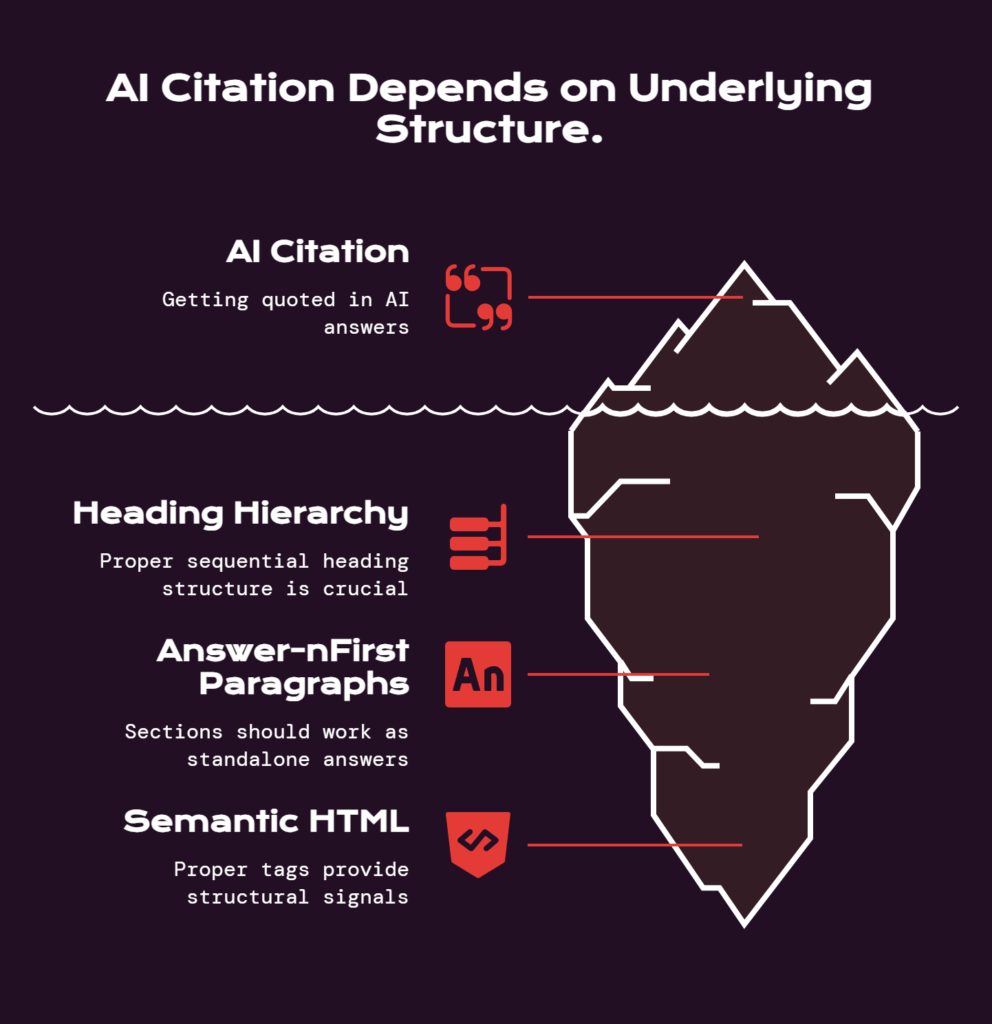
AirOps’ analysis of more than 12,000 URLs found that 68.7% of ChatGPT-cited pages followed a proper sequential heading structure, compared to just under a quarter of traditional page-one Google results. That gap says heading hierarchy carries more weight for AI citation than it does for classic ranking position alone.
A clean H1 to H2 to H3 structure works like a map the model can follow to find the exact passage that answers a specific question, rather than a decorative label sitting above a paragraph.
Skipping levels, using headings purely as visual breaks, or writing vague titles that don’t match how someone would actually phrase a question all make that map harder to follow.
This is part of why generic AI-generated blog content so often underperforms even when it’s technically well-written, a problem worth addressing directly if you’re trying to add real value to AI-written blog content instead of publishing more of the same.
Answer in First Paragraphs and Passage Chunking
Models do’t read a page start to finish the way a person browsing casually might. They tend to pull isolated chunks of text, which means each section needs to work as a standalone answer rather than the payoff at the end of a long build-up.
- Open each section with the direct answer, then follow with supporting detail
- Keep paragraphs short enough that a single idea isn’t split across two disconnected blocks
- Avoid burying the actual answer under several sentences of preamble before it shows up
Semantic HTML Vs Div-Based Layouts
Proper heading tags, list elements, and table markup give a crawler a structural signal about what each piece of content is. A page built entirely out of generic div containers with styling doing all the visual work carries none of that signal in the underlying HTML, even if it looks identical to a person looking at it in a browser.
This matters more once you consider what these crawlers can actually see in the first place, which brings up a separate technical problem entirely.

The JavaScript Rendering Problem Most Sites Still Have
Vercel and MERJ’s traffic analysis found that none of the major AI crawlers currently render JavaScript, including OpenAI’s OAI-SearchBot, ChatGPT-User, and GPTBot, Anthropic’s ClaudeBot, and Perplexity’s crawler. The data showed ChatGPT’s crawler does fetch JavaScript files in about 11.5% of requests, but doesn’t execute them, meaning content that only exists after a script runs stays invisible no matter how many times the bot visits.
For a site built with heavy client-side rendering, that’s not a ranking penalty in the traditional sense. It’s closer to the page not existing at all from the crawler’s point of view. Product details, pricing tables, FAQ content, and comparison charts that render after JavaScript loads are simply absent from what the bot receives, regardless of how well that same content performs for a human visitor or a fully rendering search engine.
The fix isn’t complicated in principle: server-side rendering or static generation for anything that matters, with client-side rendering reserved for genuinely optional elements like a live chat widget or a view counter. It just requires someone to actually check, since most teams assume “Google can see it fine” covers every crawler that matters, and that assumption stopped being true the moment AI answer engines entered the picture. For a lot of sites, this single fix does more to make content visible on ChatGPT than any amount of extra copywriting ever will.
How to Check Whether Your Structure Is Working
Fixing structure without measuring the result is a guess dressed up as a strategy. If you’re trying to figure out how to see brand visibility in ChatGPT, there’s no single dashboard number the way there is with a Google ranking, so a few consistent checks matter more than any one metric. Following a few best practices for ChatGPT website visibility keeps that guesswork to a minimum:
- Check server logs for GPTBot, OAI-SearchBot, and ChatGPT-User activity to confirm crawlers are reaching the pages you think they are
- View key pages with JavaScript disabled to see exactly what a non-rendering crawler receives
- Track actual citations over time rather than guessing based on rankings alone, since the two increasingly diverge
That last point is where most brands get stuck. Trying to measure visibility in ChatGPT and Perplexity by hand, running the same test prompts over and over, doesn’t scale past a handful of queries and tells you nothing about the trend. It’s also the same reason forecasting SEO growth has gotten harder in general, since rankings alone no longer tell the whole story of whether a site is gaining visibility.
This is the exact gap Promptwatch was built to close, giving teams a repeatable way to see which pages are surfacing in AI answers and which ones are getting crawled but never quoted.
Pairing that visibility with the crawl-layer fixes above turns structure work from a one-time audit into something you can measure over time. That ties directly into how to measure whether an SEO campaign is actually working instead of relying on rankings that no longer tell the full story.
Why LYNX SEO Builds Site Structure for Google and AI Together
Most agencies treat ChatGPT visibility optimization as a pure content problem: add an FAQ, sprinkle in some question-style headings, call it a day. If you’ve been trying to figure out how to make your brand visible in ChatGPT without much to show for it, this is usually where the real problem is hiding.
LYNX SEO starts one layer deeper, auditing whether OpenAI’s bots can actually reach and re-check your pages before touching a single heading. That means fixing crawl budget waste, cleaning up the URL debt from old redesigns, and confirming your robots.txt rules aren’t quietly blocking the one bot that controls whether you show up in ChatGPT’s answers at all.
Once that foundation is solid, the content-level work (heading hierarchy, answer-first sections, semantic markup) actually has something to stand on. Skipping straight to the content layer is how brands end up publishing beautifully structured pages that a crawler never sees in the first place.
If you want to know which layer is holding your site back, get in touch with LYNX SEO and find out before you spend another quarter guessing.
Frequently Asked Questions
Does ChatGPT Crawl My Website the Same Way Google Does?
No. Google uses one primary crawler that discovers, renders, and indexes pages in a continuous process. ChatGPT relies on separate bots for training, search indexing, and live user fetches, plus a search layer that doesn’t activate on every query, so discovery and citation work through a different pipeline entirely.
Can I Block Google While Still Being Visible in ChatGPT?
Technically yes, since the two systems use entirely separate crawlers and robots.txt rules. In practice this isn’t advisable, because Google rankings still correlate strongly with which domains AI tools trust and cite, so cutting off Google traffic tends to weaken your AI visibility over time as well.
How Long Does It Take for Site Structure Changes to Affect ChatGPT Citations?
Robots.txt changes typically take about 24 hours to be recognized by OpenAI’s systems. Content and structure changes on an already-indexed page can take longer to affect citations, since it depends on how often the relevant bot re-checks that specific page.
Does a Single-Page Application Hurt My ChatGPT Visibility?
It can, significantly. If your main content only appears after JavaScript runs in a browser, AI crawlers that don’t execute JavaScript will only see an empty or near-empty page, regardless of how complete that content looks to a human visitor.
Do Internal Links Pass Authority to AI Search the Way They Do in Google?
Not in the same sense. For AI crawlers, internal links mainly help with discovery, letting bots find new or updated pages and know to recheck them. The authority-passing concept from traditional SEO doesn’t map directly onto how these newer crawlers operate.
Should I Prioritize Google Rankings or ChatGPT Citations First?
Fixing crawl-layer issues like broken links, JavaScript rendering, and bot access benefits both systems at once, so start there. Content-level work aimed at AI citations alone, like answer-first sections and heading hierarchy, can be layered on afterward.
Does Site Speed Affect Whether ChatGPT Cites My Pages?
Site speed itself isn’t a direct citation factor the way it can be for Google’s ranking algorithm. It still matters indirectly, since slow or unreliable servers can cause crawlers to abandon fetches, which affects whether the page gets read in the first place.
Sources Used for This Article
- OpenAI: “Overview of OpenAI Crawlers” – developers.openai.com/api/docs/bots
- Vercel: “The Rise of the AI Crawler” – vercel.com/blog/the-rise-of-the-ai-crawler
- AirOps: “Use ChatGPT’s Preferred Content Structure To Get Cited More Often” – airops.com/blog/chatgpt-content-structure
- Semrush: “ChatGPT Traffic Analysis: Insights From 17 Months of Clickstream Data” – semrush.com/blog/chatgpt-search-insights
- Semrush: “How Google’s AI Mode Compares to Traditional Search and Other LLMs” – semrush.com/blog/ai-mode-comparison-study
