
Quick Answer: Data centre SEO is the practice of optimizing a colocation, hyperscale, or AI infrastructure company’s web presence so it ranks in Google and surfaces in AI-driven search tools like ChatGPT, Perplexity, and Google AI Overviews. It works through a combination of technical SEO, high-intent keyword content targeting enterprise IT buyers, and authority-building through links and structured data. Most data centre operators have never invested in organic search at all – which means early movers right now have a significant, compounding advantage.
For most of its history, the data centre industry ran on relationships, trade shows, and an RFP pipeline that didn’t need a website to function. Your facility was in the right market, you had the right uptime certifications, and your sales team knew the right people. That was the playbook. And it worked.
It doesn’t work the same way anymore.
The AI infrastructure boom has fundamentally changed who’s buying data centre capacity and how they’re making those decisions. Companies that would never have touched a colocation contract five years ago are now evaluating hyperscale options, edge deployments, and multi-region capacity arrangements to support LLM workloads. The buyers are different, the procurement teams are different, and the research process is almost entirely digital.
According to Gartner’s B2B Buying Journey research, B2B buyers now spend only 17% of their total purchase journey in direct contact with potential vendors. The other 83% happens without your sales team in the room. They’re searching Google. They’re asking ChatGPT. They’re reading industry content, comparing spec sheets, and building vendor shortlists long before anyone fills out a contact form.
If your company doesn’t exist in those search results, you don’t exist in that shortlist.
This piece is about how data centre companies – colocation providers, AI infrastructure operators, hyperscale developers, and managed IT infrastructure firms – can build the kind of organic search presence that actually generates pipeline. Not vanity traffic. Pipeline.
Key Takeaways
- The global AI data centre market is on a steep growth curve, and the buyers driving that growth research digitally before engaging vendors.
- Data centre SEO requires a different approach than most B2B verticals because of long sales cycles, multi-stakeholder buying committees, and highly technical content requirements.
- A colocation SEO strategy needs to address awareness-stage, evaluation-stage, and decision-stage search intent separately.
- GEO (Generative Engine Optimization) is now part of any serious data center digital marketing plan – buyers are querying AI tools, not just search engines.
- Hyperscale data centre marketing, enterprise IT content strategy, and link acquisition from industry publications are the three pillars that compound over time.
Data Centre SEO and AEO is one of the many industries that LYNX SEO can help you grow visibility in.
The Market Context: Why This Vertical Is Finally Taking SEO Seriously
The numbers behind the AI infrastructure build-out are staggering. The AI data centre market was valued at USD 344 billion in 2025 and is projected to reach over USD 2 trillion by 2032, growing at a CAGR of 27.5%. Infrastructure spending in this sector reached $290 billion in 2024 alone, with hyperscalers like Alphabet, Microsoft, Amazon, and Meta accounting for nearly $200 billion of that – and expected to increase CapEx by over 40% in 2025.
Colocation is one of the fastest-growing segments. The colocation AI data centre segment is projected to register a CAGR of 32.6% over the same forecast period – the highest of any data centre type. The scale of this build-out is hard to overstate. The IEA’s Energy and AI report found that global data centre electricity consumption reached 415 TWh in 2024 and is projected to nearly double to 945 TWh by 2030 – driven primarily by AI workloads. In the US alone, the Department of Energy’s Lawrence Berkeley National Laboratory projects that data centre load growth has tripled over the past decade and will double or triple again by 2028.
That growth isn’t coming from the same enterprise IT directors who already knew your brand from DCD conferences. A significant portion is coming from AI-native companies, scale-ups evaluating infrastructure for the first time, and enterprise teams trying to understand their options before issuing an RFP.
Those buyers research digitally. That’s the whole reason data centre SEO matters now in a way it simply didn’t five years ago.
How the Data Centre Buyer Journey Has Changed – and What It Means for SEO
The traditional data centre sales motion relied heavily on the sales rep. They controlled the information. They ran the demos. They walked you through the facility. Today, 67% of B2B buyers complete most of their research before ever contacting a vendor. By the time someone fills out your contact form or responds to outreach, they’ve already evaluated you against competitors – often without you knowing.
A 2025 Gartner survey found that 61% of B2B buyers prefer a rep-free buying experience, actively researching vendors through digital channels rather than engaging sales teams early. That finding is consistent with McKinsey’s B2B Pulse research, which shows B2B buyers are more comfortable than ever completing significant purchases – including high-value infrastructure contracts – through digital self-service channels. For data centre buyers specifically, that means they’re searching terms like “colocation pricing calculator,” “what is PUE,” “hyperscale vs enterprise data centre,” and “AI-ready data centre requirements” before anyone on your team has a conversation with them.
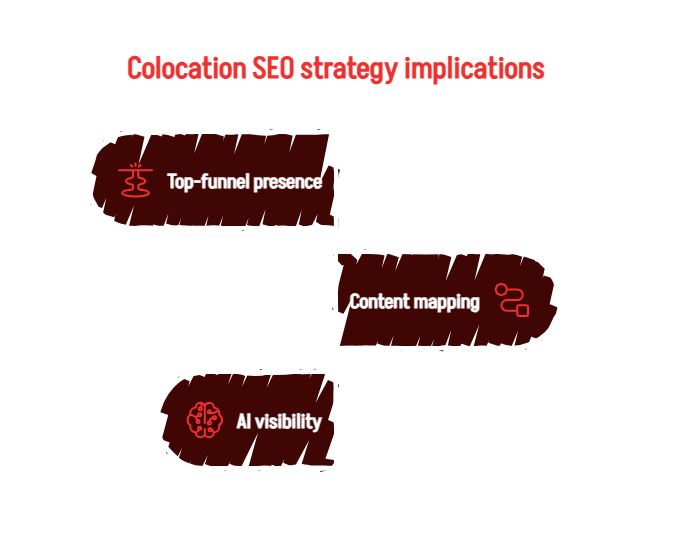
This shift has three direct implications for how a colocation SEO strategy needs to be built:
First: You need to be present at the top of the funnel. If someone is searching for information about data centre options, uptime requirements, or cooling infrastructure, you want to be the resource they land on. That’s how you shape their evaluation criteria before they’ve built their shortlist.
Second: You need to map content to each stage of a long, complex buying cycle. Data centre deals can run 6 to 24 months. Your SEO content needs to address every stage of that journey – from early awareness through vendor evaluation to internal consensus-building.
Third: You need to be visible in AI-generated search results, not just traditional Google SERPs. Buyers are increasingly asking ChatGPT, Perplexity, and Google AI Overviews questions like “what are the top colocation providers in Northern Virginia” or “how do I evaluate a data centre for AI workloads.” If your content isn’t structured to be cited by these tools, you won’t appear.
See how LYNX SEO can help get your data centre seen across the web.
Data Centre SEO vs. Generic B2B SEO: What’s Different
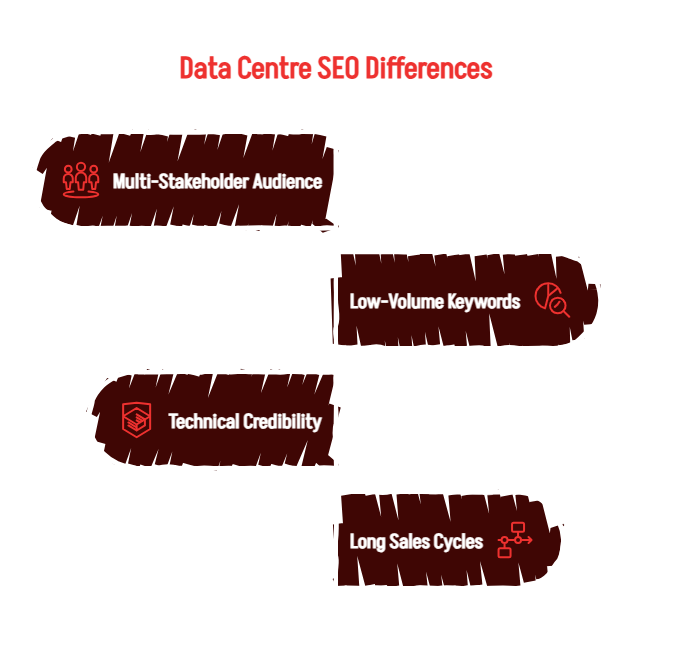
Most B2B SEO playbooks don’t translate cleanly to the data centre vertical. Here’s why:
The Audience Is Multi-Stakeholder and Deeply Technical
A typical data centre procurement decision involves CIOs, CTOs, VP of Infrastructure, procurement officers, compliance teams, and often a CFO. Each persona is searching for different information with different language. The CTO might search “AI-ready rack density requirements.” The procurement officer is looking for “data centre RFP template.” The CFO wants “colocation TCO comparison.” Your SEO content strategy has to map to all of these, not just one.
The Keywords Are Low-Volume and High-Value
“Colocation data centre pricing” might generate a few hundred searches per month. But a single deal from that keyword can be worth millions in annual contract value. This is not an SEO vertical where you’re chasing volume – you’re chasing intent. A search for “hyperscale colocation Canada” from the right company at the right stage of their procurement process is worth more than 10,000 visits from casual readers.
Technical Credibility Is Important
Data centre buyers are sophisticated. They’ll immediately flag content that doesn’t know the difference between PUE and WUE, or that conflates colocation with cloud hosting. Your content has to be accurate enough that a VP of Infrastructure would consider sharing it internally. That’s the bar.
Long Sales Cycles Demand Long-Game Content
Standard lead-gen SEO often targets bottom-funnel keywords designed to capture buyers ready to convert. In data centres, that’s a small slice of the total search opportunity. The bigger opportunity is capturing buyers earlier in their journey and staying visible through a 12-to-24-month evaluation cycle. That requires a content ecosystem, not just a few landing pages.
Building a Colocation SEO Strategy
Think about data centre SEO in three layers: technical foundation, content infrastructure, and authority acquisition. All three have to work together. Weak technical SEO means your content doesn’t get indexed properly. Great technical SEO with thin content won’t earn rankings or trust. And no external authority signals mean competitors with worse content can outrank you just because they’ve been around longer.
Layer 1: Technical SEO for Data Centre Websites
Technical SEO matters more in this vertical than most. Data centre sites tend to be built for enterprise sales teams – dense spec sheets, PDF-heavy architecture, and a site structure that makes sense to a facilities manager but is invisible to search engines.
The technical priorities for any data centre company getting serious about SEO:
- Site Architecture: Organize pages around how buyers search, not how your internal teams are structured. A page titled “INF-2 Facility Spec” means nothing to Google. A page titled “Toronto Colocation Data Centre – Uptime Institute Tier III Certified” does.
- Page Speed: Research consistently shows that slow-loading pages hurt both rankings and conversions. Enterprise buyers are not patient. A site that loads in 4 seconds while your competitor’s loads in 1.5 seconds is a signal problem and a UX problem at the same time.
- Schema Markup: Structured data helps Google and AI tools understand what your facility offers, where it’s located, what certifications you hold, and who it’s for. LocalBusiness, FAQPage, and Organization schema are table stakes.
- Mobile and Core Web Vitals: Even in a B2B context, buyers are doing early-stage research on mobile devices. A site that doesn’t render properly on mobile is leaving early funnel traffic on the table.
If your site underwent a recent redesign, it’s worth reviewing whether SEO integrity was maintained throughout that process. A technical site rebuild done without proper SEO oversight can silently destroy months of ranking progress – something we’ve covered in detail in our guide on how to redesign a website without losing SEO.
Layer 2: Content Infrastructure for AI Infrastructure Content Marketing
This is where most data centre companies have the biggest gap – and the biggest opportunity. Almost no operators in this space have built a real content program. That means the competitive landscape for organic search is still largely uncontested.
The keyword opportunity in data centre SEO breaks into three intent tiers:
Awareness-Stage Keywords These are the searches buyers make when they’re trying to understand a problem or a category, not yet evaluating vendors. They tend to have higher search volume and lower conversion intent. Examples: “what is colocation,” “hyperscale vs enterprise data centre,” “AI data centre requirements,” “data centre power density explained.”
Content format: Educational articles, explainers, and comparison pieces. The goal is to be the most useful resource in the category, not to sell anything.
Evaluation-Stage Keywords These searches signal that someone is actively comparing options. They have lower volume but higher purchase intent. Examples: “colocation pricing Toronto,” “data centre uptime tiers comparison,” “HIPAA compliant data centre Canada,” “PUE benchmarks 2025.”
Content format: Spec-forward landing pages, comparison tables, calculators, and buying guides. This is where you give buyers the information they need to put you on their shortlist.
Decision-Stage Keywords These are searches from buyers who are close to issuing an RFP or making a selection. Very low volume, very high value. Examples: “data centre RFP template,” “colocation contract terms to watch,” “how to evaluate a colocation provider.”
Content format: Sales enablement content that doubles as SEO. Checklists, RFP templates, and detailed guides that serve a buyer trying to close their internal business case.
The Keyword Map: What to Target for Data Centre Lead Generation
The following table outlines keyword categories, example terms, and the content type best suited to capture that traffic and intent.
| Keyword Category | Example Terms | Recommended Content Type |
| Category Education | “what is colocation,” “hyperscale data centre explained” | Long-form educational articles |
| Infrastructure Specs | “PUE benchmarks,” “Tier III vs Tier IV data centre,” “rack density AI” | Spec guides, comparison pages |
| Location + Service | “colocation Toronto,” “data centre Canada AI-ready” | Location-optimized service pages |
| Compliance + Certifications | “SOC 2 data centre,” “HIPAA compliant colocation” | Certification landing pages |
| Buyer Tools | “data centre RFP template,” “colocation TCO calculator” | Downloadable tools, interactive pages |
| Vendor Comparison | “best colocation providers Canada,” “hyperscale vs colocation” | Comparison articles, buying guides |
| AI Infrastructure | “AI-ready data centre,” “GPU infrastructure colocation” | AI-specific pillar pages |
This is not a keyword strategy you build out in a day. The long-term play is building topical authority across these clusters so that Google and AI tools see your domain as the definitive resource in the category. That’s also how you get cited in AI Overviews and LLM responses – by being the source that answers these questions better than anyone else.
For more on keyword research fundamentals and how to approach this process systematically, the guide on how to find SEO keywords for a website covers the core methodology.
AI Infrastructure Content Marketing: Getting Cited by LLMs, Not Just Google
A meaningful portion of data centre research now starts not in a Google search bar, but in an AI tool. A procurement team member might ask ChatGPT “what should I look for in a colocation provider” or “which data centres in Canada are AI-ready.” If your content is not structured to be extracted and cited by these models, you’re invisible in an increasingly important research channel.
This is the GEO (Generative Engine Optimization) layer of data centre digital marketing – and it’s become a non-optional part of any serious strategy.
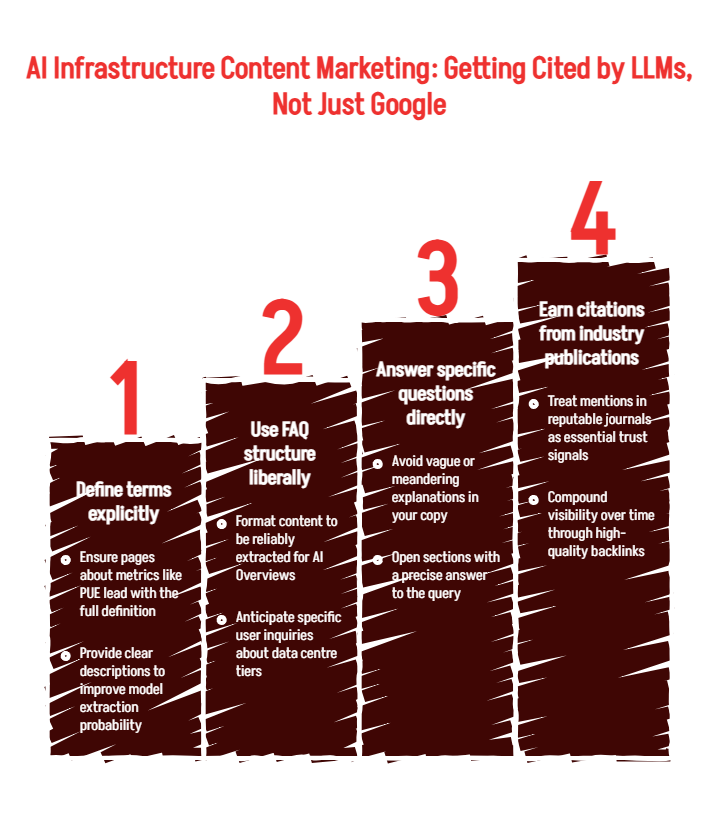
The principles that make content GEO-friendly overlap heavily with good SEO fundamentals, but with some important nuances:
- Define terms explicitly. AI models pull from content that clearly defines what something is. A page about PUE that never actually defines “Power Usage Effectiveness” is less likely to be cited than one that leads with the definition.
- Use FAQ structure liberally. FAQ-formatted content is one of the most reliably extracted content types for AI Overviews and LLM responses. If someone asks an AI “what is a Tier III data centre,” you want your content to be what it reads.
- Answer specific questions directly. Vague, meandering answers don’t get extracted. Content that opens with a direct, accurate answer to a specific question does.
- Earn citations from industry publications. AI models treat external citations from credible sources as trust signals – similar to how Google treats backlinks. Getting mentioned in Data Center Knowledge, Data Center Dynamics, or Uptime Institute’s publications compounds your GEO visibility over time.
For a deeper look at how to structure content for AI visibility, the piece on how to add value to AI blog content covers the execution side in detail.
The Buyer Persona Problem: Who Is Actually Searching?
One of the unique challenges of B2B technology SEO in the data centre space is that the people doing the searching are not always the same people making the purchase decision.
A junior IT manager might be the one Googling “colocation vs cloud for AI workloads” at 9 PM on a Tuesday. But the VP of Infrastructure is the one who signs the MSA. Your content needs to serve both – the early-stage researcher who needs to understand the category, and the experienced buyer who needs proof that your facility can handle 130 kW rack densities and has the compliance certifications their legal team will require.
This has a direct implication for enterprise IT content strategy: you can’t write everything for one persona. You need:
- Educational content that serves researchers and champions building an internal business case
- Technical specification content that satisfies senior IT and engineering evaluators
- Trust-building content (case studies, certifications, uptime data) for procurement and compliance teams
- ROI and financial framing content for the CFO who has to approve the budget
According to JSA’s data centre marketing research, data centre buyers are researching providers long before they contact one – reading industry publications, comparing options, and asking AI tools for recommendations before they ever fill out a contact form. If you’re not showing up in those research channels, you’re already behind when that buyer starts their formal evaluation.
What Great Data Centre Content Looks Like
To make this concrete, here’s the type of content that earns both rankings and trust in this vertical:
What Good Data Centre SEO Content Delivers:
- Accurate technical specifications that hold up to scrutiny from a CTO or VP of Infrastructure
- Direct answers to the questions buyers are actually searching (not the questions you want them to ask)
- Clear, jargon-free explanations of complex concepts (power density, redundancy tiers, liquid cooling) that help buyers understand what they’re evaluating
- Data-backed claims with citations from credible industry sources like Uptime Institute, JLL, or IEA
- Structured formatting that makes it easy to extract key facts quickly – which serves both human readers and AI tools
What Gets Ignored:
- Generic brand messaging that could apply to any data centre anywhere
- Technical spec dumps with no narrative or context
- Content written for the executive team to approve, not for the buyer to find useful
- Anything that reads like a brochure rather than a reference resource
A useful benchmark: if a data centre buyer forwarded your article to their colleagues during an internal evaluation, would it hold up? If the answer is yes, you’re building the right kind of content.
Hyperscale Data Centre Marketing: The Link Acquisition Layer
Ranking for competitive B2B technology SEO terms requires more than great content. You need external authority – other credible sites linking to yours and citing your work.
In the data centre space, the most valuable link sources are:
- Industry publications: Data Center Knowledge, Data Center Dynamics, DCD (Data Centre Dynamics), Uptime Institute, IEA data centre reports
- Trade associations and standards bodies: The Green Grid, AFCOM, BICSI
- Technology media: The Register, TechTarget, CRN
- Research and analyst firms: Gartner, JLL (for real estate and capacity data), IoT Analytics
- Relevant adjacent publications: Cloud computing, enterprise IT, and AI infrastructure media
The strategies that generate links in this space:
Original Data and Research: If you publish original findings – uptime data, power benchmarks, regional capacity trends – other publications will reference them. Most data centre operators have proprietary data they’re sitting on and not publishing.
Technical Guides Worth Citing: A genuinely comprehensive guide to evaluating colocation options, or a detailed breakdown of liquid cooling approaches for AI workloads, can earn links from IT media, comparison sites, and buyer guides.
Industry Commentary: Getting your leadership team’s perspective into news articles about infrastructure trends, the AI power consumption issue, or sustainability in data centres builds both links and brand visibility in the channels where your buyers are paying attention. The energy and AI story is one of the most covered topics in technology journalism right now – Brookings Institution research notes that data centre electricity demand could approach 1,050 TWh by 2026, a figure that is generating sustained editorial attention across energy, infrastructure, and technology media. That’s a built-in opportunity for data centre operators to get their voice into the coverage.
Measuring Data Centre SEO: The Metrics That Actually Matter
The standard SEO KPIs don’t tell the full story in a high-value, low-volume B2B vertical. Here’s a practical framework for measuring what matters:
| Metric | What to Track | Why It Matters |
| Organic Impressions | For target keyword clusters by intent tier | Shows whether content is being indexed and surfaced |
| Qualified Organic Traffic | Sessions from target buyer personas (by company type, location, job function) | Volume means nothing if buyers aren’t landing |
| Content Engagement | Time on page, scroll depth, internal navigation | Tells you if content is actually serving the reader |
| Assisted Conversions | Contact form submissions, tour requests, RFP downloads with organic as a touchpoint | Data centre deals are multi-touch; first-touch attribution undervalues SEO |
| AI Visibility | Mentions of your brand/facility in ChatGPT, Perplexity, Google AI Overviews | The emerging metric for GEO performance |
| Domain Authority Growth | Referring domain count and quality over time | The upstream signal for long-term ranking ability |
Learning how to forecast what organic search can realistically deliver – and at what timeline – is a discipline in itself. The LYNX guide on how to forecast SEO growth covers the practical models for doing that accurately.
Common Mistakes Data Centre Companies Make With SEO
A few patterns show up consistently when operators in this space try to do SEO without a clear strategy:
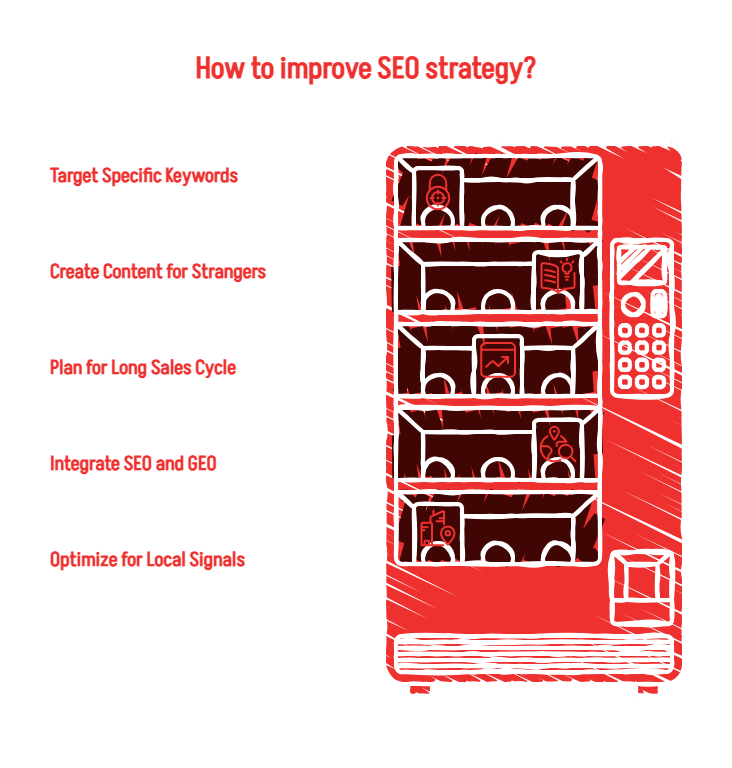
- Targeting Broad Keywords With No Conversion Path Ranking for “data centre” is not a realistic or useful goal. It attracts a mix of students, researchers, and tangentially curious readers who will never convert. The right targets are specific, intent-rich, and tied to your actual buyer.
- Treating Their Website Like a Brochure Most data centre websites are built for the sales team to send to prospects who already know who you are. SEO requires content built for strangers who don’t know you yet and need a reason to trust you.
- Ignoring the Long Sales Cycle in Content Planning A single piece of content does not convert a data centre deal. The buyer who reads your “what is colocation” article today might not issue an RFP for 14 months. That long sales cycle means SEO investments compound over time – but they also require patience and consistent content production. For organizations generating and publishing content at scale, understanding how to forecast SEO growth helps justify the investment and set realistic expectations.
- Treating SEO and GEO as Separate Programs They’re not. Content that answers specific questions clearly, earns citations from credible sources, and gets structured with schema markup serves both traditional search and AI-driven search simultaneously. Building two separate programs for this is redundant. Build one program that does both.
- Neglecting Local and Regional Signals Enterprise buyers evaluating facilities care deeply about geography – latency zones, power infrastructure, regulatory environment, and proximity to their operations. Location-specific content and pages are a critical part of any colocation SEO strategy. The principles from our work on local SEO for franchise businesses – particularly around location page optimization and citation building – apply directly to multi-facility data centre operators.
A Word on Content Quality in a Technical Vertical
One thing worth saying plainly: bad AI-generated content that sounds authoritative but gets the technical details wrong is a real problem in this space. A data centre buyer who finds an article claiming PUE of 1.0 is achievable, or that confuses Tier III and Tier IV redundancy requirements, is not going to call that company. They’re going to write them off.
Research from SeoProfy shows that B2B content marketing costs 62% less and brings in three times more leads than traditional marketing – but that stat assumes the content is actually good. In technical verticals, the quality bar is higher because the reader’s ability to detect inaccuracies is higher.
This is one of the reasons AI-generated content that isn’t reviewed by a subject matter expert creates more problems than it solves in B2B technology SEO. The upside of doing it right is significant. The downside of doing it wrong in a trust-sensitive vertical is that you’ve actively damaged your credibility with the buyers you most wanted to reach. For more on making AI-assisted content production work without compromising accuracy, see: AI Blog Content: How to Make It Worth Reading.
Conclusion: The Window for First-Mover Advantage Is Open – But Not Forever
The data centre industry is in a rare position: a market experiencing explosive growth with almost no established SEO presence to compete against. Most operators in this space have never published a piece of content designed for organic search. Almost none have a real content strategy. The authoritative guides, location pages, and technical resources that a serious buyer would expect to find don’t exist yet for most facilities.
That’s the opportunity.
The companies that build topical authority in data centre and AI infrastructure search over the next 12 to 24 months will own a compounding asset that’s very hard to dislodge. The ones that wait until competitors have established themselves will be paying significantly more – in time, budget, and effort – to catch up.
If you’re running a colocation facility, managing an AI infrastructure platform, or building a hyperscale project and you’re not investing in data centre SEO, you’re handing organic pipeline to whoever moves first.
At LYNX, this is the kind of SEO work we do for B2B technology companies navigating exactly this situation. If you’d like to understand what an SEO strategy built specifically for your facility and your buyer looks like, we’d be glad to talk.
Frequently Asked Questions
How Does a Data Centre Company Get Found in Google Search?
Getting found in Google starts with optimizing your website for the terms your buyers actually search. For data centre companies, that means creating pages and content around keywords tied to specific intent: location-based colocation terms, infrastructure specification queries, compliance-related searches, and comparison terms. Technical SEO fundamentals – clean site architecture, schema markup, fast load times, and mobile responsiveness – are the foundation. Content that answers specific buyer questions at every stage of the evaluation cycle builds rankings over time. External links from industry publications and authoritative technology media amplify the impact.
What Does an SEO Strategy Look Like for a Data Centre?
A data centre SEO strategy typically has three layers. First, a technical audit and remediation to make sure your site is indexable, fast, and structured correctly. Second, a content plan that maps keyword clusters to each stage of the buyer journey – from awareness-stage educational content through evaluation-stage spec pages to decision-stage sales enablement. Third, a link acquisition program targeting data centre and enterprise IT industry publications. The whole program is built around the understanding that data centre deals have long sales cycles and that SEO compounds over time.
How Do AI Infrastructure Companies Do Content Marketing?
AI infrastructure companies that are doing content marketing well are focusing on a few things: publishing technical content that answers specific questions from their buyer personas, building topical authority across the infrastructure category, getting cited in industry publications and research, and optimizing content for both traditional search and AI-driven tools like ChatGPT and Google AI Overviews. The emphasis is on accuracy and depth over volume – one genuinely useful technical guide is worth more than ten generic blog posts that don’t get read or linked to.
Does SEO Work for B2B Data Centre Companies?
Yes – and arguably more effectively than in many other B2B verticals, because the competition is almost nonexistent and the value of each qualified lead is extremely high. A single colocation contract can be worth hundreds of thousands to millions of dollars in annual revenue. Even a modest improvement in organic visibility that generates one or two additional qualified conversations per quarter can produce enormous ROI. The challenge in this space is that the results take time – data centre SEO is a 12-to-24-month investment, not a 90-day lead generation campaign. But the compounding effect of building topical authority in an uncontested search landscape is significant.
What Is the Best SEO Agency for Tech Infrastructure Companies?
The best fit is an agency with a genuine track record in B2B technology SEO – one that understands long sales cycles, multi-stakeholder buying decisions, and the difference between traffic that feels good in a report and traffic that actually produces pipeline. Look for case studies in adjacent verticals (enterprise IT, SaaS, managed services, cloud infrastructure), evidence that they understand technical content requirements, and an approach that treats GEO and traditional SEO as a unified program rather than separate deliverables. LYNX SEO works with B2B technology companies in exactly this position – if you’d like to see what that looks like in practice, the case studies are here.
What Keywords Should a Colocation Provider Target for SEO?
The most valuable keyword categories for a colocation provider are: location-based service terms (“colocation Toronto,” “data centre Canada”), infrastructure specification queries (“Tier III colocation,” “AI-ready rack density”), compliance-related searches (“SOC 2 data centre,” “HIPAA compliant colocation”), and buyer-intent terms (“colocation pricing,” “data centre RFP template”). The goal is not to rank for the broadest possible terms – it’s to be the most visible, most credible resource for the specific searches your highest-value buyers are making.
How Long Does It Take for Data Centre SEO to Show Results?
In a typical B2B technology context, meaningful organic traffic and ranking movement usually becomes visible within four to six months of a well-executed SEO program. In the data centre space, where there’s relatively little established competition in search, it can happen faster for specific keyword clusters. The longer investment horizon – 12 to 24 months – is when the compounding effect of topical authority, accumulated backlinks, and a content library starts producing consistent pipeline rather than occasional wins. The earlier you start, the larger that compounding advantage becomes.
What Is GEO and Why Does It Matter for Data Centre Marketing?
GEO stands for Generative Engine Optimization – the practice of structuring content so it gets cited and surfaced by AI tools like ChatGPT, Perplexity, and Google AI Overviews. It matters for data centre companies because a growing number of buyers are starting their research by asking AI tools questions about infrastructure options, provider comparisons, and technical requirements. If your content is not structured to be accurately cited by these systems, you’re invisible in an increasingly important research channel. GEO and traditional SEO are not separate programs – the same content quality, structure, and authority signals that help you rank in Google also improve your GEO visibility.
Sources
- Global energy demands within the AI regulatory landscape | Brookings
- Data Center Marketing Strategy: Visibility, Trust & Pipeline
- McKinsey B2B Pulse 2024 | McKinsey
Gartner Sales Survey Finds 61% of B2B Buyers Prefer a Rep-Free Buying Experience - DOE Releases New Report Evaluating Increase in Electricity Demand from Data Centers | Department of Energy
- Executive summary – Energy and AI – Analysis – IEA
- Data Center infrastructure market: AI-driven CapEx pushing IT and facility equipment spending toward $1 trillion by 2030
- AI Data Center Market Size, Share, Latest Trends & Growth Analysis, 2026-2032
- The B2B Buying Journey: Key Stages and How to Optimize Them