Local SEO for home service franchises is one of the hardest problems in digital marketing. You’re not running a single SEO campaign – you’re running dozens or hundreds of them at once, and each franchise location has to compete independently in its own market while the parent brand maintains consistency across every touchpoint.
Most franchise operators learn this the hard way. They hire an agency that treats the whole network like one big website, watch a handful of locations rank while the rest stay invisible, and spend the next 18 months untangling the mess. The franchises that actually dominate local search treat it as a systems problem: centralized infrastructure, decentralized execution, and unique location-level signals across every market.
This guide covers how that system actually works – from Google Business Profile optimization to location page structure to scaling past 100 markets without cannibalizing your own rankings.
Key Takeaways
- Local SEO for home service franchises is a systems problem first, an optimization problem second. Most failures trace back to treating 50 locations like 50 separate websites.
- Each franchise location needs its own Google Business Profile and its own unique landing page. No templates with the city swapped out.
- AI search results are now pulling location-specific answers, which means structured data and entity clarity per location matter more than they did two years ago.
- If you’d rather hand this off to a team that has run franchise SEO across hundreds of locations, that’s what we do at LYNX.
Why Local SEO Is Different for Home Service Franchises
Running SEO for a single plumbing or HVAC business is straightforward. One GBP, one service area, one website, one set of signals to optimize. You can usually get a small business ranking in its core market inside six to nine months with a reasonable budget and decent execution.
Franchises are a different animal.
The Multi-Location Complexity Problem
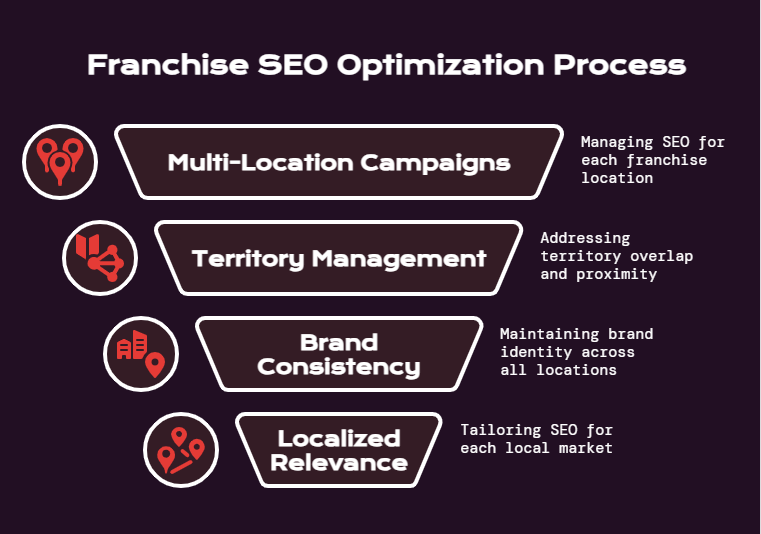
You’re not running one SEO campaign – you’re running fifty of them, and each location has to rank independently in its own city while the parent brand maintains consistency across every touchpoint.
This is where most agencies fall flat. They apply a single-location playbook at scale and get frustrated when only the flagship location ranks. Or they spin up cookie-cutter landing pages that Google flags as duplicate content and none of the locations rank.
Territory Overlap and Proximity Issues
Proximity works against you in unexpected ways. Google’s map pack is heavily weighted toward how close the searcher is to the business, so a franchise with territory overlap between locations ends up fighting itself for rankings.
We’ve seen franchises where two corporate-owned locations cannibalized each other for months because nobody had mapped out territory boundaries in the content strategy.
Centralized Brand vs Localized Relevance
The real challenge isn’t optimization. It’s infrastructure. Franchise SEO that actually works treats the whole operation like a system: centralized oversight, standardized processes, and unique execution per location. Miss any one of those pieces and the whole thing stalls.
The Biggest Local SEO Challenges Franchises Face
Before getting into what works, it helps to understand the specific issues that hold multi-location home service businesses back. Most franchise SEO problems fall into one of five categories, and the fixes for each are structurally different.
| Challenge | What It Looks Like | Why It Hurts |
| Duplicate content | Same copy on 20+ location pages with just the city swapped | Google suppresses duplicates, so most pages don’t rank |
| GBP conflicts | Mismatched categories, addresses, or service areas across locations | Profiles get suspended or stop appearing in the map pack |
| Location cannibalization | Two nearby locations ranking for the same terms | Traffic gets split, conversions drop |
| Inconsistent NAP | Different phone numbers or address formats across directories | Google lowers trust in the business entity |
| Weak local authority | No local backlinks, citations, or community signals | Location can’t compete with established local independents |
Duplicate Content Across Location Pages
This is the biggest one. A franchise rolls out a template, pushes it live across 40 locations, and every page has the same 600 words with a city name swapped in. Google’s algorithms catch this almost immediately. Usually only one or two pages end up ranking, and the rest sit invisible.
The fix isn’t complicated in theory – every location page needs genuinely unique content. It just takes more work than most franchisors budget for.
Google Business Profile Conflicts
GBP is the most important asset in any local SEO program, and franchises have more ways to mess it up than any other business type.
Common GBP issues across franchise networks:
- Conflicting primary categories across similar locations
- Inconsistent service area settings
- Duplicate listings from prior ownership or legacy setups
- Suspensions from address issues during location moves
- Missing or outdated business hours
We’ve audited franchises where 30% of their GBP profiles had some kind of issue holding them back – and nobody at corporate had any idea because nobody was monitoring it at the location level.
Location Cannibalization in Search Results
When two franchise locations are within 10 miles of each other and both target the same city for rankings, you get cannibalization. Google can’t decide which one to show, so it splits visibility between them. The result: neither location ranks well, and your total network traffic is lower than it should be.
The solve here is territory planning – mapping which cities and neighborhoods each location should target, then building content accordingly.
Inconsistent NAP Data Across Listings
Name, address, and phone number. Simple stuff. But once you’re running 75 locations across multiple directories, aggregators, and legacy citations, the number of places this data can drift is enormous.
We’ve seen franchises with three different phone number formats showing up across major directories for the same location. Google uses NAP consistency as a trust signal, and drift erodes it over time.
Lack of Local Authority Signals
A new franchise location opening in a market with 15 established plumbing companies isn’t automatically going to rank just because it has corporate backing. Local backlinks, citations, community involvement, and real reviews are what tell Google the business is a legitimate local entity.
This is the piece that most franchise SEO programs underinvest in, and it’s usually why new location rankings take longer than projected.
How Local SEO Works for Multi-Location Home Service Businesses
The framework that actually scales is simpler than most agencies make it sound. One domain, multiple location pages, one GBP per location, consistent signals everywhere else.
One Domain, Many Locations
Every location operates as its own ranking entity. It has a dedicated page on the corporate website, a paired Google Business Profile, its own citation profile, and ideally its own small body of local content.
The parent brand provides consistency, infrastructure, and oversight – but each location ranks or fails on its own signals.
URL Structure That Scales
The website structure needs to be flat and clear. Here’s what works and what doesn’t:
- Works: /locations/austin-tx/, /locations/dallas-tx/
- Works: /austin-tx/hvac-repair/, /dallas-tx/hvac-repair/
- Breaks at scale: /regions/southwest/texas/austin/services/hvac/
- Breaks at scale: Nested subdomains like austin.brandname.com
Flat structures make it easier for Google to crawl and index, and they make it easier for humans to understand your network.
Service-Area Businesses vs Storefronts
Service-area businesses (SABs) and storefront businesses follow different rules in GBP. If your franchise locations travel to customer homes, they need service-area settings configured properly.
Most franchise operators don’t realize this and leave their GBPs configured as storefronts, which limits map pack visibility outside the immediate zip code.
This same location-based structural logic applies across other multi-location service businesses. We broke down the general framework in our post on local SEO for franchises – the page-per-location pattern works whether you’re running five HVAC locations or fifty.
Core Components of Local SEO for Home Service Franchises
There are five components that determine whether a franchise SEO program actually produces leads or just consumes budget. Get these right across the network and the rankings follow.
Google Business Profile Optimization at Scale
GBP is the single highest-leverage asset in local SEO. For a home service franchise, it’s also the most complex to manage because you’re doing it 50 or 100 times.
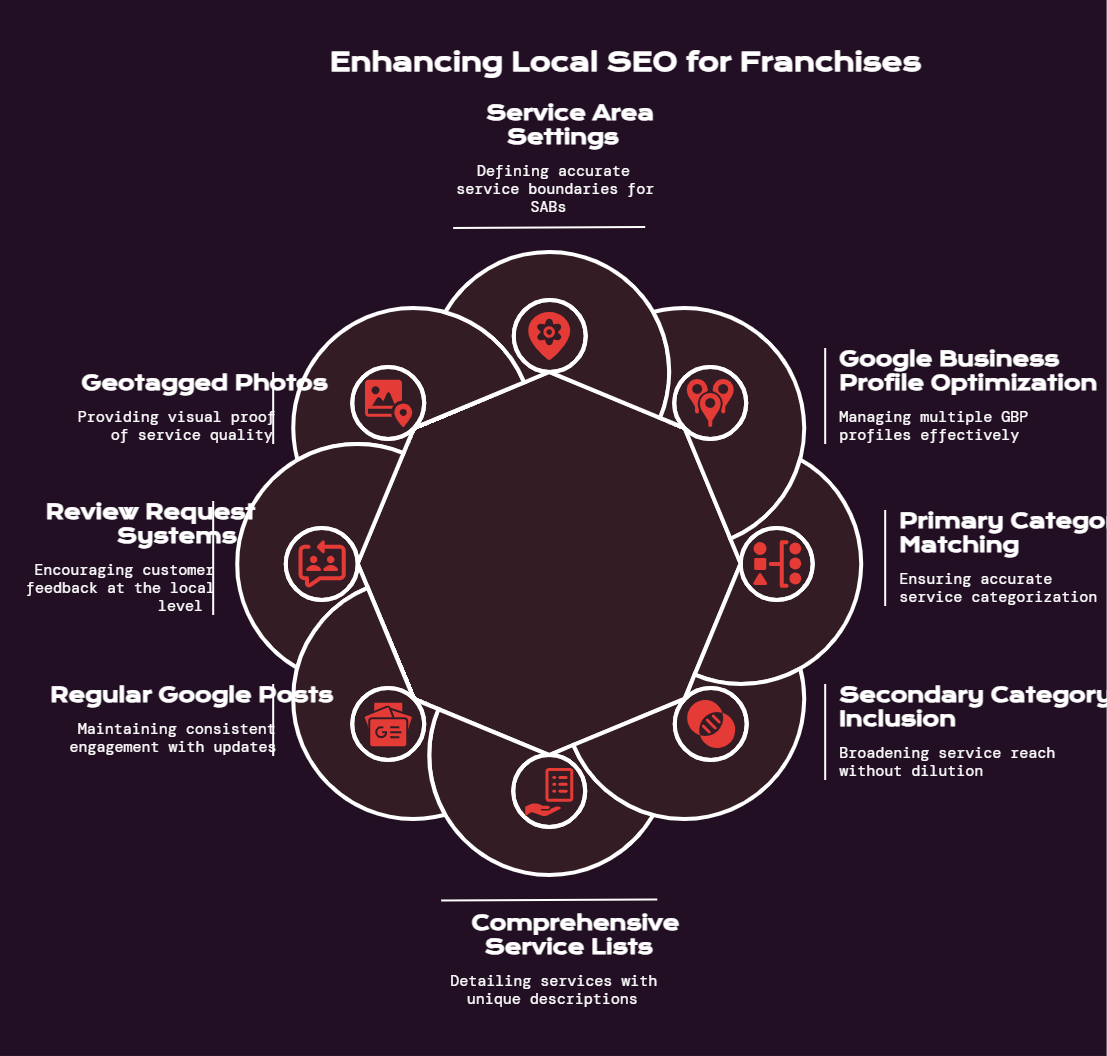
What Matters Per Location
- Primary category matching the core service (e.g. “Plumber,” “HVAC Contractor,” “Roofing Contractor”)
- Secondary categories covering adjacent services without diluting focus
- Complete services list with unique descriptions per location where possible
- Regular Google Posts – weekly is the floor, not the target
- Review request systems running at the location level, not corporate
- Photos uploaded from actual jobs, geotagged when possible
- Service area settings correctly configured for SABs
The Operational Challenge
The scaling problem here is operational, not technical. A system that lets location managers post updates without going through corporate – while still maintaining brand guardrails – is the difference between a program that works and one that stalls.
Location Landing Pages That Rank
This is where most franchise SEO dies. A typical multi-location website has 40 location pages, all built from the same template, all with near-identical copy. Every one of them ranks poorly.
The Anatomy of a Real Location Page
| Element | What to Include |
| H1 | City + primary service (e.g. “HVAC Services in Tucson, AZ”) |
| Unique intro | 100-150 words specific to that city’s market, climate, or service needs |
| Services covered | List of actual services offered at that location |
| Local proof | Reviews from real customers in that city, photos from actual jobs |
| Service area | List of neighborhoods, subdivisions, or nearby cities covered |
| Embedded map | GBP-linked map showing the service area |
| Schema markup | LocalBusiness schema with the correct address, phone, hours |
| NAP block | Name, address, phone number matching GBP exactly |
| Location-specific FAQs | Questions that reflect what locals actually ask |
Done right, a location page is a lightweight but genuinely useful resource for someone searching in that city. Done wrong, it’s a liability that keeps the whole network from ranking.
Local Citations and NAP Consistency
Citations are mentions of your business name, address, and phone number on other websites – directories, aggregators, local business listings. For a franchise, these need to be managed centrally because the scale of drift across 50+ locations is what kills trust signals.
Primary Citation Sources to Get Right
- Google Business Profile (the one that matters most)
- Bing Places for Business
- Apple Maps (Apple Business Connect)
- Yelp
- Foursquare
- Data aggregators: Data Axle, Localeze, Factual
Industry-Specific Directories
Beyond the primary aggregators, industry-specific directories matter:
- HVAC contractors: HomeAdvisor, Angi, BBB
- Plumbers: HomeAdvisor, Angi, BBB, plumbing-specific directories
- Roofers: GAF and Owens Corning contractor directories, HomeAdvisor
- Restoration: IICRC directory, insurance carrier contractor networks
A tool like BrightLocal or Yext is worth the monthly cost for any franchise running 10+ locations. The manual cost of managing citations across that many locations far exceeds the software budget.
Reviews and Reputation Management
Reviews matter for two reasons: they’re a direct ranking factor in local search, and they’re the single biggest conversion factor once a prospect lands on your GBP or website.
What We’ve Seen Across Franchise Clients
- Locations with 50+ reviews and an average above 4.5 stars get roughly 3x the click-through rate of locations with under 20 reviews
- Review velocity (new reviews per month) matters nearly as much as total count
- Responding to every review, positive and negative, improves visibility in map pack
Location-Level Review Systems
The review strategy has to run at the location level. Corporate-driven review campaigns never get the velocity or authenticity that per-location systems produce.
The franchises with the best review profiles usually have a specific technician-facing process: after every completed job, the tech sends a templated SMS with a direct GBP review link. Simple, repeatable, effective.
Local Link Building
Links are still a ranking factor, and they’re particularly important for local authority. For franchises, link building has to be coordinated carefully because you don’t want corporate building links to location pages in a way that looks unnatural.
What Works
- Local sponsorships of youth sports, community events, or charity runs in each city
- Partnerships with non-competing local businesses (realtor + plumber, landscaper + roofer)
- Local news coverage of new location openings, hiring, or community involvement
- Contractor-specific directories with genuine authority
- Scholarship or grant programs run at the location level
What Doesn’t
Bulk link building, PBNs, and the same guest post template run across 50 locations. Google sees these at scale and discounts them.
How to Structure Location Pages for Maximum Rankings
The location page is where most franchise SEO programs win or lose. Here’s the structure that consistently ranks across our home service clients.
Start with the H1
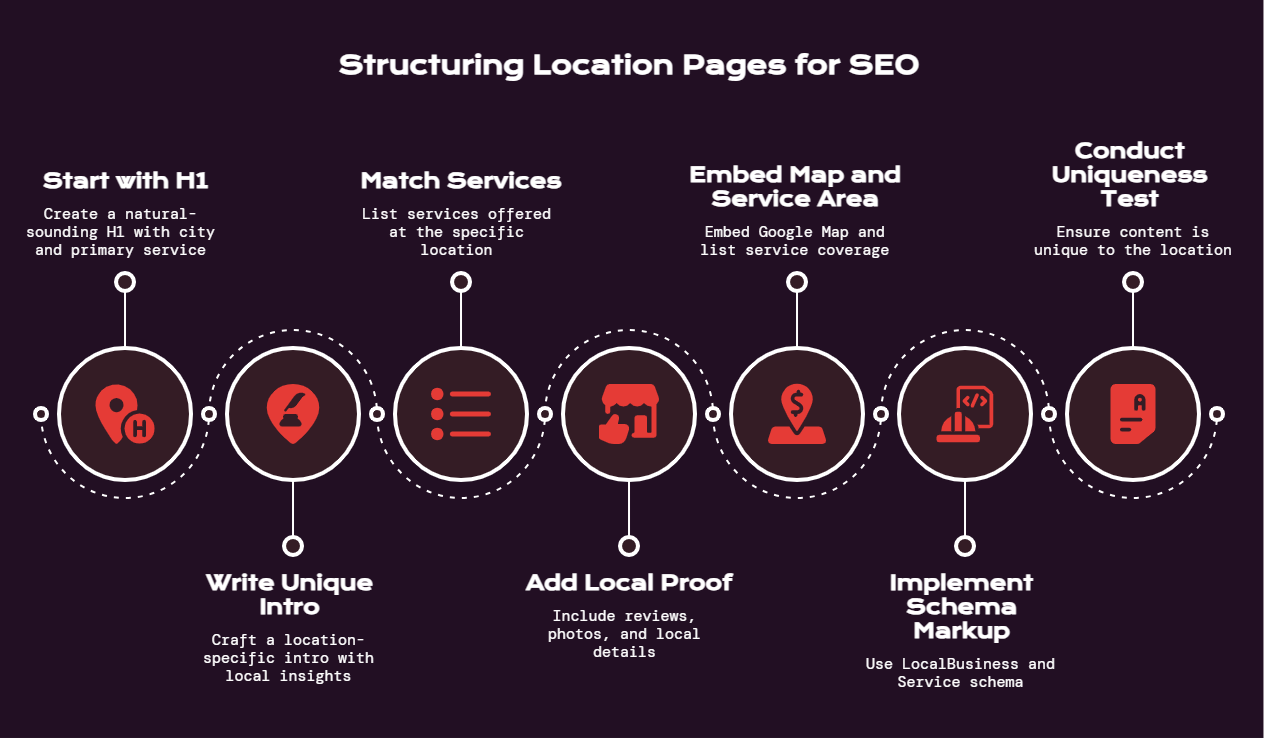
City plus primary service, in natural language: “Roofing Contractor in Charlotte, NC” or “HVAC Repair in Boise, Idaho.” Don’t stuff the H1 with every service the location offers. One primary service, one city.
Write a Genuinely Unique Intro
The first 100-150 words of page copy should be unique to that location. Not “we’re the best HVAC company in [city]” – actual information about that specific market.
Things that could only be written by someone who knows the area:
- Summer heat patterns in Phoenix
- Winter storm behavior in Minneapolis
- Humidity and coastal weather in Houston
- Seasonal service demand specific to that climate
- Local building codes or common home types
Match Services to the Location
Below the intro, list the services actually offered at that location. If the franchise doesn’t offer commercial work at this specific location, don’t list commercial services. Google cross-references location pages against GBP service listings, and inconsistencies cost rankings.
Add Real Local Proof
Local proof is what separates a real location page from a template:
- Reviews with city names attached where possible
- Photos from actual jobs in that market
- Named neighborhoods or communities served
- Job count or years in market if notable
- Licensing specific to that state or region
Embedded Map and Service Area
Embed the Google Map pulled directly from the GBP. List service area coverage in writing – cities, zip codes, or neighborhoods – so both Google and the user can see the actual coverage footprint.
Schema Markup
Schema markup across all of it – LocalBusiness at minimum, Service schema if you want to go further. FAQPage schema for the location-specific FAQ section.
The Uniqueness Test
The rule we use internally: if a competitor could copy-paste your location page content and change just the city name, the page isn’t unique enough. Every page should contain something that couldn’t apply to any other location in the network.
Avoiding Keyword Cannibalization Across Locations
Cannibalization happens when two pages on the same domain target the same keyword, and Google can’t decide which to rank. In franchise SEO, this shows up when two nearby locations both target the same city name or overlapping service areas.
Map Territory Before Building Pages
Plan geographic boundaries before building pages. Which cities and neighborhoods does each location primarily serve? Don’t let the pages overlap in their primary geo targeting.
Use Geo-Modifiers to Differentiate
If two locations both serve parts of the Dallas metro, differentiate:
- Location A: “Plumbing in North Dallas”
- Location B: “Plumbing in Irving, TX”
- Location C: “Plumbing in Plano, TX”
Both are accurate, neither competes directly.
Internal Linking Should Reinforce Hierarchy
Internal linking should reflect the structural hierarchy:
- State pages link down to all location pages in that state
- Service-specific pages link to the location pages that offer that service
- Location pages link up to the parent state page
- Blog content about a specific city links to that city’s location page
This creates a clear topical structure that Google can understand, and it keeps authority flowing to the right pages.
Scaling Local SEO Across 10, 50, or 100+ Locations
The tactics above work at any scale. What changes as you scale is the operational model.
The Scaling Breakdown
| Scale | Primary Focus | Who Owns Execution |
| 5-10 locations | Per-location uniqueness, solid GBPs | Centralized team |
| 10-50 locations | Systems, templated uniqueness, citation management | Hybrid – central + regional |
| 50-100+ locations | Platform infrastructure, location manager enablement | Decentralized with central oversight |
Small Networks (5-10 Locations)
A centralized team can manage most of the work directly. Write unique location pages, manage each GBP, track citations manually. It’s time-consuming but feasible.
Mid-Size Networks (10-50 Locations)
Manual management breaks down. You need systems: templated page structures with controlled unique fields, citation management software, GBP management platforms, and review request automation. But you still need human judgment at the edges – unique intros, local proof, location-specific FAQs.
Large Networks (100+ Locations)
The only way this works is a hybrid of centralized infrastructure and decentralized execution. Corporate owns the platform, the brand guidelines, the technical foundation, and the reporting. Location managers or regional operators own the local signals – reviews, Google Posts, photos, community involvement.
The franchises that hit 100+ locations and still rank well are almost always the ones that invested in infrastructure early. The ones that try to retrofit systems after the fact spend years untangling the mess.
Structured Data at Scale
Structured data becomes non-negotiable at scale. Every location page needs LocalBusiness schema with:
- Address matching GBP
- Phone number matching GBP
- Business hours
- Service area definition
- Aggregate review markup
- Service types offered
This is what lets Google parse your network as distinct business entities rather than one giant blob.
The Role of GEO (Generative Engine Optimization) in Local SEO
AI search is pulling location-specific answers more aggressively than most franchise operators realize. When someone asks ChatGPT or Perplexity “who’s the best HVAC company in Phoenix,” those platforms are now pulling from location-specific signals – not just the parent brand’s homepage.
Entity Clarity Per Location
Each franchise location needs to be clearly defined as a distinct business entity in schema, in content, and in structured data. If the corporate site presents all 50 locations as generic service pages, AI systems can’t extract location-specific answers reliably.
Conversational Content Formats
Conversational content performs better in AI search:
- FAQ sections on location pages
- Direct question-and-answer formatting
- Natural language that mirrors how people actually ask questions
- Clear, extractable answers in the first sentence of each response
Structured Data Isn’t Optional Anymore
Multiple schema types give AI systems the signals they need:
- LocalBusiness schema for every location
- Service schema where applicable
- Review schema for ratings and testimonials
- FAQPage schema for question-answer content
We wrote about this shift in the context of regulated industries in our piece on AI search visibility for hemp brands – the structural requirements are different from traditional SEO, and they apply to local search just as much as to e-commerce or B2B.
Common Mistakes Home Service Franchises Make
After a decade-plus of running franchise SEO audits, the same five mistakes show up over and over.
Copy-Pasting Location Pages
The number one killer. Every location deserves a real page, not a template.
Ignoring GBP Optimization
Many franchises treat GBPs as a one-time setup and never touch them again. The locations that rank in the map pack are posting weekly, uploading photos regularly, and responding to every review.
No Local Backlinks
Corporate link building helps the parent brand. It doesn’t help individual locations rank. Real local link building has to happen at the location level.
Weak Internal Linking
Franchises with 50 location pages and no logical internal linking structure leak authority everywhere. State pages, service pages, and location pages should all interlink with intention.
Treating SEO as One-Time Setup
The franchises that dominate local search aren’t the ones who built their SEO in 2022 and moved on. They’re the ones who treat SEO as an ongoing program with monthly optimization, content updates, and active management.
How to Measure Local SEO Success for Franchise Locations
Aggregate metrics hide franchise SEO problems. A network might be showing 20% traffic growth overall while 15 underperforming locations drag down the total. The only way to actually manage a multi-location SEO program is to measure at the location level.
Core Metrics to Track Per Location
| Metric | What It Tells You | How to Track |
| Map pack rankings | Whether the location shows up in local pack searches | Local rank trackers like BrightLocal or Local Falcon |
| Organic rankings by city | How the location page performs for city + service terms | Google Search Console, Ahrefs, Semrush |
| GBP insights | Searches, views, calls, direction requests per location | Native GBP insights |
| Calls and form fills per location | Actual lead volume | Call tracking, form analytics |
| Conversion rate by location page | Which pages are converting and which aren’t | GA4 with location page segments |
Why Map Pack Rankings Matter Most
Map pack rankings are particularly important because the map pack is where the majority of local home service clicks happen. If a location isn’t in the top three map results for its primary city plus service terms, something is wrong with the GBP optimization, the on-page signals, or the review profile.
Calls Over Traffic
Organic traffic is directional but calls are the revenue event for most home service businesses. A franchise SEO program that’s generating traffic but not calls has a conversion problem, not an SEO problem.
For franchises that want to project realistic growth across a full network, we covered the forecasting framework in how to forecast SEO growth – same principles apply, just scaled across multiple ranking entities.
Choosing the Right Local SEO Strategy for Your Franchise
In-house or agency? It depends on scale and existing resources.
When In-House Can Work
At 5-10 locations, a capable in-house marketer can usually manage local SEO if they have the right tools and aren’t also running paid media, social, and email. The moment you scale past 15 locations, the operational load almost always exceeds what a single person or small team can handle well.
What to Look For in an Agency
- Actual franchise or multi-location experience, with case studies showing results across similar networks
- Clear process for managing GBPs, citations, and content at scale
- Per-location reporting, not just aggregate dashboards
- Technical SEO capabilities – franchise sites often have platform issues that need developer-level attention
- Understanding of both traditional local SEO and GEO/AI search optimization
Red Flags
- Flat monthly fees that don’t scale with the number of locations
- Inability to show examples of location-level work, just corporate-level case studies
- Reliance on generic content templates without customization
- No clear process for NAP auditing or citation management
- Promises of specific rankings or timelines (nobody can guarantee these)
Expected Timelines
Timelines for franchise SEO are longer than single-location SEO:
- New franchise location in a competitive home service market: 6-9 months to rank meaningfully
- Established networks being cleaned up and optimized: 3-4 months for initial improvements
- Full network-wide impact: 9-12 months
Investment Level
The investment level reflects the complexity. Franchises running solid programs across 20+ locations typically invest somewhere between $5,000 and $25,000 per month depending on network size, competitive intensity, and scope. The ROI math works because home service leads are high-value and the program compounds over time.
If you’d rather skip the vendor evaluation process and talk to a team that runs franchise SEO across home service networks, this is exactly what we do at LYNX. We’ve built and scaled franchise SEO programs from the ground up and come in to fix existing programs that have stalled.
Frequently Asked Questions
What Is Local SEO for Home Service Franchises?
Local SEO for home service franchises is the practice of optimizing each franchise location independently to rank in local search results for its specific service area. Unlike single-location local SEO, it requires managing multiple Google Business Profiles, unique location pages, consistent NAP data across all listings, and centralized oversight to prevent duplicate content or keyword cannibalization. Each location ranks as its own entity while the parent brand maintains consistency across the network.
How Do You Handle Duplicate Content on Franchise Location Pages?
Every location page needs genuinely unique content, not a template with the city name swapped. The intro, local proof, service coverage, and FAQs should all contain information specific to that location’s market. Google suppresses pages it identifies as duplicate, so franchises that rely on templated location pages typically see only a fraction of their locations rank. The fix is time-consuming but structurally simple: write real content for every location, even if that means investing more upfront.
How Many Google Business Profiles Does a Franchise Need?
One Google Business Profile per physical location. Franchises with 50 locations need 50 profiles, each individually optimized with correct categories, services, hours, and service area settings. Corporate-level GBPs for the parent brand are separate and shouldn’t be confused with location-level profiles. Each GBP should be verified with the correct address, managed actively with weekly posts, and paired with a dedicated location page on the main website.
What’s the Difference Between Service Area and Storefront GBPs?
Storefront GBPs have a physical address where customers visit. Service area GBPs serve customers at their location and don’t have customer-facing storefronts. Most home service franchises – HVAC, plumbing, roofing, restoration – are service area businesses. These GBPs need service area settings configured properly to appear in map pack results across the zip codes the location actually serves. Misconfigured service area settings are a common reason franchise locations underperform in local search.
How Long Does Franchise Local SEO Take to Work?
New franchise locations in competitive home service markets typically take 6-9 months to start ranking meaningfully in local search. Established franchise networks being cleaned up and optimized can see improvements in 3-4 months. Full network-wide impact usually materializes over 9-12 months. The timeline depends on competitive intensity, existing signal strength, and how aggressively the program is executed across locations.
What Does Franchise Local SEO Cost?
Investment scales with network size and competitive intensity. Franchises running solid programs across 20+ locations typically invest between $5,000 and $25,000 per month. Smaller networks of 5-10 locations can see results with budgets in the $2,500-$7,500 range. The cost reflects the operational complexity of managing optimization, content, citations, reviews, and reporting across multiple ranking entities simultaneously.
Can LYNX Handle Local SEO for Franchise Networks?
Yes. LYNX specializes in franchise and multi-location SEO across home service industries including HVAC, plumbing, roofing, restoration, and cleaning. We build and execute programs that range from network cleanup and GBP optimization through to full-scale content, technical SEO, and link building across every location. If you’re running a franchise network and local SEO is underperforming, we’d be worth a conversation.