Quick Answer: SEO for sporting goods stores means building your site around how athletes actually search (sport, then equipment type, then skill level or use case), optimizing category and product pages for that intent, and pairing it with local SEO if you run physical locations. Sports equipment SEO works best when independent retailers stop chasing generic head terms that DICK’S and Amazon own and instead win sport-specific categories, specialty sub-verticals, and nearby shoppers. Clean site architecture, crawl-controlled filters, product structured data, and fresh reviews are the technical pieces that make those rankings stick.
Search “running shoes” and you already know who shows up. National chains, the big marketplace, and the brands themselves. That’s the reality every independent and mid-market sporting goods retailer is up against, and it’s why so much generic ecommerce advice falls flat in this vertical.
The good news is that nobody buys “sports equipment.” They buy youth size 5 soccer balls, 85-flex intermediate hockey sticks, and wide-toe trail runners for a first ultramarathon. The retailers who structure their sites around those specifics are the ones picking up profitable organic traffic, even with a fraction of the big-box budget.
We’re the LYNX SEO team, and this guide pulls from the work we do across our retail and ecommerce SEO engagements, where catalog structure, category pages, and product data decide whether a store gets found at all. Everything below is focused on one question: what actually moves rankings and revenue for a sporting goods store in 2026?
Key Takeaways
- Sporting goods SEO performs best when site structure follows the athlete’s search path of sport, equipment type, and skill level rather than brand or internal merchandising logic.
- Category pages are the highest-value ranking assets for sporting goods retailers because they match the commercial “shopping for a type of gear” intent behind most sports equipment searches.
- Uncontrolled filter URLs on large sports catalogs can generate thousands of near-duplicate pages, and Google’s own documentation warns this causes overcrawling and slower crawling of new product pages.
- Local SEO matters for sporting goods stores because BrightLocal’s 2026 survey found 74% of consumers only trust reviews written in the last three months and 31% will only use businesses rated 4.5 stars or higher.
- Pew Research Center found Google users clicked a traditional result on just 8% of visits when an AI summary appeared, versus 15% without one, which makes AI search visibility part of sports equipment SEO now.
What Is SEO for Sporting Goods Stores?
SEO for sporting goods stores is the practice of improving a sports retailer’s visibility in Google, Google Maps, shopping surfaces, and AI answer engines for the searches its customers use when researching and buying athletic gear. It covers keyword research, site architecture, category and product page optimization, technical SEO, local SEO for physical stores, and content that supports purchase decisions.
Sports equipment SEO is the same discipline applied at the product level: getting specific gear (bats, skis, paddles, racquets, protective equipment) to rank for the detailed, specification-heavy searches buyers run before they commit.
How Sports Equipment SEO Differs From General Ecommerce SEO
Most ecommerce SEO playbooks assume a fairly flat catalog. Sporting goods is anything but flat. A single store might sell to a nine-year-old starting baseball, a competitive triathlete, and a weekend golfer, and each of those buyers searches with a completely different vocabulary.
Four traits make this vertical its own animal:
- Sport-Specific Terminology: Buyers search using terms like “drop,” “flex,” “lie angle,” “BBCOR,” or “DIN setting,” and pages that don’t use that language rarely rank for the searches that convert.
- Skill-Level Segmentation: The same product type splits into beginner, intermediate, and competitive tiers, and each tier behaves like its own keyword set with its own intent.
- Hard Seasonality: Demand for a given sport can swing from near zero to peak inside a few weeks, so ranking late in the season is often the same as not ranking at all.
- Omnichannel Buying: Many shoppers research online and buy in store, or buy online and pick up locally, which ties local search and ecommerce search together.
That last point is backed by market data. Mordor Intelligence’s sporting goods market report estimates offline outlets still held about 62% of global sporting goods revenue in 2025, with online sales projected to grow at roughly 8.4% a year through 2031.
Treat those figures as directional, since market sizing methods vary by firm, but the takeaway is consistent: a sporting goods store that only optimizes for online checkout is ignoring most of where the money still changes hands.
Why Sports Retail SEO Is Harder Than It Looks
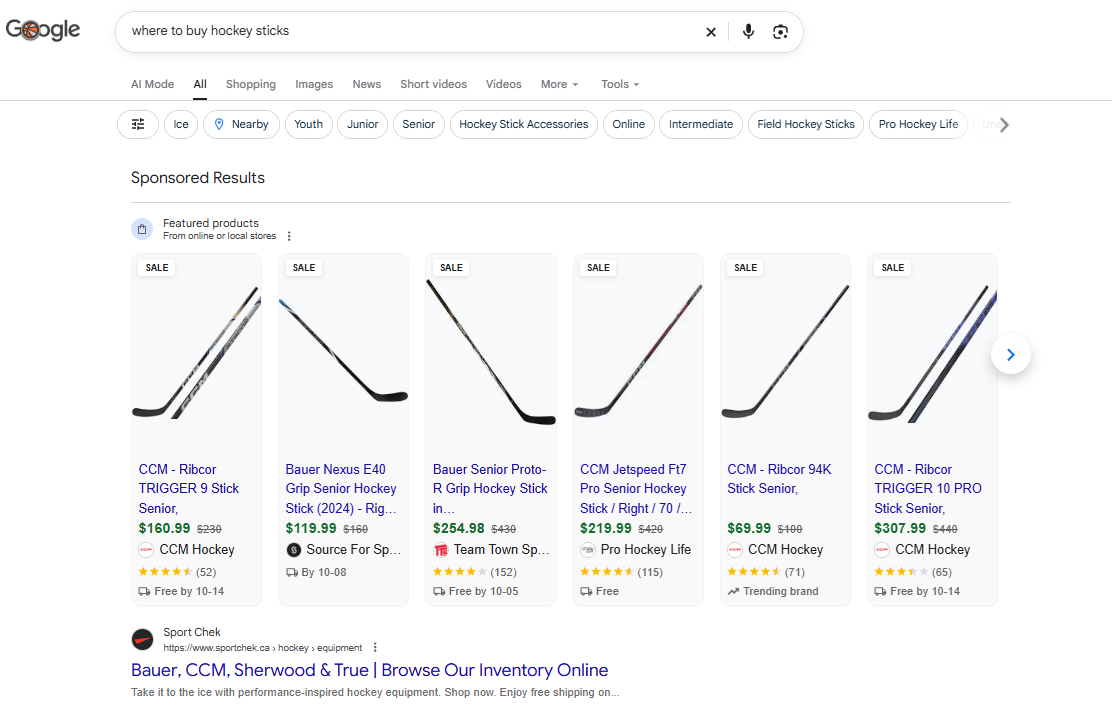
Sports retail SEO is a crowded fight at the top of the funnel. Generic terms are owned by national chains with hundreds of locations, massive marketplaces, and brand DTC sites that rank for their own product names. An independent retailer is not going to outrank a national chain for “basketball shoes” with a blog post and some title tag tweaks.
The search results page itself has also changed. A single commercial query can now trigger shopping listings, a local pack, product carousels, and an AI summary before a single organic blue link appears. Pew Research Center’s 2025 analysis of Google AI summaries, which tracked the browsing of 900 US adults, found users clicked a traditional result on 8% of visits when an AI summary appeared, compared with 15% when one didn’t. They clicked a link inside the summary itself on just 1% of visits.
Clicks on generic informational queries are shrinking, so sporting goods SEO has to concentrate on commercial and local searches where a buyer still needs to pick a store. That’s where specialty retailers have a real edge: deeper category expertise, better fit and sizing guidance, and a physical location the buyer can actually walk into.
Across the retail accounts we manage, the stores that grow fastest are almost never the ones with the most blog content. They’re the ones whose category pages match exactly what a buyer types when they’re ready to spend.
Sporting Goods Keyword Research: Mapping Sport, Gear, and Skill Level
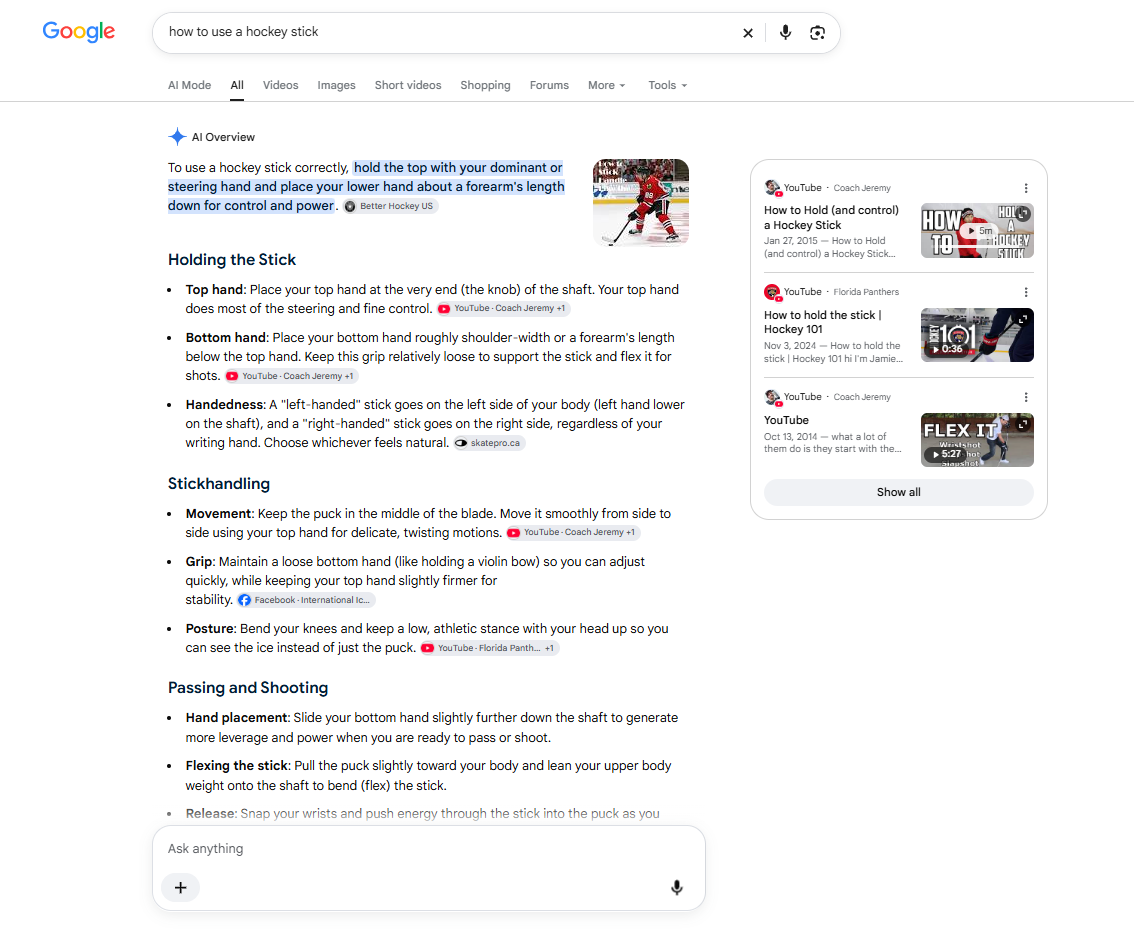
Sporting goods keyword research starts with a simple question: what would an athlete type if they were already half-sure what they wanted? That answer almost always stacks three layers: the sport, the equipment type, and a qualifier such as skill level, age, size, or use case.
Knowing keyword intent is what turns a raw keyword export into a page plan. A search for “how to choose a hockey stick flex” and a search for “intermediate hockey sticks 65 flex” come from the same buyer at different moments, and they need different pages.
| Keyword Layer | Example Query | Primary Intent | Page That Should Rank |
| Sport | “lacrosse equipment” | Commercial, broad | Sport hub page |
| Sport + Equipment Type | “lacrosse heads” | Commercial | Category page |
| Equipment + Qualifier | “youth lacrosse heads for beginners” | Commercial, high intent | Subcategory or curated collection page |
| Specific Product | “[brand] [model] lacrosse head” | Transactional | Product page |
| Research Question | “how to string a lacrosse head” | Informational | Guide or how-to post |
| Local | “lacrosse store near me” | Local, transactional | Store location page + Google Business Profile |
Finding Sporting Goods Long-Tail Keywords
Sporting goods long-tail keywords are where specialty stores win. Search volume per keyword is lower, but conversion intent is far higher, and the big retailers rarely build pages deep enough to compete.
The richest long-tail sources we use for sports equipment keyword research include Search Console queries your site already gets impressions for, Google’s autocomplete and “People also ask” results, your own on-site search logs, and the questions your floor staff answer every weekend. That last one is underrated. Your store associates already know the exact phrasing buyers use, and that phrasing is usually missing from the category pages it should be on.
Sporting Goods Site Structure and Sports Ecommerce Site Architecture
Sporting goods site structure decides which pages Google treats as important. Google’s documentation on helping Google understand your ecommerce site structure says that, as a general rule, the more internal links a page receives, the more important it looks relative to other pages on the site.
For a sports retailer, the cleanest hierarchy usually looks like this: Sport > Equipment Type > Subtype or Qualifier > Product. A hockey section might run from Hockey > Sticks > Intermediate Sticks > individual stick pages. That structure mirrors the keyword layers above, so each level of the site answers one level of search intent.
Where stores go wrong is organizing around brands or internal buying departments. A top menu of “Nike, Adidas, Under Armour” tells Google almost nothing about what a buyer can shop for. Brand pages have a place, but they belong as a secondary path, not the spine of the site. We cover the planning process in detail in our guide on how to master SEO information architecture.
URL design matters here too. Google’s guidance on designing a URL structure for ecommerce sites recommends descriptive words in URL paths, minimizing alternate URLs that return the same content, and giving each product variant its own unique URL. A path like /hockey/sticks/intermediate/ beats /cat.php?id=4471 for both users and crawlers.
Internal Linking for Sporting Goods Websites
Internal linking for sporting goods websites is how you tell Google which pages matter most this month. Seasonal category pages should be linked from the homepage and main menu as their sport approaches peak, then scaled back once the season passes.
A few internal linking patterns consistently pay off for sports retailers:
- Guide-to-Category Links: Every buying guide links to the exact category or subcategory it helps a buyer shop, using descriptive anchor text.
- Cross-Sport Equipment Links: Related gear (base layers, protective equipment, bags) links across sport sections where buyers genuinely overlap.
- Breadcrumbs on Every Page: Breadcrumbs reinforce the Sport > Type > Subtype hierarchy and give crawlers a consistent path back up the tree.
- Bestseller Promotion: Google itself suggests linking high-priority products from the homepage or other prominent content so their importance is clear.
Sporting Goods Category Page SEO
Sporting goods category page SEO is where most of the revenue gets decided. Category pages match the “shopping for a type of gear” intent behind searches like “youth baseball gloves” or “women’s trail running shoes,” which is exactly the stage where a buyer is choosing a store.
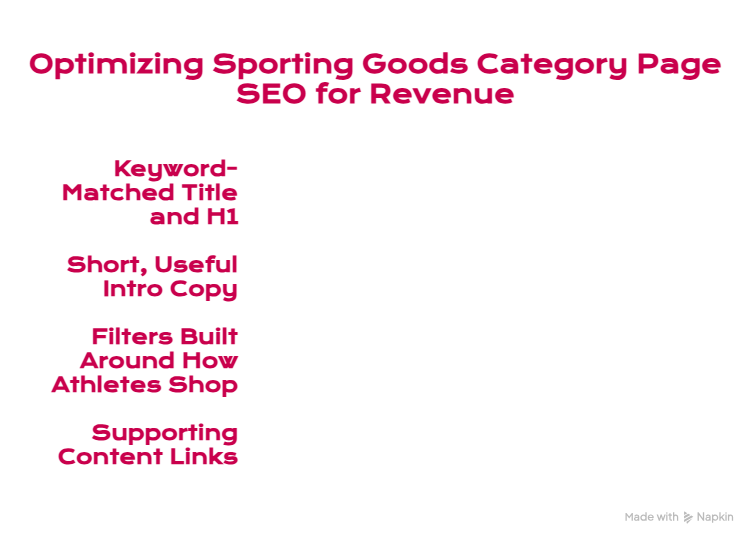
A category page that ranks and converts in this vertical usually has four things:
- A Keyword-Matched Title and H1: “Youth Baseball Gloves” beats “Gloves” or a clever brand-voice headline.
- Short, Useful Intro Copy: Two to four sentences that help the buyer choose (sizing by age, glove length by position) placed near the top, not buried below 48 products.
- Filters Built Around How Athletes Shop: Position, skill level, size, and sport-specific specs, not just color and price.
- Supporting Content Links: A link to the relevant fit guide or buying guide for shoppers who aren’t ready to choose yet.
Filter quality isn’t a cosmetic issue. Baymard Institute’s benchmark of e-commerce filtering options found 34% of tested sites had poor filtering implementations, and in its usability testing, sites with mediocre product list usability saw abandonment rates of 67% to 90%, while sites with a slightly optimized toolset saw 17% to 33% abandonment for users looking for the same types of products. Sports equipment has more purchase-deciding specifications than most retail categories, so weak filters hurt sporting goods stores more than they hurt the average store.
Handling Filters Without Wrecking Crawl Budget
Here’s the catch with good filters: every combination can create its own URL. Pick “Hockey Sticks” plus flex, curve, hand, height, and brand, and a few hundred products can explode into tens of thousands of crawlable URLs.
Google’s documentation on managing crawling of filter URLs explains that parameter-based filters can create near-infinite URL spaces, leading to overcrawling and slower crawling of new, useful pages. Its recommended options include blocking filter parameters you don’t need indexed with robots.txt, using URL fragments for filters, keeping a consistent filter order, and returning a 404 for filter combinations with no results.
Our approach on large sports catalogs is selective. Filter combinations that match real search demand (“left-handed junior hockey sticks”) get promoted to clean, indexable subcategory pages with unique copy. Everything else stays out of the index. That’s the difference between filters that build rankings and filters that quietly burn crawl budget.
| Element | Category Page Priority | Product Page Priority |
| Primary Target | Sport + equipment type (“women’s golf clubs”) | Brand + model + variant |
| Title Tag Focus | Category keyword + qualifier | Product name + key spec |
| On-Page Copy | Short buying guidance near the top | Unique description, full specs, fit notes |
| Structured Data | BreadcrumbList | Product, Offer, AggregateRating, shipping and return details |
| Internal Links | Down to subcategories and top products | Up to category, across to related gear |
| Biggest Risk | Thin or duplicate filter URLs | Copied manufacturer descriptions |
Sporting Goods Product Page SEO for Sports Equipment
Sporting goods product page SEO is about answering the questions a buyer would otherwise ask a store associate. What size do I need? Is this right for my level? Will it work with the gear I already own?
Product Descriptions, Specs, and Fit Content
Most sports retailers load the manufacturer’s description and move on. The problem is that dozens of other retailers load the same text, so the page gives Google no reason to prefer yours.
Sports equipment product optimization that actually differentiates a page includes:
- Rewritten Descriptions: Original copy that explains who the product is for, what level of athlete it suits, and how it compares to the model above or below it.
- Complete Spec Tables: Sport-specific attributes (weight, drop, flex, length, material, certification standard) in consistent, filterable fields.
- Fit and Sizing Guidance: Size charts, measurement instructions, and “runs small” or “size up” notes based on real customer feedback.
- Customer Reviews and Q&A: Reviews add fresh, buyer-language content, and Q&A captures the exact questions people type into search.
We’ve seen this pattern repeatedly with ecommerce clients: the product pages that pull organic traffic are almost never the ones with the longest descriptions. They’re the ones with the most specific answers.
Schema Markup for Sporting Goods Stores
Schema markup for sporting goods stores gives Google explicit, machine-readable product facts. Google’s Product structured data documentation splits product markup into two classes: merchant listings for pages where customers can buy, and product snippets for pages where they can’t (such as editorial reviews).
For a store that sells gear, merchant listing markup is the one to prioritize. It supports properties like price, availability, shipping details, and return policy, and Google also documents product variant markup to show which items are variations of the same parent product, which matters in a vertical built on sizes, flexes, and hand orientation. Google recommends adding return policy and loyalty program markup at the Organization level as well.
Structured data does not guarantee rich results, but a sports equipment page without it gives Google less reason to show price, stock, and ratings in search. You can monitor coverage in Search Console’s Merchant listings and Product snippets reports.
Technical SEO for Sporting Goods Websites
Technical SEO for sporting goods websites deals with problems that come from catalog size and seasonal churn. Products get discontinued every year, colorways rotate each season, and stock swings hard around peak demand.
The technical issues we see most often on sports ecommerce sites:
- Seasonal Product Churn: Discontinued products get deleted, turning pages with backlinks and rankings into 404s. Redirect to the closest successor model or the parent category instead.
- Out-of-Stock Handling: Temporarily unavailable products should stay live with accurate availability markup and links to alternatives rather than disappearing from the site.
- Variant Duplication: Separate indexable URLs for every color and size with near-identical content. Canonicalize or consolidate unless a variant has its own search demand.
- Heavy Media: Large product images and videos slow category pages, especially on mobile. Compress, lazy-load below the fold, and serve modern formats.
- Inconsistent URLs: Mixed case, trailing slash variations, and tracking parameters in internal links create duplicate crawl paths Google’s URL guidance tells retailers to avoid.
None of this is glamorous work. It’s the reason a well-written category page either gets crawled and indexed in time for the season or shows up three weeks after demand peaked.
Local SEO for Sporting Goods Stores
Local SEO for sporting goods stores covers every search where the buyer wants to see, try, or pick up gear nearby: “hockey store near me,” “ski shop open now,” “baseball bat regripping [city].” For stores with physical locations, these are often the highest-converting searches in the whole account.
Google Business Profile for Sporting Goods Stores
Google’s help documentation on how to improve your local ranking states that local results are based mainly on relevance, distance, and prominence, and that prominence draws on signals like links to your business and your review count and rating.
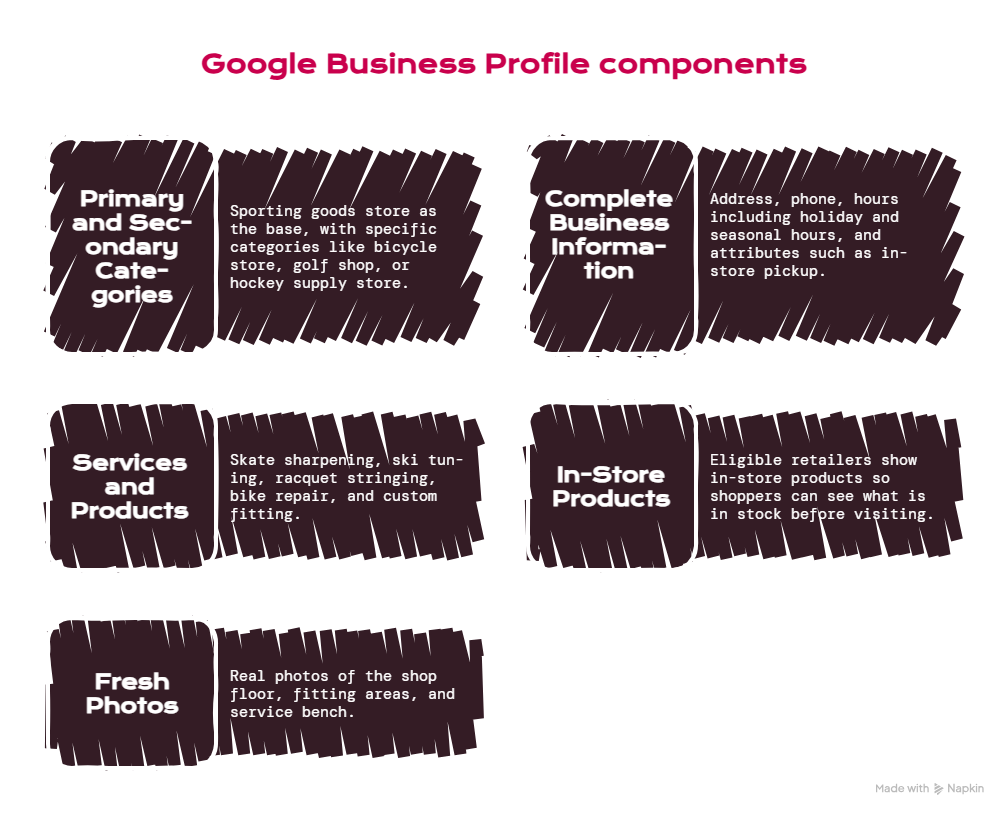
A Google Business Profile for sporting goods stores should include:
- Accurate Primary and Secondary Categories: “Sporting goods store” as the base, with more specific categories (bicycle store, golf shop, hockey supply store) where they genuinely apply.
- Complete Business Information: Address, phone, hours (including holiday and seasonal hours), and attributes such as in-store pickup.
- Services and Products: Skate sharpening, ski tuning, racquet stringing, bike repair, and custom fitting are local search magnets that most competitors never list.
- In-Store Products: Google lets eligible retailers show in-store products on their Business Profile, so shoppers can see what’s in stock before they visit.
- Fresh Photos: Real photos of the shop floor, fitting areas, and service bench beat stock imagery every time.
Reviews and Store Location Pages
Reviews carry more weight than most retailers assume. BrightLocal’s Local Consumer Review Survey 2026, based on a panel of 1,002 US adults, found 97% of consumers read reviews for local businesses, 74% look for reviews written in the last three months, 47% won’t use a business with fewer than 20 reviews, and 31% will only use a business rated 4.5 stars or higher, up from 17% the year before.
The same survey found use of ChatGPT and similar AI tools for local recommendations jumped from 6% to 45% in a year.
For sporting goods stores, a steady flow of recent reviews is now a ranking signal, a conversion signal, and an AI visibility signal at the same time. Ask at checkout, after a fitting, and after every service job.
Multi-location retailers also need a unique page for each store on their own site. The SOCi case study on DICK’S Sporting Goods local pages describes how the chain optimized each store page with localized title tags, keyword inclusion, and internal linking, and highlighted location-specific experiences. It’s a vendor case study, so weigh it accordingly, but the principle holds at any scale: a store page should describe that store’s services, specialties, and local teams, not repeat a template with the city name swapped.
Sporting Goods Content Marketing and Seasonal SEO
Sporting goods content marketing works when it supports a purchase decision. Buying guides, sizing guides, “what gear do I need to start [sport]” checklists, and comparison pages all rank for searches that sit one step before a category page visit, and they pass that visitor straight to the products.
Our SEO content strategy work for retailers starts from the category map, not an editorial calendar. Every guide exists to feed a specific category, and every category has at least one guide answering the question buyers ask before they shop it.
Timing is where sporting goods seasonal SEO separates good stores from great ones. New or refreshed pages typically need weeks to get crawled, indexed, and settle in the rankings, so sports equipment content published at the start of a season is usually published too late. The table below shows rough planning windows for North American retailers. Confirm them against your own Search Console and Google Trends data, since regional climates and league schedules shift demand.
| Sport Category | Typical Demand Build | Refresh Pages and Content By |
| Baseball and Softball | Late winter through spring | Early January |
| Golf | Early spring through summer | Late January |
| Cycling and Running | Spring | February |
| Soccer (Fall Leagues) | Mid-summer registration | May |
| Football | Mid to late summer | June |
| Hockey | Late summer through fall | July |
| Ski and Snowboard | Fall into early winter | August |
Most in-house teams know their seasons cold. What they run out of is the time to get content briefed, written, published, and linked eight to twelve weeks ahead of every one of them, which is usually where an agency earns its fee.
Sports Equipment SEO for AI Search
Sports equipment SEO now includes showing up when a buyer asks ChatGPT, Gemini, Perplexity, or Google’s AI Mode “what’s the best beginner paddleboard under $800?” Those systems assemble answers from sources they can parse and trust, and product recommendations lean on the same things good SEO already builds: clear specs, consistent entity information, reviews, and pages that answer questions directly.
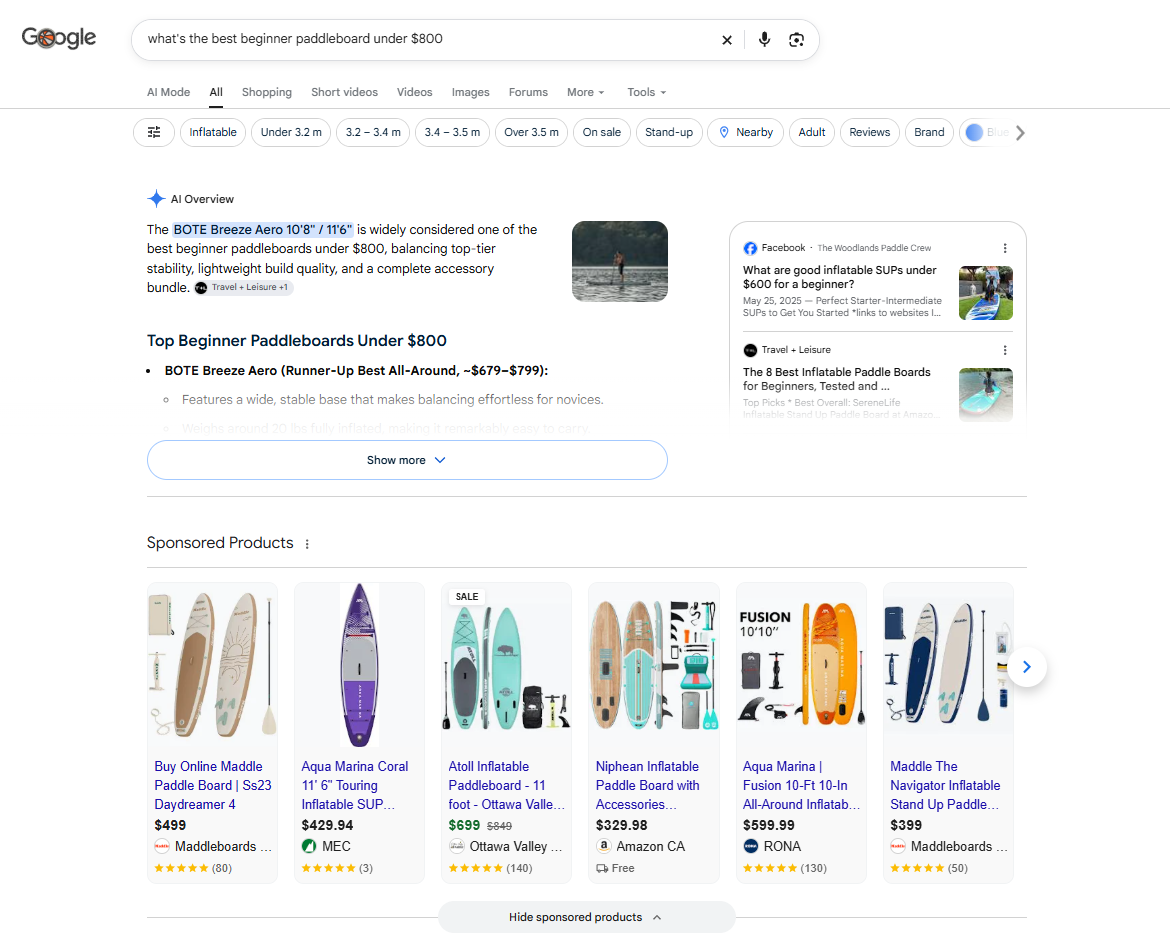
Sporting goods stores get cited when their pages contain specific, extractable facts. A buying guide that states “a 10’6″ all-around board suits most paddlers under 200 pounds” gives an AI system something to use. A guide that says “choose the board that feels right for you” gives it nothing.
If your store isn’t showing up, the causes are usually diagnosable. We break down the technical side in why your website isn’t being cited by AI tools, and the ecommerce-specific formatting in our guide on how to rank for AI snippets in Google. For stores that want this handled as a program rather than a one-off fix, it’s the core of our AEO and LLM visibility work.
The sporting goods retailers most likely to be recommended by AI assistants are the ones with the most specific, consistent, and well-reviewed product and category information across the web.
Conclusion: Building a Sporting Goods SEO Strategy That Compounds
A sporting goods SEO strategy that works in 2026 is built from the category map outward. Structure the site around sport, equipment type, and skill level. Make category pages the center of gravity. Give product pages the specs, fit guidance, and structured data buyers and search engines need. Control filter URLs before they eat your crawl budget. Keep reviews fresh and Google Business Profiles complete if you have physical stores. Publish seasonal content well before demand peaks, and make every page specific enough that an AI assistant can quote it.
None of these steps is complicated on its own. The challenge is running all of them at once, across hundreds or thousands of SKUs, on a seasonal clock that doesn’t wait. That’s the gap between knowing how SEO for sporting goods stores works and actually outranking the stores that already do it well.
You can absolutely start this in-house. If you’d rather have it built properly for your catalog and your markets, see how we approach retail and ecommerce SEO or get in touch with the LYNX SEO team. You get an SEO Director, Strategist, Technical Lead, Designer, and Editor, for less than the cost of a single senior in-house hire.
Frequently Asked Questions
How Much Does SEO for Sporting Goods Stores Cost?
The cost of SEO for sporting goods stores depends mainly on catalog size, the number of physical locations, how much technical cleanup the site needs, and how competitive your sport categories are. A single-location specialty shop with a few hundred products needs a very different scope than a multi-location retailer with thousands of SKUs and faceted filters. The more useful question is what a category page ranking in the top three for a high-intent sport term is worth in monthly revenue, since that’s the number SEO investment should be measured against.
—
How Long Does Sporting Goods SEO Take to Work?
Across the retail accounts we manage, most clients see meaningful ranking movement within three to six months for mid-competition keywords, with technical fixes and category page improvements often showing earlier gains. Seasonality stretches the picture, because a category optimized in-season may not show its full value until the same season the following year. That’s why planning pages eight to twelve weeks ahead of each sport’s peak matters so much.
—
Can Small Sports Stores Compete With DICK’S and Amazon in Search?
Yes, but not head to head on generic terms. Small sports stores win on specialty sub-verticals, detailed skill-level and fit guidance, local searches, and services the big chains don’t promote, such as skate sharpening, bike fitting, or racquet stringing. Depth beats breadth in sports retail SEO, and a specialty store can realistically own a niche like fly fishing or lacrosse in its region.
—
Should Sporting Goods Stores Rewrite Manufacturer Product Descriptions?
For priority products, yes. Manufacturer descriptions are copied across every retailer carrying the product, so they give Google no reason to rank your page over anyone else’s. Start by rewriting descriptions for your bestsellers and highest-margin items, adding who the product suits, how it fits, and how it compares to nearby models, then work down the catalog.
—
What Should Sporting Goods Stores Do With Out-of-Stock and Discontinued Products?
Keep temporarily out-of-stock product pages live, mark availability accurately in structured data, and link to in-stock alternatives. For permanently discontinued products, 301 redirect the URL to the successor model or the closest category rather than deleting the page, so any rankings and backlinks it earned carry forward.
—
Do Online-Only Sports Retailers Need Local SEO?
Online-only sports retailers without a physical storefront generally can’t rank in the local pack, since Google Business Profiles are tied to locations customers can visit or areas a business serves. They should still focus on ecommerce SEO for sporting goods, product structured data, and review platforms, since reviews influence both buyers and AI recommendations regardless of whether a store has a physical address.
—
Is Sporting Goods Ecommerce SEO Different From Google Shopping Ads?
Yes. Sporting goods ecommerce SEO earns organic rankings and free listings through site structure, content, and structured data, while Shopping ads are paid placements driven by a Merchant Center feed and bids. The two work well together, since clean product data and strong product pages improve both, but organic visibility keeps producing traffic after ad spend stops.
—
How Can Sporting Goods Stores Win Featured Snippets?
Answer common gear questions directly in the first sentence or two under a question-style heading, then support the answer with a short list or table. Sizing, fit, and “how to choose” questions are strong candidates in this vertical. Our guide to Google answer box optimization walks through the formatting patterns that tend to win position zero.
—
Should Sporting Goods Websites Add an AI Shopping Assistant?
An AI shopping assistant can help buyers match gear to their sport, size, and skill level, but it only helps if it’s fast and accurate. Slow or unreliable assistants frustrate shoppers more than a good filter set does, and running costs scale with traffic. If you’re evaluating one, our breakdown of latency and cost tradeoffs when optimizing LLM performance covers what to watch for before committing.
—
How Do I Know if My Sporting Goods Website Optimization Is Working?
Track organic revenue and conversions by category in GA4, impressions and clicks for your target sport and equipment keywords in Search Console, Merchant listings coverage for product structured data, and calls, direction requests, and website clicks from your Google Business Profile. Compare each season against the same season last year rather than month over month, since sporting goods demand is too seasonal for sequential comparisons to mean much.
Related Reading
- How to Master SEO Information Architecture
- How to Rank for AI Snippets in Google: Ecommerce Guide
- What Is Keyword Intent? Does It Matter in 2026?
Sources
- Google Search Central. “Help Google understand your ecommerce site structure.” 2025. https://developers.google.com/search/docs/specialty/ecommerce/help-google-understand-your-ecommerce-site-structure
- Google Search Central. “Introduction to Product structured data.” 2025. https://developers.google.com/search/docs/appearance/structured-data/product
- Google Business Profile Help. “How to improve your local ranking on Google.” 2026. https://support.google.com/business/answer/7091
- BrightLocal. “Local Consumer Review Survey 2026: Star Ratings Keep Rising, Old Reviews Don’t Cut It.” 2026. https://www.brightlocal.com/research/local-consumer-review-survey/
- Pew Research Center. “Google users are less likely to click on links when an AI summary appears in the results.” 2025. https://www.pewresearch.org/short-reads/2025/07/22/google-users-are-less-likely-to-click-on-links-when-an-ai-summary-appears-in-the-results/