
Quick Answer: Security companies – whether physical, cyber, or personal advisory – can absolutely do SEO. The constraint isn’t confidentiality. It’s knowing how to build authority and generate search visibility without relying on client names, specific engagements, or case study details. The playbook is different. But it works.
Most SEO advice assumes you can show your work. Write a case study. Name the client. Show the before-and-after traffic numbers. Quote someone saying your service changed their business.
That’s not an option for a lot of security firms.
If you run an executive protection agency, a personal security advisory practice, a cybersecurity consultancy serving financial institutions, or a firm protecting high-net-worth families – your clients aren’t getting named in your blog. Your engagements aren’t showing up in a “Results” section on your website. If anything, a good outcome for your clients is that nobody knows they ever hired you.
That creates a real problem for digital marketing. And it’s one I’ve seen come up again and again – not just in physical security, but in wealth management, family offices, law firms, and other high-trust professional services where discretion is part of the product.
The good news is there’s a real path forward. You can do privacy-focused business SEO. You can build authority. You can rank for the searches your ideal clients are running. You just have to build the strategy around what you can say – not around what you can’t.
This post breaks down how to do exactly that.
Key Takeaways
- Security companies operate in a YMYL (Your Money or Your Life) category, which means Google applies elevated scrutiny to your content – but also that well-executed E-E-A-T signals carry significant weight.
- You don’t need named case studies to build authority. Thought leadership, process transparency, and anonymized scenario content can do the same job.
- Keyword strategy for confidential client SEO looks different from standard B2B SEO. You’re targeting decision-makers, not wide funnels.
- Executive protection marketing, cybersecurity company content marketing, and HNW security SEO all follow the same core principles – with some important nuances.
- Local SEO matters even for national or international firms in this space, because trust decisions often start with geography.
- The firms winning search in this vertical aren’t publishing more content. They’re publishing smarter content – specific, credible, and written by someone who clearly knows the territory.
Why SEO for Security Companies Is a Unique Problem
Most industries have one major constraint: competition. Security has two: competition and confidentiality.
A SaaS company can publish a case study with traffic numbers and conversion rates. A personal security advisory firm can’t say who they protect or what threats they’ve neutralized. A cybersecurity company serving a major financial institution might not even be able to acknowledge the engagement exists.
This is the core tension in how to market a security business. The work that builds the most trust – real outcomes for real clients – is exactly the work you can’t talk about publicly.
The result is that a lot of security firms end up with one of two things:
- A website that says nothing – just “we protect high-value clients” with a contact form and zero content that ranks for anything
- A website that compensates with vague chest-thumping – “world-class professionals,” “unparalleled expertise,” “elite protection” – phrases that sound exactly like every other firm in the space
Neither works. The first is invisible to search. The second is indistinguishable from noise.
The firms that win at SEO in this space find a third way: they build authority through what they can say, not what they can’t. And it turns out there’s actually a lot you can say.
The YMYL Factor: Why Google Treats Security Content Differently
Before we get into tactics, it’s worth understanding the environment you’re operating in.
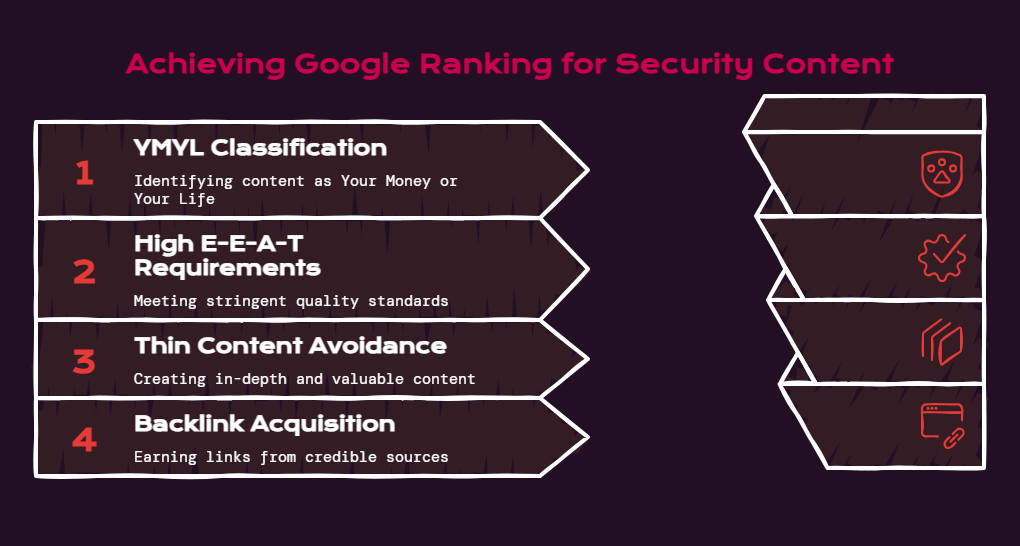
Security content – whether it’s cybersecurity advice, personal protection guidance, or threat intelligence – falls squarely into what Google classifies as YMYL content (Your Money or Your Life). These are topics where inaccurate or misleading content can cause real harm to real people. YMYL content faces the highest E-E-A-T requirements, and for these topics, Google’s quality rater evaluation is significantly more intense – with trust signals that would pass the framework on a general content site potentially failing for a security-adjacent one.
This matters for two reasons.
First, it means thin content doesn’t work here. Cybersecurity buyers – CISOs, SOC managers, compliance officers – are among the most skeptical, research-intensive audiences in B2B. They can spot shallow content immediately. If your blog is generic, it won’t rank, and even if it did, it wouldn’t convert anyone worth converting.
Second, it means the bar is actually an advantage if you clear it. In cyber security, where trust drives buying decisions, backlinks from respected media outlets, technical blogs, and expert communities serve as public endorsements – and they signal authority to Google while legitimizing your brand in the market.
Google’s E-E-A-T framework (Experience, Expertise, Authoritativeness, Trustworthiness) is the scoring rubric here. Experience means you’ve actually done the thing you’re writing about. Expertise is demonstrable knowledge through credentials or proven track record. Authoritativeness comes from external recognition – other credible sources citing or linking to you. And trustworthiness is about accuracy, transparency, and reliability.
The good news for security firms: you can signal all four of these without naming a single client.
What Privacy-Focused Business SEO Actually Looks Like
Here’s the mindset shift. You’re not trying to prove results. You’re trying to demonstrate judgment.
Your ideal client – a family office security director, a CISO evaluating an outside advisor, an HNWI looking for executive protection – isn’t going to your website expecting a case study with their specific threat profile. They’re trying to figure out if you understand the world they operate in. Whether you know the questions they’re already asking. Whether you think the way an expert thinks.
That’s what your content needs to do. Show your thinking, not your client list.
Here’s what that looks like in practice:
Process-Driven Content
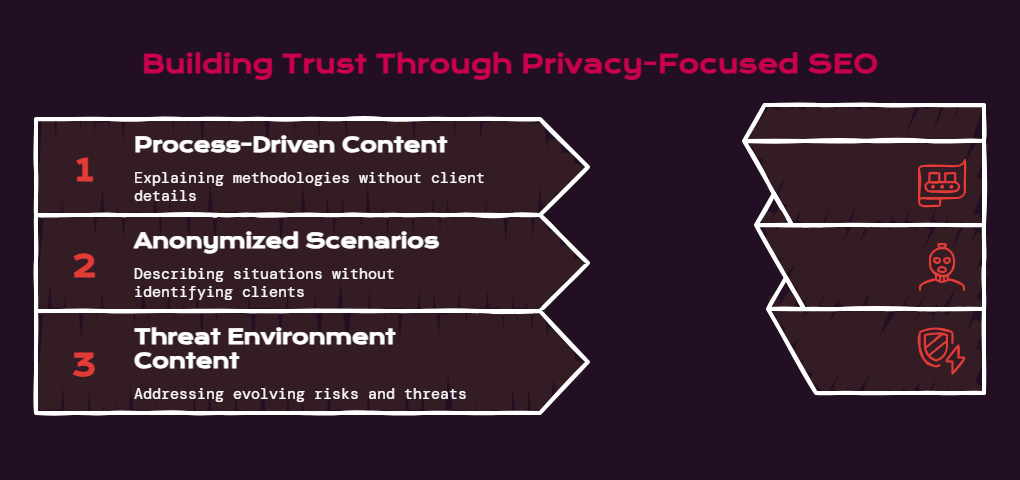
You can write extensively about how you approach problems without revealing any client information. An executive protection firm can publish a detailed piece on advance work methodology – how to scout a venue, how to assess travel routes, how threat levels are categorized – without mentioning a single client. A cybersecurity firm can explain their incident response framework. A personal security advisor can walk through how they structure an initial threat assessment.
Content categories that perform well for executive protection firms include threat intelligence breakdowns covering evolving travel risks and cyber-physical threats, case-style insights that walk through protective planning logic and advance work methodologies, and crisis prevention frameworks that address exposure during routine operations. None of those require a named client.
Anonymized Scenarios
You can describe situations without identifying anyone involved. “A family office with 12 properties across 4 countries required…” is a useful anchor for explaining your approach. The client is anonymous. The situation is real. The content builds credibility.
This is standard practice in legal and financial services, where client confidentiality is similarly non-negotiable. Law firms write about case types, not named plaintiffs. Wealth managers write about portfolio scenarios, not named investors. You can do the same.
Threat Environment Content
The threat landscape changes constantly. Travel risk, geopolitical instability, social engineering vectors, doxing exposure for executives – this is all content you can own without touching client information. It’s also the content your ideal client is actively searching for.
A personal security advisor who publishes the best publicly available content on digital privacy for high-net-worth individuals is building a stronger lead funnel than one who’s waiting around for testimonials they’ll never get.
Cybersecurity Company Content Marketing: Building Authority Without a Reveal
For cybersecurity firms specifically, the content opportunity is massive – and most companies are leaving it on the table.
Winning SEO today requires aligning content with real threats, buyer intent, and measurable business outcomes. AI-driven search and zero-click results are changing how buyers discover, evaluate, and validate security vendors. This means the firms that own clear, authoritative definitions, frameworks, and expert commentary are the ones getting cited in AI answers and appearing in the searches that matter.
What does cybersecurity company content marketing look like when you can’t name clients?
Framework and Methodology Content: Publish your thinking on frameworks – Zero Trust, NIST CSF, MITRE ATT&CK. Don’t just explain what they are. Explain how you apply them, where they break down in practice, and what you’ve learned from using them. This is the kind of content a CISO actually wants to read.
Thought leadership content that positions your company as a trusted advisor, rather than just another vendor, is what earns meetings – and according to the 2024 Edelman-LinkedIn B2B Thought Leadership Impact Report, 73 percent of decision-makers consider thought leadership a more trustworthy basis for judging a company’s competencies than traditional marketing materials.
Threat Intelligence Breakdowns: A monthly or quarterly breakdown of the threat types you’re seeing – without attribution – is valuable, linkable content. Security publications, industry newsletters, and other blogs actively look for this kind of material to reference.
Compliance and Regulatory Guides: GDPR, HIPAA, SOC 2, PIPEDA, PCI DSS – the compliance landscape is complex and changes frequently. If you serve clients in regulated industries, owning this content is a major authority play. Compliance officers searching for guidance are high-value leads.
Comparison Content: “Penetration testing vs. vulnerability assessment – when you need each” is a piece that serves buyers at the research stage, costs you nothing in confidentiality, and ranks for searches with genuine intent behind them.
Personal Security Advisor Marketing and HNW Security SEO
This is the vertical where the confidentiality challenge is sharpest – and where the SEO opportunity is least developed by competitors.
Personal security advisors and executive protection firms serving high-net-worth individuals and family offices are in a category where the buyer is sophisticated, the sales cycle is long, and referral has historically been the only channel that worked. That’s changing.
The key to acquiring and retaining HNWIs is no longer exclusively in-person events; it’s driving online visibility and out-competing others on factors like inbound content, lead nurture, and the use of data analytics. The HNW buyer is doing research online before they reach out. If your firm doesn’t show up in that research phase, you don’t exist.
The keyword strategy here isn’t about volume – it’s about precision. Search volume for terms like “personal security advisor for high-net-worth individuals” or “executive protection family office” is low. That’s expected. These are niche, high-intent searches. A single client conversion from organic can be worth years of search marketing investment.
For HNW security SEO specifically, focus on:
Location-Qualified Service Pages: “Executive protection services [city]” or “personal security advisors [region]” – these are the service pages your site needs. They’re also searchable and buildable without any confidential information.
Threat-Specific Education: The families and executives in this market care about specific threats: doxing, digital privacy, kidnap and ransom risk in specific regions, physical surveillance. Content that addresses these directly – from a genuine practitioner’s perspective – builds the exact credibility a potential client is looking for.
Credential and Background Content: For firms where operators have military, law enforcement, or intelligence backgrounds, this is public and valuable. The background is a trust signal. Write about it without it being a resume dump.
HNW individuals value privacy and are highly selective about the brands and services they engage with – their preference for exclusivity and discretion offers marketing opportunities for firms that understand how to position accordingly. Your messaging should feel like a private briefing, not a sales page.
How to Market a Security Business: The Technical SEO Baseline
Content strategy gets most of the attention, but the technical foundation matters just as much – especially for a YMYL site trying to build trust signals with Google.
Here’s what the baseline looks like:
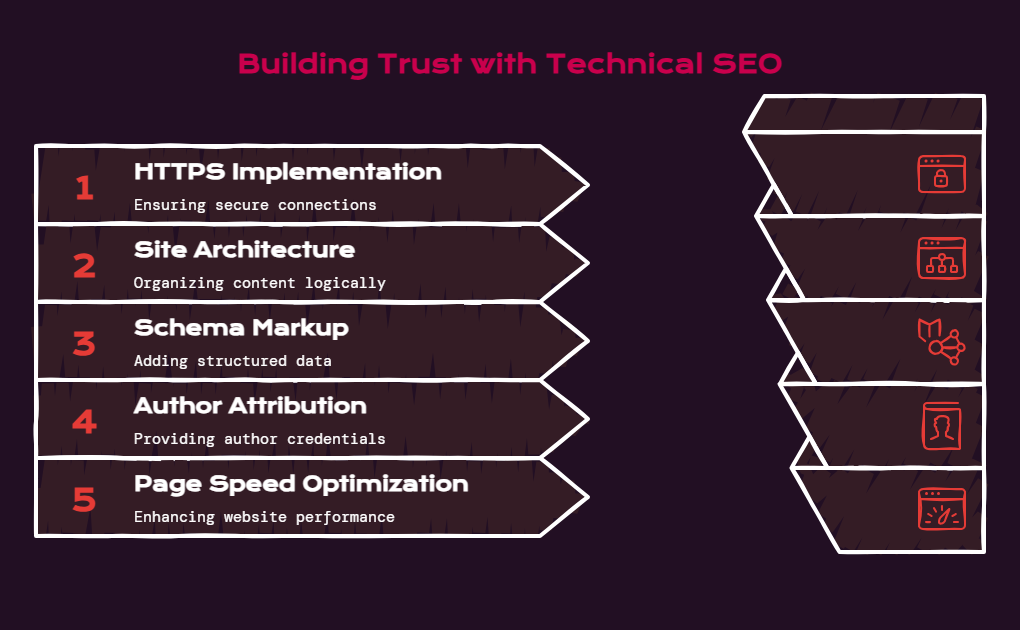
HTTPS Is Non-Negotiable
For a security firm to be running on an unsecured connection in 2026 is a credibility problem that goes beyond SEO. Sites running on plain HTTP fail the technical trust filter at the first measurement – and Google’s systems treat the absence of SSL as a signal of either neglect or inability to perform basic web operations. For a firm selling security services, this should need no further explanation.
Site Architecture and Internal Linking
A streamlined site taxonomy that reflects how buyers navigate from high-level strategy to solution detail is the foundation. Use internal linking to guide movement between related topics and to surface high-intent pages – strong information architecture makes SEO more resilient as you scale content.
For security firms, this often means separate sections or service pages for each offering type (physical security, cyber, travel security, family office advisory), with clear internal linking between them and from informational content to service pages.
Schema Markup
Service schema, FAQ schema, and author markup all send trust signals that matter in YMYL categories. They’re not optional extras – they’re part of how Google establishes that your content comes from a credible source.
Author Attribution
On February 1, 2026, Google added a new Authors section to Search Central documentation – the clearest signal yet that authorship transparency is a direct quality consideration. If you’re publishing content under a firm name with no author attribution, you’re missing a signal that matters. Name the author. Include credentials. Link to their professional profile.
Page Speed and Core Web Vitals
Security audiences have low patience for slow or unreliable websites. Core Web Vitals, clean architecture, and technical performance are table stakes. Run your site through Google’s PageSpeed Insights and Lighthouse. Fix what’s broken.
Keyword Strategy for Confidential Client SEO
Standard keyword research works differently when your primary evidence type – client results – isn’t available. Here’s how to approach it.
Bottom-of-Funnel First
Start with the searches closest to a buying decision. “Executive protection firm [city],” “personal security advisor,” “cybersecurity consultant for financial firms” – these are the searches that matter most. Bottom-of-funnel keywords summarize what your business does and are where you want a solid base before moving up the funnel to longer-term awareness and consideration content.
Intent Mapping for High-Trust Buyers
Your buyers don’t search the same way a SaaS buyer does. Security professionals and decision-makers search for specific threats, compare tools against known frameworks, and look for evidence that a vendor understands their environment. Your keyword list should reflect that. “How to evaluate an executive protection firm,” “what to ask a personal security advisor,” “SOC 2 vs ISO 27001 which do I need” – these are research-phase queries from real buyers.
Comparison and Evaluation Queries
Decision-stage buyers often use comparison queries. They’re deciding between options, not still figuring out if they have a problem. Creating content that answers these comparison questions – even honestly, including where your service isn’t the right fit – builds the trust that moves people from research to contact.
The table below shows how keyword intent maps across the funnel for security firms:
| Funnel Stage | Intent | Example Keywords | Content Type |
| Awareness | Problem recognition | “executive threat landscape 2026,” “cybersecurity risks family office” | Blog posts, threat reports |
| Consideration | Evaluating solutions | “executive protection vs security guard,” “what does a personal security advisor do” | Comparison guides, service explainers |
| Decision | Vendor selection | “executive protection firm [city],” “personal security advisor for HNW families” | Service pages, credentials pages |
| Loyalty | Ongoing relationship | “travel risk briefings,” “quarterly threat updates” | Newsletter, gated content |
Link Building for Security Companies: Getting Links Without Giving Information Away
Backlinks remain one of the strongest authority signals in SEO – and they’re entirely achievable without compromising client confidentiality.
Here’s what actually works:
- Industry publications: Security publications like Dark Reading, CSO Online, and Security Management are actively looking for practitioner-authored content. A guest article on travel threat assessment methodology or digital privacy for executives positions your firm as a credible voice in the space – and earns editorial links in the process.
- Original research and data: If you can aggregate anonymized data – threat frequencies, incident categories, regional risk trends – that’s linkable content. Publications cite data. Other blogs reference it. Backlinks follow.
- Whitepapers and frameworks: A publicly available whitepaper on executive digital privacy, kidnap and ransom risk mitigation, or family office security assessment methodology can earn citations from academic, government, and industry sources. Authoritative whitepapers on topics like biometric access controls, real-time threat analytics, or physical and digital security integration attract citations from cybersecurity blogs, tech publications, and B2B journals.
- Podcast appearances and speaking: Industry events and podcasts are high-credibility link sources. A principal speaking at ASIS, ISACA, or a family office conference earns coverage and backlinks without any client information changing hands.
- Unlinked brand mentions: Set up Google Alerts or use a tool like Ahrefs to track mentions of your firm or your principals. When someone mentions you without linking, reach out and request the link. This is especially powerful for firms that already have a reputation in the field.
Family Office Digital Marketing: The Referral Network Problem
A note specifically for firms serving family offices, private family offices, and UHNW clients.
Referral has historically dominated client acquisition in this space. A family principal trusts their attorney, who trusts their security advisor, who refers them. That chain works – until it doesn’t. Markets shift. Relationships retire. And when a new principal is doing their own research, they go online.
Family office digital marketing isn’t about replacing the referral network. It’s about being findable when the referral doesn’t happen – or when the referred client does their due diligence before making contact.
That due diligence is happening on Google. Executives, family offices, and high-net-worth individuals conduct extensive research before hiring a firm, seeking signals that demonstrate credibility and strategic depth. If your site has no content, no blog, no thought leadership, and no searchable presence, the due diligence phase produces nothing. That’s a problem.
The solution isn’t a content machine. It’s a targeted content presence – ten to twenty well-researched pieces that rank for the specific queries a family office security decision-maker would run, supported by solid technical SEO and a professional site that reflects the level of service you actually deliver.
Confidential Client SEO Strategy: The Content Blueprint
For security firms across all sub-verticals, the content architecture follows a similar pattern. Here’s a practical framework:
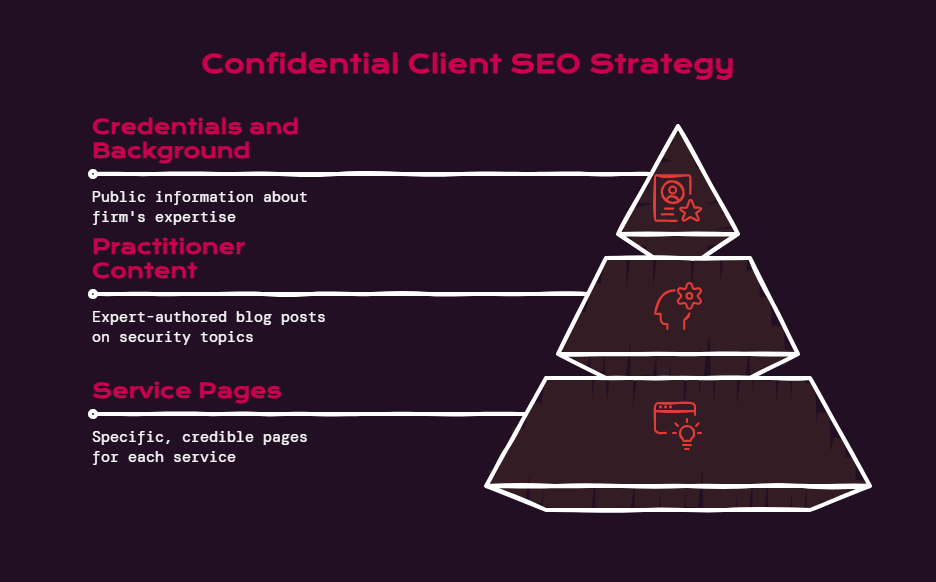
Foundation Layer: Service Pages
Every service you offer needs a dedicated, well-optimized page. Not one page that says “we do security.” Separate pages for executive protection, travel security, threat assessment, cybersecurity advisory, digital privacy, residential security, and so on. These are the bottom-of-funnel pages that convert. They need to be specific, credible, and clearly written for the person who already knows they need the service.
Authority Layer: Practitioner Content
This is the blog or insights section. The content here is practitioner-authored, specific, and demonstrates genuine operational knowledge. The topics don’t require client disclosure. They require expertise – which you have.
Trust Layer: Credentials and Background
Who runs the firm? What’s their background? What professional associations are they members of? What certifications do they hold? ASIS membership, CPP designation, relevant military or law enforcement background, academic credentials in security studies or risk management – all of this is public information that builds trust without touching client confidentiality.
Publishing thought-leadership content like articles on security practices and methodologies, combined with clearly communicated credentials and background, builds credibility over time in a way that SEO amplifies.
The table below maps content type to SEO and business development goals for security firms:
| Content Type | SEO Function | Business Development Function | Confidentiality Risk |
| Service pages | Rank for commercial intent keywords | Convert research-stage buyers | None |
| Threat intelligence posts | Earn topical authority | Demonstrate current awareness | None |
| Framework/methodology explainers | Build E-E-A-T signals | Show operational expertise | None |
| Anonymized scenario content | Capture long-tail queries | Provide relatable context | Minimal (if anonymized properly) |
| Regulatory/compliance guides | Rank for compliance queries | Serve adjacent buyer needs | None |
| Credentials and background pages | Build author trust signals | Establish principal credibility | None |
| Original research/data | Earn backlinks | Generate media attention | None |
What Google’s Quality Raters Are Looking For in Security Content
Google’s Search Quality Rater Guidelines specifically flag safety-related content as requiring the highest-quality signals. YMYL applies to content that could impact a person’s health, finances, safety, or well-being, and Google applies stricter evaluation standards as a result.
For security firms, this is relevant in two ways.
First, it means your content needs to be accurate. Don’t publish threat statistics you can’t source. Don’t make claims about capabilities or outcomes you can’t support. Don’t speculate about methods or tactics in ways that could be misread. E-E-A-T is a verification architecture, not a content checklist. Google’s systems are trained to detect trust signals across four dimensions simultaneously, and trust is the dimension that overrides all others.
Second, it means your About page needs to be real. Not a template. Not a generic firm biography. The people behind the firm, their relevant backgrounds, their credentials, their professional history. Generic About pages copied from templates don’t produce the signal because they’re easy for systems to detect and they tell potential clients nothing.
For security firms where principals have genuine, verifiable backgrounds – military, intelligence, law enforcement, specialized academic training – this is an asset. Use it. Write it explicitly. Link it to verifiable profiles where possible.
Conclusion
Security companies face a genuinely different SEO problem than most B2B firms. You can’t name your clients. You can’t publish case studies. You often can’t even acknowledge that an engagement happened.
But you can do SEO. You can rank for the searches your ideal clients are running. You can build authority that makes the right people trust you before they’ve ever spoken to you.
The strategy is built on what you can say: your process, your expertise, your credentials, your point of view on the threat environment, and your genuine understanding of the world your clients operate in. That’s enough. In fact, for a high-trust buyer doing due diligence, it’s exactly what they’re looking for.
The firms that figure this out – that build a real content presence and earn search visibility without compromising a single client relationship – are going to have a significant advantage over the firms that keep waiting for testimonials they’ll never be allowed to use.
Security is a long-game business. So is SEO. The timelines actually match pretty well.
If you’d rather have someone who knows this space handle the strategy and execution, this is exactly the kind of work we do at LYNX SEO. You focus on protecting your clients. We’ll handle making sure the right ones can find you.
Frequently Asked Questions
How Do I Do SEO for a Security Business When I Can’t Share Case Studies?
You build authority differently. Instead of case studies, you use process content (how you approach engagements), threat intelligence content (what you’re seeing in the current threat environment), framework and methodology explainers, credentials and background pages, and anonymized scenario content that demonstrates operational knowledge without identifying anyone. Content that walks through protective planning logic and advance work methodologies demonstrates strategic depth – which security decision-makers prioritize when shortlisting vendors – without requiring any client disclosure.
What Does Content Marketing Look Like for a Privacy-Focused Company?
It looks like thought leadership without attribution. You publish what you know – about threats, about frameworks, about your methodology – rather than what you’ve done for specific clients. The goal is to demonstrate expertise, not results. A buyer in a high-trust vertical isn’t just evaluating outcomes. They’re evaluating whether you understand the world they operate in. Content that shows genuine operational knowledge does that job without compromising anyone.
How Do Cybersecurity Companies Do SEO?
The cybersecurity companies seeing the best marketing results follow one fundamental principle: they help first and sell second. By creating genuinely useful content that addresses buyers’ real questions at each stage of their journey, they build the trust that naturally leads to sales. For cybersecurity company content marketing, this means a mix of technical content for practitioner audiences, strategic content for C-suite buyers, compliance guides for regulated industries, and threat intelligence content that earns external links and citations.
What Is the SEO Strategy for a Personal Security Advisory Firm?
Start with your service pages – each service you offer should have a dedicated, keyword-optimized page. Layer in practitioner content that demonstrates expertise in the specific threats your clients face (travel risk, digital privacy, physical surveillance, doxing, etc.). Build out your credentials page thoroughly – background, certifications, professional associations, speaking history. Then build links through industry publications, whitepapers, and original research. Local SEO matters too – even for firms that operate nationally or internationally, decision-makers often start their research with geographically specific queries.
How Do High-Trust Professional Services Firms Do Content Marketing?
The same way law firms, wealth managers, and private banks do it – by owning the questions their clients are already asking, rather than publishing results they can’t disclose. Content that helps a potential client understand a problem, evaluate their options, or make a better decision is high-value content regardless of whether it includes named case studies. This approach is sometimes called “help first” marketing, and it works especially well in high-trust verticals because the content itself becomes the trust signal.
What Keywords Should Security Companies Target?
The keyword strategy depends on the specific sub-vertical, but the structure is consistent. Start at the bottom of the funnel with commercial-intent queries: “[service type] [location],” “executive protection firm,” “personal security advisor for HNW.” Then build consideration-phase content around evaluation queries: “what does an executive protection firm do,” “how to hire a personal security advisor,” “cybersecurity consultant vs MSSP.” Finally, build awareness-phase content around threat environment and educational topics that your ideal client is already searching. For HNW security SEO specifically, expect lower search volumes but higher intent – a single conversion can justify significant content investment. For help finding the right keywords for your specific practice, see our guide on how to find SEO keywords for a website.
Does Local SEO Matter for Security Firms That Operate Nationally?
Yes – more than most firms realize. Decision-makers often start their search with local or regional qualifiers even if they’re open to a firm that operates nationally. A family principal in Toronto looking for executive protection isn’t going to search “best executive protection firm globally.” They’re starting locally and expanding from there. This means you need location-specific service pages and a Google Business Profile even if your engagements aren’t confined to one geography. For more on how local SEO works across multi-location or regional businesses, see our guide on local SEO for home service franchises – the principles apply across service verticals.
How Long Does SEO Take for a Security Company?
The same timeline as any other B2B YMYL vertical – typically six to twelve months before you see meaningful ranking movement, and twelve to twenty-four months to build sustained lead flow from organic search. The timeline exists because building topical authority and E-E-A-T signals is a compounding process, not a switch. The firms that start now are the ones who have an established organic presence when a buyer runs the search that matters. Waiting until you need the leads is the wrong time to start.
Can a Security Firm Get Backlinks Without Exposing Client Information?
Absolutely. In-depth guides on protection techniques, security technology reviews, authoritative whitepapers on threat categories, and guest contributions to security publications can all earn high-quality backlinks without touching any client information. The key is creating content that other security publications, risk management blogs, and professional associations would want to reference – which means it needs to be genuinely useful, accurate, and specific. Generic content doesn’t earn links. Practitioner-quality content does.
How Do I Add Value to AI-Generated Blog Content for My Security Firm?
AI tools can speed up content production, but for a YMYL vertical like security, the content needs genuine practitioner input to pass Google’s quality evaluation and actually connect with sophisticated buyers. Read our guide on how to add value to AI blog content for a framework on how to layer real expertise onto AI-assisted drafts. For security firms specifically, that means adding specific threat data, operational nuance, and genuine point-of-view – the things an AI model without field experience can’t supply.
What Should a Security Company’s Website Architecture Look Like?
Clear, credible, and fast. Separate service pages for each offering. A robust About section with principal credentials and background. A blog or insights section for practitioner content. A contact page that signals seriousness without overselling. Navigation that a sophisticated buyer can move through without friction. A streamlined site taxonomy that reflects how buyers navigate from high-level strategy to solution detail, with internal linking that guides movement between related topics and surfaces high-intent pages, makes your SEO more resilient as you scale content. If your site is due for an overhaul, read our guide on how to redesign a website without losing SEO before making any structural changes.