
Instagram has over two billion monthly active users, and a significant chunk of them use the platform’s search function to find content, products, creators, and businesses.
Since 2021, Instagram has been indexing caption keywords – not just hashtags – as part of how it ranks and surfaces content. That means the same thinking that goes into finding SEO keywords for a website applies, in modified form, to what you post on Instagram.
If you’re not thinking about Instagram SEO strategy the same way you think about Google SEO, you’re leaving reach on the table.
Key Takeaways
- Instagram has its own internal search engine, and keyword placement in your bio, captions, and alt text directly affects your Instagram search ranking.
- The best Instagram SEO keywords are specific and niche-focused – matching how your audience actually searches, not how you’d describe yourself.
- Instagram keyword research is a real process: use Instagram’s own search bar, competitor analysis, and third-party tools to find what’s working.
- Keywords go in five specific places: your name field, bio, captions, hashtags, and alt text – and each plays a different role.
- Instagram Reels SEO is the fastest-moving opportunity right now – Reels get indexed differently and can reach people who don’t follow you.
- Instagram discoverability compounds over time – consistent keyword signals across your profile grow faster than chasing trends.
- If you want someone to build and execute this at scale, that’s exactly what we do at LYNX SEO.
How Instagram’s Algorithm Uses Keywords
Instagram evaluates content across multiple signals. Keywords are one of them.
| Signal | What Instagram Looks At |
| Profile keywords | Name field, username, bio text |
| Content keywords | Caption text, alt text |
| Hashtag keywords | Hashtags in captions and comments |
| Engagement signals | Saves, shares, comments, watch time |
| Relevance signals | How well content matches a user’s behavior |
Keywords don’t work alone. A post with good keywords but poor engagement still won’t rank. But keywords are the signal that tells Instagram who your content is for – so the algorithm can start testing it with the right audience.
Instagram Keyword Research: How to Do It
This is where most people skip ahead to guessing. Don’t. There are four steps to doing this properly, and none of them require a paid tool to start.
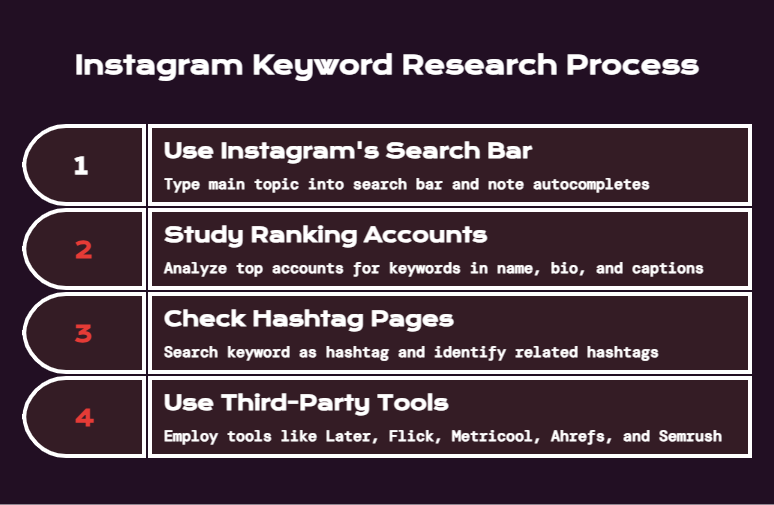
Step 1: Use Instagram’s Own Search Bar
Type your main topic into Instagram’s search bar and note what autocompletes. Those suggestions are real search queries with real volume behind them. For a meal prep business, try “meal prep,” “meal prep ideas,” “meal prep for beginners” – each one is a live keyword.
Step 2: Study Accounts Already Ranking
Search your main keyword and look at the top accounts that appear. What words are in their name field, bio, and caption first lines? What hashtags do they repeat? This is reverse-engineering Instagram’s own relevance signals.
Step 3: Check Hashtag Pages
Search your keyword as a hashtag and look at what other hashtags cluster in the top posts. That’s your secondary keyword list – the Instagram hashtag keywords that already sit around your topic.
Step 4: Use Third-Party Tools
| Tool | What It’s Good For |
| Later | Hashtag analytics and suggestions |
| Flick | Instagram-specific hashtag research |
| Metricool | Content analytics and keyword tracking |
| Ahrefs / Semrush | Finding Google keywords that translate to Instagram |
The Ahrefs/Semrush angle is underused. If a keyword has high Google search volume, it likely has Instagram search volume too – people searching on one platform are usually searching on both.
Where to Put Instagram Keywords
Here’s where you need to put Instagram keywords for the broadest reach:
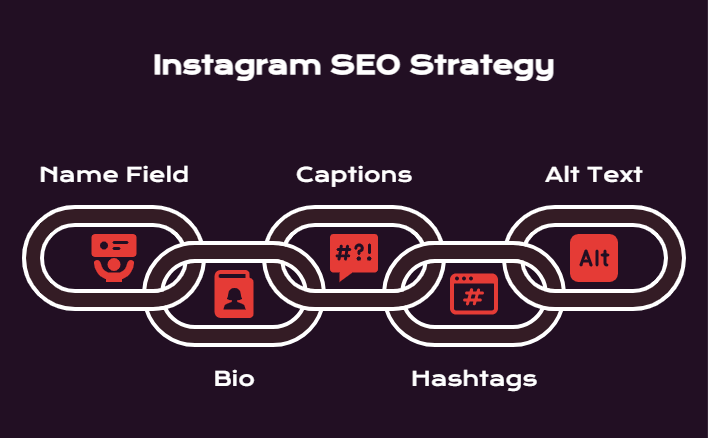
Name Field
This is your most valuable Instagram SEO real estate. The name field is indexed and heavily weighted in Instagram search. Don’t just put your name – add your primary keyword.
Instead of: Sarah Johnson Try: Sarah Johnson | Wedding Photographer Toronto
Bio
Your bio gets 150 characters. Use them to reinforce keywords and tell the algorithm exactly what you do. A bio that works for Instagram search optimization looks like: what you do (use the keyword), who you help, a proof point, and a CTA.
Captions
Since 2021, Instagram indexes caption text for search. Lead with your main topic in the first two lines (before the “more” cutoff), include related terms naturally through the body, and put hashtags at the end.
Keywords for Instagram captions work best when they’re specific. “Interior designer” is weaker than “small space interior designer Toronto.” Specific language is closer to how people actually search.
Hashtags
The Instagram hashtag strategy has shifted. Three to ten relevant hashtags now outperforms the old 30-hashtag approach. Mix sizes:
| Hashtag Tier | Volume | Purpose |
| Broad | 500K+ posts | Reach |
| Mid-tier | 50K-500K posts | Relevance |
| Niche | Under 50K posts | Targeting |
Rotate your hashtag sets across posts. Instagram can de-prioritize repetitive hashtag use.
Alt Text
Instagram lets you add alt text to every post. Most people ignore it. That’s a mistake – alt text is read by the algorithm and is free keyword real estate that most competitors aren’t using. Write a clear description and include your keywords naturally.
Instagram Reels SEO: The Fastest Growing Opportunity Right Now
Reels are Instagram’s primary growth product. The algorithm actively distributes Reels to non-followers based on relevance signals – including keywords.
| Reel Element | How to Optimize |
| Caption | Start with a keyword-rich first line |
| On-screen text | Include keywords as text overlays |
| Spoken audio | Say your keywords – Instagram transcribes audio |
| Cover image | Use keyword-relevant text |
The audio transcription piece is newer and genuinely powerful. If you’re a personal trainer and say “home workout for beginners” in your Reel, Instagram picks that up as an Instagram reel keyword signal. This is the same logic behind forecasting SEO growth – identify the terms with the right demand signal, then build content that captures them consistently.
Viral Instagram Keywords by Niche
These keyword categories are consistently driving Instagram discoverability right now.
| Niche | Broad Keywords | Niche Keywords |
| Fitness | “workout for beginners,” “home gym setup” | “glute workout women,” “postpartum fitness” |
| Food | “meal prep ideas,” “easy dinner recipes” | “dairy free baking,” “high protein meals” |
| Business | “small business tips,” “passive income ideas” | “Etsy seller tips,” “freelance designer” |
| Photography | “photography tips,” “photo editing tutorial” | “wedding photographer,” “newborn photography” |
| Real Estate | “real estate tips,” “buying a house” | “first time home buyer,” “luxury real estate Toronto” |
Real estate is one of the most competitive Instagram niches. Hyper-local Instagram niche keywords (“Toronto condo market”) combined with evergreen educational content is the winning combination – the same approach that works for SEO keywords in real estate on Google.
If you work in photography, the Instagram keyword research overlaps closely with SEO keywords for photographers – the same intent signals apply across platforms.
How the Explore Page Actually Works
The Explore page is where viral happens – but it’s not a search result. It’s a personalized feed built around user behavior. Here’s the distribution chain:
- You post with relevant keywords in caption, hashtags, and alt text
- Instagram tests the post with a small slice of your followers
- Strong engagement (saves, shares, comments) triggers a wider test audience
- If that audience engages, Explore distributes to similar non-followers
Keywords get your content in front of the right initial test audience. Engagement quality drives the rest.
Saves are the most powerful Explore signal. Create content people save – tutorials, checklists, dense tips, before/afters. These are your Instagram engagement keywords in action – content types that trigger save behavior are the ones that compound.
Common Instagram SEO Mistakes
There are a few things you absolutely must avoid when doing SEO on Instagram:
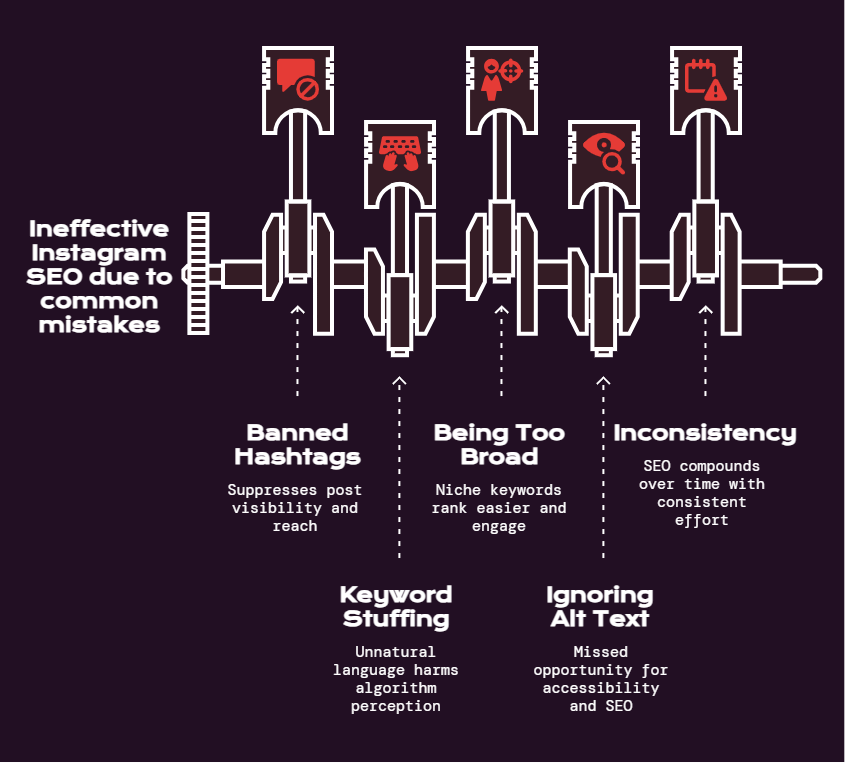
- Using banned hashtags. If the “Top Posts” section is hidden on a hashtag page, it’s likely restricted. Using it can suppress your entire post.
- Keyword stuffing. Captions that read like keyword lists are worse than no keywords at all. Instagram’s algorithm identifies unnatural language. Write for humans first.
- Being too broad. “Fitness” is not a keyword strategy. “Postpartum fitness for new moms” is. Specific Instagram niche keywords rank easier and reach people who actually engage.
- Ignoring alt text. Thirty seconds per post. Almost nobody does it. Do it.
- Inconsistency. Instagram SEO compounds. An account posting consistently in the same keyword cluster for 90 days will outperform an account with better individual posts but no strategy.
Instagram SEO vs. Google SEO: Key Differences
Both reward relevance, authority, and consistency. But the mechanics differ.
| Factor | Google SEO | Instagram SEO |
| Ranking signals | Backlinks, content, technical | Engagement, keywords, consistency |
| Keyword placement | URL, title, H1, body, meta | Name field, bio, captions, alt text |
| Algorithm speed | Months | Days to weeks |
| Competition research | Ahrefs, Semrush | Manual + Flick, Later |
The fastest compounding growth happens when Instagram SEO and traditional SEO work together. A business optimizing for Google search and building Instagram authority in the same niche is covering the entire discovery funnel from both ends.
The Broadest Reach on Instagram with LYNX SEO
Instagram SEO is not about chasing every viral trend or stuffing your captions with random hashtags. It is about making your content easier for the right people to find. When your name field, bio, captions, Reels, hashtags, and alt text all point toward the same niche, Instagram has clearer signals to work with. That clarity helps your content reach better-fit audiences, improve engagement, and build momentum over time.
The accounts that win are not always the loudest. They are the ones that consistently tell Instagram exactly who they serve and why their content matters. Use the right viral SEO keywords for Instagram, keep your content useful, and treat every post as another signal in a bigger discovery system. That is how visibility turns into growth.
If you want to build this kind of keyword strategy across Instagram and Google and actually have it executed consistently – that’s the work we do at LYNX SEO.
Frequently Asked Questions
What Are Viral SEO Keywords for Instagram?
Viral SEO keywords for Instagram are the search terms people type into Instagram’s search bar to find content, creators, or businesses. Placing these viral Instagram keywords in your profile name, bio, captions, and alt text helps Instagram understand who your content is for – which is the foundation of Instagram search optimization.
Where Should I Put Instagram SEO Keywords?
Instagram SEO keywords belong in five places: your name field (most important), your bio, your captions (especially the first two lines), your hashtags, and your alt text. Each location sends a different signal to the algorithm and contributes to your overall Instagram search ranking.
Do Instagram Hashtags Still Help With SEO?
Yes – but the Instagram hashtag strategy has changed. Using 3 to 10 highly relevant, niche-specific hashtags now outperforms packing in 30 generic ones. Viral Instagram hashtags in your specific niche matter more than the biggest hashtags available.
What Is Instagram Reels SEO and How Does It Work?
Instagram Reels SEO is optimizing short-form video for Instagram’s search and discovery systems. Instagram indexes Reel captions, on-screen text overlays, and transcribes spoken audio. Using your target Instagram reel keywords across all three gives you the best chance of being discovered through search and the Explore page.
How Long Does Instagram SEO Take to Work?
Faster than Google. Hashtag and caption keyword changes can improve reach within days or weeks. Building consistent topical authority – the kind that drives ongoing Explore page distribution – typically takes 60 to 90 days of consistent posting.
Can Instagram SEO Help Small Accounts Grow?
Yes – and it’s actually a bigger advantage for small accounts than large ones. Big accounts already have engagement-driven distribution. Small accounts can use Instagram growth keywords and content optimization to reach non-followers they’d never reach through followers alone. Instagram’s Reels algorithm regularly elevates small accounts when the content and keywords are dialed in.