
Every real estate agent has a website. Most of them get almost no organic traffic.
It’s not a design problem. It’s a keyword problem – specifically, targeting the wrong ones. Broad terms like “real estate agent” or “homes for sale” pull in national volume numbers that look great in a pitch deck and do almost nothing for a local business trying to book showings.
What works in real estate SEO is the same thing that works in every local service niche: the right keyword, matched to the right page, in the right market. That’s the whole game.
This post covers the full keyword map – buyer terms, seller terms, local modifiers, long-tail blog ideas, and how to put all of it together on a real site. The tables here have real volume estimates, but the strategy behind them is what matters.
Key Takeaways
- Broad keywords like “real estate” are nearly impossible to rank for – local and service-specific terms are where real estate agents actually win.
- Buyer and seller keywords have different intent and need separate pages – mixing them dilutes both.
- Local SEO keywords with city and neighborhood modifiers are the highest-converting terms in real estate search.
- Long-tail keywords (3-5 words) tend to have lower competition and much higher purchase intent than short-tail alternatives.
- Your Google Business Profile is a separate ranking system – it matters just as much as your website for local real estate keywords.
- Real estate blog content targeting pricing, timing, and process questions captures leads at the research phase, before they’ve picked an agent.
- LYNX SEO builds out this keyword infrastructure for real estate brands that want to dominate their local market – without the trial and error.
What Makes a Real Estate Keyword Worth Targeting
Not every keyword on a volume report is worth your time. Real estate SEO keyword research comes down to three filters.
| Filter | What to Ask |
| Intent | Is this person ready to buy, sell, or just browsing? |
| Relevance | Does it match a service your brokerage or team actually offers? |
| Achievability | Can your site realistically compete for this term in your market? |
The keywords worth building pages around sit at the intersection of all three. In practice, that usually looks like: service type + city + buyer or seller signal.
“Real estate agent” fails all three for most sites. “First-time home buyer agent Burlington Ontario” passes all three.
The rest of this post is built around that pattern.
Core Real Estate SEO Keywords
These are the foundational terms that shape how Google understands your site. They’re competitive, and most won’t move quickly – but they need to be on your homepage and core service pages.
| Keyword | Est. Monthly Volume (US) | Difficulty |
| real estate agent | 201,000 | Very High |
| real estate agent near me | 165,000 | High |
| homes for sale | 823,000 | Very High |
| real estate | 1,220,000 | Very High |
| realtor near me | 135,000 | High |
| real estate services | 40,500 | High |
| real estate listings | 60,500 | Very High |
| property search | 33,100 | High |
| MLS listings | 49,500 | High |
These terms are dominated by Zillow, Realtor.com, Redfin, and large brokerages with hundreds of thousands of backlinks. You’re not beating them on “homes for sale.”
What you can do is use these terms to establish your site’s topical focus – and win the local versions where national portals have less of a grip.
Buyer Keywords: Homes for Sale and Property Search Terms
Buyer keywords are the highest-volume segment in real estate SEO. The searcher intent ranges from early browsing to “I need to move in 60 days.” Your job is to capture both ends.
General Buyer Keywords
| Keyword | Est. Monthly Volume (US) | Intent |
| homes for sale near me | 550,000 | Very High |
| buy a house | 90,500 | High |
| first time home buyer | 74,000 | High |
| home buying process | 22,200 | Medium |
| how to buy a house | 49,500 | High |
| houses for sale | 673,000 | Very High |
| new homes for sale | 110,000 | High |
| condos for sale | 90,500 | High |
| townhomes for sale | 60,500 | High |
| luxury homes for sale | 33,100 | High |
| investment property for sale | 22,200 | High |
First-Time Buyer and Financing Keywords
These are lower-volume but high-intent. Someone searching “first time home buyer programs [city]” is actively trying to buy – they just need guidance.
| Keyword | Est. Monthly Volume (US) | Intent |
| first time home buyer programs | 27,100 | High |
| home buyer checklist | 12,100 | Medium |
| how much house can I afford | 22,200 | High |
| mortgage pre-approval process | 9,900 | High |
| buyer agent vs listing agent | 6,600 | High |
| real estate buyer agent | 8,100 | High |
| home inspection process | 14,800 | Medium |
| closing costs for buyers | 12,100 | High |
Content targeting buyer keywords works best as a resource hub on your site. A “Buyer’s Guide” section with individual pages for each step of the process builds topical authority and captures leads at every stage.
Seller Keywords: Listing and Valuation Terms
Seller keywords tend to have stronger conversion intent than buyer keywords. Someone searching “sell my house fast” or “home valuation” is ready to talk to an agent – often today.
These are the terms worth building dedicated seller-focused landing pages around.
| Keyword | Est. Monthly Volume (US) | Intent |
| sell my house | 110,000 | Very High |
| sell my house fast | 74,000 | Very High |
| home valuation | 40,500 | Very High |
| how much is my home worth | 33,100 | Very High |
| list my home for sale | 14,800 | Very High |
| listing agent | 18,100 | High |
| real estate seller agent | 9,900 | High |
| home selling tips | 9,900 | Medium |
| how to sell a house without a realtor | 12,100 | High |
| seller closing costs | 8,100 | High |
| home staging tips | 22,200 | Medium |
| best time to sell a house | 18,100 | Medium |
“How to sell a house without a realtor” is a counterintuitive one. It pulls in a lot of DIY-intent traffic – but a well-written page that addresses their real concerns and shows your value can convert those searchers into leads. It’s worth building.
The key distinction: keep buyer pages and seller pages separate. Combining them in a single “Buy or Sell” page dilutes the relevance signal for both and splits your internal authority.
If you’re building out your real estate site’s page structure and want a second set of eyes on it, LYNX does exactly this work – keyword mapping, page architecture, and execution.
Talk to us at lynxseo.com
Local Real Estate SEO Keywords
This is where real estate agents actually win search. Local real estate SEO keywords are where national portals have gaps – and where a well-built local site can outrank Zillow.
The formula is simple: [service] + [city]. What makes it powerful is that Google prioritizes local relevance for these searches. You’re not competing nationally – you’re competing against the other agents in your market.
The Local Keyword Pattern
| Pattern | Example |
| [city] real estate agent | Burlington real estate agent |
| [city] homes for sale | Hamilton homes for sale |
| [city] realtor | Oakville realtor |
| homes for sale in [city] | homes for sale in Mississauga |
| [city] real estate listings | Toronto real estate listings |
| best realtor in [city] | best realtor in Calgary |
| [neighborhood] homes for sale | Aldershot homes for sale |
| [city] luxury homes | West Vancouver luxury homes |
| [city] condos for sale | Ottawa condos for sale |
| real estate agent in [city] | real estate agent in Guelph |
Every city in your service area is a separate keyword cluster. Every neighborhood within that city is another one. Each deserves its own page – not a template with the city name swapped.
Service Area Expansion: The Page Play Most Agents Miss
Most agents serve a 45-60 minute radius but only build content for their home city. Every other city in that radius is an uncaptured keyword opportunity.
The right move: one dedicated location page per city you actively serve. Not thin duplicates – real pages with local context. Mention popular neighborhoods, recent market trends in that area, and any transactions you’ve closed there.
A page that just swaps a city name into a template is easy for Google to spot. It ranks poorly and deserves to. The extra effort of making each page genuinely useful is the gap that separates the sites that actually rank from the ones that don’t.
This is the same structural logic we covered in our guide on local SEO for franchises – the page-per-location model works the same way across multi-location service businesses.
Near Me Keywords
“Real estate agent near me” gets searched over 165,000 times a month. You don’t build a page targeting that exact phrase – Google resolves “near me” from the searcher’s device location. What you’re optimizing for is your local presence signals:
- Google Business Profile completeness and review volume
- Consistent name, address, and phone number across directories
- Local citations from real estate networks and directories
- Location-specific content on your core service pages
Get those right and “near me” searches resolve to your profile automatically.
Long-Tail and Blog Keyword Ideas for Real Estate
Blog content isn’t filler. It builds the topical authority that makes your service pages rank better – and it catches potential clients at the research phase, before they’ve chosen an agent.
Pricing and Cost Keywords
People researching costs are active buyers. They’re not DIYers – they’re trying to set expectations. These are high-value blog targets.
| Keyword | Est. Monthly Volume (US) | Intent |
| how much does a real estate agent cost | 18,100 | High |
| real estate agent commission | 40,500 | High |
| how much does it cost to sell a house | 22,200 | High |
| closing costs | 60,500 | High |
| home appraisal cost | 12,100 | High |
| real estate attorney fees | 9,900 | Medium |
Write these with real numbers. Vague answers like “it depends on the market” don’t satisfy the searcher and don’t rank. A post that says what agents typically charge in your area, and what drives the variation, is useful and rankable.
Timing and Process Keywords
| Keyword | Est. Monthly Volume (US) | Intent |
| best time to buy a house | 27,100 | Medium |
| best time to sell a house | 18,100 | Medium |
| how long does it take to buy a house | 14,800 | Medium |
| how long does it take to sell a house | 9,900 | Medium |
| how to make an offer on a house | 12,100 | High |
| home inspection checklist | 9,900 | Medium |
| what to look for when buying a house | 14,800 | High |
| steps to selling your home | 8,100 | High |
Comparison and Niche Keywords
Comparison searches attract people who are narrowing down options. They’re close to a decision. These are worth targeting in blog content because they’re low competition and high intent.
| Keyword | Est. Monthly Volume (US) | Intent |
| realtor vs real estate agent | 22,200 | Medium |
| buyer agent vs listing agent | 6,600 | High |
| renting vs buying a home | 12,100 | High |
| condo vs house | 9,900 | Medium |
| new construction vs existing home | 8,100 | High |
| fixer upper vs move in ready | 6,600 | High |
Neighborhood and Location Blog Content
This category is the most underused in real estate content marketing. Writing about specific neighborhoods, school districts, or suburbs creates pages that:
- Have almost no competition from national portals
- Rank locally without needing significant link authority
- Attract buyers already researching where they want to live
- Build internal links to your listings and service pages naturally
Examples: “Best neighborhoods in Burlington for families,” “Living in Aldershot: what to know before you buy,” “Top school districts in Hamilton.” Write one for every area you serve. This compounds over time.
We cover the same compounding logic in our post on how to forecast SEO growth – the piece shows how a content build like this translates to traffic and lead projections over a 12-24 month window.
High-Intent Conversion Keywords for Real Estate Lead Generation
These are the terms that indicate someone is seconds away from contacting an agent. They have lower volume than broad terms, but the conversion rate is substantially higher.
| Keyword | Est. Monthly Volume (US) | Intent Signal |
| real estate agent near me | 165,000 | Ready to hire |
| sell my house fast | 74,000 | Urgent seller |
| free home valuation | 33,100 | Pre-listing |
| homes for sale [city] | Varies by city | Active buyer |
| buy home [city] | Varies by city | Active buyer |
| best real estate agent [city] | Varies by city | Evaluating agents |
| top realtor in [city] | Varies by city | Evaluating agents |
| real estate lead generation | 9,900 | Agent research |
| expired listing agent | 3,600 | Re-listing |
| FSBO real estate agent | 4,400 | Conversion |
The expired listing and FSBO keywords are worth a closer look. Both target people who’ve tried to sell and haven’t – they’re already motivated and already frustrated. A page that speaks directly to that situation converts well.
How to Do Real Estate Keyword Research
The keyword tables above are a starting point. Your actual market research needs to account for local search volume, competitor gaps, and what’s realistically rankable in your specific city. Here’s how to run that process.
Step 1: Start With Your Services, Not a Tool
Before opening any keyword tool, write down every service you offer. Every property type, every city, every client type you want to attract. This is your seed list.
A keyword tool’s job is to expand that list – not to define your business for you.
Step 2: Use Google’s Free Tools First
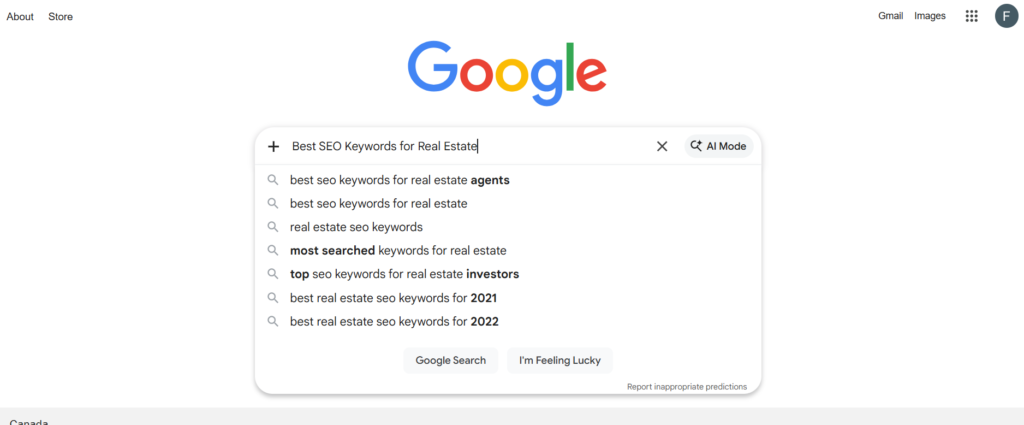
Google autocomplete and related searches are free, real-time, and reflect what people in your market actually type. Search your main service + city. Read every autocomplete suggestion. Screenshot the related searches at the bottom of the page.
Google Search Console is equally useful if your site has any history. The Queries report shows what you already rank for – sometimes at position 20 or 30. Improving the content on those pages can move rankings faster than building new pages from scratch.
Step 3: Run Competitor Research
Identify the top 2-3 agents or brokerages ranking in your city for your primary service terms. Run their URLs through Ahrefs or Semrush and look at their top organic keywords.
You’re looking for two things: the terms they’re winning on (so you can build better content for the same keywords) and the gaps they’ve missed (opportunities they haven’t captured yet).
Keyword Research Tools Worth Using
| Tool | Cost | Best For |
| Google Search Console | Free | Understanding what you already rank for |
| Google Keyword Planner | Free (needs Ads account) | Volume estimates by city or metro |
| Ahrefs Webmaster Tools | Free (own site only) | Keyword gaps and competitor research |
| Semrush Free Tier | Free (limited) | Competitor keyword snapshots |
| Ahrefs or Semrush (paid) | $99-$129+/month | Full keyword research, tracking, link data |
| Keywords Everywhere | ~$15/year | Quick volume data while browsing |
The same research process works across any local service niche. We walked through it in detail for SEO keywords for roofers and the approach transfers directly – it’s a local service SEO problem with different keywords, not a different strategy.
How to Use Real Estate SEO Keywords on Your Website
Having the right keyword list is step one. Getting those keywords onto the right pages, in the right places, is where most real estate websites fall short.
Match Keywords to the Right Page Type
Every keyword needs a home. The wrong pairing is worse than no pairing at all – it sends Google mixed signals and dilutes both pages.
| Page Type | Keywords That Belong Here |
| Homepage | Your city + primary service (“Burlington real estate agent”) |
| Buyer page | Buyer process, first-time buyer, home search terms |
| Seller page | Home valuation, list my home, sell my house terms |
| Location pages | One page per city or neighborhood in your service area |
| Neighborhood pages | Specific community or district searches |
| Blog posts | Pricing, process, comparison, and neighborhood content |
| About page | Your name, brand terms, secondary city queries |
On-Page Basics
For each page, the keyword needs to appear in these places to signal relevance:
- Title tag: “Burlington Real Estate Agent | [Your Name]” is right. Your name alone is wrong.
- H1 heading: One per page. Should match or mirror your title tag keyword.
- First 100 words: Mention the keyword naturally early. Don’t force it, don’t bury it.
- Image alt text: “burlington-real-estate-agent-home-showing.jpg” beats “IMG_4032.jpg” every time.
- Meta description: Doesn’t directly affect ranking, but affects click-through rate. Write for the human.
- URL: /burlington-real-estate-agent/ not /page2/ or /services-listing-1/
Site Structure That Works
Here’s what a well-built real estate site structure looks like for an agent serving a few cities:
- /services/buy-a-home/
- /services/sell-your-home/
- /services/luxury-homes/
- /services/investment-properties/
- /locations/burlington/
- /locations/oakville/
- /locations/hamilton/
- /neighborhoods/aldershot/
- /blog/how-much-does-a-real-estate-agent-cost/
- /blog/best-time-to-sell-a-house-in-ontario/
- /blog/burlington-neighborhoods-for-families/
Build a few pages properly before expanding. Three strong, well-targeted pages will outperform thirty thin ones. Every time.
Internal Linking
Every page on your site should answer: where does a reader go if they’re ready to take action? Link there. Blog posts pass authority to service pages – don’t let that go to waste by leaving pages disconnected.
The same structural logic applies whether you’re a solo agent or a multi-office brokerage. We broke down how it scales in our post on best SEO keywords for photographers – the page-matching and local layering approach is identical across local service businesses.
If you’d rather skip the trial and error and hand this off to a team that does it every day, this is exactly what we build at LYNX.
Frequently Asked Questions
What Are the Best SEO Keywords for Real Estate Agents?
The best SEO keywords for real estate agents combine a specific service with a local market – for example, “Burlington real estate agent,” “homes for sale in Oakville,” or “sell my house Hamilton.” Broad national real estate keywords are dominated by Zillow, Realtor.com, and Redfin. Local and long-tail real estate keywords are where individual agents and smaller brokerages can compete and win.
How Do I Find Real Estate Keywords for My Local Market?
Start with Google autocomplete and related searches – these are free and show exactly what people in your area are typing. Then run your top local competitors through Ahrefs or Semrush to see their top-ranking real estate keywords. Google Search Console will show you what you already rank for, sometimes at positions where small improvements to your content can move the needle quickly.
What’s the Difference Between Buyer Keywords and Seller Keywords in Real Estate SEO?
Real estate buyer keywords target people searching for homes to purchase – “homes for sale in [city],” “first time home buyer programs,” “how to buy a house.” Real estate seller keywords target homeowners looking to list – “sell my house,” “free home valuation,” “listing agent near me.” These need to live on separate pages with separate targeting. Combining them on one page dilutes the relevance signal for both.
Are Local Real Estate SEO Keywords Better Than National Ones?
For almost every agent or brokerage, yes. Local real estate keywords like “[city] homes for sale” or “best realtor in [city]” have lower competition than national terms and convert at a significantly higher rate – because the searcher is looking for exactly what you offer, in exactly the market you serve. Geo-targeted real estate keywords are the core of any realistic local SEO strategy.
How Many Real Estate Keywords Should I Target per Page?
Target one primary keyword per page – the core service or location term the page is built around. Layer in 2-4 closely related secondary terms that naturally fit the content. Trying to target 10 different real estate keyword ideas on a single page splits your focus and almost always results in ranking for none of them well. One page, one primary target, built well.
What Real Estate Blog Keywords Drive the Most Leads?
Real estate blog keywords targeting cost and pricing questions tend to drive the highest-quality leads. Searches like “how much does a real estate agent cost,” “real estate agent commission,” and “closing costs for buyers” come from people who are actively planning a transaction – they’re not browsing, they’re preparing to make a move. Neighborhood guides and “best time to buy or sell” content capture earlier-stage leads and build topical authority over time.
How Long Does Real Estate SEO Take to Work?
Local real estate SEO keywords – especially city-level and neighborhood terms – can start showing movement in 3-6 months with proper on-page execution and consistent content. Broader, more competitive terms take longer. The sites that dominate local real estate search didn’t sprint there. They built steadily, compounded over 12-24 months, and now hold positions that are difficult to displace. If you want to understand what that curve looks like in terms of traffic and leads, our post on how to forecast SEO growth maps it out.