
Every photographer’s inbox has at least one email from an SEO agency promising to rank them for ‘wedding photographer’ – as if that means anything without a city attached to it. National volume numbers look impressive in a report. They don’t translate to booked sessions.
What gets photography clients through search is a combination of the right service keywords matched to the right page types in the right local market. That’s what this post covers. The keyword tables here have real volume data – but the tables aren’t the point. The strategy behind them is.
If you want to build this yourself, everything you need is here. If you’d rather hand it off, that’s what we do at LYNX SEO.
What Makes a Good SEO Keyword for Photographers
Not all keywords are created equal. A keyword is only worth targeting if it passes three tests:
- Relevance. Does it match a service you actually offer? Ranking for ‘film photography tutorial’ when you shoot commercial headshots wastes everyone’s time.
- Intent. Is the person searching ready to book, or just browsing? ‘Wedding photographer Toronto’ is a buyer. ‘How to pose for wedding photos’ is not.
- Achievability. Can your site realistically rank for it? Broad national terms take years. Local long-tail terms can move in months.
The keywords worth your time sit at the intersection of all three. Usually that means: a specific service + a specific location + some signal of buying intent.
That pattern is what the rest of this post is built around.
The Best SEO Keywords for Photographers (By Category)
Before getting into the lists: volume data alone won’t help you. A keyword only has value when it’s assigned to the right page on your site. The wrong pairing – like targeting ‘headshot photographer Toronto’ on your homepage when you’ve got a dedicated headshots page – sends Google mixed signals and dilutes both pages.
Each cluster below maps to a page type. That’s not a formatting choice – it’s how the strategy works.
Core Service Keywords
These are your money terms. High intent, competitive, and absolutely worth building toward even if they take time.
| Keyword | Est. Monthly Volume (US) | Difficulty |
| photographer near me | 135,000 | High |
| photography services | 27,100 | High |
| photography studio near me | 18,100 | Medium |
| hire a photographer | 9,900 | Medium |
| professional photographer | 22,200 | High |
| photography packages | 8,100 | Medium |
| photography pricing | 5,400 | Medium |
| photography contract | 4,400 | Medium |
These belong on your homepage and core service pages – not scattered across blog posts. They’re too broad for a single piece of content to rank for, but they shape the overall authority of your site when you build your structure correctly.
Wedding Photography Keywords
Weddings are the highest-value niche in photography SEO. High CPCs, high buyer intent, and a searcher who is actively planning a major purchase. The competition is real – but so is the opportunity.
| Keyword | Est. Monthly Volume (US) | Intent |
| wedding photographer | 135,000 | High |
| wedding photography | 90,500 | High |
| wedding photographer near me | 60,500 | Very High |
| best wedding photographers | 18,100 | High |
| affordable wedding photographer | 12,100 | High |
| wedding photography packages | 9,900 | High |
| wedding photos | 27,100 | Mixed |
| elopement photographer | 22,200 | High |
| engagement photographer | 14,800 | High |
| engagement photos | 22,200 | Mixed |
| destination wedding photographer | 9,900 | High |
The local modifiers are where you actually compete. ‘Wedding photographer Toronto’ is a realistic target. ‘Wedding photographer’ nationally is not – unless you have years of authority and a serious link-building program behind you.
Portrait Photography Keywords
Portrait is a large category. The most commercially valuable sub-niches are headshots and family portraits – both attract buyers who are ready to book and willing to spend.
| Keyword | Est. Monthly Volume (US) | Intent |
| portrait photographer | 49,500 | High |
| family photographer | 33,100 | High |
| family photographer near me | 22,200 | Very High |
| headshot photographer | 27,100 | High |
| professional headshots near me | 18,100 | Very High |
| LinkedIn headshot photographer | 8,100 | High |
| newborn photographer | 27,100 | High |
| newborn photographer near me | 14,800 | Very High |
| senior portrait photographer | 9,900 | High |
| maternity photographer | 22,200 | High |
| boudoir photographer | 18,100 | High |
Real Estate Photography Keywords
Real estate photography is a high-volume, repeat-business niche. You’re not selling to homeowners – you’re selling to agents who book you over and over. The keyword intent here is very commercial.
| Keyword | Est. Monthly Volume (US) | Intent |
| real estate photographer | 27,100 | High |
| real estate photography | 18,100 | High |
| real estate photographer near me | 12,100 | Very High |
| real estate photography pricing | 3,600 | High |
| architectural photographer | 6,600 | High |
| interior photography | 8,100 | Mixed |
| drone real estate photography | 4,400 | High |
| real estate video | 9,900 | High |
| Matterport photographer | 2,900 | High |
Event Photography Keywords
Event photography casts a wide net. Corporate clients, nonprofits, sports leagues – the keyword targeting here mirrors the clientele you actually want.
| Keyword | Est. Monthly Volume (US) | Intent |
| event photographer | 22,200 | High |
| event photographer near me | 12,100 | Very High |
| corporate photographer | 8,100 | High |
| corporate event photography | 4,400 | High |
| birthday photographer | 9,900 | High |
| sports photographer | 8,100 | High |
| conference photographer | 2,900 | High |
| product photographer | 12,100 | High |
| commercial photographer | 9,900 | High |
Local SEO Keywords That Actually Get Photography Clients
This is where most photography websites completely fall flat. And it’s also where the real money is.
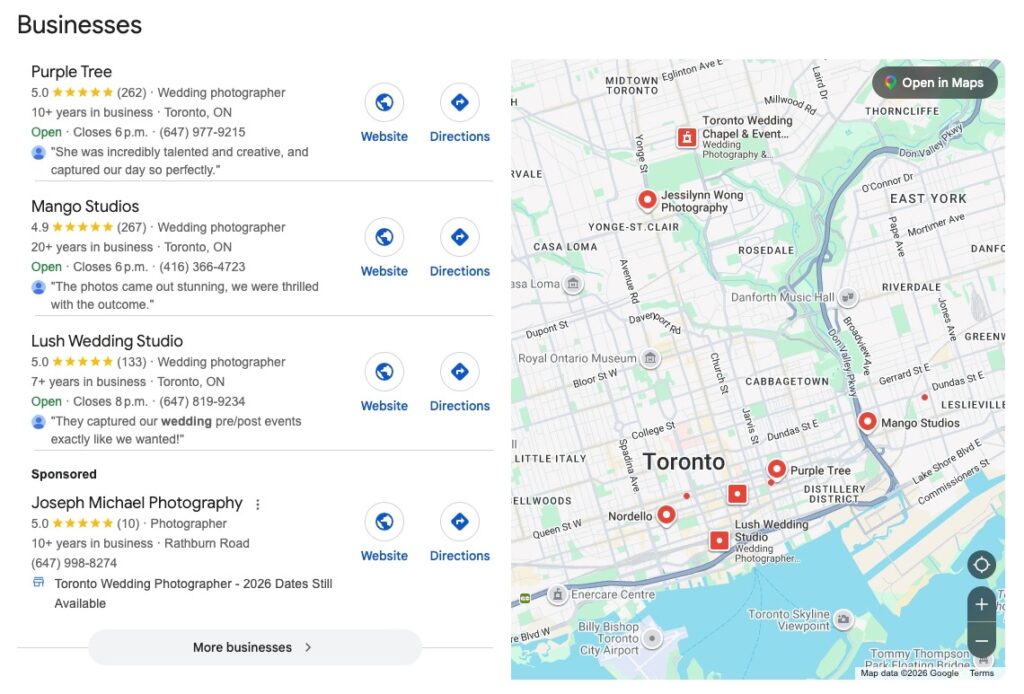
The formula is simple: [your service] + [your city]. What makes it powerful is that Google knows the search is local, so you’re competing against the other photographers in your market – not against national brands.
The Local Keyword Pattern
Here’s what this looks like in practice. If you’re a wedding photographer based in Toronto:
| Local Keyword | Example |
| [city] wedding photographer | Toronto wedding photographer |
| [city] portrait photographer | Toronto portrait photographer |
| [city] family photographer | Toronto family photographer |
| [city] headshot photographer | Toronto headshot photographer |
| [city] newborn photographer | Toronto newborn photographer |
| [city] engagement photographer | Toronto engagement photographer |
| [neighborhood] photographer | Distillery District photographer |
| photographer in [city] | photographer in Mississauga |
| [city] photography studio | Toronto photography studio |
Each one of those is a separate keyword cluster. Each one deserves its own page – or at minimum, its own section with a distinct URL.
The Service Area Expansion Play
Here’s the piece most photography sites miss entirely: you don’t just serve one city. You drive 45 minutes for the right shoot. Every city in that radius is a keyword opportunity.
The right structure is a dedicated location page for each city you serve. Done right, these aren’t thin duplicates – each should have genuine local context: notes about popular venues or parks in that area, photos from actual shoots you’ve done nearby, and specific services offered there.
A page that just swaps a city name is easy for Google to spot. It ranks poorly – and it should. Real local pages take a bit more effort, which is exactly what creates the competitive gap.
‘Near Me’ Keywords
“Photographer near me” gets searched over 135,000 times a month in the US. You don’t build a dedicated page for this. Google resolves “near me” based on the searcher’s location, so what you’re optimizing for is your local presence signals:
- Google Business Profile completeness and review volume
- Consistent NAP (name, address, phone) across directories
- Location-specific content on your website pages
- Local citations from wedding directories, event sites, and photography networks
Get those right and “near me” searches take care of themselves.
If you’re working across multiple locations and want to understand how this scales, the same structural logic applies to franchise SEO – we broke that down in detail in our post on local SEO for franchises.
Niche Photography Keywords (Wedding, Portrait, Real Estate)
The photographers who dominate local search aren’t usually the ones going after the broadest terms. They’re the ones who’ve built out depth in a specific niche. Here’s how that looks across three of the highest-value categories.
Best SEO Keywords for Wedding Photographers
Wedding is competitive, but it’s also one of the best-monetized niches in local service SEO. The key is going beyond the obvious terms.
| Keyword Type | Examples |
| Primary local | Toronto wedding photographer, Vancouver wedding photographer |
| Style-specific | documentary wedding photographer, film wedding photographer |
| Venue-specific | Elora Mill wedding photographer, Hacienda Sarria photographer |
| Time/season | fall wedding photographer Ontario, winter wedding photos |
| Budget-modifier | affordable wedding photographer Toronto |
| Elopement | Toronto elopement photographer, elopement packages Ontario |
| Day-of-week | Sunday wedding photographer, weekday wedding photographer |
Venue-specific keywords are one of the most underused opportunities in wedding SEO. A blog post targeting “Elora Mill wedding photographer” is going up against almost no competition while reaching couples who are actively researching that specific venue. Write one for every venue you’ve shot at.
Best SEO Keywords for Portrait Photographers
Portrait SEO works best when you’re specific about who you shoot. “Portrait photographer” is too broad. “LinkedIn headshot photographer Toronto” is a buyer.
| Keyword Type | Examples |
| Headshots | corporate headshot photographer, LinkedIn headshots Toronto |
| Family | family portrait photographer, outdoor family photos |
| Newborn | newborn photographer, fresh 48 photographer |
| Senior | senior portrait photographer, grad photos Toronto |
| Maternity | maternity photographer, pregnancy photos near me |
| Boudoir | boudoir photographer near me, empowerment photography |
| Pets | pet photographer, dog photos near me |
Best SEO Keywords for Real Estate Photography
Real estate is a B2B sale in most cases. Your keyword strategy should reflect who’s actually searching – agents and brokers, not homeowners.
| Keyword Type | Examples |
| Core service | real estate photographer [city], property photography |
| Video | real estate videographer, listing video Toronto |
| Drone/aerial | drone photography for real estate, aerial listing photos |
| Virtual tours | Matterport real estate, 3D home tours |
| Pricing-focused | real estate photography pricing, listing photo packages |
| Turnaround-focused | same day real estate photos, 24 hour listing photos |
How to Find SEO Keywords for Your Photography Business
The keyword tables above give you a starting framework. But keyword research for your specific market needs to account for what your local competitors are actually ranking for, where their gaps are, and what real search volume looks like in your city.
Here’s how to do it right.
Step 1: Start With Your Services, Not a Keyword Tool
Before you open Ahrefs or Semrush, write down every service you offer. Every session type, every location you serve, every client type you want to attract.
This becomes your seed list. Each item on that list maps to a keyword cluster. A keyword tool’s job is to expand that list – not to tell you what business to be in.
Step 2: Use Google’s Free Tools First
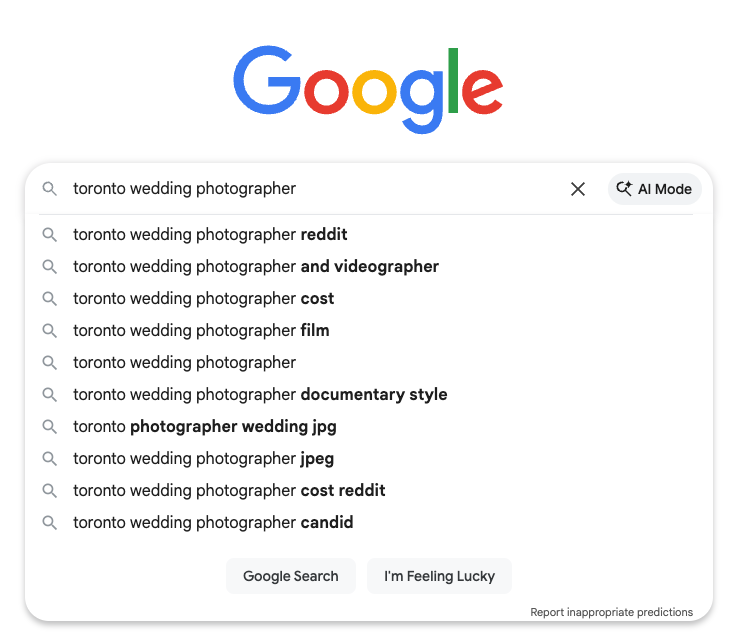
Google autocomplete and related searches are free, real-time, and reflect what people in your market are actually typing. Search your main service + city and read every autocomplete suggestion. Scroll to the bottom of the results page and read the related searches. Screenshot everything.
Google Search Console is the other underused free tool. If your site has any history, log in and look at the Queries report. You’ll see keywords Google already associates with your site – sometimes at position 30 or 40. Those are low-hanging fruit. Improve the content on the relevant page and those rankings can move quickly.
Step 3: Run Competitor Research
Pick the top 2-3 photographers ranking in your city for your primary service. Run their URLs through a tool like Ahrefs or Semrush (both have free tiers) and look at their top organic keywords.
You’re not looking to copy them. You’re looking to find the terms they’re winning on so you can build better content for the same keywords – and find the gaps they’ve missed.
Step 4: Validate Volume and Difficulty
Once you have a list of candidate keywords, you need to sanity-check volume and difficulty. National volume numbers are directionally useful but don’t tell you what’s actually being searched in your city.
For local keyword research, the most useful approach is to filter any tool you’re using to your specific metro area, or look at Google Keyword Planner with your city as the target location. The numbers will be lower than national averages, but they’ll be real.
Keyword Research Tools Worth Using
| Tool | Cost | Best For |
| Google Search Console | Free | Understanding what you already rank for |
| Google Keyword Planner | Free (needs Ads account) | Volume estimates by location |
| Ahrefs Webmaster Tools | Free (your own site only) | Keyword gaps and competitor research |
| Semrush Free Tier | Free (limited) | Competitor keyword analysis |
| Ahrefs or Semrush (paid) | $99-$129+/month | Full keyword research and tracking |
| Keywords Everywhere | ~$15/year | Quick volume data while browsing |
Blog Keyword Ideas for Photographers
Blog content isn’t filler. It’s how you build the topical authority that makes your service pages rank better – and it catches clients at every stage of the research process, not just when they’re ready to book.
Here are the keyword categories worth building out, with real examples.
Cost and Pricing Searches
People researching what things cost are real buyers. They’re not DIYers – they’re trying to set expectations before they call. These are high-value searches worth targeting with specific, honest content.
| Keyword | Est. Monthly Volume |
| how much does a wedding photographer cost | 22,200 |
| wedding photography prices | 12,100 |
| how much do photographers charge | 9,900 |
| photography session cost | 5,400 |
| headshot photography cost | 4,400 |
| newborn photo session cost | 3,600 |
| real estate photography pricing | 3,600 |
| family portrait photography cost | 2,900 |
Write these as honest guides with real price ranges. Vague hedging like ‘it depends’ doesn’t satisfy the searcher and doesn’t rank. A post that says ‘wedding photographers in Toronto typically charge between $2,500 and $7,000, and here’s what drives the difference’ is useful and rankable.
“What to Expect” and Prep Searches
These are high-volume, low-competition, and capture clients who are in the process of booking – just trying to prepare.
| Keyword | Est. Monthly Volume |
| what to wear for family photos | 18,100 |
| what to wear for engagement photos | 12,100 |
| how to prepare for a photoshoot | 8,100 |
| what to wear for headshots | 6,600 |
| what to wear for newborn photos | 4,400 |
| how long does a newborn session take | 2,900 |
| how many photos from a wedding photographer | 5,400 |
| when to book a wedding photographer | 3,600 |
These posts do double duty: they help your existing clients prepare, and they attract new ones who are clearly in the planning stage of booking exactly the service you offer.
Comparison and Style Searches
Comparison keywords attract people who are narrowing down their options. These searchers are close to a decision.
| Keyword | Est. Monthly Volume |
| film vs digital wedding photography | 4,400 |
| documentary vs traditional wedding photos | 2,900 |
| indoor vs outdoor family photos | 2,400 |
| studio vs location headshots | 1,900 |
| candid vs posed photography | 2,400 |
| drone vs traditional real estate photos | 1,600 |
Location and Venue Blog Content
This category is criminally underused. Writing about specific venues, parks, or neighborhoods where you shoot creates pages that:
- Have very low competition (few photographers write this content)
- Rank locally without needing significant link authority
- Target couples and families already researching those specific places
- Build internal links to your main service pages naturally
Examples: “Best places for family photos in Toronto,” “A guide to engagement photos at Scarborough Bluffs,” “What to expect when you get married at Casa Loma.”
Write one for every venue or location you shoot regularly. This strategy compounds over time.
How to Use These Keywords on Your Photography Website
Having the right keywords is one thing. Getting them onto your pages correctly is another. This is where most photography websites leave points on the table – not because they’re missing the keywords, but because they’ve placed them wrong.
Match Keywords to the Right Page Type
Every keyword needs a home – and the wrong home is worse than no home at all.
| Page Type | Keywords That Belong Here |
| Homepage | Your city + your primary service (e.g., “Toronto wedding photographer”) |
| Service pages | One service per page – wedding, portrait, headshots, real estate (not combined) |
| Location pages | One page per city or neighborhood you serve |
| Blog posts | Educational, cost, comparison, and prep-related searches |
| About page | Your name, secondary city terms, and brand-level queries |
The On-Page Basics
For each page, the keyword needs to appear in these places to signal relevance to Google:
- Title tag. The most important element. ‘Toronto Wedding Photographer | [Studio Name]’ is exactly right. ‘Home’ or just your studio name is exactly wrong.
- H1 heading. One per page. Should match or closely mirror your title tag keyword.
- First 100 words. Mention the keyword naturally early. Don’t force it, but don’t bury it either.
- Image file names and alt text. “toronto-wedding-photographer-bride-groom.jpg” beats “IMG_2045.jpg” in every way that matters for SEO.
- Meta description. Doesn’t directly affect ranking, but it does affect click-through rate. Write for the human, not the algorithm.
- URL. Keep it clean and keyword-focused. /toronto-wedding-photographer/ not /services-page-1/.
Internal Linking: The Glue Between Your Pages
Photography sites often have the right content but no connective tissue between pages. A blog post on session prep has no link to your booking page. A location page has no link to your pricing. Each page is an island.
Fix this by asking one question for every piece of content you publish: where does a reader go next if they want to take action? Link there. Blog posts earn their keep partly through the authority they pass to service pages – don’t let that go to waste.
Site Structure That Makes Sense
Here’s what this looks like when it’s built correctly for a photographer serving a few cities:
- /services/wedding-photography/
- /services/portrait-photography/
- /services/headshot-photography/
- /services/newborn-photography/
- /services/real-estate-photography/
- /locations/toronto/
- /locations/mississauga/
- /locations/oakville/
- /blog/how-much-does-a-wedding-photographer-cost/
- /blog/what-to-wear-for-family-photos/
- /blog/engagement-photos-toronto/
Resist the urge to build everything in month one. The photographers who see results fastest are the ones who build three or four pages properly – correct keyword targeting, real content, solid on-page execution – and then expand from there. A handful of strong pages beats a site full of thin ones.
If you want to understand how to forecast what that kind of build translates to in traffic and revenue over time, we mapped it out in our guide on how to forecast SEO growth.
What Doing This Well Requires
Most photographers who try to build this out themselves stall in the same place: it’s not one skill, it’s five. Keyword research, content strategy, technical SEO, local signals, and consistent execution. Any one of those is learnable. All five at once, while also running a photography business, is where things break down.
| What It Takes | What That Means in Practice |
| Keyword research | Local volume data, competitor gaps, intent mapping – not just a generic list |
| Page-level execution | Right title tags, H1s, copy, and CTAs on every service and location page |
| Content volume | 20+ posts covering pricing, prep, venues, comparisons – built over time |
| Local SEO signals | Google Business Profile, consistent citations, local link building |
| Technical foundation | Clean URL structure, schema markup, fast load times, proper crawlability |
Photography SEO is a slow build that accelerates. Month three looks nothing like month twelve if you’re doing it right. The sites that dominate local search didn’t get there in a sprint – they built steadily and let the compounding do its job.
For context on how this structural thinking applies across service businesses, our post on the best SEO keywords for roofers covers the same page-matching and local layering approach in a different niche.
For most photography studios, the honest bottleneck isn’t knowledge – it’s bandwidth. Running shoots, editing, client communication, and business development leaves very little room for an ongoing SEO operation. That’s not a knock; it’s just a real constraint that an agency is better positioned to absorb.
| Ready to Skip the Learning Curve?
If you’d rather put this time toward shooting and running your business, LYNX handles exactly this kind of work – keyword research, content strategy, page-level execution, and local SEO for photographers who want to dominate their market. Get in touch at lynxseo.com. |