
Quick Answer: Canadian cannabis and hemp brands cannot run paid ads on Google, Meta, or most major platforms due to Cannabis Act restrictions. SEO, educational content, and local search remain the main legal digital channels, but AI visibility now also requires clean compliant content, strong brand entity signals, and third-party citations from authoritative sources.
If you run a licensed cannabis or hemp brand in Canada, you already know the marketing situation is rough. No Google Ads. No Meta campaigns. Billboard restrictions. Influencer marketing is off the table. Event sponsorships are out. And if you try to get creative around any of it, you risk a fine – Ghost Drops, one of the most recognizable cannabis brands in Ontario, was hit with a $250,000 penalty by Health Canada in 2025 for marketing violations. The first penalty of its kind issued under the Cannabis Act.
So the question most Canadian cannabis and hemp operators keep coming back to is: where exactly can we build visibility?
SEO has always been the answer – and it still is. But the rules of the game are shifting in ways that most cannabis brands haven’t fully caught up to.
Google is no longer just a list of blue links. AI Overviews now dominate many search results pages, and LLMs like ChatGPT and Perplexity are where a growing share of consumers go to research products. For regulated industries like cannabis, those AI systems are running a second layer of content filtering that your organic rankings alone can’t get around.
This article breaks down what’s actually allowed under the Cannabis Act and ACMPR framework, where SEO still works, and how Canadian cannabis and hemp brands can start building AI search visibility in a space where most of your competitors still don’t know this problem exists.
Key Takeaways
- The Cannabis Act and Health Canada regulations prohibit almost all traditional advertising for cannabis brands in Canada, making SEO the primary growth channel
- Traditional SEO is necessary but no longer sufficient – LLM safety filters suppress cannabis content in AI Overviews and chatbot answers even when pages rank well organically
- Gartner projected a 25% drop in traditional search traffic by 2026 as users shift to AI agents; cannabis brands are experiencing this shift more acutely than other industries
- Educational content built for topical authority – not just keyword targeting – is the foundation of both Google rankings and AI citations in this space
- Third-party citations in authoritative publications increase AI citation rates significantly compared to publishing exclusively on owned properties
- Consistent brand entity signals across every digital touchpoint directly affect LLM citation likelihood
- Local SEO, Google Business Profile optimization, and schema markup are underutilized by most Canadian cannabis operators
- Hemp brands in Canada face a distinct regulatory environment from US hemp brands, and most US-focused cannabis SEO advice does not apply directly
What the Cannabis Act Actually Prohibits for Digital Marketing
Before getting into strategy, it’s worth being specific about the regulatory environment – because a lot of Canadian cannabis brands are operating with a fuzzy understanding of where the lines are.
Canada legalized recreational cannabis federally in 2018 under the Cannabis Act (Bill C-45). What came with legalization was one of the strictest advertising frameworks for any legal product in Canadian history – stricter in many respects than the rules governing tobacco or alcohol.
Under sections 17 through 24 of the Cannabis Act, promotion of cannabis, cannabis accessories, and cannabis-related services is generally prohibited except in specific, tightly defined circumstances. The goal of the framework is to prevent promotion from appealing to young people or encouraging use – and Health Canada has made clear it takes enforcement seriously.
Here is what is specifically prohibited or heavily restricted:
- TV commercials, billboards, and glossy magazine ads
- Sponsorships of events or cultural venues
- Influencer marketing and testimonials
- Lifestyle imagery that associates cannabis with excitement, success, or social desirability
- Health claims of any kind, including vague wellness language
- Advertising to anyone under the legal age in any province
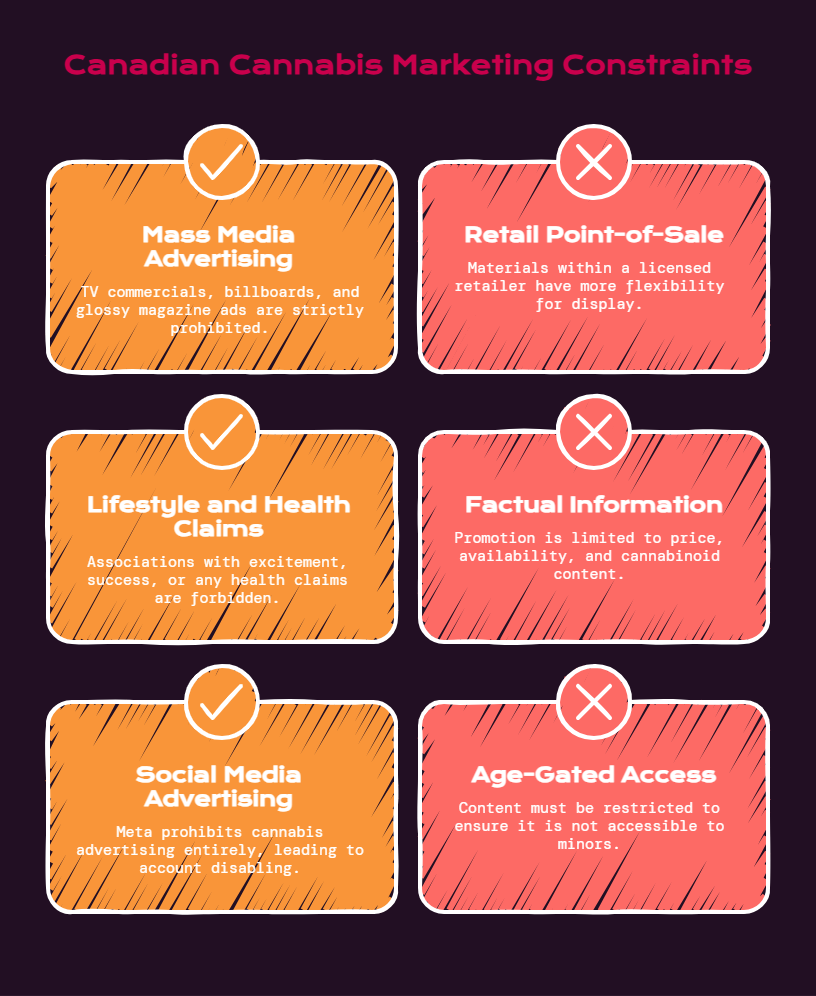
What is permitted is narrower: factual, informational promotion (price, availability, cannabinoid content) that is age-gated and not accessible to minors. Brand elements can appear on merchandise or signage under specific conditions. Point-of-sale materials within a licensed retailer have more flexibility.
Google and Meta enforce their own policies on top of Canadian law – and their policies are stricter. Meta prohibits cannabis advertising entirely for Canadian brands; attempts to run campaigns often result in account flags or permanent disabling. Google restricts cannabis ads even for Canadian licensed producers, though there have been some signals around a potential Canadian pilot for certain adjacent categories.
The practical result: nearly every paid digital channel that other industries take for granted is closed to Canadian cannabis brands.
How Hemp Brands Differ Under the Industrial Hemp Regulations
Hemp brands in Canada operate under the Industrial Hemp Regulations (IHR), which exist alongside the Cannabis Act. The regulatory distinction matters for marketing because hemp grain derivatives (hemp seed oil, hemp protein, hemp seed) that meet specific THC thresholds are largely exempt from the most restrictive cannabis promotion rules. These products can be positioned as food or natural health products in ways that standard cannabis cannot.
However, hemp brands trying to market CBD products run into a different set of restrictions. CBD is classified as a cannabis extract under the Cannabis Act, meaning full cannabis promotion restrictions apply.
The YMYL problem in AI search applies equally to hemp CBD brands as it does to THC cannabis brands. The 2025 regulatory amendments from Health Canada provided some relief on packaging and labeling compliance, but did not change the fundamental marketing restrictions in any meaningful way for most operators.
Why SEO Is the Most Powerful Legal Marketing Channel for Canadian Cannabis Brands
Given what’s off the table, organic search becomes the default growth channel. And there’s a real structural advantage here that isn’t obvious until you look at the competitive landscape.
Most cannabis and hemp brands have avoided content marketing because of legal uncertainty. They don’t publish much. They don’t earn many links. They don’t build topical authority around strain education, cannabinoid science, or regulatory guidance. The result is that keyword competition in this space is often surprisingly low relative to search demand – there is still meaningful ground to take for brands willing to do the work.
The compliant content categories that drive organic traffic include:
- Strain and product education: Factual descriptions of cannabinoid profiles, terpenes, effects, and product formats (no health claims, no lifestyle framing)
- Regulatory and legal guidance: Province-by-province purchasing rules, age restrictions, possession limits, traveling with cannabis
- Responsible use content: Dosing guidance for new users, onset time differences between formats, interactions to be aware of
- Industry and business content: LP licensing, retail compliance, Health Canada processes (targets B2B audiences and earns professional links)
- Local dispensary content: Store information, hours, available formats, neighborhood context
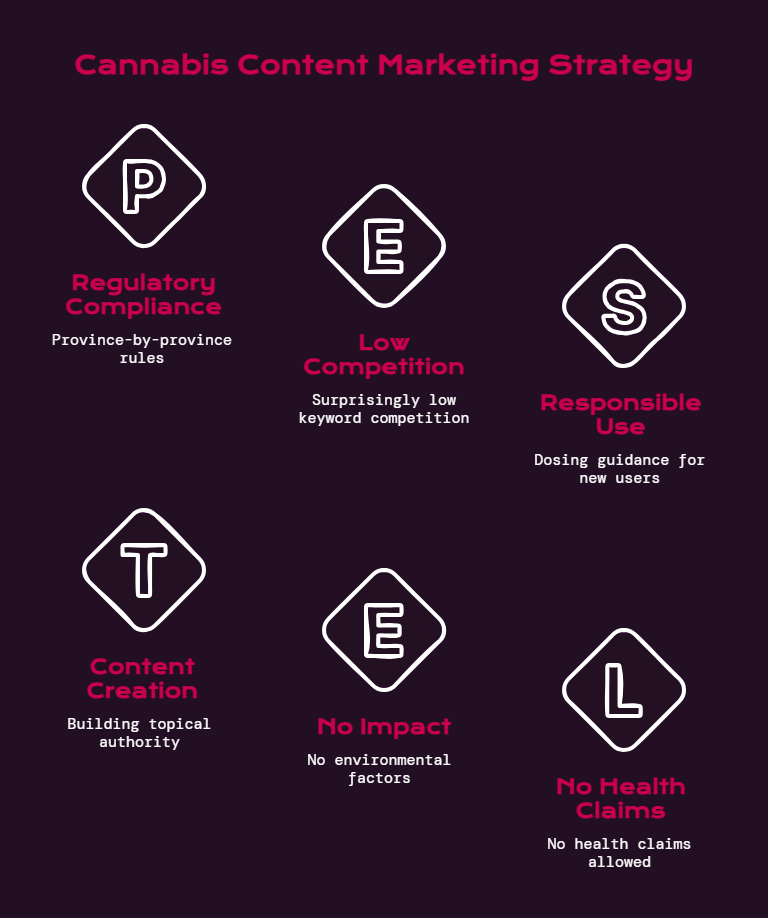
Each of these content types serves real search intent without running into promotion restrictions. And when you build enough of it with enough consistency and depth, you start building topical authority that competitors who have been sitting on static product pages simply don’t have.
Canadian Cannabis SEO vs. Dispensary SEO: A Comparison
The SEO priorities differ depending on what kind of cannabis business you’re running. The table below maps the key differences:
| Business Type | Primary SEO Goal | Key Content Types | Critical Technical Elements |
| Licensed Producer (LP) | Brand entity, wholesale leads, trade press | Strain guides, cultivation content, compliance resources | Organization schema, author markup, technical site health |
| Retail Dispensary | Local pack rankings, foot traffic, online orders | Location pages, store guides, product education | Google Business Profile, LocalBusiness schema, NAP consistency |
| Hemp / CBD Brand | Organic traffic, AI citations, product trust | Educational content, ingredient explainers, lab data | Entity consistency, FAQ schema, third-party citations |
| Cannabis Accessory Retailer | Product visibility, purchase intent | Product comparisons, how-to guides, brand pages | Product schema, ecommerce technical SEO, review markup |
The AI Search Problem Canadian Cannabis Brands Are Not Talking About
Here is the part of the story that most cannabis SEO resources are missing.
Gartner projected that traditional search engine traffic would drop 25% by 2026 as users shift to AI agents and chatbots. That shift is already showing up in analytics across multiple industries. For cannabis brands, it is hitting harder than almost anywhere else.
The mechanism is specific. LLMs – the models behind ChatGPT, Google’s AI Overviews, Perplexity, and Gemini – apply YMYL (Your Money or Your Life) safety filters to content that could affect a person’s health or safety. Cannabis content, even for fully legal, Health Canada-authorized products, gets classified in this tier.
The same safety logic that governs pharmaceutical information and financial advice is being applied to strain guides and dispensary recommendations.
The practical result: a cannabis brand can hold a solid first-page ranking for multiple target keywords and still not appear in AI-generated answers for those same queries. The traditional SEO layer is working; the AI citation layer is not.
For cannabis brands, this means Google’s AI Overviews are using safety filters that exclude content, resulting in brand-free or hedged answers even when search results show licensed retailers prominently.
With zero-click searches now happening in the majority of AI-triggered queries – where users get their answer inside the AI summary without ever clicking through to a website – the stakes of being excluded from AI-generated answers are higher than most cannabis brands realize.
This compounds a problem that already existed. Paid ads are blocked. Social reach is unreliable and restricted. And now the organic and AI channels that were supposed to be the durable alternative are running additional filters that most of the industry hasn’t figured out how to work with.
The brands that are getting cited in AI answers have figured out something specific: this isn’t just a standard SEO problem. It requires building a different kind of digital presence – one focused on entity clarity, third-party validation, and content structure that AI systems can extract and reference with confidence.
Our more detailed breakdown of this mechanism for hemp brands specifically covers the full picture: Hemp Brand SEO: Why You’re Invisible in AI Search.
How Canadian Cannabis and Hemp Brands Build AI Visibility
Building AI visibility in a YMYL-restricted category requires being deliberate about three things: what you publish, where it lives beyond your own site, and how your brand is understood as an entity across the web. These are not three separate workstreams. They work together.
1. Compliant Educational Content Built for Citation
The content that gets cited by AI systems in regulated industries is content that reads like a reference document, not marketing copy. Factual, structured, specific, and clearly authored.
This aligns well with what Cannabis Act compliance already requires. You cannot make health claims. You cannot write lifestyle copy. You have to be informational. Those constraints, frustrating as they are for brand expression, actually push you toward exactly the format that AI systems prefer to cite.
What works:
- Direct answer structures: Open every article, section, and key concept with a clear, direct answer. AI systems extract specific passages – if your answer is buried under four paragraphs of preamble, it won’t get pulled. The core principle of effective GEO (Generative Engine Optimization) is structuring content with direct answers in the first 40-60 words of each section, with fact density throughout
- Precise, verifiable claims: LLMs prefer content they can cross-reference. THC concentrations, onset times, Health Canada license numbers, regulatory citations – specific, verifiable detail is exactly what gets cited. Vague wellness language gets filtered
- FAQ schema markup: FAQ markup allows AI systems to extract question-and-answer pairs directly, making your content significantly easier to cite in both Google AI Overviews and standalone LLM responses
- Expert bylines with real credentials: Author markup matters in YMYL. An article authored by a named person with a verifiable professional background – a Health Canada-licensed practitioner, a compliance specialist, an industry researcher – carries a different trust signal than an anonymous “Editorial Team”
- Lab data and compliance documentation: For hemp brands, publishing Certificates of Analysis (COAs), explaining cannabinoid ratios explicitly, and documenting testing methodology gives AI systems exactly the kind of verifiable, entity-dense content that gets cited. Compliance becomes an SEO asset when it’s structured correctly
Content quality matters here in a way it doesn’t always in other verticals. For more on building blog content that actually adds informational value for AI systems, see our breakdown on how to add value to AI blog content.

2. Brand Entity Consistency Across Every Digital Touchpoint
LLMs don’t rank pages. They build what amounts to a probabilistic model of what your brand is and what it’s known for, based on patterns in how you’re described across the web.
When those descriptions are consistent – same company name, same product terminology, same positioning – the model can reference your brand reliably. When they’re inconsistent, it defaults to brands it understands more clearly.
Brands with inconsistent entity information across their digital properties see 2.8 times lower citation rates in AI-generated answers than brands with a consistent entity stack.
For cannabis brands, inconsistency usually happens for understandable reasons. Compliance language differs between provinces, so product descriptions get adjusted for different markets. Retail partner listings use different framing than the direct-to-consumer site.
The press kit from 18 months ago uses different terminology than the current packaging. Marketing teams rotate between “hemp-derived CBD,” “cannabis oil,” and “full-spectrum extract” depending on the context.
From an AI entity standpoint, this fragmentation is costly. The model encounters multiple, conflicting descriptions of the same brand and can’t build a clear, citable entity profile.
The practical fix is to define your brand entity explicitly and maintain it consistently:
- Exact company name and licensed producer name (as registered with Health Canada) used uniformly across every platform
- A consistent one-paragraph brand description that appears on your site, Google Business Profile, trade directory listings, Weedmaps and Leafly profiles, and any press coverage you can influence
- Consistent product terminology locked to whatever language appears on your Health Canada-approved labeling
- Organization schema markup on your website that explicitly defines your entity – name, address, license information, founding date, founders
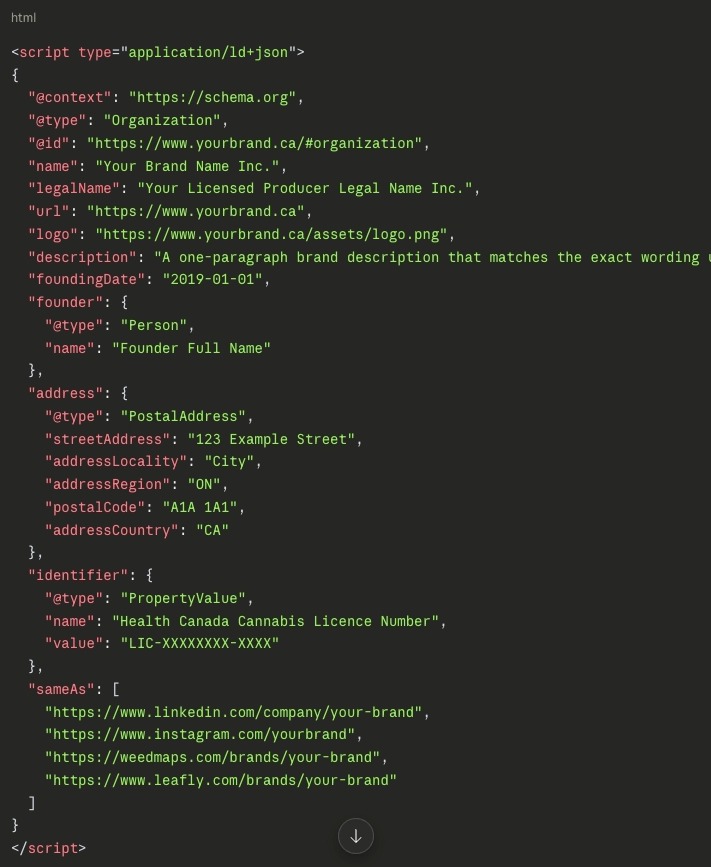
Schema markup tells AI and search engines exactly what your content means, anchoring your brand entity in a machine-readable format that AI systems can use when they encounter your brand across different sources.
Consistent entity signals across your website, GBP, industry directories, and third-party coverage compound over time into a brand entity that AI systems recognize as authoritative.
3. Third-Party Citations in Authoritative Publications
This is the piece that most cannabis brands are not doing and that makes the biggest difference in AI visibility.
Distributing content to a wide range of authoritative publications increases AI citation rates by up to 325% compared to publishing exclusively on owned properties. That is not a marginal improvement.
For brands in YMYL categories specifically, the trust profile of the domain where content lives affects whether AI systems will cite it. A hemp brand’s own website, however well-optimized, carries a lower default trust signal than an article about that brand published in an established trade publication.
The Canadian cannabis trade press is more limited than the US market – but it exists:
- StratCann: The strongest independent Canadian cannabis trade publication. A mention, interview, or contributed article here carries real weight
- Cannabis Counsel / Cannabis & Tech Today: Industry resources that get indexed and referenced
- MJ Biz Daily / Marijuana Business Magazine: US-focused but highly authoritative; Canadian LPs and brands regularly appear here
- Cannabis Business Times: Similar reach and authority
Beyond cannabis-specific press, cannabis brands can also earn citations in:
- General business and entrepreneurship publications covering the Canadian cannabis sector
- Retail industry publications covering the dispensary market
- Health and wellness publications (for hemp/CBD, with careful compliance attention to health claim restrictions)
- Academic and policy research that cites industry data
The strategy is to become the cited source for specific, well-defined topics – not to try to appear everywhere. If you are a licensed producer in British Columbia, becoming the go-to cited source for BC outdoor cultivation practices is more achievable and more valuable than trying to compete on “Canadian cannabis” broadly.
Dispensary SEO Canada: What Local Cannabis Brands Need to Do Differently
For retail dispensaries in Canada, the SEO picture has some specific elements that differ from the LP and hemp brand strategies above.
Google Business Profile Optimization
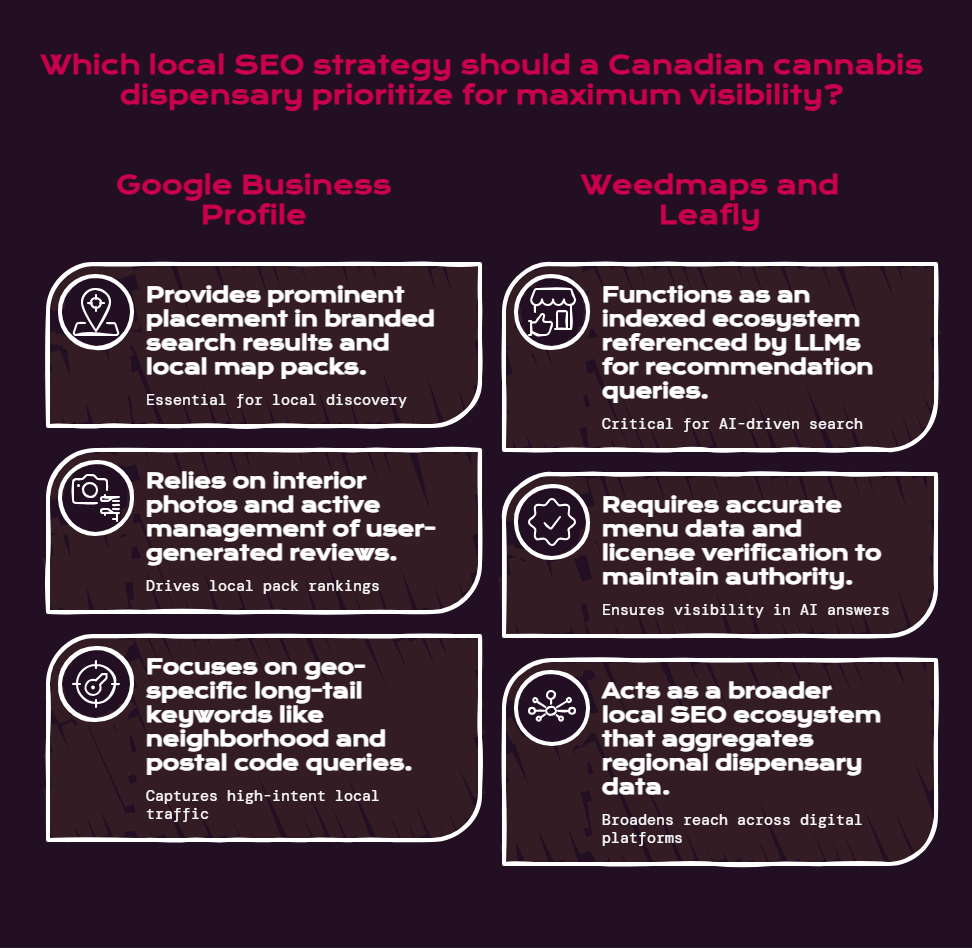
Google allows cannabis dispensary listings in Canadian markets. This is one of the few places where cannabis brands can show up prominently in branded search without running into platform restrictions. Maintaining a complete, accurate Google Business Profile with current hours, address, and interior photos is foundational for dispensary SEO Canada.
Product imagery is permitted within GBP to a degree – display photos of your retail environment are generally allowed. User-generated reviews are permitted in this context and are one of the strongest signals for local pack rankings. Actively managing your review profile matters.

Location Pages and Local Keyword Architecture
A dispensary in Toronto is not just competing for “cannabis dispensary” – it’s competing for “dispensary near [neighborhood],” “weed delivery [postal code],” “cannabis store open now [area].” These long-tail, geo-specific queries convert at a much higher rate than broad terms, and the competition is far lower.
Build dedicated location pages with real neighborhood content – not just a page title with a city name and a map embed. What is the local area like? What types of consumers does your store serve? What formats are most popular in this market? Content that answers real questions about the specific local experience outperforms thin location pages every time.
Weedmaps and Leafly Profiles
These platforms function as local SEO ecosystems for cannabis retail. Your Weedmaps and Leafly profiles are indexed by Google and referenced by LLMs when answering dispensary recommendation queries. An incomplete, outdated Weedmaps listing is invisible in AI answers. A complete, current listing with accurate menu data and positive user-generated reviews carries meaningful authority.
LocalBusiness Schema Markup
Schema markup for dispensaries should include LocalBusiness type (or more specifically, the relevant subtype), complete address and operating hours, license information, and where applicable, geo-coordinates. Including your Health Canada license number in your schema data and on your website creates a verifiable trust signal that AI systems can use when building citations for local cannabis queries.
Compliant Social Media Strategy for Canadian Hemp Digital Marketing
Organic social is where Canadian cannabis brands have the most flexibility – but the Cannabis Act still applies to everything you post, and platform policies add another layer on top.
The key rules for organic social presence:
- Age-gating: Where platforms allow it, enable age restrictions on your account
- Factual and educational content only: No lifestyle imagery that presents cannabis as aspirational, exciting, or tied to a positive emotional state. No testimonials. No before-and-after framing
- No consumption imagery that associates cannabis with positive effects: The regulatory language around this is genuinely ambiguous – be conservative
- No influencer campaigns: Testimonials and endorsements from any person who could influence consumer behavior are prohibited
What tends to work on social for compliant Canadian cannabis brands:
- Behind-the-scenes production and cultivation content (process-focused, not product-promotional)
- Regulatory education and compliance updates
- Employee stories that humanize the brand without promoting products
- Industry news and policy discussion
- Community involvement where the connection to cannabis is incidental rather than promotional
Meta’s advertising policies prohibit cannabis advertising entirely for Canadian brands, and even organic content on Instagram and TikTok gets flagged and removed regardless of whether it complies with Canadian law – the platforms’ own policies are stricter than the regulation in most cases.
For hemp brands with products that qualify as natural health products under the IHR, there is somewhat more flexibility on platforms like Pinterest, where CBD content with appropriate disclaimers has historically had more tolerance. This is not a permanent policy position from any platform and needs to be monitored.
SEO for Licensed Cannabis Producers: Building B2B Authority
For Licensed Producers (LPs) whose primary marketing goal is B2B relationships – wholesale, provincial distribution, retail partnerships, investment community visibility – the SEO strategy looks different from retail dispensary or DTC hemp brand work.
The target audience is procurement teams at provincial retailers, dispensary buyers, institutional investors, and trade journalists. They’re searching for things like:
- “[Province] cannabis wholesale supplier”
- “Canadian LP [product category] supplier”
- Cannabis industry regulatory updates and compliance resources
- LP comparison and due diligence content
Building authority in this space means publishing content that serves professional audiences: cultivation methodology, quality assurance processes, regulatory compliance documentation, provincial distribution capabilities.
This content earns links from trade publications, gets referenced by cannabis business journalists, and gets cited by AI systems when sourcing cannabis industry information.
This is also the space where ACMPR brand marketing restrictions are least constraining – B2B information sharing and educational trade content falls more comfortably within what’s permitted than consumer-facing promotion.
Key SEO Tactics for Canadian Cannabis Brand Content Strategy
The table below maps the core tactical elements of a Canadian cannabis SEO strategy to their primary purpose and compliance status:
| Tactic | Primary Purpose | Compliant Under Cannabis Act | AI Visibility Impact |
| Educational blog content (strain guides, format education) | Organic traffic, topical authority | Yes – factual/informational content is explicitly permitted | High – structured educational content is the primary AI citation surface |
| FAQ schema markup | Featured snippets, AI Overviews | Yes | High – allows AI to extract Q&A pairs directly |
| Google Business Profile optimization | Local pack rankings, map visibility | Yes | Medium – LLMs use GBP data for local queries |
| Organization schema with license data | Entity trust signals | Yes | High – machine-readable brand entity data |
| Third-party trade press citations | Domain authority, AI citation trust | Yes – press coverage is not promotion | Very High – the most impactful AI visibility lever |
| Weedmaps / Leafly profile optimization | Local cannabis directory presence | Yes | Medium – aggregators surface in AI local answers |
| User-generated reviews (managed) | Conversion trust, local SEO | Yes – user reviews are not brand promotion | Medium – review signals support GBP and local rankings |
| Health claims or lifestyle promotion | N/A | No – explicitly prohibited | N/A |
| Influencer campaigns | N/A | No – testimonials are prohibited | N/A |
The Cannabis Brand Content Strategy That Builds Long-Term AI Visibility
The brands that will win in Canadian cannabis AI search over the next few years are not going to be the ones with the most content. They’re going to be the ones whose content is most trusted by AI systems – which means most clearly structured, most consistently attributed to a verified brand entity, and most widely cited across authoritative external sources.
That’s a longer game than most marketing teams are used to playing. But in a space where the fast paths are all closed, the slow path is also the only path.
A few things worth building toward specifically:
Original Research and Industry Data. Cannabis brands that publish their own lab testing data, consumer research, or cultivation yield data become reference sources. Primary research and proprietary data are among the content types most likely to be cited by AI systems and to be referenced by trade journalists.
A dispensary chain that publishes quarterly data on consumer purchasing patterns in their market has something genuinely citable that no generic cannabis blog can replicate.
Topical Clusters, Not Individual Posts. A single strain guide doesn’t build topical authority. A library of 30 interlinked strain guides, product format explainers, cannabinoid science articles, and regulatory guides does.
AI systems build their understanding of a brand’s authority from patterns across multiple documents, not from any single piece of content. Build content clusters around specific topics your brand can genuinely own.
Content That Lives Beyond Your Website. This is worth repeating. A great piece of content that only exists on your own domain is significantly less likely to be cited by AI than the same content described and linked to from established cannabis trade publications, provincial business directories, and industry associations like the Cannabis Council of Canada.
When building out your content strategy, it’s also worth thinking about how to use social platforms to amplify content that already exists on your site. Our guide on viral SEO keywords for Instagram covers how to use Instagram to build awareness of compliant educational content without crossing into promotion – a tactic cannabis brands can adapt within the spirit of what the Cannabis Act allows.
And if your site has been through a redesign, or if you’re planning one – restructuring your site architecture can have a significant impact on both technical SEO and AI crawlability. Read our guide on how to redesign a website without losing SEO before making any structural changes to your current setup.
Monitoring Whether AI Is Citing Your Canadian Cannabis Brand
Most cannabis brands have no idea whether they’re being cited in AI answers or not. There’s no Google Search Console for LLM citations – at least not yet. But you can build a basic monitoring system manually.
Build a list of 30-50 queries that your target audience would use to find information about your category. Include:
- Brand name queries (“Is [Brand] a licensed producer in Canada?”)
- Category queries (“best dispensary in [city]”)
- Product queries (“CBD oil brands Canada”)
- Regulatory queries your brand could reasonably be cited for
Run these queries weekly across ChatGPT, Perplexity, Google AI Overviews, and Gemini. Record whether your brand appears, whether a source link points to your domain, and which competitors are being cited in the answers where you’re absent.
If your brand appears in brand-name queries but not in category-level queries, you have an entity clarity problem – the AI knows who you are but doesn’t understand your authority in your category. If your brand doesn’t appear even in brand-name queries, you have a fundamental citation profile problem.
This kind of audit is worth doing before investing in any content production, because it tells you whether the problem is content structure, entity consistency, third-party citations, or something technical on the indexing side. The strategic fix is different depending on what the audit reveals.
Conclusion
Canadian cannabis and hemp brands are operating with one of the most restricted digital marketing toolkits of any legal industry. What’s left – organic search, educational content, local SEO, and now AI visibility – is worth protecting and investing in seriously, because it compounds in ways that paid channels never do.
The strategic picture for 2026 and beyond: SEO is still the most powerful legal marketing channel available to Canadian cannabis brands. But traditional SEO – ranking pages on Google for target keywords – is increasingly insufficient on its own.
AI search is restructuring who gets seen, and cannabis brands face an additional YMYL suppression layer that requires a deliberate response. The response isn’t complicated, but it takes discipline: compliant educational content built with citation-ready structure, brand entity signals maintained consistently across every digital touchpoint, and third-party mentions in publications that AI systems already treat as authoritative.
The brands building this infrastructure now are building a durable competitive advantage. Most of their competitors aren’t thinking about any of it yet.
If you’re a Canadian cannabis or hemp brand trying to build serious organic and AI visibility in a compliance-constrained market, this is exactly the kind of work we do at LYNX SEO. We’ve worked with brands in cannabis, SaaS, automotive, finance, and other high-restriction verticals – and we know what it takes to build search authority when the standard playbook isn’t available to you. Get in touch if you want to talk through where your brand stands.
Frequently Asked Questions
What Is Canadian Cannabis SEO and Why Is It Different From Regular SEO?
Canadian cannabis SEO is the practice of optimizing a cannabis brand’s digital presence for organic search visibility under the restrictions imposed by the Cannabis Act, Health Canada’s promotion prohibitions, and provincial regulations.
It differs from standard SEO in two important ways. First, the content strategy must avoid health claims, lifestyle promotion, testimonials, and anything that could be considered advertising under the Act. Second, the industry’s YMYL classification means cannabis content faces additional suppression in AI-generated search results even when traditional rankings are strong. A Canadian cannabis SEO strategy has to account for both layers.
What Digital Marketing Is Allowed for Canadian Hemp Brands Under ACMPR and the Cannabis Act?
The ACMPR framework historically governed medical cannabis access, while current marketing restrictions fall primarily under the Cannabis Act and its promotion regulations.
For hemp brands, the allowed digital marketing activities include: organic search engine optimization, educational content marketing (strain guides, regulatory explainers, cannabinoid education), local SEO and Google Business Profile management, organic social media posting that is factual and educational rather than promotional, email marketing to opted-in subscribers, and Weedmaps and Leafly profile management.
Paid advertising on Google, Meta, and most major platforms is prohibited or practically inaccessible. Health claims of any kind are prohibited. Influencer campaigns and testimonials are prohibited.
Why Can’t Canadian Cannabis Brands Run Ads and What Else Works Instead?
The Cannabis Act explicitly prohibits promotion that uses endorsements, testimonials, lifestyle imagery, or any content that could appeal to young people or encourage cannabis use beyond informed adult decision-making. Google and Meta apply their own policies that are stricter than Canadian law, effectively blocking paid advertising for recreational cannabis regardless of Canadian legality.
What works instead is organic search – SEO built around educational, factual content that earns traffic without relying on paid placement. For dispensaries, local SEO and Google Business Profile optimization are critical. For LPs and hemp brands, content marketing that earns third-party coverage and builds topical authority is the primary long-term channel.
How Do Canadian Cannabis Brands Build AI Search Visibility for LLMs Like ChatGPT and Perplexity?
AI visibility for Canadian cannabis brands requires a three-part approach.
First, publish educational content with direct-answer structure, FAQ schema markup, and specific verifiable claims that AI systems can extract and cite. Second, maintain consistent brand entity signals across your website, Google Business Profile, trade directory listings, and any external coverage – inconsistency in how your brand is described reduces AI citation rates significantly.
Third, build third-party mentions in authoritative cannabis trade publications, which dramatically increases the likelihood of AI citation compared to publishing exclusively on owned properties. The YMYL safety filter can be partially offset by building the kind of trust signals (verified authorship, external citations, license documentation) that AI systems use to evaluate credibility.
What Is the Best SEO Agency for Canadian Cannabis Companies?
The best agency for Canadian cannabis SEO has specific experience with Health Canada’s promotion regulations and understands both the compliance constraints and the AI visibility challenge unique to this industry. Look for an agency that can demonstrate actual results in regulated industries, not just general SEO case studies.
They should understand the difference between LP/wholesale SEO, retail dispensary local SEO, and hemp brand DTC content strategy – these require meaningfully different approaches. At LYNX SEO, we’ve worked across cannabis, automotive, finance, SaaS, and other verticals where compliance constraints shape the marketing strategy. We’re a Canadian agency based in Ontario with direct experience in this market.
Is SEO Legal for Canadian Cannabis Businesses?
Yes – organic SEO is legal for Canadian cannabis businesses. Health Canada’s promotion restrictions target advertising and promotional content, not organic search visibility.
Educational content that is factual, age-gated where appropriate, and does not make health claims or use promotional language falls within what the Cannabis Act permits. The key is that the content itself must comply: no health claims, no lifestyle promotion, no testimonials, no content designed to appeal to minors.
When those conditions are met, SEO is not just legal – it is one of the very few high-impact marketing channels available to the industry.
How Does Dispensary SEO in Canada Differ From Province to Province?
Provincial cannabis regulations vary significantly. Ontario’s retail market is governed by the AGCO (Alcohol and Gaming Commission of Ontario) with additional municipal-level variation across its 444 municipalities. British Columbia, Alberta, and Quebec each have different regulatory structures, retail models, and in Quebec’s case, French-language content requirements.
A dispensary SEO strategy for a Toronto store will look materially different from one for a dispensary in Calgary or Montreal. Local SEO requires province-specific and city-specific content, local schema markup that reflects the applicable regulatory framework, and keyword research that accounts for regional search behavior differences.
What Schema Markup Should Canadian Cannabis Brands Use for AI Visibility?
The most valuable schema types for cannabis brands include: Organization schema (defines your brand entity, company name, location, founding date, relevant external profiles), LocalBusiness schema (for dispensaries – includes address, hours, license information, geo-coordinates), FAQPage schema (allows AI systems to extract question-and-answer pairs directly), and Article schema (for educational content – defines author credentials, publication date, and content category).
Including your Health Canada license number in your Organization schema creates a verifiable trust signal that AI systems can use when evaluating your brand’s credibility as a source.
Sources
- AI search is changing cannabis SEO and how to stay visible
- How AI-Native Search Is Reshaping Visibility for Cannabis Brands | The AI Journal
- Cannabis Advertising In Canada | Digital Marketing For Cannabis | Adster Creative Edmonton
- Promotion of cannabis: Prohibitions and permissions in the Cannabis Act and Regulations – Canada.ca
- Cannabis Advertising – Ad Standards
- Cannabis brand files legal action against Health Canada for $500,000 marketing fine | StratCann