
Quick Answer: The most important questions to ask your SEO agency in 2026 cover AI search readiness, how they define and report on success, who actually does the work, and what their link-building strategy looks like. If they can’t answer clearly and specifically, that’s your answer.
Most people ask the wrong questions when evaluating an SEO agency. They ask about timelines and packages. They ask “how do you build links?” They ask if you “guarantee rankings.” These questions are easy to rehearse. Every agency has a polished answer.
The questions that actually tell you something are the ones that require specifics. The ones that expose whether an agency is still running a 2020 playbook while collecting a 2026 retainer.
This matters more now than it ever has. Search has changed. AI Overviews now trigger on nearly half of all tracked queries, and every single study measuring CTR impact has found a decline when AI Overviews are present – the magnitude varying from 15% to 89% depending on query type and methodology, but the direction unanimous. An agency that isn’t accounting for that shift isn’t just behind – they’re actively wasting your budget on a surface area that’s shrinking.
This guide gives you the actual questions to ask, what a good answer looks like, and what to do when you don’t get one.
Key Takeaways
- Rankings and traffic alone are not sufficient reporting metrics in 2026 – ask specifically what business outcomes the agency ties its work to
- AI search visibility (AEO/GEO) is now a core requirement, not an optional add-on
- The agency should be able to show you AI citation examples, not just describe the concept
- Vanity metrics – rankings, domain authority, impressions – are easy to show and hard to act on; push for leads, revenue attribution, and qualified traffic
- Who does the work matters as much as what the work is – get clarity before you sign
- A good agency will ask you hard questions before they recommend anything
Why the Old Vetting Questions Don’t Work Anymore
The standard checklist – “how long have you been in business,” “can I see some case studies,” “what tools do you use” – doesn’t filter for capability anymore. Every agency can produce a chart that goes up. Every agency has a case study from a client who stayed long enough to see some movement.
What you’re trying to figure out is whether this agency actually knows what they’re doing right now – not in 2020, not in a market that doesn’t exist anymore.
Traditional agency vetting questions test for 2020 skills – they miss AI Overview capability, entity positioning, and methodology proof.
The shift isn’t subtle. The defining search crisis of 2026 is that your keyword positions can look fine in the dashboard while traffic quietly disappears. An agency focused purely on rankings is optimizing for a metric that increasingly doesn’t predict actual visibility or revenue.
The questions below are organized by what they’re actually testing.
Questions to Ask Your SEO Agency About AI Search and AEO/GEO
This is the clearest dividing line in 2026. An agency that can’t speak concretely to AI search visibility – how they build it, how they measure it, what results they’ve gotten – is operating without a strategy for a meaningful and growing share of how people find information.
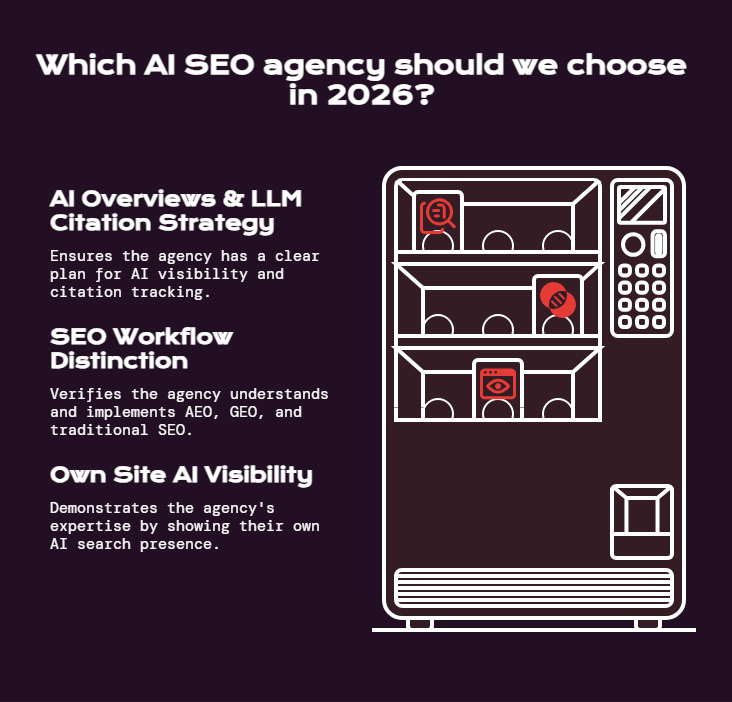
- Do you have an AI Overviews and LLM citation strategy? Ask them to describe it. Not in marketing language – specifically. Which tools do they use to track citations? How do they structure content to get cited? Can they show you examples from a current client?
- What’s the difference between AEO, GEO, and traditional SEO in your workflow? A real answer distinguishes between optimizing for traditional rankings, optimizing to appear in AI-generated answers (AEO), and optimizing visibility across generative AI platforms like ChatGPT and Perplexity (GEO). A vague answer that treats them all as the same thing is a problem.
- Can you show me where your own site appears in AI search results? This is the one most agencies can’t answer. The most dangerous red flag in 2026 is an agency claiming AI SEO expertise without showing a single verifiable citation for their own brand or any client. If they can’t show you their own AI visibility, they’re selling something they haven’t built.
Why does this matter? Brands cited in AI Overviews earn 35% more organic clicks and 91% more paid clicks than those that aren’t. This isn’t a nice-to-have. It’s becoming a core driver of qualified traffic.
Related reading: AI Blog Content: How to Make It Worth Reading, How to Find SEO Keywords for a Website
Questions to Ask Your SEO Agency About Reporting and Accountability
Reporting is where mediocre agencies hide. Show a ranking graph. Point at impressions going up. Mention domain authority. Call it a win. None of that tells you whether SEO is actually growing your business.
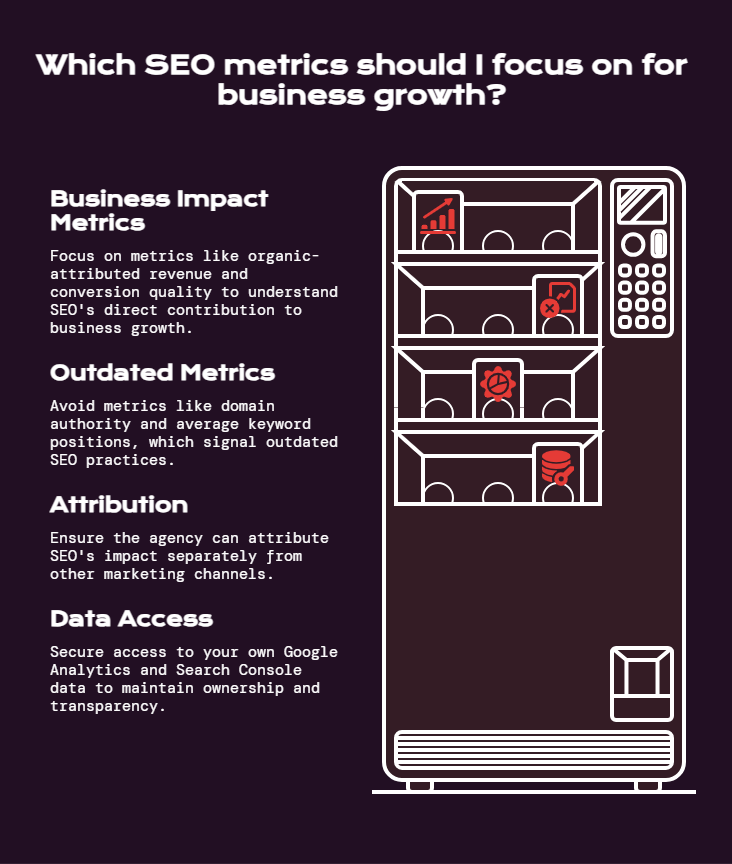
The metrics that matter are different now. According to Search Engine Land, domain authority scores and average keyword positions have become the metrics that “signal outdated thinking” among modern practitioners, with the shift moving toward business impact measurement like organic-attributed revenue and conversion quality.
Ask these:
- What three metrics will you report on every month, and how do they tie back to my revenue? A strong answer includes organic-attributed leads or revenue, not just traffic or rankings. A weak answer leads with impressions or DA.
- Can I see a sample report from a current client? Look at what’s front and center. If rankings take up half the report and revenue doesn’t appear, that’s what you’ll be looking at for the next 12 months.
- How do you separate your impact from other marketing channels? Attribution is hard, but an agency that’s never thought about it can’t tell you what SEO is actually doing for your business.
- What access will I have to my own data? You should own your Google Analytics and Search Console. Always. Any agency that won’t provide access is hiding something.
Related reading: Viral SEO Keywords for Instagram: How to Get Found
SEO Agency Red Flags to Watch For
Some of these have been around forever. Some are specific to where the industry is right now.
| Red Flag | What It Usually Means |
| Guaranteed rankings | They’re either lying or using tactics that will get your site penalized |
| Reports focused entirely on rankings and impressions | They’re measuring what’s easy to move, not what matters to your business |
| “We have a proprietary link-building network” | Paid link networks – a penalty waiting to happen |
| Senior pitch, junior delivery | You’ll meet the account person once and never again |
| AI SEO claims with no examples | Marketing language, not capability |
| Long contracts with no performance benchmarks | The contract protects them, not you |
| They don’t ask you any hard questions | They’re not actually diagnosing your problem |
The most dangerous agencies in 2026 are not the ones sending spam emails promising page-one rankings – those are easy to ignore. The dangerous ones are the agencies that sound credible, use the right terminology, and show polished case studies but cannot point to a single verifiable result in AI-powered search.
One thing I’ve watched play out with clients coming to us after bad experiences: the agency looked totally legitimate on paper. Decent website, recognizable client logos, professional deck. The problem wasn’t obvious until month six when the reporting hadn’t changed, the work hadn’t changed, and the business had nothing to show for it.
Questions About Strategy, Link Building, and the Work Itself
Once you understand pricing and reporting, the next step is figuring out whether the agency actually knows how to do the work.
How Do You Evaluate an SEO Agency’s Actual Methodology?
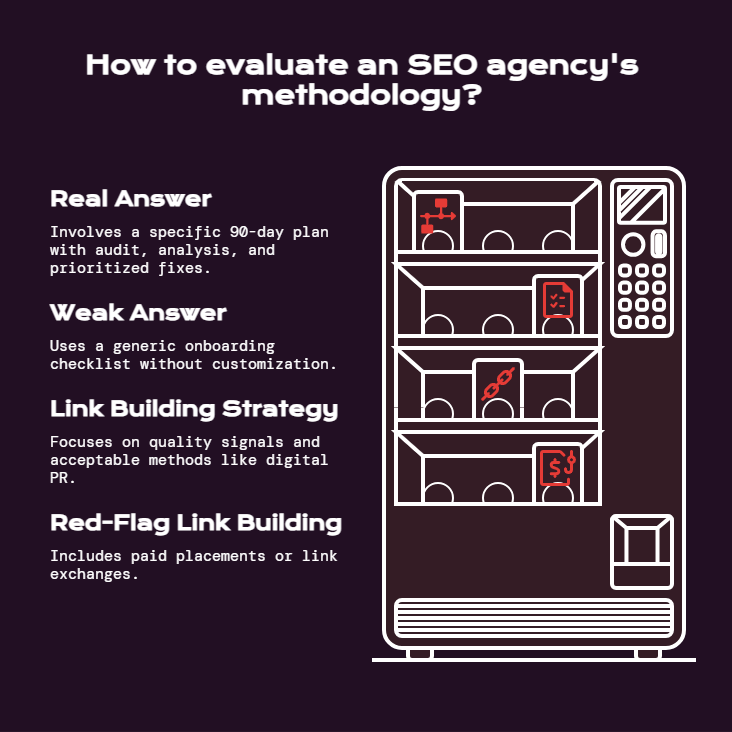
Ask them to walk you through what the first 90 days looks like – not generically, but for a business like yours. A real answer involves an audit of your current state, competitive analysis, prioritized fixes, and a rationale for why those are the highest-leverage starting points. A weak answer is a repackaged onboarding checklist.
Ahrefs’ research on link building and Google’s own Search Central documentation consistently emphasize that quality signals – authority, relevance, editorial context – matter far more than volume. Ask your agency how they think about this.
On links specifically, acceptable answers include digital PR, editorial outreach, broken-link campaigns, and expert citation building. Red-flag answers include paid placements at scale, link exchanges, or any reference to private blog networks.
Who Evaluates an SEO Agency for Technical Depth?
You do, with the right questions. Ask how they’d approach a technical audit of your site. Do they ask about your CMS? Your dev team’s process? Your deployment cycle? An agency that can’t connect technical recommendations to your actual build environment is going to hand you a report full of fixes that never get implemented.
Signs Your SEO Agency Is Behind on Content Strategy
Content is where a lot of agencies are still living in 2019. Ask how they structure content to answer questions the way Google’s AI and LLMs want to answer them. Ask about FAQ schema, structured headers, and how they decide what to create versus what to prune. If the strategy is “publish more content” without a clear framework for intent and structure, that’s a sign they haven’t updated their playbook.
Semrush’s research on content and AI visibility and Moz’s authority documentation both point in the same direction: content needs to demonstrate real expertise and answer questions completely, not just target keywords.
Choosing an SEO Agency in 2026: How to Compare Apples to Apples
Run the same core questions across every agency you talk to. Score the answers on specificity. Vague is a low score regardless of confidence. Then compare.
| Evaluation Area | What to Compare |
| AI search capability | Can they show you real citations, real tools, real results? |
| Reporting | Do they report on business outcomes or vanity metrics? |
| Link strategy | Quality-focused and transparent, or volume-based and vague? |
| Who does the work | Named people, clear roles, or generic “our team”? |
| First 90 days | Specific and customized, or a canned onboarding template? |
| Red flags present | Any guarantees, data hostage tactics, or mystery methods? |
The agency that asks you the most intelligent questions before recommending anything is usually the one worth talking to again. They’re diagnosing before prescribing. That’s what an actual operator does.
Conclusion
There’s no shortage of SEO agencies. There’s a real shortage of ones that have kept pace with how search actually works in 2026 – and can prove it.
The questions in this piece aren’t hard to ask. The answers tell you everything you need to know. Specifics mean competence. Vague means rehearsed. An agency that gets uncomfortable when you push on AI search visibility, revenue attribution, or who’s actually doing the work is telling you something important.
Ask the questions before you sign. It saves you the six-month version of that lesson.
If you’d rather skip the vetting process and work with an agency that can actually answer all of these – with examples – LYNX SEO is exactly what you’re looking for. Reach out and let’s talk about what competitive looks like in your market.
Frequently Asked Questions
What to Ask Your SEO Agency About AI Search?
Ask whether they have a specific strategy for AI Overviews and LLM platforms like ChatGPT and Perplexity. A real answer describes how they structure content for citation, which tools they use to track it (platforms like Profound, Otterly, or manual tracking processes), and includes actual examples from their own site or a client’s. If the answer is conceptual with no examples, treat it as a no.
How Do You Evaluate an SEO Agency’s Track Record?
Ask for case studies in your industry and your business model – not just a flashy chart. Push for absolute numbers: sessions per month before and after, leads generated, revenue attributed to organic. Percentage gains without context are easy to manufacture. Also ask what went wrong in a past engagement and how they handled it. That answer is more revealing than any success story.
What Are the Biggest SEO Agency Red Flags in 2026?
Guaranteed rankings, reporting exclusively on vanity metrics (rankings, DA, impressions), vague link-building language, senior-pitch-to-junior-delivery bait-and-switches, and AI SEO claims with zero verifiable examples. Also watch for agencies that don’t ask you hard questions before recommending a strategy – that means they’re not diagnosing your actual problem.
How Do I Know If My SEO Agency Understands AEO and GEO?
Ask them to define both clearly and explain how they approach each differently. AEO (Answer Engine Optimization) targets AI-generated answer boxes within search results. GEO (Generative Engine Optimization) targets visibility across generative AI platforms. An agency that conflates them or can’t explain the distinction hasn’t built the muscle yet – they’ve added the terms to their website.
What Questions Should I Ask My SEO Agency About Reporting?
Ask what metrics they report on monthly and how those tie to your revenue. Ask to see a sample report before you commit. Look at whether business outcomes – leads, organic-attributed revenue, qualified conversions – are front and center, or buried behind impressions and keyword position graphs. Also confirm that you’ll have direct access to your Google Analytics and Search Console accounts at all times.
How Do I Know If My SEO Agency Is Keeping Up With AI?
The simplest test: ask them to show you where they appear in AI search results for their own relevant keywords. An agency that can’t demonstrate their own AI visibility is selling a capability they haven’t built. Then ask which tools they use to track AI citations across ChatGPT, Perplexity, Google AI Overviews, and Gemini. A real answer names specific platforms and processes.
What Signs Indicate My SEO Agency Is Behind?
Reporting that leads with rankings and domain authority. No mention of AI search strategy after 2025. Link-building language that’s vague or centered on volume. Content strategy that doesn’t account for zero-click behavior and AI-generated answers. An inability to explain how their work connects to your revenue. Any of these individually warrant a direct conversation. More than two or three together, and it’s probably time to look elsewhere.
How Do I Choose an SEO Agency in 2026 Without Getting Burned?
Run the same core questions across three to four agencies and compare answers on specificity. The strongest agencies ask you hard questions before recommending anything. They can name who will do the work. They report on outcomes, not just activity. They have a clear and demonstrable AI search strategy. And they don’t make guarantees no one can actually keep.