Your dev team shipped schema across every template last year. The Rich Results Test is green, Search Console shows no errors, and someone on the marketing side is now asking why the brand still barely appears in ChatGPT answers. That difference between “technically valid” and “visible in AI search” is where a lot of SEO budget vanishes into thin air.
Part of the problem is the advice itself. Most guides treat schema as a switch that makes AI models notice you, and they recycle the same list of markup types without asking how each AI system collects data in the first place. Controlled testing over the past year tells a messier story, and it changes where schema effort should go.
Key Takeaways
- Adding JSON-LD to pages that AI already cites produced no measurable citation lift in controlled testing.
- Google and Bing parse schema at the index layer, while ChatGPT, Claude, and Perplexity mostly strip it during live page fetches.
- The facts in your schema, visible HTML, and product feeds must match, because AI systems drop or misquote conflicting data.
- Schema injected through tag managers is invisible to most live AI fetchers, so server-side rendering matters.
- LYNX SEO builds structured data that stays accurate across Google, ChatGPT, and every AI agent reading your site. Get in touch and find out what your schema is telling AI about you.
What Is Schema Markup for AI Optimization?
Schema has existed since 2011, but the job it does changed when answer engines started summarizing the web instead of listing it. A short grounding in what schema is, and what AI systems read instead, makes the rest of this article easier to act on.
How Schema Differs From the Content AI Models Read
Schema markup is code that labels the facts on a page using a shared vocabulary from Schema.org, a project founded by Google, Microsoft, Yahoo, and Yandex. It tells a machine that “4.8” is a review rating and that a string of digits is a price in US dollars. Schema.org reports that more than 45 million web domains used its vocabulary as of 2024.
The text a reader sees and the JSON-LD block a crawler sees are two separate layers of the same page. Search engines built their pipelines to parse the second layer into structured records, while large language models were built to read the first. That difference drives almost everything else in this article.
Why AI Search Changed the Job Schema Does
For most of its history, schema’s payoff was rich results like star ratings, recipe cards, and FAQ dropdowns. Google has pulled back on several of those features, just as AI answers began pulling facts about brands, prices, and people straight into responses.
That change turns schema from a display tool into an identity tool, where the real question is whether every system describing your company gets the same facts.
Does Schema Markup Help AI Search Visibility? What the Research Shows
This is the question behind most schema budget requests, and the answer depends on which layer of AI search you measure. Three pieces of evidence now exist, and they point in a consistent direction once you read them together.
The Correlation Most Guides Cite
The popular case for schema for AI search citations rests on correlation. In a scan of 6 million URLs, Ahrefs found that pages cited by AI were almost three times more likely to carry JSON-LD than uncited pages, and 53% of AI-cited pages ran schema.
The catch is that sites with structured data also tend to invest in technical SEO, stronger content, and link building, so schema may simply be riding along with other signals. There’s no clean way to extract data for sites ranking solely based on schema.
What Happened When 1,885 Pages Added Schema
To separate those signals, Ahrefs tracked 1,885 pages that added JSON-LD between August 2025 and March 2026, matched each against control pages that never added it, and compared citation changes.
- Google AI Overviews: a 4.6% decline relative to controls, small but statistically significant
- Google AI Mode: a 2.4% change, statistically indistinguishable from zero
- ChatGPT: a 2.2% change, also indistinguishable from zero
One caveat deserves weight before anyone cuts schema from the roadmap. Every page in the study was already heavily cited before the markup went live, so the results say little about pages AI systems are not seeing yet. For those, schema may still help with getting crawled and indexed, which is where the next test comes in.
Why ChatGPT, Claude, and Perplexity Skip Json-Ld During Live Retrieval
A German technical SEO firm, searchVIU, built a test page that placed product prices in eight different ways, from visible HTML to JSON-LD that appeared nowhere else. It asked ChatGPT, Claude, Perplexity, Gemini, and Google AI Mode to report the prices, and not one system surfaced a price that existed only in JSON-LD or hidden Microdata. Gemini was the only system that executed JavaScript during a live fetch, and even it ignored schema-only data.
The reason is mechanical. When an assistant fetches a page in real time, its extractor usually strips script tags and keeps the readable text, and JSON-LD lives inside a script tag. So structured data schema for AI search visibility still pays off, but through indexes and knowledge graphs rather than through an assistant reading your markup on the fly.
How Different AI Systems Use Structured Data
“AI search” is not one system. Each platform collects data through a different pipeline, and schema reaches some of them while missing others entirely, which is why the same markup can matter a lot on one surface and not at all on another.
Google AI Overviews and AI Mode Pull Schema Through the Index
Google’s AI features sit on top of the standard search index, where structured data has been parsed for years. Its guidance on AI features and your website says no special schema.org markup is required, but it tells site owners to make sure structured data matches the visible text.
That instruction matters because AI Overviews and AI Mode may use query fan-out, running several related searches and pulling from many pages, and schema helps Google resolve entities only when markup and content agree.
The same guidance points site owners toward keeping Merchant Center and Business Profile data current. Both are structured data delivered outside the page, and for many businesses they carry more weight in AI answers than on-page markup does.
Bing Copilot and Microsoft’s Structured Data Pipeline
Copilot grounds its answers in the Bing index, and Microsoft has treated Schema.org as core infrastructure since co-founding it. Bing’s pipeline behaves much like Google’s, with markup parsed during crawling rather than read live by the model. Clean, server-rendered JSON-LD that mirrors the page gives Bing a reliable record to ground against, while markup that contradicts the page gives it a reason to trust the page less.
Live-Fetch Assistants Only Read What Renders on the Page
ChatGPT and Claude often fetch pages directly when a user asks about something current. As the searchVIU results showed, those fetches work from readable HTML, so any fact that lives only in your schema is invisible at that moment. Perplexity leaned on its own index in the same test and captured very little from a newly published page.
For these systems, the visible page is the structured data. Clear headings, direct answers near the top of each section, and exact entity names are what an extractor can work with. That is why learning how to add value to AI blog content overlaps so heavily with AI retrieval work, since the qualities that help readers also help parsers.
AI Agents and NLWeb Query Schema as an Interface
A newer layer treats schema less like a label and more like an API. Microsoft introduced NLWeb in May 2025 as an open project that turns a website into a natural language interface built on the Schema.org and RSS data sites already publish. Every NLWeb instance also acts as an MCP server, which lets AI agents query a site directly.
The project comes from R.V. Guha, the creator of Schema.org, RSS, and RDF, and early collaborators included Shopify, Tripadvisor, and Eventbrite. For sites whose catalog is the product, the quality of your schema becomes the quality of the answers an agent receives, with no human reading the page in between.
Product Feeds Are Replacing On-Page Schema for AI Shopping
Commerce is where AI platforms have moved furthest from crawling. OpenAI’s product feed specification has merchants supply a structured file that OpenAI ingests for ChatGPT, with fields for price, availability, variants, and returns, plus flags that control whether a product appears in search or can be bought in the chat.
One requirement stands out for engineering teams. The spec says each product ID must remain stable over time, which is a governance commitment more than a mapping task. If your catalog regenerates IDs during a replatform, the feed breaks in ways on-page schema never would.
| AI System | How It Gets Your Data | Does Schema Reach It | What to Prioritize |
| Google AI Overviews and AI Mode | Search index plus query fan-out | Yes, parsed at indexing | Schema that matches visible text, current Merchant Center and Business Profile data |
| Bing Copilot | Bing search index | Yes, parsed at indexing | Server-rendered JSON-LD that mirrors the page |
| ChatGPT and Claude (live fetch) | Real-time page retrieval | Rarely, script tags are stripped | Clear visible content with exact entity names |
| Perplexity | Its own selective index | Limited evidence either way | Crawlable, prominent on-page facts |
| NLWeb agents | Schema.org and RSS ingestion | Yes, schema is the input | Complete, accurate markup on catalog pages |
| ChatGPT shopping | Merchant-supplied product feed | No, the feed replaces it | Stable product IDs and feed accuracy |
Which Schema Types Matter Most for AI Search
Once you know which systems parse schema, picking the best schema for AI search gets simpler. The types that matter are the ones that tell indexes and agents who you are, what you sell, and how those things connect.
Organization and Person Schema for Entity Resolution
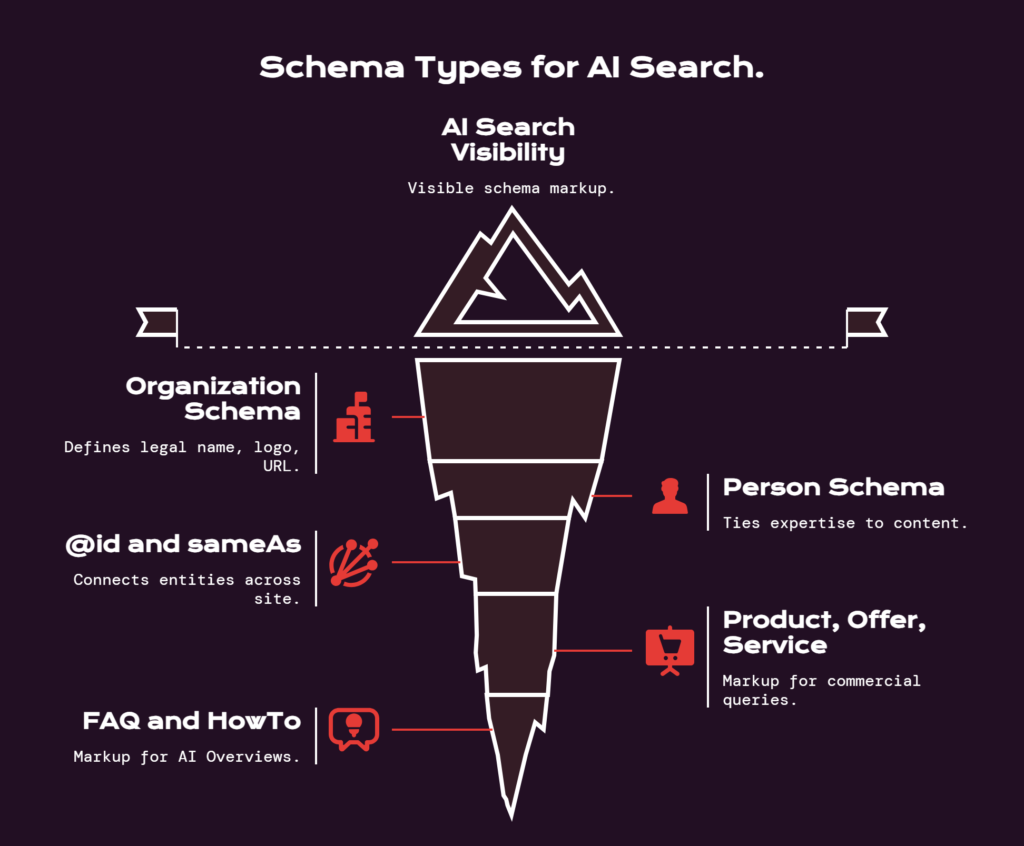
Organization schema is the anchor for everything else. It defines your legal name, logo, URL, contact points, and founders, giving Google and Bing one record to attach your brand to when an AI answer describes you. Person schema does the same for authors and executives whose expertise you want tied to your content.
This is also where structured data schema for blog posts earns AI visibility. An Article block whose author points to a real Person entity, and whose publisher points to your Organization, tells an index the post comes from a verifiable source.
Connecting Entities Across Your Site With @id and sameAs
Most implementations are a pile of disconnected blocks, with a slightly different Organization declared on every page. The @id property fixes that by giving each entity a permanent identifier that every other block can reference, so the homepage defines the Organization once and every Article, Product, and Service points back to it.
The sameAs property links your entity to profiles that already exist elsewhere, such as LinkedIn, Crunchbase, Wikipedia, or Wikidata. For a knowledge graph, those links work like corroborating witnesses, and a connected graph is far easier to resolve than fifty isolated blocks.
Product, Offer, and Service Schema for Commercial Queries
Commercial queries are where wrong facts in AI answers do the most direct damage. Product and Offer markup carries price, availability, and identifiers like GTIN, while Service markup describes what a B2B company delivers and where. These are also the types most likely to go stale, because prices and stock move daily.
Regulated categories feel this most. We noticed this while working on hemp brand SEO and AI search visibility. They needed schema claims that match their compliant on-page language exactly. Multi-location operators face a similar problem, since local SEO for franchises depends on dozens of LocalBusiness entities with accurate addresses and hours.
Why FAQ and HowTo Markup Lost Their Old Value
FAQPage and HowTo were once the default answer to the best schema for AI Overviews, largely because they produced eye-catching rich results. In August 2023, Google announced that FAQ rich results would only appear for well-known government and health sites, and it deprecated HowTo rich results weeks later. It also noted that unused structured data causes no problems, so existing markup can stay.
The visible Q&A content still matters, because clear questions with short answers are easy for any extractor to lift. The markup around them is now a minor bonus rather than the reason the content works.
Schema Mistakes That Quietly Hurt AI Visibility
Most schema problems never throw an error. The markup validates, the dashboard stays green, and the damage shows up months later as AI answers that misstate your pricing or skip your pages entirely.
Markup That Claims Things the Page Does Not Show
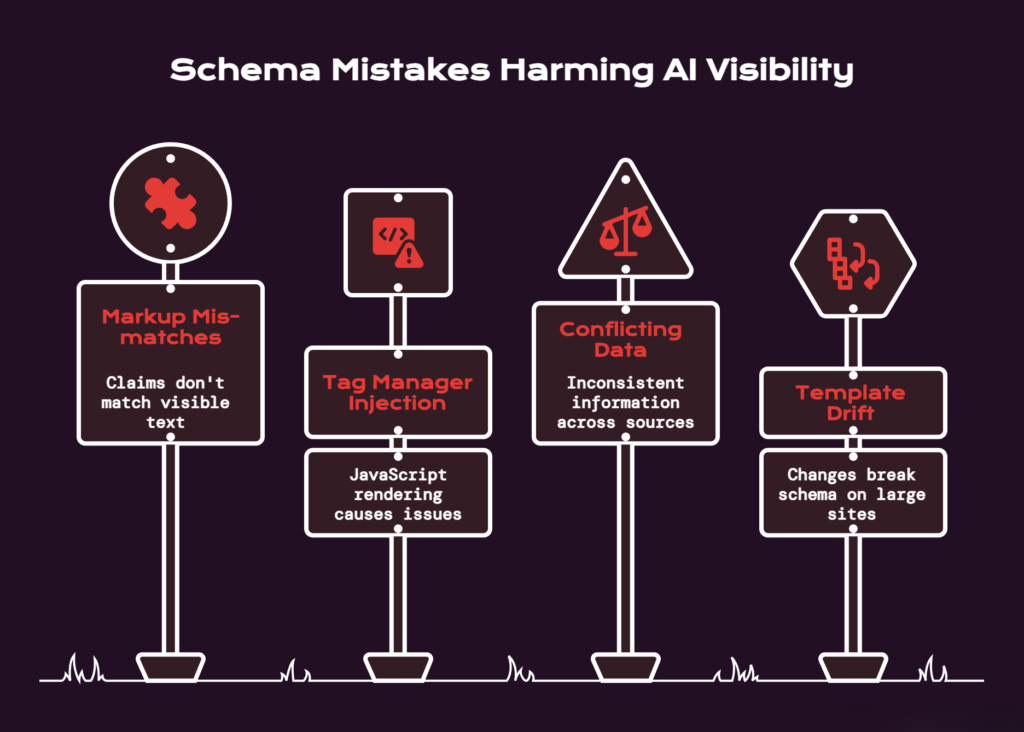
Some teams treat JSON-LD as a place to add facts that did not fit the design, like extra service areas, ratings, or specs. Google’s AI features guidance asks that structured data match the visible text, and live-fetch assistants never see the hidden version anyway. Teams dealing with inherited bad website SEO should also expect markup that references discontinued products, old addresses, or a previous company name.
JSON-LD Injected Through Tag Managers
Tag managers are a popular way to add schema without developer time, and Google can process markup in the rendered page. Its own documentation on generating structured data with JavaScript still warns that Product markup generated this way can make Shopping crawls less frequent and less reliable. Live-fetch assistants are an even bigger gap, since most do not run JavaScript at all, so server-side rendering of JSON-LD removes both problems.
Conflicting Data Across Schema, HTML, and Feeds
The searchVIU test also included a product with two different hidden prices, one in RDFa and one in JSON-LD, and no system reported either one. At scale, AI systems facing conflicting facts either drop them or pick one, and you do not control which. The most common conflicts look like this:
- Price Mismatches: sale pricing updated on the page but not in the feed or the Offer block
- Stale Availability: stock status cached in schema after a product sells out
- Entity Drift: different company names, logos, or addresses declared on different templates
- Duplicate Authors: the same writer appearing as three separate Person entities
Template Drift on Large and Programmatic Sites
On large sites, schema lives in templates, and templates change constantly. A developer renames a field or a new page type launches without markup, and nobody notices because nothing visibly breaks. Programmatic sites multiply the effect, since one template bug can corrupt schema on 40,000 pages at once.
Migrations are the highest-risk moment. Anyone planning to redesign a website without losing SEO should treat structured data as part of the parity checklist, because losing @id references during a rebuild can quietly reset years of entity work.
How LYNX SEO Builds Schema That AI Systems Can Trust
Most schema projects end when the validator turns green, and that is where LYNX SEO starts. Our veteran SEOs trace how your data moves from your CMS and product systems into markup, visible pages, and feeds. Then we rebuild that pipeline so Google, Bing, ChatGPT, and emerging AI agents all receive the same verified facts.
That work includes connected entity graphs with permanent IDs, server-rendered JSON-LD, validation built into your deploys, and citation tracking that shows whether the effort is paying off. We have taken brands from zero visibility to hundreds of thousands of clicks in categories where competition bites back, including ecommerce, SaaS, finance, healthcare, legal, and cannabis. The same technical rigor now goes into making sure AI systems describe your business correctly.
Your schema is already telling AI something about your company. Get in touch and let’s make sure it tells the right story.
Frequently Asked Questions
Does ChatGPT Use Schema Markup?
Not directly during live browsing. When ChatGPT fetches a page in real time, testing shows it reads visible HTML and ignores JSON-LD that appears only in script tags. Schema may still influence ChatGPT indirectly through the search indexes it draws on, but key facts should always appear in visible page content too.
Is JSON-LD Better Than Microdata for AI Search?
JSON-LD is Google’s recommended format and much easier to maintain, because it sits in one block separate from your HTML. Microdata attached to visible elements can be read by live-fetch assistants since the text itself is visible. Server-rendered JSON-LD paired with the same facts in visible copy gives equal coverage with less clutter.
Can Schema Markup Stop AI From Getting My Brand Facts Wrong?
Schema lowers the odds of errors by giving Google and Bing a clean, consistent entity record, but it cannot force an AI model to use it. Accuracy improves most when your schema, website copy, business profiles, and third-party listings all state the same facts. Conflicting sources are a common cause of AI misstatements.
Should I Still Add FAQ Schema in 2026?
It is optional. Google now shows FAQ rich results mainly for authoritative government and health sites, so most businesses gain little visible benefit. The visible question-and-answer content still helps AI systems extract answers. If FAQ markup already exists and matches the page, leave it in place, since unused structured data causes no harm.
Does Invalid Schema Hurt AI Visibility?
Invalid schema will not trigger a penalty, but it disqualifies the markup from rich results and weakens the entity signals Google and Bing rely on. Language models that see markup read it as plain text, so inaccurate data inside broken JSON-LD can still spread. Fix errors rather than assuming they are harmless.
Do I Need Schema Markup If I Have an Llms.txt File?
Yes. An llms.txt file is a proposed convention with limited support among major AI platforms, and Google says no special AI text files are needed for its AI features. Schema serves a different purpose by feeding search indexes and knowledge graphs. The two are not substitutes, and schema has far broader support today.
Sources Used for This Article
- Schema.org: “Schema.org” – schema.org/
- Ahrefs: “We Tracked 1,885 Pages Adding Schema. AI Citations Didn’t Move” – ahrefs.com/blog/schema-ai-citations/
- searchVIU: “Schema Markup and AI in 2025: What ChatGPT, Claude, Perplexity & Gemini Really See” – searchviu.com/en/schema-markup-and-ai-in-2025-what-chatgpt-claude-perplexity-gemini-really-see/
- Google Search Central: “AI Features in Google Search” – developers.google.com/search/docs/appearance/ai-features
- Microsoft Source: “Introducing NLWeb: Bringing conversational interfaces directly to the web” – news.microsoft.com/source/features/company-news/introducing-nlweb-bringing-conversational-interfaces-directly-to-the-web/
- OpenAI Developers: “Feed Reference — Agentic Commerce” – developers.openai.com/commerce/product-feeds/spec
- Google Search Central: “Simplifying How-To and FAQ rich results” – developers.google.com/search/blog/2023/08/howto-faq-changes
- Google Search Central: “Generate structured data with JavaScript” – developers.google.com/search/docs/appearance/structured-data/generate-structured-data-with-javascript
