Quick Answer: Answer engine optimization (AEO) is the practice of structuring brand content and signals so ChatGPT, Perplexity, Google AI Overviews, and Gemini can extract, trust, and cite them. The tactics differ by engine because each one retrieves information differently, and brands that treat AEO as one universal checklist usually end up visible on one platform while staying invisible everywhere else.
Key Takeaways
- Answer engine optimization structures brand content so ChatGPT, Perplexity, Google AI Overviews, and Gemini can extract, trust, and cite it.
- AEO differs from SEO and generative engine optimization by focusing on direct AI answer citations rather than rankings or blended brand framing.
- ChatGPT, Perplexity, Google AI Overviews, and Gemini use different retrieval, training, and entity signals, so one universal checklist is insufficient.
- Website corrections may not immediately update AI answers because outdated facts can persist in model training data or visible third-party sources.
- AI-ready content should use answer-first sections, self-contained paragraphs, comparison tables, clear lists, crawlable pages, and accurate crawler permissions.
- Third-party validation from reviews, forums, press mentions, schema markup, and consistent entity data helps AI systems corroborate brand claims.
- Get in touch with LYNX SEO to audit your AI search visibility and identify where your brand is missing citations across answer engines.
Marketing teams keep hearing that AI search is rewriting the rules, then they open five different guides and get five nearly identical lists of the same seven tips. Structure your content, add schema, write FAQs, build authority.
None of it is wrong, but none of it explains why a brand can follow every step and still watch a competitor get quoted by ChatGPT while they get quoted by nobody. The missing piece is that ChatGPT, Perplexity, and Google AI Overviews are not the same kind of system wearing different logos. They pull information through different mechanisms, trust different signals, and update on different timelines, so a brand that only optimizes for one can look completely absent on another.
Fixing a factual error on your own site doesn’t always mean the AI stops repeating the old version either. This piece breaks down what separates these systems, why corrections lag behind reality, and what a brand can do about both.
What Is Answer Engine Optimization for Brands
Answer engine optimization is the process of shaping brand content, structure, and third-party signals so AI systems select, extract, and cite that brand when generating an answer.
Where SEO earns a position on a results page a person browses, AEO earns a mention inside a response the person never has to click through to see. For brands, this extends past the content on a website into how the brand is described, verified, and corroborated everywhere else AI systems look, including reviews, forums, and press coverage.
This matters more for brands than for individual articles because a brand is not just competing for a single query. It is competing to be the name an AI system reaches for whenever someone asks a question in its category, which means the work spans the whole site rather than one page.
The stakes are real: a Forbes analysis pointed to research showing businesses answering conversational, AI-driven queries can see conversion rates roughly nine times higher than those relying on traditional search alone, since a person arriving through an AI answer has usually already done their research.
That shift in behavior is already showing up in buyer data. HubSpot has reported that 42% of CRM software buyers now use AI search as part of how they evaluate vendors, which means brands that skip AEO aren’t just missing a nice-to-have channel, they’re missing a step that’s already built into how a meaningful share of buyers make decisions.
Brands that only think about AEO at the blog-post level tend to win occasional citations while missing the compounding effect of being recognized as a trusted source across many related questions.
AEO Vs SEO Vs GEO: What Really Separates Them
These three terms get used almost interchangeably in marketing meetings, and that’s part of the confusion. SEO, AEO, and GEO solve overlapping but distinct problems, and knowing which one applies to a given task keeps a team from spending a content budget on the wrong outcome.
The table below breaks down how each one actually differs in goal, output, and what a brand needs to do to win at it.
| Discipline | Primary Goal | What Success Looks Like | Where It’s Won or Lost |
| SEO | Rank a page for a search query | A click from a results page to your site | Keywords, backlinks, technical performance |
| AEO | Get a direct answer extracted and cited | A mention or citation inside an AI-generated answer | Answer-first structure, schema, entity clarity |
| GEO | Shape how a brand appears inside a synthesized, multi-source AI summary | Favorable framing across a blended response, even without a direct citation | Topic depth, consistent third-party corroboration, semantic coverage |
The short version: SEO gets people to your site, AEO gets your content pulled into a direct answer, and GEO shapes how your brand is described inside a longer, blended AI response. A brand asking “aeo vs seo” is usually trying to decide where to put the budget first, and the honest answer is that SEO fundamentals still support both AEO and GEO, so none of the three replaces the others.
Why One AEO Tactic Works on ChatGPT and Fails on Perplexity
Most AEO advice talks about “AI search” as a single target, as if ChatGPT, Perplexity, and Google AI Overviews all worked off the same underlying system. They don’t.
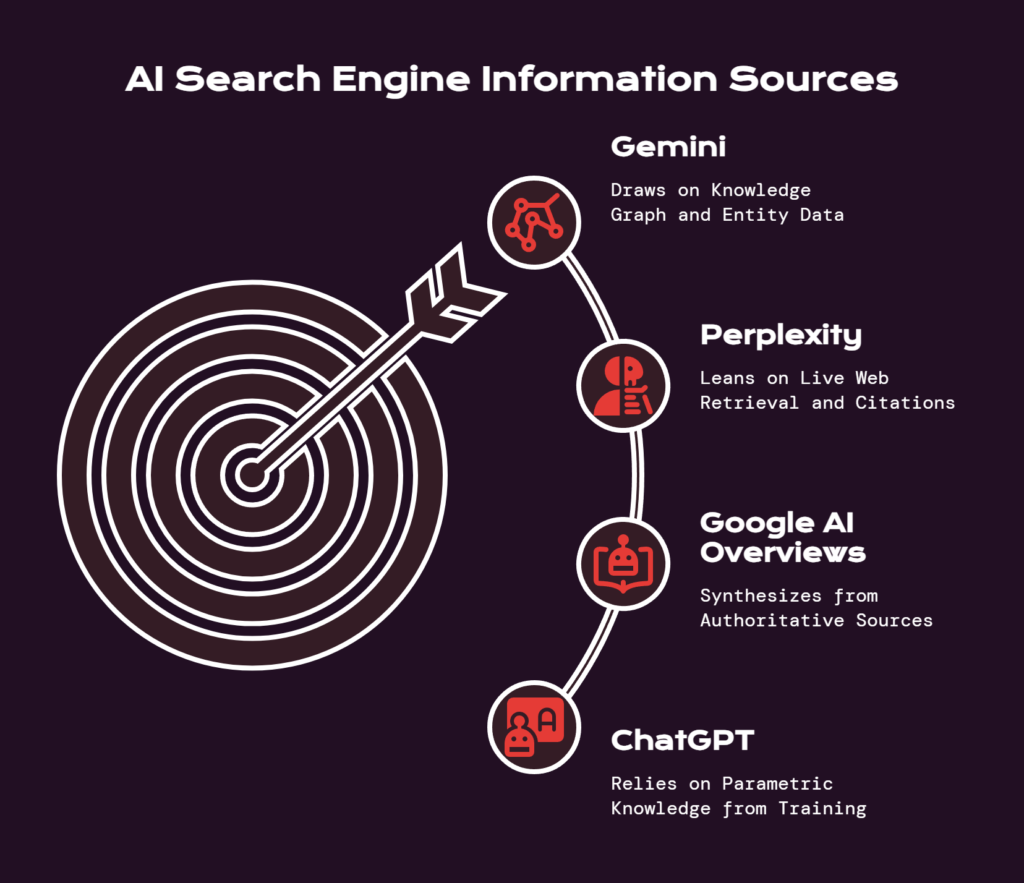
Each one leans on a different mix of stored training knowledge, live web retrieval, and existing knowledge graph data, and that mix determines what actually gets a brand mentioned. A brand that only optimizes for one mechanism can end up fully invisible on a platform running on a completely different one.
1. How ChatGPT Draws on What It Already Knows About Your Brand
ChatGPT’s base responses lean heavily on parametric knowledge, meaning facts absorbed during training rather than pulled from a live search at that moment. It can browse the web through OAI-SearchBot or respond to a live request through ChatGPT-User, but its default instinct is still shaped by what was already baked in during training.
This means a brand’s visibility here depends heavily on how often and how clearly it was described across the web before that training data was collected, not just on how well-optimized this week’s blog post is.
2. Why Perplexity and Google AI Overviews Lean on Live Retrieval
Perplexity works closer to a real-time retrieval system, pulling from current web pages at the moment of the query and citing them directly, which is why deeply factual, well-referenced, and easily extractable content performs disproportionately well there. Google AI Overviews follows the same basic pattern, synthesizing an answer from multiple authoritative sources pulled at query time rather than relying only on stored knowledge.
For both, a brand’s odds improve the moment a new, well-structured page goes live, which is a much faster feedback loop than trying to shift what a model learned during training.
3. Where Gemini Pulls Brand Information From
Gemini sits closer to Google’s own Knowledge Graph and structured entity data than the other two, drawing on verified facts, sameAs relationships, and existing entity recognition to decide what it can say about a brand with confidence.
This is part of why entity consistency, meaning matching brand facts across your site, business profiles, and third-party listings, carries more weight here than it does for a purely retrieval-based system.
A brand with a messy or inconsistent digital footprint can struggle here even with excellent on-page content, simply because Gemini has less confidence in which facts about that brand are actually correct.
Why Fixing Your Website Does Not Immediately Fix What AI Says About You
In classic SEO, a factual error is a fast fix. Correct the page, request reindexing, and within days or weeks the search result reflects reality. AI answers don’t work that way, and it is one of the most frustrating realities for brand and communications teams trying to manage how they are represented. Wrong or outdated claims about a brand can keep surfacing in AI answers for months after the original source has already been corrected.
The Time Gap Between Publishing a Correction and Models Reflecting It
Once information about a brand is repeated widely enough across the web before a model’s training cutoff, it becomes part of that model’s parametric knowledge, and correcting the original source doesn’t retroactively edit what the model already learned.
A widely cited academic review of AI chatbots in health information contexts found that relying on outdated training content inevitably produces outdated outputs, an effect that persists until the model itself gets updated, not just until the source article changes. For a brand, this means a bad review, an old product claim, or an outdated pricing page that got scraped widely can echo in AI answers well past the point where the brand fixed it.
Retrieval-based engines like Perplexity and Google AI Overviews are somewhat more forgiving, since they pull from the live web rather than frozen training data.
Even then, if outdated pages still rank or get referenced elsewhere, the model can repeat the wrong version simply because it’s still the version most visible online. This connects to the kind of technical debt covered in our piece on what to do after inheriting a website with bad SEO history, where old, incorrect content keeps resurfacing until it’s actively cleaned up everywhere it lives, not just on the primary domain.
Steps That Shorten the Correction Window
There’s no way to force an AI model to instantly forget bad information, but a few actions consistently shorten how long incorrect claims linger:
- Update the Source and Every Syndicated Copy: If the wrong fact appeared in a press release, directory listing, or partner site, correcting only your own domain leaves the other copies to keep feeding retrieval systems.
- Publish a Clear, Dated Correction: A visible update with a timestamp gives retrieval-based engines a stronger, more recent signal to pull instead of the older version.
- Push the Correct Fact Through Channels AI Systems Weight Heavily: Reviews, forums, and press coverage carry outsized influence, so getting the accurate version restated there speeds up the correction more than editing your own site alone.
- Monitor Rather Than Assume: Regularly ask ChatGPT, Perplexity, and Gemini directly what they say about your brand, since this is often the only way to catch a lingering error before a customer does.
How to Structure Content So AI Systems Can Extract It Cleanly
None of the engine-specific behavior above matters if the content itself isn’t built for extraction in the first place. AI systems don’t read a page top to bottom the way a person does. They pull the specific section, sentence, or chunk that answers the query, which changes what “good structure” actually means compared to a page written purely for human browsing.
Answer-First Sections and Chunk-Sized Paragraphs
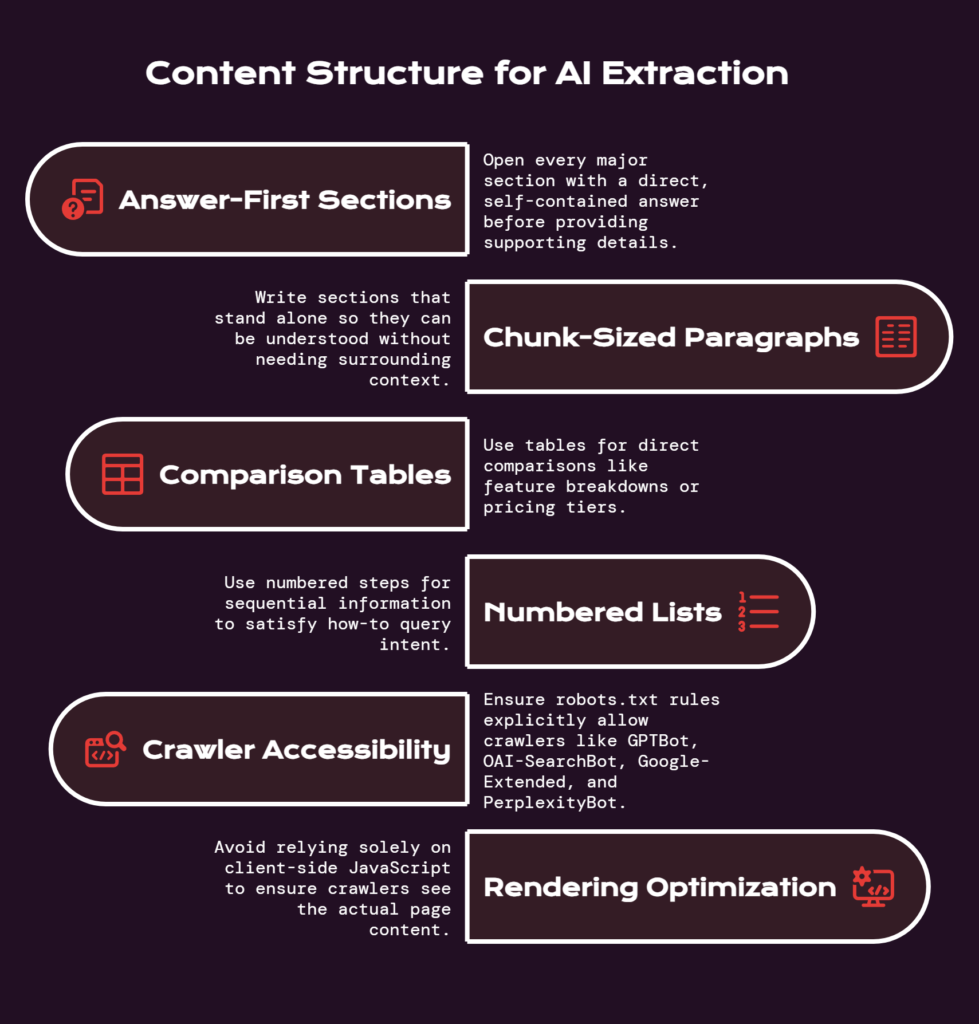
Every major section should open with a direct, self-contained answer before going into supporting detail, since AI systems tend to extract the first clear statement that resolves the question rather than piecing an answer together from scattered sentences.
Anthropic’s own research on retrieval-augmented generation explains that AI systems process content in chunks, and that chunks stripped of surrounding context are far more likely to be misread or skipped entirely. In practice, this means writing sections that can stand alone: a reader (or a model) should be able to understand the point of a paragraph without needing the paragraph before it.
This is a big part of what separates genuinely useful AEO optimized content writing tips from generic advice to “just write clearly.” Clear writing helps humans. Self-contained, chunk-sized sections with the conclusion stated up front help both humans and the retrieval systems doing the extracting. Your AI-facing blog content should grade well on both criteria.
Comparison Tables and Lists AI Systems Pull Into Answers
Structured formats give AI systems a shortcut. A comparison table or a clearly labeled list is easier to lift wholesale into an answer than the same information buried in prose, which is part of why this article uses two of them. Reach for bullets and tables when information is naturally comparative or sequential, not as a way to pad out a section that would read better as a paragraph.
- Use tables for direct comparisons, like feature breakdowns, pricing tiers, or the engine-by-engine mechanics covered earlier in this piece.
- Use numbered steps for anything sequential, since AI systems favor process content when a user’s query implies a “how to” intent.
- Avoid stacking bullet lists back to back, since a page that’s entirely lists with no connecting prose loses the context that helps both readers and models understand why the list matters.
Making Sure Crawlers Can Reach That Content in the First Place
Perfectly structured content is invisible to an AI system that can’t crawl the page. This is a separate problem from content quality, and it’s one CTOs are often better positioned to catch than marketing teams are.
OpenAI’s own crawler documentation confirms that GPTBot and OAI-SearchBot are controlled independently through robots.txt, meaning a site can accidentally allow one while blocking the other without anyone noticing until traffic or citations quietly disappear. The same applies to Google-Extended for Gemini and PerplexityBot for Perplexity, each of which needs its own explicit rule rather than a single blanket directive.
JavaScript-heavy pages create a second, less visible version of the same problem. If a page’s core content only renders after client-side JavaScript executes, some AI crawlers may see an empty shell instead of the actual page, even when a human visitor sees a fully rendered page in their browser.
This is closely tied to the kind of technical audit covered in our guide on redesigning a website without losing SEO, where rendering and crawlability issues are far more common after a redesign than most teams expect.
Building Third-Party Signals That Back Up Your Brand Claims
AI systems don’t take a brand’s word for it. Because these systems are built to avoid confidently repeating unverified claims, they tend to favor brands whose own descriptions are echoed and confirmed elsewhere on the web. This is one of the more underrated parts of AEO, since it has almost nothing to do with a brand’s own website and everything to do with what other sources are saying.
Reviews, Forums, and Press Coverage AI Models Cross-Check
Reviews on independent platforms, discussion threads on forums like Reddit, and coverage from industry press all function as corroborating evidence that a model can point to alongside a brand’s own claims.
A brand that only talks about itself on its own domain gives an AI system nothing to cross-reference, which makes that system more cautious about citing it with confidence. This pattern shows up clearly in niche categories like hemp and cannabis brands, where regulatory sensitivity means AI systems lean even harder on third-party validation before citing a brand directly.
- Reviews on independent platforms carry weight because they’re written by people with no incentive to inflate claims.
- Forum and community discussions show up in retrieval-based answers surprisingly often, since they read as organic, unbiased confirmation.
- Press mentions from established publications function as a trust signal that’s difficult to fake or manufacture quickly.
Schema and Entity Consistency as Supporting Evidence
Schema markup, particularly Organization schema with accurate sameAs links to a brand’s other verified profiles, gives AI systems machine-readable confirmation of who a brand is and how its pieces connect.
It’s worth noting that Google has been explicit that structured data isn’t required for its generative AI search features, so schema shouldn’t be treated as a magic switch that guarantees a citation. It still functions as useful supporting evidence, especially for entity-driven systems like Gemini, and it’s low effort relative to the payoff, so there’s little reason to skip it even if it isn’t a guarantee.
How to Measure Whether AEO Is Working
Clicks and rankings don’t capture what AEO is actually trying to achieve, since a citation inside an AI answer often generates zero click-through even when it drives real brand awareness or a direct visit later.
Brands need to track citation frequency by asking target queries directly across ChatGPT, Perplexity, and Gemini on a regular schedule, then logging whether and how the brand gets mentioned. Comparing that citation rate against competitors targeting the same queries turns a vague “are we visible in AI search” question into an actual trackable metric.
AEO measurement suffers from the same trap as vanity SEO metrics. It’s easy to track something that feels productive without tracking whether it’s actually moving the business forward. Share of voice inside AI answers, not just citation count, is the metric that ties this work back to a business outcome, since being cited once in a low-intent context matters far less than being the consistent answer for the queries that actually drive revenue.
How LYNX SEO Builds AEO Strategies That Stick
Most of what’s covered here takes real time to execute well: mapping how five different AI systems each treat a brand, correcting information that’s already baked into training data, restructuring content for extraction, and building the third-party signals that make an AI system trust a citation in the first place.
LYNX SEO builds AEO strategies that treat these as connected problems rather than a checklist to run through once and forget. That includes auditing crawler access, fixing entity inconsistencies across a brand’s digital footprint, and monitoring how a brand actually gets described across ChatGPT, Perplexity, and Gemini over time.
LYNX also works with Promptwatch to track how often a brand shows up in AI-generated answers compared to competitors, turning what’s usually a guessing game into something a team can actually report on.
If your brand’s visibility in AI search feels like a black box right now, that’s the exact problem our work is built to solve. Get in touch with LYNX SEO and let’s figure out where your brand currently stands.
Frequently Asked Questions
What Is AEO in Simple Terms?
AEO, or answer engine optimization, is the practice of structuring content and brand signals so AI systems like ChatGPT and Perplexity can extract, trust, and cite them directly in a generated answer. It shifts the goal from ranking a page to being the source an AI system pulls from when answering a question in your category.
How Much Does AEO Cost?
AEO costs vary widely depending on whether it’s handled in-house or through an agency, ranging from a few hundred dollars a month for basic monitoring tools to several thousand for a full strategy covering content, technical fixes, and citation tracking. Most brands spend less restructuring existing content than they would building an entirely new content program from scratch.
Do I Need Extra Budget for AEO?
Most brands don’t need an entirely separate budget line, since AEO builds on existing SEO and content work rather than replacing it. What usually requires new spend is citation tracking tools and the technical audit work needed to fix crawler access and entity consistency issues that traditional SEO audits don’t typically check.
What Are the Best Tools for AEO?
The best tools for AEO combine AI visibility trackers that monitor brand citations across ChatGPT, Perplexity, and Gemini with existing SEO platforms for technical audits and schema validation. Tools like Promptwatch focus on tracking how often and how favorably a brand appears in AI-generated answers compared to competitors.
What Keyword Research Tools Work for AEO in LLMs?
Keyword research for AEO focuses less on search volume and more on the actual conversational questions people ask AI systems, which means tools that surface question-based and long-tail phrasing tend to matter more than traditional volume-focused keyword tools. Reviewing real prompts and follow-up questions in ChatGPT or Perplexity directly often surfaces more useful patterns than a keyword tool built for traditional search.
Is AEO Replacing SEO?
AEO is not replacing SEO, since strong technical SEO and content authority still support how AI systems retrieve and trust information in the first place. The two work together, with SEO building the foundation and AEO shaping how that foundation gets surfaced inside AI-generated answers.
How Long Does It Take to See AEO Results?
Results vary by engine, with retrieval-based systems like Perplexity and Google AI Overviews sometimes reflecting changes within weeks of a page update, while training-based systems like ChatGPT’s default responses can take much longer to shift since they depend partly on the model’s training data rather than live content alone.
Sources Used for This Article
- Forbes: “AI Is Destroying SEO. Rank Now Requires Answer Engine Optimization” – forbes.com/sites/joetoscano1/2025/09/03/ai-is-destroying-seo-rank-now-requires-answer-engine-optimization/
- HubSpot: “Show Up in AI Search with Answer Engine Optimization (AEO)” – hubspot.com/products/marketing/aeo-guide
- OpenAI: “Overview of OpenAI Crawlers” – developers.openai.com/api/docs/bots
- Anthropic: “Contextual Retrieval in AI Systems” – anthropic.com/engineering/contextual-retrieval
- Google Search Central: “AI Features and Your Website” – developers.google.com/search/docs/appearance/ai-features
- National Center for Biotechnology Information (NCBI): “What Is the Impact of Artificial Intelligence-Based Chatbots on Infodemic Management?” – ncbi.nlm.nih.gov/pmc/articles/PMC10896940/
