
Quick Answer: SEO for data center providers works differently than most B2B SEO because buyers evaluate facilities using technical specifications like power density, PUE, Tier rating, and compliance certifications rather than generic service descriptions. The providers who win search visibility, including inside AI answers, are the ones who structure facility data as machine-readable facts instead of burying it in marketing copy.
Key Takeaways
- SEO for data center providers depends on structured facility data, not generic B2B service copy or broad keyword targeting.
- Buyers search for specific technical facts, including power density, Power Usage Effectiveness, Tier ratings, compliance certifications, connectivity, and facility location.
- Facility pages should use structured data to make specs, certifications, carriers, cloud on-ramps, and market details readable by search engines and AI tools.
- Multi-market providers need unique location pages with specific carriers, local compliance context, connectivity advantages, and facility-level specifications.
- Interconnection content should explain peering, cloud on-ramps, carriers, and use cases instead of listing logos without technical context.
- AI search tools are more likely to cite providers that publish clear, verifiable facility facts rather than vague claims like “industry-leading efficiency.”
- Data center SEO is something we’ve done before successfully and would love to do it for you! Get in touch with LYNX SEO today and audit your facility pages to find missing structured facts that could improve buyer-ready search visibility.
Picking a data center provider is not like picking a marketing tool off a comparison chart. A facility team evaluating colocation options is cross-checking power density against their rack requirements, verifying a Tier rating against their uptime SLA, and confirming a compliance certification actually applies to their industry.
Most provider websites were not built to answer those questions directly, so buyers end up hunting through PDFs, spec sheets, and sales calls just to confirm basic facts.
That gap creates a real opportunity. When facility information is structured clearly enough for both people and search systems to read, it shortens the buyer’s research phase and puts a provider in front of AI tools and search results at the exact moment someone is comparing options.
This guide walks through what that structure actually looks like, from schema markup to multi-market page architecture to how AI systems decide which facility facts to surface.
What Makes SEO for Data Center Providers Different
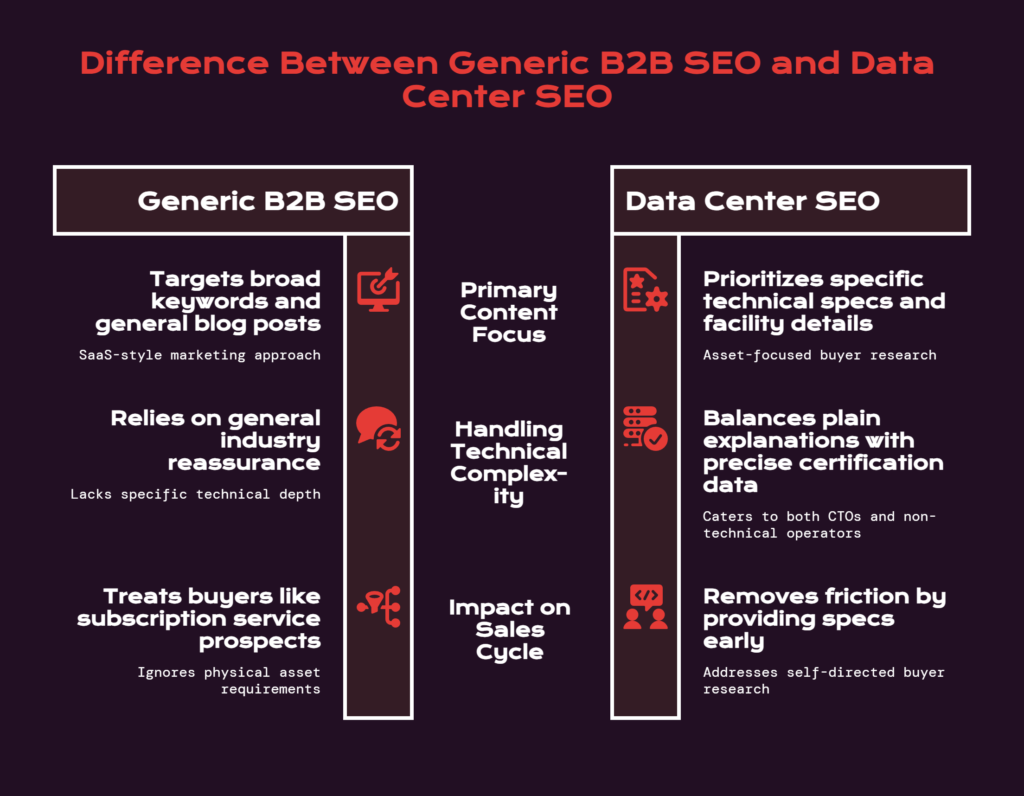
Data center SEO gets treated like any other B2B service SEO: publish blog posts, target broad keywords, build backlinks. That approach misses the fact that data center buyers are shopping for a physical asset with hard technical requirements, not a subscription. The sections below cover why the standard playbook falls short and what to write instead.
Why Generic SEO Playbooks Fail Data Center Buyers
Most data center marketing content repeats the same advice: optimize for relevant keywords, publish blog content, build authority through backlinks. None of that is wrong, but it treats a data center website the same way it would treat a SaaS landing page, and the buyer research process looks nothing alike.
A prospect comparing colocation providers wants specific numbers, not reassurance that a company understands the industry.
The first step in fixing this is knowing which terms your buyers are actually typing, and that starts with real keyword research rather than assumptions carried over from other B2B verticals.
How Data Center Buyers Search Before They Ever Contact Sales
Data center purchases involve long sales cycles and multiple stakeholders, and most of that research happens before anyone picks up a phone. Gartner’s sales research found that 61% of B2B buyers now prefer a rep-free buying experience, and the same research found that 69% of buyers encounter inconsistencies between a supplier’s website and what a sales rep later tells them.
For a facility purchase, that inconsistency usually shows up as vague copy on the website that does not match the actual spec sheet a rep sends over.
That means your facility pages carry more weight than your sales team might assume. A buyer who cannot find power density, connectivity options, or compliance details on the page itself will either bounce to a competitor’s site or arrive at a sales call already frustrated. Getting these details onto the page early removes friction at the exact stage where most buyers are still self-directed.
Writing for CTOs and Small Operators Without a Technical Team at the Same Time
Here is where data center content gets genuinely difficult to write.
A CTO evaluating your facility for an enterprise deployment will notice immediately if your PUE numbers are vague or your Tier claims do not match the actual certification. At the same time, a growing share of colocation inquiries come from small businesses and regional operators who do not have anyone with a technical background making the call.
Writing for both audiences at once means every technical term needs a plain explanation the first time it appears, without dumbing down the actual numbers a technical buyer needs to verify. A paragraph explaining what a Tier III rating means in practice can sit right next to the certification details a CTO wants to confirm. Neither reader has to wade through content meant for the other one.
Structuring Facility Data So Search Engines and AI Models Can Read It
This is where data center SEO diverges most sharply from other industries. Search engines and AI tools increasingly rely on structured data to understand facts about a page, and a colocation facility has an unusually large set of facts worth structuring: power capacity, cooling type, certifications, connectivity, and location. Getting this right is less about writing more content and more about labeling the content you already have.
Schema Markup for Power Density, PUE, and Tier Ratings
Google’s own documentation on structured data explains that structured data markup helps Google understand content and determine eligibility for rich search features. For a data center page, that means the numbers buyers care about most should be marked up explicitly rather than left as plain paragraph text that a crawler has to interpret.
Power Usage Effectiveness is a good example of why this matters. The Green Grid, which developed the metric, defines PUE as the total energy used by a data center divided by the energy used by its IT equipment, and it remains the industry standard for comparing facility efficiency. A facility page that states a PUE of 1.3 in a sentence is far less useful to a search or AI system than one that structures it as a labeled data point search engines can extract and compare.
Facility pages should structure at minimum:
- Power Density: rack-level and floor-level capacity, stated in kW, not vague language like “high density available.”
- PUE: current measured value, not a target or industry average.
- Tier Rating: the specific certification level and whether it applies to design, construction, or ongoing operations.
- Compliance Certifications: which standards apply and to which parts of the facility.
- Connectivity: carriers present and cloud on-ramps available on-site.
Turning Compliance Certifications Into Structured Trust Signals
Compliance certifications are some of the highest-intent content on a data center website, yet they are often buried in a single paragraph or a logo strip with no context. SOC 2, defined by the AICPA as a report on controls at a service organization relevant to security, availability, processing integrity, confidentiality, or privacy, means something very different depending on which trust services criteria were actually included in the audit. A buyer in healthcare or finance needs to know that detail, not just that a SOC 2 report exists somewhere.
Rather than treating compliance as a badge to display, structure each certification with what it covers, when it was last audited, and which facility locations it applies to if you operate more than one site.
This does double duty: it answers the buyer’s actual question, and it gives search and AI systems specific, verifiable facts to associate with your brand instead of a generic compliance claim repeated across every competitor’s site.
Avoiding Duplicate Content Across Multi-Market Facility Pages
Providers with several facilities often build a page per location using the same template, which creates a duplicate content problem if the only thing that changes is the city name. Search engines struggle to decide which page should rank when ten pages say nearly the same thing with different addresses, and the result is that none of them rank well.
If your facility pages were built years ago on an older template, this is often one of the first things to fix, and it is worth reading our breakdown on redesigning a website without losing SEO before touching the templates directly. Each facility page needs unique specs, unique local connectivity details, and unique context about that market, not just a swapped city name over identical boilerplate.
| Facility Data Point | Where It Should Live | Why It Matters to Buyers | Structured Data Priority |
| Power density | Facility spec section | Confirms rack compatibility | High |
| PUE | Facility spec section | Signals efficiency and cost | High |
| Tier rating | Certification section | Verifies uptime commitment | High |
| Compliance certs | Dedicated compliance section | Confirms regulatory fit | High |
| Connectivity partners | Interconnection section | Confirms latency and carrier fit | Medium |
| Physical location | Facility overview | Confirms market and proximity | Medium |
Local SEO for Multi-Market Data Center Providers
Local SEO for a data center provider looks closer to franchise SEO than most people expect, because buyers are searching for a physical facility in a specific market, not a national brand. The difference is that instead of foot traffic, the intent is technical and connectivity-driven.
Why Market-Specific Terms Outperform Generic Colocation Keywords
Buyers rarely search “colocation services.” They search for colocation in a specific market because location determines latency, carrier access, and often regulatory jurisdiction. A page built around “colocation services” alone is competing against every generic provider page on the internet, while a page built around a specific market and its connectivity ecosystem is competing in a much narrower, more winnable space.
This is one of the few areas where data center SEO and franchise SEO genuinely overlap, since both involve ranking multiple location pages under one brand without them fighting each other for the same terms.
Building Market Pages That Don’t Cannibalize Each Other
The fix for market pages competing against each other is differentiation at the content level, not just the URL level. Each market page should reference the specific carriers present at that facility, the regional compliance considerations that apply there, and any market-specific advantages like proximity to a major internet exchange point.
- Lead with what is unique to that market: available carriers, power grid characteristics, or regulatory environment.
- Keep shared boilerplate, like company background, to a small section rather than the bulk of the page.
- Link market pages to each other only where a buyer would realistically want to compare two specific locations.
Location Signals That Matter for Latency-Sensitive Searches
Buyers evaluating a facility for latency-sensitive workloads care about physical proximity to internet exchange points and major population centers in a way that most local SEO advice does not account for.
Structuring a facility’s address, coordinates, and nearby interconnection points as clear, structured facts helps both search engines and AI tools answer distance-based questions accurately. This matters more for data centers than almost any other local business category, since the physical location is directly tied to the product’s performance.
Making Your Interconnection Ecosystem Visible in Search
Interconnection is one of the most technical, most differentiated parts of a data center’s value proposition, and it is also one of the most underused topics in data center content. Buyers evaluating cloud connectivity or carrier diversity are making a decision that directly affects their own customers’ performance, so this content carries real weight.
Why Peering and Cloud On-Ramp Pages Are an SEO Asset
PeeringDB, described on its own site as the go-to database for interconnection data at internet exchange points, data centers, and other interconnection facilities, is where network operators go first when evaluating peering options. A facility that maintains detailed, current interconnection information, both on PeeringDB and on its own website, signals technical credibility that a vague “extensive connectivity” claim never will.
A dedicated page listing the specific carriers, cloud on-ramps, and exchange points present at each facility gives search engines and AI systems concrete facts to reference, and it gives technical buyers exactly what they need to shortlist a facility without a sales call. This kind of page also tends to earn organic backlinks from network operator communities, which most data center marketing content never touches.
Referencing Carrier and Cloud Partnerships Without Sounding Like a Directory
The risk with interconnection pages is turning them into a flat list of logos with no context, which reads like a directory rather than useful content. Instead, group carriers and cloud on-ramps by use case: which combination works best for hybrid cloud deployments, which supports the lowest latency to a specific region, and which is most relevant for a specific compliance requirement. That framing turns a list of names into content a buyer actually reads before their evaluation call.
Earning Citations in AI Answers for Spec-Driven Buyer Queries
Buyers increasingly ask AI tools questions like which providers offer a specific Tier rating in a given market, and the facilities that get cited in those answers are the ones with clear, structured facts rather than persuasive marketing copy. This section covers how that citation process actually works.
How LLMs Weigh Facility Facts Against Marketing Copy
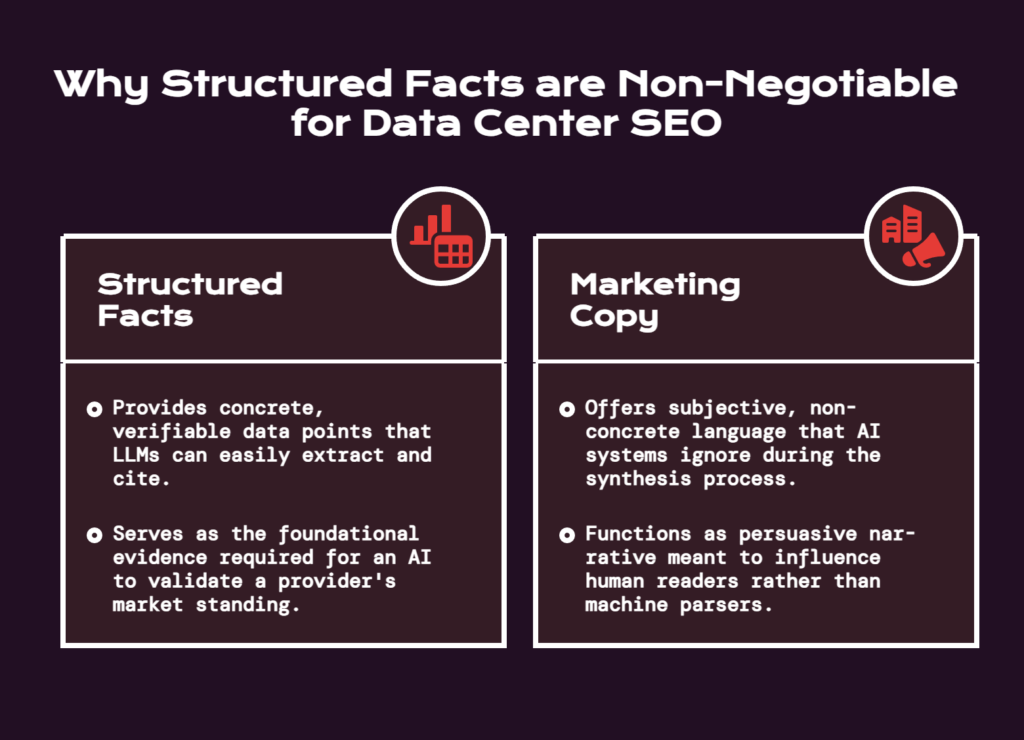
AI systems pulling together an answer about data center options are looking for specific, verifiable claims: a stated PUE, a named Tier certification, a listed compliance certification. Marketing language like “industry-leading efficiency” gives an AI model nothing concrete to cite, while a clearly labeled fact does.
This is the same principle behind structured data for traditional search, extended to a context where the “result” is a generated answer rather than a ranked list of links.
This pattern shows up clearly in emerging vertical content too. We’ve noticed this while improving AI search visibility for hemp brands: AI systems reward specific, structured claims and ignore vague ones, regardless of the vertical.
Writing Comparison Content That Doesn’t Read Like a Spec Sheet
The goal is not to strip all the writing out of facility pages and replace it with tables. It is to pair structured facts with enough plain explanation that a non-technical reader understands why a number matters, while the underlying data stays clean enough for a search or AI system to extract accurately.
A short paragraph explaining what a specific PUE range means for a buyer’s energy costs, immediately followed by the labeled data point, does both jobs at once.
One recent shift worth planning around: Google’s own FAQ structured data documentation now states that FAQ rich results are only available for well-known, authoritative government and health websites, which rules out virtually every data center provider. That does not mean FAQ content stops being useful.
It means FAQ schema should be treated as a way to help AI systems parse your content clearly rather than a tactic aimed at earning a visual rich result in Google Search.
Tracking whether your facility actually gets cited when someone asks an AI tool about providers in your market is worth building into your reporting, and tools like Promptwatch are built to track that kind of AI visibility over time rather than guessing at it.
Aligning Content With the Data Center Sales Cycle
None of this structured data work matters if it is not mapped to where a buyer actually is in their decision process. A data center marketing strategy that treats every page the same way, regardless of whether the reader is at the awareness stage or writing an RFP, wastes the specificity you just built into your facility pages.
Mapping Content to RFP and Technical Evaluation Stages
Buyers move from general research into a formal technical evaluation, often built around an RFP that references specific power, cooling, and compliance requirements. Content built for that stage should mirror the structure of a typical RFP response rather than general marketing pages, because that is literally the format the buyer is comparing.
- Early-Stage: market overview pages that establish location, connectivity, and general capabilities.
- Evaluation-Stage: detailed spec pages with power density, PUE, Tier rating, and compliance detail structured for direct comparison.
- Decision-Stage: case studies, SLA documentation, and uptime history that support a final internal sign-off.
A data center marketing plan built around these stages naturally produces the structured facility pages this guide has been describing, since evaluation-stage content is exactly where technical specificity matters most. If you have not mapped your existing content against these stages yet, our guide on forecasting SEO growth is a useful starting point for connecting content investment to pipeline timing.
Uptime Data and Case Studies as Link-Worthy Assets
Actual uptime history, incident reports handled transparently, and detailed case studies tend to earn backlinks and citations that generic service pages never will, because they contain facts other sites and AI systems want to reference.
A facility that publishes real uptime data over time, rather than a static “99.999% uptime” claim with no supporting detail, builds a kind of credibility that shows up in both rankings and AI answers.
How LYNX SEO Helps Data Center Providers Win Search Visibility
LYNX SEO builds data center marketing strategy around the same structured, verifiable facts that buyers and AI systems actually look for. Instead of generic blog content and keyword stuffing, we structure facility data, fix multi-market duplicate content issues, and build interconnection and compliance content that gives search engines and AI tools something concrete to cite.
How do we know we can do that? Because we’ve already done it.
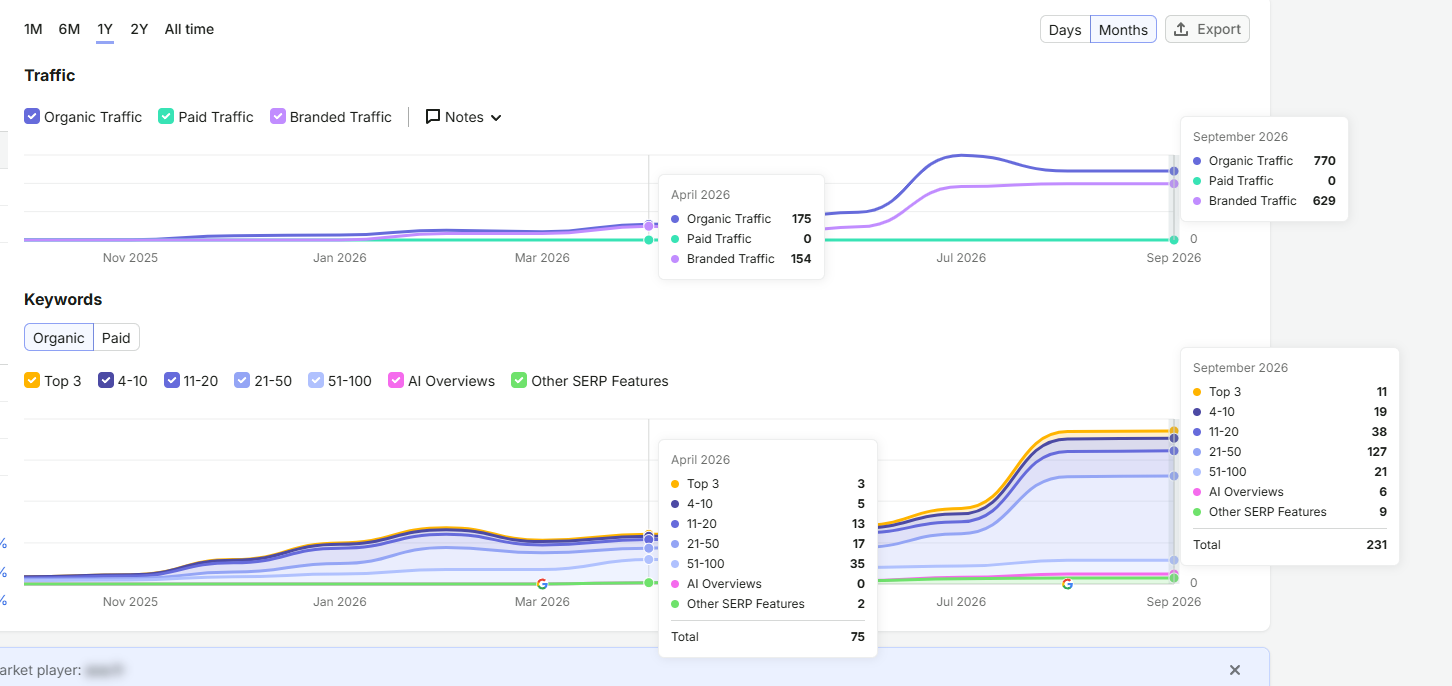
One of our data center clients saw this kind of movement in the five months since we started working with them in April, and the percentages hold up under any level of scrutiny:
- Organic traffic grew from 175 to 770 sessions a month, up 340%.
- Branded traffic climbed from 154 to 629, up 308%, meaning the market started searching for this provider by name.
- Total ranking keywords went from 75 to 231, a 208% increase.
- Keywords ranking in positions 21 through 50, the pages closest to breaking into page one, jumped from 17 to 127, up 647%.
If your facility pages read like every competitor’s, that is a technical SEO problem, not a content problem, and it is one we fix regularly.
Get in touch and let’s find out what your facility pages are missing. A quick audit from LYNX often uncovers more buyer-ready traffic than a new blog calendar ever will.
Frequently Asked Questions
What Is Considered Technical SEO for a Data Center Website?
Technical SEO for a data center site includes schema markup for facility specs, clean multi-market page architecture that avoids duplicate content, fast page load times for spec-heavy pages, and structured compliance data. It goes beyond standard technical SEO because the underlying facts, like power density and Tier rating, need to be both accurate and machine-readable.
Does Schema Markup Improve Rankings for Colocation Pages?
Schema markup does not directly move rankings, but it makes a page eligible for rich search features and gives search engines and AI tools clearer facts to work with. For colocation pages, structured data around specs and certifications helps buyers and AI systems find and trust the information faster.
How Long Does SEO Take to Show Results for Data Center Companies?
Data center SEO typically takes several months to show meaningful results, largely because sales cycles are long and technical evaluation stages take time. Structural fixes like schema markup and duplicate content cleanup can show crawl and indexing improvements faster, while ranking and lead volume improvements usually take longer to materialize.
Should Every Data Center Facility Have Its Own Page?
Yes, each facility should have its own page with unique specs, connectivity details, and market context rather than a shared template with swapped city names. Duplicate or near-duplicate facility pages compete against each other in search results instead of ranking, which weakens visibility across the entire portfolio of locations.
Can AI Search Tools Recommend a Data Center Provider?
AI search tools can and do surface specific providers when asked about facilities matching certain criteria, such as a Tier rating or compliance requirement in a given market. They tend to favor providers whose websites contain clear, structured facts rather than vague marketing language, since specific claims are easier to verify and cite.
What Compliance Certifications Should Be Listed on a Data Center Website?
Common certifications include SOC 2, ISO 27001, HIPAA alignment for healthcare workloads, and PCI DSS for payment processing environments. Each should be listed with what it actually covers and which facility locations it applies to, since a certification that applies to only one site should never be implied to cover all of them.
Is Local SEO Relevant for a Data Center With National Reach?
Local SEO stays relevant even for providers with a national footprint, since buyers are ultimately choosing a specific physical location for latency, compliance, or proximity reasons. Each market a provider operates in should be treated as its own local SEO target rather than folded into one generic national page.
Sources Used for This Article
- Uptime Institute: “Data Center Tier Certification” – uptimeinstitute.com/tier-certification
- The Green Grid: “Power Usage Effectiveness (PUE)” – thegreengrid.org/node/372
- Gartner: “Gartner Sales Survey Finds 61% of B2B Buyers Prefer a Rep-Free Buying Experience” – gartner.com/en/newsroom/press-releases/2025-06-25-gartner-sales-survey-finds-61-percent-of-b2b-buyers-prefer-a-rep-free-buying-experience
- Google Search Central: “Intro to How Structured Data Markup Works” – developers.google.com/search/docs/appearance/structured-data/intro-structured-data
- Google Search Central: “Mark Up FAQs with Structured Data” – developers.google.com/search/docs/appearance/structured-data/faqpage
- AICPA & CIMA: “SOC 2 – SOC for Service Organizations: Trust Services Criteria” – aicpa-cima.com/topic/audit-assurance/audit-and-assurance-greater-than-soc-2
- PeeringDB: “PeeringDB – The Interconnection Database” – peeringdb.com
